

Form 424B2 DEUTSCHE BANK AKTIENGESE
|
Pricing supplement No. E524 To prospectus supplement dated April 26, 2024 |
Registration Statement No. 333-278331 Rule 424(b)(2) |
The information in this preliminary pricing supplement is not complete and may be changed. This preliminary pricing supplement and the accompanying prospectus supplement and prospectus do not constitute an offer to sell nor do they seek an offer to buy the notes in any jurisdiction where the offer or sale is not permitted.
Subject to Completion. Dated September 14, 2026

Deutsche Bank AG
$ Callable Fixed to Range Accrual Senior Debt Funding Notes Linked to the 10-Year CMT Rate due on or about September 30, 2041
General
•The Callable Fixed to Range Accrual Senior Debt Funding Notes Linked to the 10-Year CMT Rate due on or about September 30, 2041 (the “notes”) pay periodic interest payments that will accrue:
•for the first four quarterly Interest Periods, at a fixed per annum rate of 10.00%
•for each quarterly Interest Period thereafter, at a variable per annum rate of 10.00% for each U.S. Government Securities Business Day that the 10-Year CMT Rate is equal to or less than 6.05%, subject to an Early Redemption and as described further below.
•We may, in our sole discretion, redeem the notes in whole, but not in part, on any Optional Redemption Date specified below. All payments on the notes, including interest payments and the repayment of principal at maturity, are subject to the credit of the Issuer.
•Unsecured, unsubordinated senior preferred obligations of Deutsche Bank AG; the notes are intended to qualify as eligible liabilities for the minimum requirement for own funds and eligible liabilities of the Issuer.
•Any payment on the notes, including any repayment of principal, is subject to the credit of the Issuer. Delivery of the notes in book-entry form only will be made through The Depository Trust Company (“DTC”).
Key Terms
|
Issuer: |
Deutsche Bank AG |
|
Principal Amount; Minimum Denominations: |
$1,000 per Note and integral multiples in excess thereof |
|
Issue Price: |
100% of the Principal Amount. |
|
Interest: |
The notes will bear interest at the applicable Interest Rate, payable in arrears each Interest Payment Date. If the Interest Payment Date is not a Business Day, the applicable interest payment will be made on the succeeding Business Day, and no additional interest will accrue in respect of any delay in the interest payment. Interest will be computed on the basis of a 360-day year consisting of twelve 30-day months. |
|
Interest Rate: |
The Interest Rate for each Interest Period will be determined by the calculation agent based on the following formulas: ●for the first four quarterly Interest Periods (each such period, a “Fixed Interest Period”): ●for each quarterly Interest Period thereafter (each such period, a “Contingent Interest Period”): Accrual Days” is the number of calendar days during the applicable Interest Period on which the Reference Rate is equal to or less than the Accrual Barrier (the “Accrual Condition”); and “Actual Days” is the number of calendar days in such Interest Period. |
|
Base Rate: |
10.00% per annum |
|
Reference Rate: |
The 10-Year Constant Maturity Treasury Rate (the “CMT10”) With respect to any applicable U.S. Government Securities Business Day, the CMT10 is the yield on actively traded U.S. Treasury nominal/non-inflation-indexed securities adjusted to constant maturity with a maturity equal to 10 years as published by the Board of Governors of the Federal Reserve System (the “Federal Reserve”) at or around 4:00 p.m. (New York time) and displayed on the Bloomberg screen page “H15T10Y <Index>” (or any successor or replacement page or service) on the immediately following U.S. Government Securities Business Day. With respect to a calendar day that is not a U.S. Government Securities Business Day, the Reference Rate will be that with respect to the immediately preceding U.S. Government Securities Business Day, subject to the Rate Cut-Off Date as described below. If with respect to any U.S. Government Securities Business Day the CMT10 cannot be determined as described above by 5:00 p.m. New York time, then the calculation agent will determine the CMT10 as described under “Information About the Reference Rate” herein. |
|
Accrual Barrier: |
6.05% |
|
Interest Periods: |
Each period from, and including, an Interest Payment Date (or the Settlement Date in the case of the first Interest Period) to, but excluding, the following Interest Payment Date. |
|
Rate Cut-Off Date: |
With respect to each Contingent Interest Period, the 5th U.S. Government Securities Business Day prior to the corresponding Interest Payment Date. The Reference Rate on each calendar day from, and including, the Rate Cut-Off Date to, but excluding, the Interest Payment Date with respect to such Interest Period will be the Reference Rate as of the Rate Cut-Off Date. |
|
Interest Payment Dates: |
Quarterly, on the 30th day of each March, June, September and December of each year, commencing in December 2026 and ending on the Maturity Date; provided if any scheduled Interest Payment Date (other than the Maturity Date) is not a Business Day, it will be postponed to the following Business Day, except that, if that Business Day would fall in the next calendar month, the Interest Payment Date will be the immediately preceding Business Day. If the scheduled Maturity Date falls on a day that is not a Business Day, the payment of principal and interest will be made on the next succeeding Business Day, but interest on that payment will not accrue from and after the scheduled Maturity Date. |
|
Day Count Convention: |
30/360 |
|
Early Redemption: |
We have the right to redeem the notes in our sole discretion, in whole, but not in part, at 100% of the Principal Amount together with any accrued but unpaid interest, on any Interest Payment Date beginning in September 2027 and ending on the Interest Payment Date prior to the Maturity Date (each, an “Optional Redemption Date”), by giving not less than 5 Business Days’ prior notice, subject to regulatory approval as described under “Description of Notes — Redemptions of Notes” in the prospectus supplement. If the scheduled Interest Payment Date is not a Business Day, it will be postponed to the following Business Day. |
|
Payment at Maturity |
If the notes are not redeemed early, on the Maturity Date you will receive a cash payment per note equal to the Principal Amount together with any accrued but unpaid interest. |
|
U.S. Government Securities Business Day: |
Any day except for a Saturday, Sunday or a day on which the Securities Industry and Financial Markets Association (or any successor thereto) recommends that the fixed income departments of its members be closed for the entire day for purposes of trading in U.S. government securities. |
|
Business Day: |
Any day other than a day that is (i) a Saturday or Sunday, (ii) a day on which banking institutions generally in the City of New York are authorized or obligated by law, regulation or executive order to close, (iii) a day on which transactions in U.S. dollars are not conducted in the City of New York or (iv) a day on which T2 is not operating. |
|
Trade Date: |
On or about September 28, 2026 |
|
Settlement Date: |
On or about September 30, 2026 |
|
Maturity Date |
On or about September 30, 2041 |
|
Listing: |
None |
|
CUSIP / ISIN: |
25160YFX1 / US25160YFX13 |

 , where:
The Issuer’s estimated value of the Notes on the Trade Date is approximately $930.00 to $950.00 per Note, which is less than the Issue Price. Please see “Issuer’s Estimated Value of the Notes” on page PS-3 herein for additional information.
Investing in the notes involves a number of risks not associated with an investment in conventional debt securities. See “Selected Risk Considerations” beginning on page PS-5 herein.
By acquiring the notes, you will be bound by and will be deemed irrevocably to consent to the imposition of any Resolution Measure (as defined below) by the competent resolution authority, which may include the write down of all, or a portion, of any payment on the notes or the conversion of the notes into ordinary shares or other instruments of ownership. If any Resolution Measure becomes applicable to us, you may lose some or all of your investment in the notes. Please see “Resolution Measures” beginning on page 75 in the accompanying prospectus and “Resolution Measures and Deemed Agreement” on page PS–2 of this pricing supplement for more information.
Neither the Securities and Exchange Commission nor any state securities commission has approved or disapproved of the notes or passed upon the accuracy or the adequacy of this pricing supplement or the accompanying prospectus supplement or prospectus. Any representation to the contrary is a criminal offense.
|
|
Price to Public(1) |
Discounts and Commissions(2) |
Proceeds to Us(2) |
|
Per Note |
$1,000.00 |
Up to $50.00 |
$950.00 |
|
Total |
$ |
$ |
$ |
(1) The price to public for an eligible institutional investor and an investor purchasing the notes in a fee-based advisory account will vary based on then-current market conditions and the negotiated price determined at the time of each sale; provided, however, the price to public for such investors will not be less than $950.00 per note and will not be more than $1,000 per note. The price to public for such investors reflects a foregone selling concession with respect to such sales as described below.
(2) Deutsche Bank Securities Inc. (“DBSI”) will receive discounts and commissions of up to $50.00 per note, and from such agent discount will allow selected dealers a selling concession of up to $50.00 per note depending on market conditions that are relevant to the value of the notes at the time an order to purchase the notes is submitted to DBSI. Dealers who purchase the notes for sales to eligible institutional investors and fee-based advisory accounts may forgo some or all selling concessions. For more detailed information about discounts and commissions, please see “Supplemental Plan of Distribution (Conflicts of Interest)” in this pricing supplement.
Deutsche Bank Securities Inc. (“DBSI”), the agent for this offering, is our affiliate. For more information, see “Supplemental Plan of Distribution (Conflicts of Interest)” herein.
The notes are not deposits or savings accounts and are not insured or guaranteed by the Federal Deposit Insurance Corporation or any other U.S. or foreign governmental agency or instrumentality.
Deutsche Bank Securities
September , 2026
Resolution Measures And Deemed Agreement
On May 15, 2014, the European Parliament and the Council of the European Union adopted a directive establishing a framework for the recovery and resolution of credit institutions and investment firms (Directive 2014/59/EU, as amended the “Bank Recovery and Resolution Directive” or the “BRRD”), which was implemented into German law by the German Recovery and Resolution Act (Sanierungs- und Abwicklungsgesetz, or, as amended, the “Resolution Act”), which became effective on January 1, 2015. The BRRD and the Resolution Act provided national resolution authorities with a set of resolution powers to intervene in the event that a bank is failing or likely to fail and certain other conditions are met. From January 1, 2016, the power to initiate Resolution Measures applicable to significant banking groups (such as Deutsche Bank Group) in the European Banking Union was transferred to the European Single Resolution Board which, based on the European Union regulation establishing uniform rules and a uniform procedure for the resolution of credit institutions and certain investment firms in the framework of a Single Resolution Mechanism and a Single Resolution Fund (Regulation (EU) No 806/2014, as amended, the “SRM Regulation”), works in close cooperation with the European Central Bank, the European Commission and the national resolution authorities. Pursuant to the SRM Regulation, the Resolution Act and other applicable rules and regulations, the notes may be subject to any Resolution Measure by the competent resolution authority if we become, or are deemed by the competent supervisory authority to have become, “non-viable” (as defined under the then-applicable law) and are unable to continue our regulated banking activities without a Resolution Measure becoming applicable to us.
By acquiring the notes, you will be bound by and will be deemed irrevocably to consent to the provisions set forth in the accompanying prospectus, which we have summarized below. Under the relevant resolution laws and regulations as applicable to us from time to time, the notes may be subject to the powers exercised by the competent resolution authority to: (i) write down, including to zero, any payment on the notes; (ii) convert the notes into ordinary shares of (a) the Issuer, (b) any group entity or (c) any bridge bank or other instruments of ownership of such entities qualifying as common equity tier 1 capital (and the issue to or conferral on the holders (including the beneficial owners) of such ordinary shares or instruments); and/or (iii) apply any other resolution measure including, but not limited to, any transfer of the notes to another entity, the amendment, modification or variation of the terms and conditions of the notes or the cancellation of the notes. The write-down and conversion powers are commonly referred to as the “bail-in tool” and the bail-in tool and each of the other resolution measures are hereinafter referred to as a “Resolution Measure.” A “group entity” refers to an entity that is included in the corporate group subject to a Resolution Measure. A “bridge bank” refers to a newly chartered German bank that would receive some or all of our equity securities, assets, liabilities and material contracts, including those attributable to our branches and subsidiaries, in a resolution proceeding.
Furthermore, by acquiring the notes, you:
●are deemed irrevocably to have agreed, and you will agree: (i) to be bound by, to acknowledge and to accept any Resolution Measure and any amendment, modification or variation of the terms and conditions of the notes to give effect to any Resolution Measure; (ii) that you will have no claim or other right against us arising out of any Resolution Measure; and (iii) that the imposition of any Resolution Measure will not constitute a default or an event of default under the notes, under the Amended and Restated Senior Debt Funding Indenture dated August 3, 2021, as amended and supplemented by the First Supplemental Senior Debt Funding Indenture dated as of April 26, 2024, in each case among us, Delaware Trust Company, as trustee, and Deutsche Bank Trust Company Americas, as paying agent, authenticating agent, issuing agent and registrar (as amended and supplemented from time to time, the “Indenture”), or for the purposes of, but only to the fullest extent permitted by, the Trust Indenture Act of 1939, as amended (the “Trust Indenture Act”);
●waive, to the fullest extent permitted by the Trust Indenture Act and applicable law, any and all claims against the trustee and the paying agent, the issuing agent and the registrar (each, an “indenture agent”) for, agree not to initiate a suit against the trustee or the indenture agents in respect of, and agree that the trustee and the indenture agents will not be liable for, any action that the trustee or any of the indenture agents takes, or abstains from taking, in either case in accordance with the imposition of a Resolution Measure by the competent resolution authority with respect to the notes; and
●will be deemed to have: (i) consented to the imposition of any Resolution Measure as it may be imposed without any prior notice by the competent resolution authority of its decision to exercise such power with respect to the notes; (ii) authorized, directed and requested DTC and any direct participant in DTC or other intermediary through which you hold such notes to take any and all necessary action, if required, to implement the imposition of any Resolution Measure with respect to the notes as it may be imposed, without any further action or direction on your part or on the part of the trustee or the indenture agents; and (iii) acknowledged and accepted that the Resolution Measure provisions described herein and in the “Resolution Measures” section of the accompanying prospectus are exhaustive on the matters described herein and therein to the exclusion of any other agreements, arrangements or understandings between you and the Issuer relating to the terms and conditions of the notes.
This is only a summary, for more information please see the accompanying prospectus dated April 26, 2024, including the risk factors beginning on page 20 of such prospectus.
PS-2
Issuer’s Estimated Value of the Notes
The Issuer’s estimated value of the notes is equal to the sum of our valuations of the following two components of the notes: (i) a bond and (ii) an embedded derivative(s). The value of the bond component of the notes is calculated based on the present value of the stream of cash payments associated with a conventional bond with a principal amount equal to the Principal Amount of notes, discounted at an internal funding rate, which is determined primarily based on our market-based yield curve, adjusted to account for our funding needs and objectives for the period matching the term of the notes. The internal funding rate is typically lower than the rate we would pay when we issue conventional debt securities on equivalent terms. This difference in funding rate, as well as the discounts and commissions, if any, and the estimated cost of hedging our obligations under the notes, reduces the economic terms of the notes to you and is expected to adversely affect the price at which you may be able to sell the notes in any secondary market. The value of the embedded derivative(s) is calculated based on our internal pricing models using relevant parameter inputs such as expected interest rates and mid-market levels of price and volatility of the assets underlying the notes or any futures, options or swaps related to such underlying assets. Our internal pricing models are proprietary and rely in part on certain assumptions about future events, which may prove to be incorrect.
The Issuer’s estimated value of the notes on the Trade Date (as disclosed on the cover hereof) is less than the Issue Price of the notes. The difference between the Issue Price and the Issuer’s estimated value of the notes on the Trade Date is due to the inclusion in the Issue Price of the discounts and commissions, if any, and the cost of hedging our obligations under the notes through one or more hedge counterparties (which may be one of our affiliates). Such hedging cost includes our or our hedge counterparty’s expected cost of providing such hedge, as well as the profit we or our hedge counterparty expect to realize in consideration for assuming the risks inherent in providing such hedge.
The Issuer’s estimated value of the notes on the Trade Date does not represent the price at which we or any of our affiliates would be willing to purchase your notes in the secondary market at any time. Assuming no changes in market conditions or our creditworthiness and other relevant factors, the price, if any, at which we or our affiliates would be willing to purchase the notes from you in secondary market transactions, if at all, would generally be lower than both the Issue Price and the Issuer’s estimated value of the notes on the Trade Date. Our purchase price, if any, in secondary market transactions will be based on the estimated value of the notes determined by reference to (i) the then-prevailing internal funding rate (adjusted by a spread) or another appropriate measure of our cost of funds and (ii) our pricing models at that time, less a bid spread determined after taking into account the size of the repurchase, the nature of the assets underlying the notes and then-prevailing market conditions. The price we report to financial reporting services and to distributors of our notes for use on customer account statements would generally be determined on the same basis. However, during the period of approximately 6 months beginning from the Settlement Date, we or our affiliates may, in our sole discretion, increase the purchase price determined as described above by an amount equal to the declining differential between the Issue Price and the Issuer’s estimated value of the notes on the Trade Date, prorated over such period on a straight-line basis, for transactions that are individually and in the aggregate of the expected size for ordinary secondary market repurchases.
PS-3
Summary
Deutsche Bank AG has filed a registration statement (including a prospectus) with the Securities and Exchange Commission, or SEC, for the offering to which this pricing supplement relates. Before you invest, you should read the prospectus in that registration statement and the other documents relating to this offering that Deutsche Bank AG has filed with the SEC for more complete information about Deutsche Bank AG and this offering. You may obtain these documents without cost by visiting EDGAR on the SEC website at www.sec.gov.
You should read this pricing supplement together with the prospectus supplement dated April 26, 2024 relating to our Senior Debt Funding Notes, Series E of which these notes are a part and the prospectus dated April 26, 2024. You may access these documents on the website of the Securities and Exchange Commission (the “SEC”) at.www.sec.gov as follows (or, if such address has changed, by reviewing our filings for the relevant date on the SEC website):
•Prospectus supplement dated April 26, 2024:
https://www.sec.gov/Archives/edgar/data/1159508/000095010324005864/crt_dp210218-424b2.pdf
•Prospectus dated April 26, 2024:
https://www.sec.gov/Archives/edgar/data/1159508/000119312524118649/d776815d424b21.pdf
Our Central Index Key, or CIK, on the SEC website is 0001159508. As used in this pricing supplement, “we,” “us” or “our” refers to Deutsche Bank AG, including, as the context requires, acting through one of its branches.
This pricing supplement, together with the documents listed above, contains the terms of the notes and supersedes all other prior or contemporaneous oral statements as well as any other written materials including preliminary or indicative pricing terms, correspondence, trade ideas, structures for implementation, sample structures, brochures or other educational materials of ours. You should carefully consider, among other things, the matters set forth in “Selected Risk Considerations” beginning on page PS-5 in this pricing supplement, as the notes involve risks not associated with conventional debt securities. We urge you to consult your investment, legal, tax, accounting and other advisers before deciding to invest in the notes.
In making your investment decision, you should rely only on the information contained or incorporated by reference in this pricing supplement relevant to your investment and the accompanying prospectus supplement and prospectus with respect to the notes offered by this pricing supplement and with respect to Deutsche Bank AG. We have not authorized anyone to give you any additional or different information. The information in this pricing supplement and the accompanying prospectus supplement and prospectus may only be accurate as of the dates of each of these documents, respectively.
You should be aware that the regulations of the Financial Industry Regulatory Authority, Inc. (“FINRA”) and the laws of certain jurisdictions (including regulations and laws that require brokers to ensure that investments are suitable for their customers) may limit the availability of the notes. This pricing supplement and the accompanying prospectus supplement and prospectus do not constitute an offer to sell or a solicitation of an offer to buy the notes under any circumstances in which such offer or solicitation is unlawful.
We are offering to sell, and are seeking offers to buy, the notes only in jurisdictions where such offers and sales are permitted. Neither the delivery of this pricing supplement nor the accompanying prospectus supplement or prospectus nor any sale made hereunder implies that there has been no change in our affairs or that the information in this pricing supplement and accompanying prospectus supplement and prospectus is correct as of any date after the date hereof.
You must (i) comply with all applicable laws and regulations in force in any jurisdiction in connection with the possession or distribution of this pricing supplement and the accompanying prospectus supplement and prospectus and the purchase, offer or sale of the notes and (ii) obtain any consent, approval or permission required to be obtained by you for the purchase, offer or sale by you of the notes under the laws and regulations applicable to you in force in any jurisdiction to which you are subject or in which you make such purchases, offers or sales; neither we nor the agents shall have any responsibility therefor.
We reserve the right to change the terms of, or reject any offer to purchase, the notes prior to their issuance. We will notify you in the event of any changes to the terms of the notes, and you will be asked to accept such changes in connection with your purchase of any notes. You may also choose to reject such changes, in which case we may reject your offer to purchase the notes.
PS-4
Selected Risk Considerations
An investment in the notes involves risks. This section describes the most significant risks relating to the notes. For a complete list of risk factors, please see “Risk Factors” beginning on page PS–6 of the accompanying prospectus supplement and beginning on page 20 of the prospectus.
Risks Relating to the Notes Generally
•THE NOTES ARE NOT ORDINARY DEBT SECURITIES AND ARE SUBJECT TO AN INTEREST ACCRUAL PROVISION; THE INTEREST RATE DURING EACH CONTINGENT INTEREST PERIOD IS VARIABLE, WILL NOT EXCEED THE BASE RATE, MAY BE LESS THAN THE FIXED RATE APPLICABLE DURING THE FIXED INTEREST PERIODS AND MAY BE EQUAL TO 0.00% — The terms of the notes differ from those of ordinary debt securities in that the rate of interest you will receive during each Contingent Interest Period is not fixed, but will vary based on the level of the Reference Rate over the course of each Contingent Interest Period. For each Contingent Interest Period, there is an implied maximum Interest Rate per annum equal to the Base Rate. This is because the variable Interest Rate during each Contingent Interest Period, while determined by reference to the levels of the Reference Rate as described herein, does not actually pay an amount based directly on such levels.
Further, your return on the notes for any Contingent Interest Period will not exceed the Base Rate for such Contingent Interest Period and may be less than the fixed rate applicable during the Fixed Interest Periods, regardless of any increase of the Reference Rate, which may be significant. Moreover, each calendar day during a Contingent Interest Period with respect to which the Reference Rate fails to satisfy the Accrual Condition will result in a reduction of the Interest Rate per annum applicable for the corresponding Contingent Interest Period and, therefore, the interest payment you will receive for such Contingent Interest Period. For each Contingent Interest Period, if the Reference Rate fails to satisfy the Accrual Condition for an entire Contingent Interest Period, the Interest Rate for such Contingent Interest Period will be equal to 0.00% and you will receive no interest payment for such Contingent Interest Period. Even if the Interest Rate with respect to a Contingent Interest Period is greater than 0.00%, the effective yield on the notes for such Contingent Interest Period may be less than that of a conventional fixed- or floating-rate debt security of comparable maturity. Further, if the expected interest payable on the notes is greater than the interest that would be payable on other similar instruments, it is more likely that we will redeem the notes, as discussed below. Your investment may not reflect the full opportunity cost to you when you take into account factors that affect the time value of money.
•BECAUSE THE NOTES ACCRUE INTEREST AT A FIXED RATE DURING EACH FIXED INTEREST PERIOD, THE AMOUNT OF INTEREST PAYABLE ON YOUR NOTES ON EACH INTEREST PAYMENT DATE DURING THE FIXED INTEREST PERIODS MAY BE BELOW MARKET INTEREST RATES — Because interest payable on your notes during the Fixed Interest Periods accrues at a fixed rate, there can be no guarantee that the interest you will receive on one or more of the Interest Payment Dates during the Fixed Interest Periods will be equal to or greater than the market interest rate on such dates. We have no control over a number of factors that may affect market interest rates, including geopolitical conditions and economic, financial, political, regulatory, judicial and other events that affect markets generally that are important in determining the existence, magnitude and longevity of these risks and their results. You should have a view as to the Fixed Interest Rate relative to market interest rates for the term of the notes, and be willing to forgo market interest rates during the Fixed Interest Periods.
•THE NOTES HAVE REINVESTMENT RISK — As described under “Key Terms—Early Redemption,” we retain the option to redeem the notes in our sole discretion, in whole, but not in part, on any Interest Payment Date specified under “Key Terms—Early Redemption”, by giving not less than 5 Business Days’ prior notice.
It is more likely that we will redeem the notes prior to the Maturity Date to the extent that the expected interest payable on the notes is greater than the interest that would be payable on other instruments of ours of a comparable maturity, of comparable terms and of a comparable credit rating trading in the market. If the notes are redeemed, you may have to reinvest the proceeds in a lower interest rate environment.
•THE LEVELS OF THE REFERENCE RATE OBSERVED DURING THE CONTINGENT INTEREST PERIODS WILL BE UNEQUALLY WEIGHTED IN DETERMINING THE INTEREST RATE FOR EACH CONTINGENT INTEREST PERIOD— If any calendar day with respect to a Contingent Interest Period is not a U.S. Government Securities Business Day, the Reference Rate for that day will be that for the immediately preceding U.S. Government Securities Business Day. This means that, for example, if the Accrual Condition is not satisfied on a U.S. Government Securities Business Day that is a Friday, the Accrual Condition would also be deemed to not be satisfied for the Saturday or Sunday thereafter.
In addition, for each day from and including the Rate Cut-Off Date preceding an applicable Interest Payment Date to but excluding that Interest Payment Date, the Reference Rate will be that for the Rate Cut-Off Date. As a result, the levels of the Reference Rate will be unequally weighted in determining the Interest Rate for each Contingent Interest Period. This could reduce the Interest Rate for one or more Contingent Interest Periods if the level of the Reference Rate referenced for multiple calendar days fails to satisfy the Accrual Condition.
•THE NOTES ARE SUBJECT TO INTEREST RATE RISK AND MAY BE MORE RISKY THAN AN INVESTMENT IN NOTES WITH A SHORTER TERM — The Interest Rate applicable during each Interest Period may be lower than the interest rates for other debt securities then-prevailing in the market. Accordingly, you would earn less interest on the notes than you could earn on other investments available at such time. The value of your note may decline during a period of rising interest rates and the amount that you would receive for them in any secondary market transaction would be adversely affected. We have no control over a number of factors that may affect market interest rates, including geopolitical conditions and economic, financial, political, regulatory, judicial
PS-5
and other events that affect markets generally that are important in determining the existence, magnitude and longevity of these risks and their results. You will bear greater exposure to fluctuations in interest rates than if you purchased a similar investment with a shorter term.
Any payments on the notes may not fully compensate you for any loss in value due to inflation and other factors relating to the value of money over time. You should only purchase the notes if you are comfortable with owning a security with a longer tenor.
Risks Relating to the Issuer
•THE NOTES ARE SUBJECT TO THE CREDIT OF DEUTSCHE BANK AG — The notes are unsecured and unsubordinated obligations of Deutsche Bank AG, ranking in priority to its senior non-preferred obligations, and are not, either directly or indirectly, an obligation of any third party. Any interest payments to be made on the notes and the repayment of principal at maturity depend on the ability of Deutsche Bank AG to satisfy its obligations as they become due. An actual or anticipated downgrade in Deutsche Bank AG’s credit rating or increase in the credit spreads charged by the market for taking Deutsche Bank AG’s credit risk will likely have an adverse effect on the value of the notes. As a result, the actual and perceived creditworthiness of Deutsche Bank AG will affect the value of the notes. Any future downgrade could materially affect Deutsche Bank AG’s funding costs and cause the trading price of the notes to decline significantly. Additionally, under many derivative contracts to which Deutsche Bank AG is a party, a downgrade could require it to post additional collateral, lead to terminations of contracts with accompanying payment obligations or give counterparties additional remedies. In the event Deutsche Bank AG were to default on its payment obligations or become subject to a Resolution Measure, you might not receive interest and principal payments owed to you under the terms of the notes and you could lose your entire investment.
•THE NOTES MAY BE WRITTEN DOWN, BE CONVERTED INTO ORDINARY SHARES OR OTHER INSTRUMENTS OF OWNERSHIP OR BECOME SUBJECT TO OTHER RESOLUTION MEASURES. YOU MAY LOSE SOME OR ALL OF YOUR INVESTMENT IF ANY SUCH MEASURE BECOMES APPLICABLE TO US — Pursuant to the SRM Regulation, the Resolution Act and other applicable rules and regulations described above under “Resolution Measures and Deemed Agreement,” the notes are subject to the powers exercised by the competent resolution authority to impose Resolution Measures on us, which may include: (i) writing down, including to zero, any claim for payment on the notes; (ii) converting the notes into ordinary shares of (x) the Issuer, (y) any group entity or (z) any bridge bank or other instruments of ownership of such entities qualifying as common equity tier 1 capital (and the issue to or conferral on the holders (including the beneficial owners) of such ordinary shares or instruments); or (iii) applying any other resolution measure including, but not limited to, transferring the notes to another entity, amending, modifying or varying the terms and conditions of the notes or cancelling the notes. The competent resolution authority may apply Resolution Measures individually or in any combination. Imposition of a Resolution Measure would likely occur if the competent supervisory authority determines that we are failing or likely to fail and that certain other conditions are met (as set forth under the applicable law). The BRRD, the Resolution Act and, as applicable, the SRM Regulation are intended to eliminate the need for public support of troubled banks, and you should be aware that public support, if any, would only potentially be used by the competent supervisory authority as a last resort after having assessed and exploited, to the maximum extent practicable, the resolution tools, including the bail-in tool.
By acquiring the notes, you would have no claim or other right against us arising out of any Resolution Measure and we would have no obligation to make payments under the notes following the imposition of such Resolution Measure. In particular, the imposition of any Resolution Measure will not constitute a default or an event of default under the notes, under the Indenture or for the purposes of, but only to the fullest extent permitted by, the Trust Indenture Act. Furthermore, it will be difficult to predict when, if at all, a Resolution Measure might become applicable to us in our individual case. Accordingly, secondary market trading in the notes may not follow the trading behavior associated with similar types of securities issued by other financial institutions which may be or have been subject to a Resolution Measure.
In addition, by your acquisition of the notes, you waive, to the fullest extent permitted by the Trust Indenture Act and applicable law, any and all claims against the trustee and the indenture agents for, agree not to initiate a suit against the trustee or the indenture agents in respect of, and agree that the trustee and the indenture agents will not be liable for, any action that the trustee or the indenture agents take, or abstain from taking, in either case in accordance with the imposition of a Resolution Measure by the competent resolution authority with respect to the notes. Accordingly, you may have limited or circumscribed rights to challenge any decision of the competent resolution authority to impose any Resolution Measure.
•OUR SENIOR DEBT FUNDING SECURITIES, INCLUDING THE NOTES OFFERED HEREIN, ARE INTENDED TO QUALIFY AS ELIGIBLE LIABILITIES WITHIN THE MEANING OF ARTICLE 72B(2), WITH THE EXCEPTION OF POINT (D), CRR FOR THE MINIMUM REQUIREMENT FOR OWN FUNDS AND ELIGIBLE LIABILITIES UNDER THE ISSUER REGULATORY CAPITAL PROVISIONS APPLICABLE TO US. THEY ARE EXPECTED TO CONSTITUTE “SENIOR PREFERRED” DEBT SECURITIES AND WOULD, IF INSOLVENCY PROCEEDINGS ARE OPENED AGAINST US OR IF RESOLUTION MEASURES ARE IMPOSED ON US, BEAR LOSSES AFTER OUR “SENIOR NON-PREFERRED” DEBT INSTRUMENTS BUT BEFORE OTHER LIABILITIES WITH AN EVEN MORE SENIOR RANK, FOR EXAMPLE, COVERED DEPOSITS AND DEPOSITS HELD BY NATURAL PERSONS AND MICRO, SMALL AND MEDIUM-SIZED ENTERPRISES — The notes are intended to qualify as eligible liabilities instruments within the meaning of Article 72b(2), with the exception of point (d), CRR for the minimum requirement for own funds and eligible liabilities, as described and provided for in the bank regulatory capital provisions to which we are subject, including restrictions on the aggregate amount of similar instruments that we may use for such purposes, but do not constitute senior non-preferred debt instruments within the meaning of Section 46f(6) sentence 1 of the German Banking Act (Kreditwesengesetz). The notes will constitute our unsecured and unsubordinated obligations ranking pari passu among themselves and with all of our other unsecured and unsubordinated obligations, subject, however, to statutory priorities conferred upon certain unsecured and
PS-6
unsubordinated obligations in the event of any Resolution Measures imposed on us or in the event of our dissolution, liquidation, insolvency or composition, or if other proceedings are opened for the avoidance of the insolvency of, or against, us; in accordance with Section 46f(5) of the German Banking Act (Kreditwesengesetz), our obligations under the notes will rank in priority to our senior non-preferred obligations under (i) any of our debt instruments (Schuldtitel) within the meaning of Section 46f(6) sentence 1 of the German Banking Act (including the senior non-preferred obligations under any such debt instruments that we issued before July 21, 2018 and that are subject to Section 46f(9) of the German Banking Act) or any successor provision and (ii) eligible liabilities within the meaning of Articles 72a and 72b(2) of Regulation (EU) No 575/2013 of the European Parliament and of the Council, as amended, supplemented or replaced from time to time (the “CRR”).
You as holder of notes may not set off or net your claims arising under the notes against any of our claims. No collateral or guarantee shall be provided at any time to secure claims of a holder of notes under the notes; any collateral or guarantee already provided or granted in the future in connection with our other liabilities may not be used for claims under the notes.
No subsequent agreement may enhance the seniority of the obligations as described above or shorten the term of the notes or any applicable notice period. Any redemption, repurchase or termination of the notes prior to their scheduled maturity is subject to the prior approval of the competent resolution authority.
If insolvency proceedings are opened against us or if Resolution Measures are imposed on us, our “senior preferred” debt securities (including the notes offered herein) are expected to be among the unsecured unsubordinated obligations that would bear losses after our “senior non-preferred” debt instruments, including our non-structured senior debt securities issued before July 21, 2018.
On the other hand, there are liabilities with an even more senior rank, for example, covered deposits and deposits held by natural persons and micro, small and medium-sized enterprises. Therefore, you may lose some or all of your investment in the notes offered herein if insolvency proceedings are opened against us or a Resolution Measure becomes applicable to us.
•THE NOTES CONTAIN LIMITED EVENTS OF DEFAULT, AND THE REMEDIES AVAILABLE THEREUNDER ARE LIMITED — As described in “Description of Debt Securities — Senior Debt Funding Securities — Events of Default” in the accompanying prospectus, the notes provide for no event of default other than the opening of insolvency proceedings against us by a German court having jurisdiction over us. In particular, the imposition of a Resolution Measure will not constitute an event of default with respect to the Indenture or the notes.
If an event of default occurs, holders of the notes have only limited enforcement remedies. If an event of default with respect to the notes occurs or is continuing, either the trustee or the holders of not less than 33 1/3% in aggregate principal amount of all outstanding debt securities issued under the Indenture, including the notes, voting as one class, may declare the principal amount of the notes and interest accrued thereon to be due and payable immediately. We may issue further series of debt securities under the Indenture and these would be included in that class of outstanding debt securities.
In particular, holders of the notes will have no right of acceleration in the case of a default in the payment of principal of, interest on, or other amounts owing under, the notes. If such a default occurs and is continuing with respect to the notes, the trustee and the holders of the notes could take legal action against us, but they may not accelerate the maturity of the notes. Moreover, if we fail to make any payment because of the imposition of a Resolution Measure, the trustee and the holders of the notes would not be permitted to take such action, and in such a case you may permanently lose the right to the affected amounts.
Holders will also have no rights of acceleration due to a default in the performance of any of our other covenants under the notes.
Risks Relating to the Estimated Value of the Notes and any Secondary Market
•THE ISSUER’S ESTIMATED VALUE OF THE NOTES ON THE TRADE DATE WILL BE LESS THAN THE ISSUE PRICE OF THE NOTES — The Issuer’s estimated value of the notes on the Trade Date (as disclosed on the cover of this pricing supplement) is less than the Issue Price of the notes. The difference between the Issue Price and the Issuer’s estimated value of the notes on the Trade Date is due to the inclusion in the Issue Price of the discounts and commissions, if any, and the cost of hedging our obligations under the notes through one or more hedge counterparties. Such hedging cost includes our or our hedge counterparty’s expected cost of providing such hedge, as well as the profit we or our hedge counterparty expect to realize in consideration for assuming the risks inherent in providing such hedge. The Issuer’s estimated value of the notes is determined by reference to an internal funding rate and our pricing models. The internal funding rate is typically lower than the rate we would pay when we issue conventional debt securities on equivalent terms. This difference in funding rate, as well as the discounts and commissions, if any, and the estimated cost of hedging our obligations under the notes, reduces the economic terms of the notes to you and is expected to adversely affect the price at which you may be able to sell the notes in any secondary market. In addition, our internal pricing models are proprietary and rely in part on certain assumptions about future events, which may prove to be incorrect. If at any time a third party dealer were to quote a price to purchase your notes or otherwise value your notes, that price or value may differ materially from the estimated value of the notes determined by reference to our internal funding rate and pricing models. This difference is due to, among other things, any difference in funding rates, pricing models or assumptions used by any dealer who may purchase the notes in the secondary market.
•ASSUMING NO CHANGES IN MARKET CONDITIONS AND OTHER RELEVANT FACTORS, THE PRICE YOU MAY RECEIVE FOR YOUR NOTES IN SECONDARY MARKET TRANSACTIONS WOULD GENERALLY BE LOWER THAN BOTH THE ISSUE PRICE AND THE ISSUER’S ESTIMATED VALUE OF THE NOTES ON THE TRADE DATE — While the payment(s) on the notes described herein is based on the Principal Amount of the notes, the Issuer’s estimated value of the notes on the Trade Date (as disclosed on the cover hereof) is less than the Issue Price of the notes. The Issuer’s estimated value of the notes on the Trade Date does not represent the price at which we or any of our affiliates would be willing to purchase your notes in the secondary market at
PS-7
any time. Assuming no changes in market conditions or our creditworthiness and other relevant factors, the price, if any, at which we or our affiliates would be willing to purchase the notes from you in secondary market transactions, if at all, would generally be lower than both the Issue Price and the Issuer’s estimated value of the notes on the Trade Date. Our purchase price, if any, in secondary market transactions would be based on the estimated value of the notes determined by reference to (i) the then-prevailing internal funding rate (adjusted by a spread) or another appropriate measure of our cost of funds and (ii) our pricing models at that time, less a bid spread determined after taking into account the size of the repurchase, the nature of the assets underlying the notes and then-prevailing market conditions. The price we report to financial reporting services and to distributors of our notes for use on customer account statements would generally be determined on the same basis. However, during the period specified under “Issuer’s Estimated Value of the Notes” herein beginning from the Settlement Date, we or our affiliates may, in our sole discretion, increase the purchase price determined as described above by an amount equal to the declining differential between the Issue Price and the Issuer’s estimated value of the notes on the Trade Date, prorated over such period on a straight-line basis, for transactions that are individually and in the aggregate of the expected size for ordinary secondary market repurchases.
In addition to the factors discussed above, the value of the notes and our purchase price in secondary market transactions after the Trade Date, if any, will vary based on many economic and market factors, including our creditworthiness, and cannot be predicted with accuracy. These changes may adversely affect the value of your notes, including the price you may receive in any secondary market transactions. Any sale prior to the Maturity Date could result in a substantial loss to you. The notes are not designed to be short-term trading instruments. Accordingly, you should be able and willing to hold your notes to maturity.
•THE NOTES WILL NOT BE LISTED AND THERE WILL LIKELY BE LIMITED LIQUIDITY — The notes will not be listed on any securities exchange. There may be little or no secondary market for the notes. We or our affiliates intend to act as market makers for the notes but are not required to do so and may cease such market making activities at any time. Even if there is a secondary market, it may not provide enough liquidity to allow you to sell the notes when you wish to do so or at a price advantageous to you. Because we do not expect other dealers to make a secondary market for the notes, the price at which you may be able to sell your notes is likely to depend on the price, if any, at which we or our affiliates are willing to buy the notes. If, at any time, we or our affiliates do not act as market makers, it is likely that there would be little or no secondary market in the notes. If you have to sell your notes prior to maturity, you may not be able to do so or you may have to sell them at a substantial loss, even in cases where the value of the Reference Rate has performed favorably to you.
•MANY ECONOMIC AND MARKET FACTORS WILL AFFECT THE VALUE OF THE NOTES — The value of the notes prior to maturity will be affected by a number of economic and market factors that may either offset or magnify each other, including:
•the performance of the Reference Rate;
•the time remaining to the maturity of the notes;
•interest rates and yields in the markets generally;
•geopolitical conditions and economic, financial, political, regulatory or judicial events that affect the Reference Rate or the markets generally;
•supply and demand for the notes; and
•our creditworthiness, including actual or anticipated downgrades in our credit ratings.
During the term of the notes, their value may decline significantly due to the factors described above even if the value of the Reference Rate performs favorably to you, and any sale prior to the Maturity Date could result in a substantial loss to you. You must hold the notes to maturity to receive the stated payout from the Issuer.
Risks Relating to the Reference Rate
•THE PERFORMANCE OF THE REFERENCE RATE, AND THEREFORE THE INTEREST RATE DURING THE CONTINGENT INTEREST PERIODS, WILL BE AFFECTED BY A NUMBER OF FACTORS — The Interest Rate during the Contingent Interest Periods will depend primarily on the performance of the Reference Rate. A number of factors can affect the value of your notes and/or the amount of interest that you will receive, including, but not limited to:
•sentiment regarding underlying strength in the U.S. and global economies;
•expectations regarding the level of price inflation;
•sentiment regarding credit quality in the U.S. and global credit markets;
•central bank policy regarding interest rates;
•inflation and expectations concerning inflation; and
•performance of capital markets.
These and other factors may have a negative effect on the performance of the CMT10 and on the value of the notes in the secondary market.
•THE CMT10 AND THE MANNER IN WHICH IT IS CALCULATED MAY CHANGE IN THE FUTURE — There can be no assurance that the method by which the CMT10 is calculated will continue in its current form. Any changes in the method of calculation could reduce the CMT10 and may negatively impact the interest payable on the notes.
PS-8
•IF THE CMT10 DOES NOT APPEAR ON THE DESIGNATED CMT10 PAGE AT THE CMT10 REFERENCE TIME, AND A CMT10 TRANSITION EVENT AND RELATED CMT10 REPLACEMENT DATE HAVE NOT OCCURRED, THE CMT10 WILL BE DETERMINED BY THE CALCULATION AGENT USING ALTERNATIVE METHODS, WHICH MAY INVOLVE THE EXERCISE OF DISCRETION BY THE CALCULATION AGENT — If the CMT10 does not appear on the Designated CMT10 Page at the CMT10 Reference Time on an applicable U.S. Government Securities Business Day and a CMT10 Transition Event and related CMT10 Replacement Date (each as defined under “Information About the Reference Rate” herein) have not occurred with respect to the CMT10, the calculation agent will refer to the alternative sources for such rate as described under “Information About the Reference Rate” herein. If the CMT10 does not appear on such sources, then the calculation agent will determine the CMT10 for such applicable U.S. Government Securities Business Day after consulting such sources as it deems comparable to the CMT10 Page or any other source or data it determines to be reasonable for the purpose of estimating such rate. This method of determining the CMT10 may result in interest on the notes that are higher than, lower than or that do not otherwise correlate over time with the interest that would have been made on the notes if the CMT10 had been published in accordance with the usual policies and procedures of the Treasury (the “Treasury”) governing the determination and publication of such rate and appeared on the CMT10 Page at the CMT10 Reference Time. This could adversely affect the rate of interest on the notes, which, in turn, could adversely affect the market value of, and return on, the notes.
•IF A CMT10 TRANSITION EVENT AND RELATED CMT10 REPLACEMENT DATE ARE DETERMINED TO HAVE OCCURRED WITH RESPECT TO THE CMT10, THE CMT10 REPLACEMENT MAY NOT BE A SUITABLE REPLACEMENT FOR SUCH RATE — If the calculation agent determines that a CMT10 Transition Event and related CMT10 Replacement Date have occurred with respect to the CMT10 and the notes, then the applicable CMT10 Replacement will replace the CMT10 for the notes for all purposes relating to the notes in respect of all determinations on such date and for all determinations on all subsequent dates, as set forth under “Information About the Reference Rate — Effect of a CMT10 Transition Event and Related CMT10 Replacement Date.” The CMT10 Replacement will be the alternate rate of interest that has been selected by the calculation agent as an industry-accepted replacement for the current CMT10 Benchmark for U.S. dollar-denominated floating-rate notes at such time, plus the CMT10 Replacement Adjustment (if any). After determination of the CMT10 Replacement, interest on the notes will no longer be determined by reference to the CMT10, but instead will be determined by reference to the CMT10 Replacement. If the calculation agent determines that there is no such replacement rate as of any applicable date of determination, then the calculation agent will determine a substitute rate or substitute rate value to be used in place of the CMT10 for that date of determination after consulting such sources (if any) as the calculation agent deems comparable to the sources described under “Key Terms — Reference Rate” and “Information About the Reference Rate” herein, or any other source or data determined by the calculation agent for the purpose of determining such substitute rate or substitute rate value.
There is no assurance that any CMT10 Replacement will be similar to the initial CMT10 in any respect as it is determined and published by the Treasury as of the date of this pricing supplement, or that any CMT10 Replacement will produce the economic equivalent of such CMT10 as a reference rate for determining the interest rate on the notes, or otherwise be a suitable replacement or successor for such rate. In addition, it is possible that, at the time of the occurrence of a CMT10 Transition Event and related CMT10 Replacement Date, no industry-accepted interest rate as a replacement for the CMT10 will exist and there may be disagreement regarding the selection of a replacement rate for such CMT10. Notwithstanding the foregoing, the determination of the CMT10 Replacement will become effective without the consent of the holders of the notes of any other party. Use of the CMT10 Replacement may result in interest on the notes that are higher than, lower than or that do not otherwise correlate over time with the interest that would have been made on such notes in the absence of a CMT10 Transition Event and related CMT10 Replacement Date. This could adversely affect the interest rate and amount of interest payable on the notes, which, in turn, could adversely affect the market value of, and return on, the notes.
In addition, although the CMT10 benchmark transition provisions provide for a CMT10 Replacement Adjustment to be added to the Unadjusted CMT10 Replacement, such CMT10 Replacement Adjustment may be zero or negative, and there is no guarantee that the CMT10 Replacement Adjustment (if any) will make the Unadjusted CMT10 Replacement equivalent to the CMT10 as it is calculated and published by the Treasury as of the date hereof.
Risks Relating to Conflicts of Interest
•TRADING AND OTHER TRANSACTIONS BY US OR OUR AFFILIATES IN OR RELATING TO THE REFERENCE RATE MAY IMPAIR THE VALUE OF THE NOTES — We or our affiliates expect to hedge our exposure from the notes by entering into derivative transactions, such as over-the-counter options, futures or exchange-traded instruments with one or more hedge counterparties. We or our affiliates may also engage in trading in instruments linked or related to the Reference Rate on a regular basis as part of our or their general broker-dealer and other businesses, for proprietary accounts, for other accounts under management or to facilitate transactions for customers, including block transactions. Such trading and hedging activities may adversely affect the value of the Reference Rate and, therefore, the return on the notes. It is possible that we or our affiliates could receive substantial returns from these hedging and trading activities while the value of the notes declines. We or our affiliates may also issue or underwrite other securities or financial or derivative instruments with returns linked or related to the Reference Rate. To the extent that we or our affiliates serve as issuer, agent or underwriter for such securities or financial or derivative instruments, our or our affiliates’ interests with respect to such products may be adverse to those of the holders of the notes. Introducing competing products into the marketplace in this manner could adversely affect the value of the Reference Rate and the value of the notes. Any of the foregoing activities described in this paragraph may reflect trading strategies that differ from, or are in direct opposition to, investors’ trading and investment strategies related to the notes. Furthermore, because DBSI or one of its affiliates is expected to conduct trading and hedging activities for us in connection with the notes, DBSI or such affiliate may profit in connection with such trading and hedging activities and such profit, if any, will be in addition to any compensation that DBSI receives for the sale of the notes to you.
PS-9
You should be aware that the potential to earn a profit in connection with hedging activities may create a further incentive for DBSI to sell the notes to you in addition to any compensation they would receive for the sale of the notes.
•WE OR OUR AFFILIATES MAY PUBLISH RESEARCH, EXPRESS OPINIONS OR PROVIDE RECOMMENDATIONS THAT ARE INCONSISTENT WITH INVESTING IN OR HOLDING THE NOTES. ANY SUCH RESEARCH, OPINIONS OR RECOMMENDATIONS COULD ADVERSELY AFFECT THE VALUE OF THE REFERENCE RATE AND THE VALUE OF THE NOTES — We or our affiliates may publish research from time to time on financial markets and other matters that could adversely affect the value of the Reference Rate and the value of the notes, or express opinions or provide recommendations that are inconsistent with purchasing or holding the notes. Any research, opinions or recommendations expressed by us or our affiliates may not be consistent with each other and may be modified from time to time without notice. You should make your own independent investigation of the merits of investing in the notes and the Reference Rate.
•POTENTIAL CONFLICTS OF INTEREST — Deutsche Bank AG or its affiliates play a variety of roles in connection with the issuance of the notes, including acting as calculation agent, hedging our obligations under the notes and determining the Issuer’s estimated value of the notes on the Trade Date and the price, if any, at which we or our affiliates would be willing to purchase the notes from you in secondary market transactions. In performing these roles, our economic interests and those of our affiliates are potentially adverse to your interests as an investor in the notes. The calculation agent will determine, among other things, all values, prices and levels required to be determined for the purposes of the notes on any relevant date or time. The calculation agent will also be responsible for determining whether a Benchmark Transition Event has occurred and make other determinations with respect to the Reference Rate under the circumstances described herein. In making these determinations, the calculation agent may be required to make discretionary judgments. In making these discretionary judgments, the fact that we are the calculation agent may cause us to have economic interests that are adverse to your interests as an investor in the notes, and our determinations as calculation agent may adversely affect your return on the notes.
Risks Relating to U.S. Federal Income Tax
•YOU GENERALLY WILL BE REQUIRED TO RECOGNIZE TAXABLE INCOME ON THE NOTES PRIOR TO MATURITY — If you are a U.S. investor in a Note, under the treatment of a Note as a variable rate debt instrument, you generally will be required to recognize taxable interest income at the time at the time you receive or accrue such payments, depending on your method of accounting for tax purposes. You should read the section entitled “Tax Consequences” herein, in combination with the section entitled “U.S. Federal Income Taxation” in the accompanying prospectus supplement, and consult your tax adviser regarding the U.S. federal income tax consequences of an investment in the Notes.
PS-10
Hypothetical Examples of Calculation of the Interest Rate on the Notes for a Contingent Interest Period
The below examples are based on hypothetical terms. The actual terms will be set on the Trade Date and will be indicated on the cover of the final pricing supplement.
The table below illustrates the hypothetical interest payment per note for a hypothetical Contingent Interest Period, with the following assumptions. Amounts may have been rounded for ease of reference.
|
Base Rate: |
10.00% per annum |
|
Accrual Barrier: |
6.05% |
|
Actual Days in Interest Period: |
90 calendar days |
|
Day Count for Interest Period: |
90/360 |
|
Accrual Days (Reference Rate is |
Interest Rate |
Interest Payment (per Note) |
|
90 |
10.0000% |
$25.0000 |
|
80 |
8.8889% |
$22.2222 |
|
70 |
7.7778% |
$19.4444 |
|
60 |
6.6667% |
$16.6667 |
|
50 |
5.5556% |
$13.8889 |
|
40 |
4.4444% |
$11.1111 |
|
30 |
3.3333% |
$8.3333 |
|
20 |
2.2222% |
$5.5556 |
|
10 |
1.1111% |
$2.7778 |
|
0 |
0.0000% |
$0.0000 |
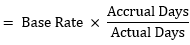

Beginning as of the first Contingent Interest Period it is possible that you could receive little or no interest on the notes. If, on any calendar day during any Contingent Interest Period, the Reference Rate is greater than the Accrual Barrier, interest will accrue at a rate of 0.00% per annum for that day.
PS-11
Information About the Reference Rate
All disclosures contained herein regarding the CMT10, including, without limitation, its make-up and method of calculation, have been derived from publicly available sources. The information reflects the policies of, and is subject to change by the Treasury. The Reference Rate is published by the Federal Reserve, but the Federal Reserve has no obligation to continue to publish, and may discontinue publication of, the Reference Rate. Neither we nor any of our affiliates accepts any responsibility for the calculation, maintenance or publication of the Reference Rates or any successor or replacement rate.
Information from outside sources including, but not limited to any website referenced in this section, is not incorporated by reference in, and should not be considered part of, this document or any document incorporated herein by reference. Deutsche Bank AG has not conducted any independent review or due diligence of any publicly available information with respect to the Reference Rate.
The constant maturity Treasury rate for a designated maturity (e.g., 10 years) is intended to be indicative of the bond equivalent yield of a U.S. Treasury security having a remaining term to maturity equivalent to such designated maturity. The constant maturity Treasury rate as of any business day is derived from the daily yield curve of outstanding non-inflation-indexed Treasury securities calculated by the Treasury. This yield curve, which relates the yield on a security to its time to maturity, is based on (a) composites of over-the-counter market bid price quotations (not actual transactions) on actively traded Treasury securities reported by leading U.S. government securities dealers, which may include the calculation agent or our other affiliates, and (b) an interpolation methodology used to calculate theoretical yields for designated maturities that fall between the remaining terms to maturity of actively traded Treasury securities. The constant maturity Treasury rate for a 10-year designated maturity is the yield that is indicated at the 10-year point on this yield curve. The constant maturity Treasury rate represents a “bond equivalent yield” for a bond that pays semiannual interest, which is expressed on a simple annualized basis. As such, the constant maturity Treasury rate is not an annualized percentage yield, which would include the effect of compounding.
Determination of the Reference Rate
With respect to any applicable U.S. Government Securities Business Day, the CMT10 is the yield on actively traded U.S. Treasury nominal/non-inflation-indexed securities adjusted to constant maturity with a maturity equal to 10 years as published by the Federal Reserve at or around 4:00 p.m. (New York time) and displayed on the Designated CMT10 Page on the immediately following U.S. Government Securities Business Day (the “CMT10 Publication Day”).
The Reference Rate shall be determined by the calculation agent as described under “Key Terms — Reference Rate”, provided that if the Reference Rate cannot be determined as described therein by 5:00 p.m. New York time, then the CMT10 will be:
●the yield on actively traded U.S. Treasury nominal/non-inflation-indexed securities adjusted to constant maturity with a maturity equal to 10 years for such U.S. Government Securities Business Day as published by the Federal Reserve (or any successor) in the H.15 Daily Update under the heading “Treasury constant maturities” in the row titled “10-year”;
●if such rate is not published in the H.15 Daily Update by 5:00 p.m., New York time, on the applicable CMT Rate Publication Day, the yield for U.S. Treasury securities at “constant maturity” with a maturity equal to 10 years for such U.S. Government Securities Business Day as published by the United States Department of the Treasury (or any successor) in its Daily Treasury Par Yield Curve Rates (or any successor publication) in the column titled “10 Yr”;
●if neither of the foregoing is available by 5:00 p.m., New York time, the 10-Year CMT Rate for such U.S. Government Securities Business Day will be determined by the calculation agent after consulting such sources (if any) as it deems comparable to the foregoing sources, or any other source or data it determines to be reasonable.
“Designated CMT10 Page” means the Bloomberg screen page “H15T10Y <Index>” (or any successor or replacement page or service).
“H.15 Daily Update” means the Selected Interest Rates (Daily)-H.15 release of the Federal Reserve, available at federalreserve.gov/releases/h15/, or any successor site or publication.
Notwithstanding the foregoing, if the calculation agent determines that a CMT Rate Transition Event and related CMT Rate Replacement Date have occurred prior to the applicable CMT Rate Reference Time in respect of any determination of the 10-Year CMT Rate on any date, as described below, then the CMT Rate benchmark replacement provisions will thereafter apply to all determinations of the Interest Rate payable on the notes.
Effect of a CMT10 Transition Event and Related CMT10 Replacement Date with Respect to the CMT10
CMT10 Replacement. If the calculation agent determines that a CMT10 Transition Event and related CMT10 Replacement Date have occurred with respect to the then-current CMT10 Benchmark prior to the applicable CMT10 Reference Time in respect of any determination of the then-current CMT10 Benchmark required to be made under the terms of the notes, the CMT10 Replacement will replace the then-current CMT10 Benchmark for all purposes relating to the notes in respect of such determination on such date and all such determinations on all subsequent dates unless and until another CMT10 Transition Event and related CMT10 Replacement Date have occurred with respect to the applicable CMT10 Replacement. In the event that a CMT10 Transition Event and related CMT10 Replacement Date are determined to have occurred with respect to a CMT10 Benchmark as set forth in the preceding sentence, and the calculation agent has selected a CMT10 Replacement, the provisions set forth in this section will apply to any such CMT10 Replacement and references in this section to the applicable CMT10 Benchmark will mean such CMT10 Replacement.
PS-12
CMT10 Replacement Conforming Changes. In connection with the implementation of a CMT10 Replacement, the calculation agent will have the right to make CMT10 Replacement Conforming Changes from time to time.
No CMT10 Replacement. In the event that a CMT10 Transition Event and related CMT10 Replacement Date are determined to have occurred as set forth above, if the calculation agent determines that there is no CMT10 Replacement as of any relevant date of determination of such CMT10 Benchmark, then the calculation agent will determine a substitute rate or substitute rate value to be used in place of the applicable CMT10 Benchmark for that date of determination after consulting such sources (if any) as it deems comparable to the sources described under “Key Terms — Reference Rate” and “Information About the Reference Rate” herein or any other source or data it determines to be reasonable.
Certain Defined Terms.
As used herein with respect to any CMT10 Transition Event and implementation of the CMT10 Benchmark Replacement and CMT10 Replacement Conforming Changes:
“CMT10 Benchmark” means, initially, the 10-Year CMT10, provided that if a CMT10 Transition Event and related CMT10 Replacement Date have occurred with respect to the 10-Year CMT10 or then-current CMT10 Benchmark, then the “CMT10 Benchmark” means the CMT10 Replacement.
“CMT10 Replacement” means the sum of (a) the alternate rate of interest that has been selected by the calculation agent as an industry-accepted replacement for the current CMT10 Benchmark for U.S. dollar-denominated floating-rate notes at such time and (b) the CMT10 Replacement Adjustment (if any).
“CMT10 Replacement Adjustment” means the spread adjustment (which may be a positive or negative value or zero) that has been selected by the calculation agent giving due consideration to any industry-accepted spread adjustment, or method for calculating or determining such spread adjustment, for the replacement of the then-current CMT10 Benchmark with the applicable Unadjusted CMT10 Replacement for floating-rate notes at such time.
“CMT10 Replacement Conforming Changes” means, with respect to any CMT10 Replacement, changes to (1) any interest determination dates, interest payment dates, or other relevant dates, business day convention or interest period, (2) the manner, timing and frequency of determining rates and amounts of interest that are payable on the notes and the conventions relating to such determination and calculations with respect to interest, (3) the timing and frequency of making payments of interest, (4) rounding conventions, (5) index maturities, and (6) any other terms or provisions of the notes, in each case that the calculation agent determines, from time to time, to be appropriate to reflect the determination and implementation of such CMT10 Replacement giving due consideration to any industry-accepted market practice (or, if the calculation agent determines that implementation of any portion of such market practice is not administratively feasible or determines that no market practice for use of the CMT10 Replacement exists, in such other manner as the calculation agent determines is appropriate).
“CMT10 Replacement Date” means the earliest to occur of the following events with respect to the current CMT10 Benchmark:
(A)in the case of clause (A) or (B) of the definition of “CMT10 Transition Event,” the later of (a) the date of the public statement or publication of information referenced therein and (b) the date on which the administrator of the CMT10 Benchmark permanently or indefinitely ceases to provide such CMT10 Benchmark;
(B)in the case of clause (C) of the definition of “CMT10 Transition Event,” if such statement or publication referenced therein indicates that the administrator or regulatory supervisor for the administrator has determined that such rate is no longer representative: (a) at the date of such statement or publication referenced therein, the date of such statement or publication; or (b) as of a specified future date, the first date on which such rate would ordinarily have been published or provided and is non-representative by reference to the most recent statement or publication referenced therein, even if such rate continues to be published or provided on such date; or
(C)in the case of clause (D) or (E) of the definition of “CMT10 Transition Event,” the date of such determination referenced therein.
For the avoidance of doubt, if the event giving rise to the CMT10 Replacement Date occurs on the same day as, but earlier than, the CMT10 Reference Time in respect of any determination, the CMT10 Replacement Date will be deemed to have occurred prior to the CMT10 Reference Time for such determination.
“CMT10 Reference Time” with respect to any determination of CMT10 for the notes means 5:00 p.m., New York time, on the CMT10 Publication Day for the applicable U.S. Government Securities Business Day; provided that if a CMT10 Transition Event and related CMT10 Replacement Date have occurred with respect to the then-current CMT10 Benchmark and the calculation agent has selected a CMT10 Benchmark Replacement, “CMT10 Reference Time” will mean with respect to such CMT10 Replacement, the time determined by the calculation agent in accordance with the CMT10 Replacement Conforming Changes.
“CMT10 Transition Event” means the occurrence of one or more of the following events with respect to the current CMT10 Benchmark:
(A)a public statement or publication of information by or on behalf of the administrator of the CMT10 Benchmark announcing that such administrator has ceased or will cease to provide such CMT10 Benchmark, permanently or indefinitely, provided that, at the time of such statement or publication, there is no successor administrator that will continue to provide such CMT10 Benchmark;
PS-13
(B)a public statement or publication of information by the regulatory supervisor for the administrator of the CMT10 Benchmark, the central bank for the currency of such CMT10 Benchmark, an insolvency official with jurisdiction over the administrator for such CMT10 Benchmark, a resolution authority with jurisdiction over the administrator for such CMT10 Benchmark or a court or an entity with similar insolvency or resolution authority over the administrator for such CMT10 Benchmark, which states that the administrator of such CMT10 Benchmark has ceased or will cease to provide such CMT10 Benchmark permanently or indefinitely, provided that, at the time of such statement or publication, there is no successor administrator that will continue to provide such CMT10 Benchmark;
(C)a public statement or publication of information by the administrator of such CMT10 Benchmark or the regulatory supervisor for the administrator of such CMT10 Benchmark announcing that such CMT10 Benchmark is no longer, or as of a specified future date will no longer be, representative of the underlying market and economic reality that such CMT10 Benchmark is intended to measure, and that representativeness will not be restored;
(D)a determination by the calculation agent that the CMT10 Benchmark has been permanently or indefinitely discontinued; or
(E) a determination by the calculation agent that such CMT10 Benchmark as published is no longer an industry-accepted rate of interest for U.S. dollar-denominated floating-rate notes at such time.
“Unadjusted CMT10 Replacement” means the CMT10 Replacement excluding the CMT10 Replacement Adjustment (if any).
PS-14
Historical Information
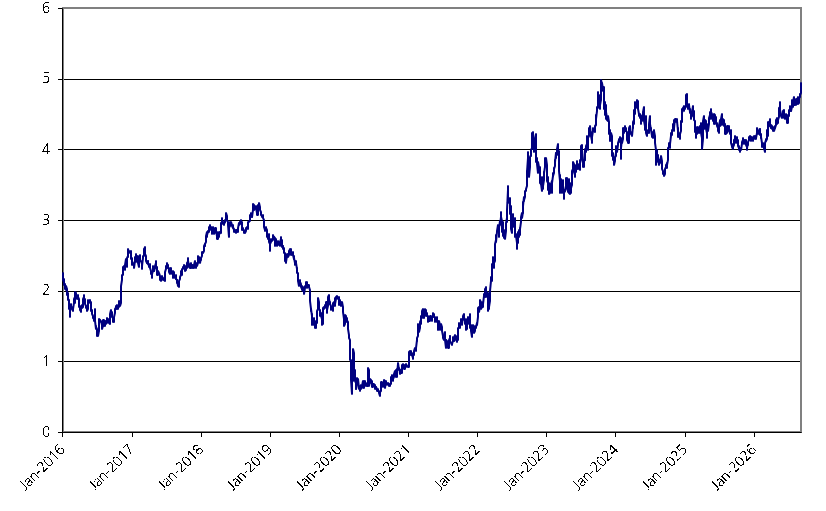
The following graph sets forth the historical performance of the CMT10 from January 4, 2016 through September 11, 2026. The CMT10 on September 11, 2026 was 4.96%. We obtained the historical performance information below from Bloomberg, and we have not participated in the preparation of, or verified, such information.
The historical levels of the CMT10 should not be taken as an indication of future performance, and no assurance can be given as to the performance of the CMT10 during the term of the notes. We cannot give you assurance that the performance of the CMT10 will result in the payment of any interest on your notes.
PS-15
Description of the Notes
The following description of the terms of the notes supplements the description of the general terms of the debt securities set forth under the headings “Description of Notes” in the accompanying prospectus supplement and “Description of Debt Securities—Senior Debt Funding Securities” in the accompanying prospectus. Capitalized terms used but not defined in this pricing supplement have the meanings assigned to them in the accompanying prospectus supplement and prospectus.
General
The notes are unsecured unsubordinated obligations of Deutsche Bank AG, ranking in priority to its senior non-preferred obligations that pay interest at a variable per annum rate of 10.00% for each U.S. Government Securities Business Day that the CMT10 is equal to or less than 6.05% as described further specified under “Key Terms—Interest Rate” above. The interest will be paid quarterly in arrears on each Interest Payment Date, including the Maturity Date, based on an unadjusted 30/360 day count convention, unless earlier redeemed. The notes are our Senior Debt Funding Notes, Series E referred to in the accompanying prospectus supplement and prospectus. The notes will be issued by Deutsche Bank AG under an indenture among us, Delaware Trust Company, as trustee, and Deutsche Bank Trust Company Americas, as paying agent, authenticating agent, issuing agent and registrar. From time to time, we may create and issue additional notes with the same terms, so that the additional notes will be considered as part of the same issuance as the earlier notes.
The notes are not deposits or savings accounts and are not insured or guaranteed by the Federal Deposit Insurance Corporation or any other U.S. or foreign governmental agency or instrumentality. The notes constitute our unsecured and unsubordinated obligations ranking pari passu among themselves and with all of our other unsecured and unsubordinated obligations, subject, however, to statutory priorities conferred upon certain unsecured and unsubordinated obligations in the event of any Resolution Measures imposed on us or in the event of our dissolution, liquidation, insolvency or composition, or if other proceedings are opened for the avoidance of the insolvency of, or against, us; in accordance with Section 46f(5) of the German Banking Act (Kreditwesengesetz), our obligations under the notes will rank in priority to our senior non-preferred obligations (i) under any of our debt instruments (Schuldtitel) within the meaning of Section 46f(6) sentence 1 of the German Banking Act (including the senior non-preferred obligations under any such debt instruments that we issued before July 21, 2018 and that are subject to Section 46f(9) of the German Banking Act) or any successor provision and (ii) eligible liabilities within the meaning of Articles 72a and 72b(2) of Regulation (EU) No 575/2013 of the European Parliament and of the Council, as amended, supplemented or replaced from time to time (the “CRR”). For more information on Resolution Measures, see “Resolution Measures and Deemed Agreement” on page PS–2 of this pricing supplement.
The notes are intended to qualify as eligible liabilities instruments within the meaning of Article 72b(2), with the exception of point (d), CRR for the minimum requirement for own funds and eligible liabilities, as described and provided for in the bank regulatory capital provisions to which we are subject, including restrictions on the aggregate amount of similar instruments that we may use for such purposes, but do not constitute senior non-preferred debt instruments within the meaning of Section 46f(6) sentence 1 of the German Banking Act.
The notes will be issued in minimum denominations of $1,000 and integral multiples of $1,000 in excess thereof. The principal amount (the “Principal Amount”) of the notes is $1,000 and the Issue Price of the notes is $1,000.00. The notes will be issued in registered form and represented by one or more permanent global notes registered in the name of The Depository Trust Company (“DTC”) or its nominee, as described under “Description of Notes — Form, Legal Ownership and Denomination of Notes” in the accompanying prospectus supplement and “Forms of Securities — Legal Ownership — Global Securities” in the accompanying prospectus.
The specific terms of the notes are set forth under the heading “Key Terms” on the cover page of this pricing supplement and in the subsections below.
Payments on the Notes
We will irrevocably deposit with DTC no later than the opening of business on the applicable Interest Payment Date and the Maturity Date funds sufficient to make payments of the amount payable with respect to the notes on such date. We will give DTC irrevocable instructions and authority to pay such amount to the holders of the notes entitled thereto.
Subject to the foregoing and to applicable law (including, without limitation, United States federal laws) and subject to approval by the competent authority, we or our affiliates may, at any time and from time to time, purchase outstanding notes by tender, in open market transactions or by private agreement.
Calculation Agent
Deutsche Bank AG, London Branch will act as the calculation agent. As the calculation agent, Deutsche Bank AG, London Branch will determine, among other things, the 10-Year CMT Rate, the number of Accrual Days for each Interest Period, the Interest Rate for each Interest Period, whether to redeem the notes on any Optional Redemption Date and the amount of interest payable in respect of your notes on each Interest Payment Date. Unless otherwise specified in this pricing supplement, all determinations made by the calculation agent will be at the sole discretion of the calculation agent and will, in the absence of manifest error, be conclusive for all
PS-16
purposes and binding on you, the trustee and us. We may appoint a different calculation agent from time to time after the date of this pricing supplement without your consent and without notifying you.
All calculations with respect to the 10-Year CMT Rate and the amount of interest payable on the notes will be rounded to the nearest one hundred-thousandth, with five one-millionths rounded upward (e.g., 0.876545 would be rounded to 0.87655); all dollar amounts related to determination of the payment per $1,000 note Principal Amount at maturity will be rounded to the nearest ten-thousandth, with five one hundred-thousandths rounded upward (e.g., 0.76545 would be rounded up to 0.7655); and all dollar amounts paid on the aggregate Principal Amount of notes per holder will be rounded to the nearest cent, with one-half cent rounded upward.
Events of Default
Under the heading “Description of Debt Securities — Senior Debt Funding Securities — Events of Default” in the accompanying prospectus is a description of the event of default relating to senior debt funding securities including the notes. The notes provide for no event of default other than the opening of insolvency proceedings against us by a German court having jurisdiction over us.
The Indenture provides that there is no right of acceleration in the case of a default in the payment of principal of, interest on, or other amounts owing under the notes or a default in the performance of any of our other covenants under the notes or the Indenture.
Payment Upon an Event of Default
If an event of default occurs and the maturity of the notes is accelerated, we will pay a default amount for each $1,000 Principal Amount of notes equal to $1,000 plus any accrued but unpaid interest to, but excluding, the date of acceleration.
If the maturity of the notes is accelerated because of an event of default as described above, we will, or will cause the calculation agent to, provide written notice to the trustee at its New York office, on which notice the trustee may conclusively rely, and to DTC of the cash amount due with respect to the notes as promptly as possible and in no event later than two business days after the date of acceleration. See “Selected Risk Considerations — Risks Relating to the Issuer — THE NOTES CONTAIN LIMITED EVENTS OF DEFAULT, AND THE REMEDIES AVAILABLE THEREUNDER ARE LIMITED” herein and “Description of Debt Securities — Senior Debt Funding Securities — Events of Default” in the accompanying prospectus.
Modification
Under the heading “Description of Debt Securities — Senior Debt Funding Securities — Modification of the Senior Debt Funding Indenture” in the accompanying prospectus is a description of when the consent of each affected holder of debt securities is required to modify the Indenture.
Listing
The notes will not be listed on any securities exchange.
Book-Entry Only Issuance — The Depository Trust Company
DTC will act as securities depositary for the notes. The notes will be represented by a type of global note in book-entry form referred to as a master note registered in the name of Cede & Co. (DTC’s nominee). In connection with the issuance of the notes by us, the trustee and/or paying agent will, in accordance with our instructions, make appropriate entries or notations in its records relating to the master note to indicate that the master note evidences the issuance of the notes. See the descriptions contained in the accompanying prospectus supplement under the headings “Description of Notes — Form, Legal Ownership and Denomination of Notes.” The notes are offered on a global basis. Investors may elect to hold interests in the registered global notes held by DTC through Clearstream, Luxembourg or the Euroclear operator if they are participants in those systems, or indirectly through organizations that are participants in those systems. See “Notes Offered on a Global Basis — Book-Entry, Delivery and Form” in the accompanying prospectus supplement.
Governing Law
The notes will be governed by and construed in accordance with the laws of the State of New York, except as may be otherwise required by mandatory provisions of law and except with respect to the provisions relating to the ranking of the notes, which will be governed by and construed in accordance with the laws of the Federal Republic of Germany, including, in relation to such provisions, any determination of whether a Resolution Measure has been imposed on us.
PS-17
Tax Consequences
You should review carefully the section of the accompanying prospectus supplement entitled “United States Federal Income Taxation.” The discussion below applies to you only if you are an initial purchaser of notes acquiring them for their Issue Price as stated on the cover of this document.
Although not free from doubt, in the opinion of our special tax counsel, Fried, Frank, Harris, Shriver & Jacobson LLP, the notes should be treated for U.S. federal income tax purposes as debt, and the remainder of this discussion so assumes. Based on current market conditions, we intend to treat the notes for U.S. federal income tax purposes as “variable rate debt instruments,” as described in “U.S. Federal Income Taxation — Tax Consequences to U.S. Holders — VRDI Notes” in the accompanying prospectus supplement. Under this treatment, you should include the interest payments on the notes in ordinary income at the time you receive or accrue such payments, depending on your method of accounting for tax purposes, and recognize capital gain or loss on the sale or retirement of your notes equal to the difference between the amount you realize on the sale or retirement, excluding any amounts attributable to accrued but unpaid interest (which should be treated as interest payments), and your tax basis in your notes.
However, the IRS could assert that the notes should be treated pursuant to some other characterization for U.S. federal income tax purposes. If the notes were treated as other than variable rate debt instruments, your U.S. federal income tax consequences in respect of the notes could be materially different from those described herein.
Non-U.S. Holders. If you are a non-U.S. holder (as defined in the accompanying product supplement), we do not believe that you should be required to provide an IRS Form W-8 in order to avoid 30% U.S. withholding tax with respect to interest payments on the notes, although the IRS could challenge this position. However, you should in any event expect to be required to provide an appropriate IRS Form W-8 or other documentation in order to establish an exemption from backup withholding, as described under the heading “U.S. Federal Income Taxation — Tax Consequences to Non-U.S. Holders” in the accompanying prospectus supplement.
As discussed under “U.S. Federal Income Taxation — Tax Consequences to Non-U.S. Holders — Withholding Under Section 871(m) of the Code” in the accompanying prospectus supplement, Section 871(m) of the Internal Revenue Code and Treasury regulations promulgated thereunder (“Section 871(m)”) generally impose a 30% withholding tax on dividend equivalents paid or deemed paid to non-U.S. holders with respect to certain financial instruments linked to U.S. equities or indices that include U.S. equities. Section 871(m) provides certain exceptions to this withholding regime, including for instruments linked to certain broad-based indices that meet requirements set forth in the applicable Treasury regulations, generally as of the first business day of the calendar year in which the relevant issuance is priced. In addition, the Treasury regulations, as modified by an IRS notice, exempt financial instruments issued prior to January 1, 2027 that do not have a “delta” of one. Based on certain determinations made by us, our special tax counsel is of the opinion that these regulations should not apply to the notes with regard to non-U.S. holders. Our determination is not binding on the IRS, and the IRS may disagree with this determination.
We will not be required to pay any additional amounts with respect to U.S. federal withholding taxes.
You should read the section entitled “U.S. Federal Income Taxation” in the accompanying prospectus supplement. The preceding discussion, when read in combination with that section, constitutes the full opinion of our special tax counsel regarding the material U.S. federal income tax consequences of owning and disposing of the notes. You should also consult your tax adviser regarding the U.S. federal income tax consequences of an investment in the notes, as well as tax consequences arising under the laws of any state, local or non-U.S. taxing jurisdiction.
For a discussion of certain German tax considerations relating to the notes, you should refer to the section in the accompanying prospectus supplement entitled “Taxation by Germany of Non-Resident Holders.”
You should consult your tax adviser regarding the U.S. federal tax consequences of an investment in the notes, as well as tax consequences arising under the laws of any state, local or non-U.S. taxing jurisdiction.
PS-18
USE OF PROCEEDS; HEDGING
The net proceeds we receive from the sale of the notes will be used for general corporate purposes, as more particularly described in “Use of Proceeds” in the accompanying prospectus.
We or our affiliates may acquire a long or short position in securities similar to the notes from time to time and may, in our or their sole discretion, hold or resell those securities. Although we have no reason to believe that any of these activities will have a material impact on the value of the notes, we cannot assure you that these activities will not have such an effect.
PS-19
Supplemental Plan of Distribution (Conflicts of Interest)
Under the terms and subject to the conditions contained in the Distribution Agreement entered into between Deutsche Bank AG and DBSI, as agent thereunder, DBSI has agreed to purchase, and we have agreed to sell, the Principal Amount of notes set forth on the cover of this pricing supplement.
Notes sold by DBSI to the public will initially be offered at the Issue Price set forth on the cover of this pricing supplement. If all of the notes are not sold at the Issue Price, DBSI may change the offering price and the other selling terms.
DBSI will receive discounts and commissions in the amount indicated on the cover hereof, and from such discounts and commissions will allow selected dealers a selling concession in an amount not to exceed such discounts and commissions. Dealers who purchase the notes for sales to eligible institutional investors and fee-based advisory accounts may forgo some or all selling concessions.
DBSI and any dealers that participate with DBSI in the distribution of the notes may be deemed to be underwriters, and any discounts or commissions received by them and any profit on the resale of the notes by them may be deemed to be underwriting discounts or commissions.
We own, directly or indirectly, all of the outstanding equity securities of DBSI. The net proceeds received from the sale of the notes may be used, in part, by DBSI or one of its affiliates in connection with hedging our obligations under the notes. Because DBSI is both our affiliate and a member of FINRA, the underwriting arrangements for this offering must comply with the requirements of FINRA Rule 5121 regarding a FINRA member firm’s distribution of the securities of an affiliate and related conflicts of interest. In accordance with FINRA Rule 5121, DBSI may not make sales in offerings of the notes to any of its discretionary accounts without the prior written approval of the customer.
DBSI may act as principal or agent in connection with offers and sales of the notes in the secondary market. Secondary market offers and sales will be made at prices related to market prices at the time of such offer or sale; accordingly, DBSI or a dealer may change the public offering price, concession and discount after the offering has been completed.
In order to facilitate the offering of the notes, DBSI may engage in transactions that stabilize, maintain or otherwise affect the price of the notes. Specifically, DBSI may sell more notes than it is obligated to purchase in connection with the offering, creating a naked short position in the notes for its own account. DBSI must close out any naked short position by purchasing the notes in the open market. A naked short position is more likely to be created if DBSI is concerned that there may be downward pressure on the price of the notes in the open market after pricing that could adversely affect investors who purchase in the offering. As an additional means of facilitating the offering, DBSI may bid for, and purchase, notes in the open market to stabilize the price of the notes. Any of these activities may raise or maintain the market price of the notes above independent market levels or prevent or slow a decline in the market price of the notes. DBSI is not required to engage in these activities and may end any of these activities at any time.
No action has been or will be taken by us, DBSI or any dealer that would permit a public offering of the notes or possession or distribution of this pricing supplement, the accompanying prospectus supplement or prospectus other than in the United States, where action for that purpose is required. No offers, sales or deliveries of the notes, or distribution of this pricing supplement, the accompanying prospectus supplement or prospectus or any other offering material relating to the notes, may be made in or from any jurisdiction except in circumstances which will result in compliance with any applicable laws and regulations and will not impose any obligations on us, DBSI or any dealer.
DBSI has represented and agreed that if any notes are to be offered outside the United States, it will not offer or sell any such notes in any jurisdiction if such offer or sale would not be in compliance with any applicable law or regulation or if any consent, approval or permission is needed for such offer or sale by it or for or on behalf of the Issuer unless such consent, approval or permission has been previously obtained and DBSI will obtain any consent, approval or permission required by it for the subscription, offer, sale or delivery of the notes, or the distribution of any offering materials, under the laws and regulations in force in any jurisdiction to which it is subject or in or from which it makes any subscription, offer, sale or delivery.
Notice to Prospective Investors in the EEA
This pricing supplement and the accompanying prospectus supplement and prospectus have been prepared on the basis that any offer of notes in any Member State of the European Economic Area (“EEA”) will be made pursuant to an exemption under Regulation (EU) 2017/1129 (as amended, the “Prospectus Regulation”) from the requirement to publish a prospectus for offers of notes. The accompanying prospectus supplement and the accompanying prospectus are not a prospectus for the purposes of the Prospectus Regulation.
PS-20
Prohibition of Sales To EEA Retail Investors
The notes are not intended to be offered, sold or otherwise made available to and should not be offered, sold or otherwise made available to any retail investor in the EEA. For these purposes, a retail investor means a person who is one (or more) of: (i) a retail client as defined in point (11) of Article 4(1) of Directive 2014/65/EU (as amended, “MiFID II”); or (ii) a customer within the meaning of Directive (EU) 2016/97 (as amended, the “Insurance Distribution Directive”), where that customer would not qualify as a professional client as defined in point (10) of Article 4(1) of MiFID II or (iii) not a qualified investor as defined in the Prospectus Regulation . The expression an offer includes the communication in any form and by any means of sufficient information on the terms of the offer and the notes to be offered so as to enable an investor to decide to purchase or subscribe for the notes. Consequently no key information document required by Regulation (EU) No 1286/2014 (as amended, the “PRIIPs Regulation”) for offering or selling the notes or otherwise making them available to retail investors in the EEA has been prepared and therefore offering or selling the notes or otherwise making them available to any retail investor in the EEA may be unlawful under the PRIIPs Regulation.
Notice to Prospective Investors in the UK
This pricing supplement and the accompanying prospectus supplement and prospectus have been prepared on the basis that any offer of notes in the United Kingdom (“UK”) will be made pursuant to an exemption under Regulation (EU) 2017/1129 as it forms part of domestic law by virtue of the European Union (Withdrawal) Act 2018 (the “UK Prospectus Regulation”) from the requirement to publish a prospectus for offers of notes. The accompanying prospectus supplement and the accompanying prospectus are not a prospectus for the purposes of the UK Prospectus Regulation.
Prohibition of Sales to UK Retail Investors
The notes are not intended to be offered, sold or otherwise made available to and should not be offered, sold or otherwise made available to any retail investor in the UK. For these purposes, a retail investor means a person who is one (or more) of: (i) a retail client, as defined in point (8) of Article 2 of Regulation (EU) No 2017/565 as it forms part of domestic law by virtue of the European Union (Withdrawal) Act 2018 (“EUWA”); or (ii) a customer within the meaning of the provisions of the Financial Services and Markets Act 2000, as amended (“FSMA”), and any rules or regulations made under the FSMA to implement Directive (EU) 2016/97, where that customer would not qualify as a professional client, as defined in point (8) of Article 2(1) of Regulation (EU) No 600/2014 as it forms part of domestic law by virtue of the EUWA or (iii) not a qualified investor as defined in Article 2 of the UK Prospectus Regulation. The expression an offer includes the communication in any form and by any means of sufficient information on the terms of the offer and the notes to be offered so as to enable an investor to decide to purchase or subscribe for the notes. Consequently no key information document required by Regulation (EU) No 1286/2014 as it forms part of domestic law by virtue of the EUWA (the “UK PRIIPs Regulation”) for offering or selling the notes or otherwise making them available to retail investors in the UK has been prepared and therefore offering or selling the notes or otherwise making them available to any retail investor in the UK may be unlawful under the UK PRIIPs Regulation.
PS-21