




Form 497AD RoboStrategy, Inc.
 Tweet
 Share
 E-mail
Filed Pursuant to Rule 497(a)
File No. 333-297289
Rule 482ad
RoboStrategy, Inc. Video Script
Topic: “1 Billion Robots are Coming… THIS is the ONE Stock I’m Buying,” sponsored interview of Andrew Kang, Chief Executive Officer of RoboStrategy, Inc., by Joseph Hogue, CFA, on the Let’s Talk Money! YouTube channel (published October 13, 2026)
Script
Joseph Hogue: Nearly 1 billion humanoid robots and a market worth more than 5 trillion dollars. That's one estimate for where robotics could be headed, but the opportunity could go far beyond that. In my last video, I showed you why AI could finally unlock this market.
Now, I want to go deeper, why robotics is reaching an inflection point, how big this could become, and where investors could find the biggest opportunities. Helping us with that is Andrew Kang, CEO of RoboStrategy, a publicly traded fund focused on robotics and physical AI, and an early investor in companies including Figure AI, Apptronik, and Dyna Robotics. Andrew, thanks for joining us.
[On-screen: RoboStrategy website, “Private Robotics Investments, Public Company.”]

We got a wave of feedback on that first video, so I'd love to get your insights into robotics and how investors can follow this trend.
[On-screen: Nasdaq MarketSite display welcoming the listing of RoboStrategy, Inc. (BOT)]

Andrew Kang: Hey Joseph, thanks for having me.
Joseph Hogue: So now, let's get into this, why robotics, and really more appropriately, why now? You know, we've watched AI become arguably the biggest investing theme of the last several years. You believe robotics could be the next wave.
What changed that makes the robotics possible now when people have been promising this for robots for decades?
Andrew Kang: Yeah, that's the thing, right? Is that robotics have been in the works for a very long time. It's a very difficult problem, and we see the opportunity as, I would say, an opportunity that is as large as AI itself, if not even larger.
[On-screen: RoboStrategy website, homepage banner]

The thing about robotics is that to get it to work, like in the movies, like in the Jetsons or other pieces of sci-fi, you need to have robots understand the world around us. And you need to have the robots also be able to act in the world around us, to be able to sense things, to be able to react in the way that humans would. And that intelligence portion was always the missing piece.
We could build the hardware to build the robots, right? We could build the robot bodies if we put enough effort and resources into it. But it was always kind of solving the question of, how do we have the robots perceive the world and act intelligently?
That was the main problem. And it was, I would say, three years ago when ChatGPT came out, when things really became more obvious that the intelligence portion of the problem was really going to be solved. We were solving it for knowledge work, right?
The amount of throughput, the amount of confidence you can have in AI systems like Claude or ChatGPT in doing a lot of the daily work that humans do today for various desk jobs has gone up quite a bit, right? A lot of software engineering has completely changed. And we think that those changes are also soon going to apply to the physical world as well, where entire physical industries start to become revolutionized, because a lot of the menial, repetitive work that humans are doing today can be done by robots.
And that's what's so exciting.
Joseph Hogue: You said the movies, and I'm so glad you said Jetsons, because I thought you were going to say Terminator. But that takes us to something I've heard you talk about. You've called this move from AI to physical AI.
So what does physical AI actually mean? And why is that such an important technological transition?
Andrew Kang: Yeah, so what physical AI means is that robots can understand basically the physics of the world around us, right? They know that if they go and they grab a bottle of water, how much pressure they need to put on that bottle so that it doesn't fall out of their grasp, how they need to pour it so that the water comes out in a stream that doesn't go all over the place. And that type of intelligence, it seems kind of easy because it's so intuitive for us as humans.
But it's actually a little bit more difficult than solving some of the intelligence problems like with software engineering that I mentioned before, because it requires an understanding of the physical world that you have. You have another dimension of intelligence on top of kind of like the reasoning that has already been solved for. And so if you were to ask a robot to do this complicated task of how to put together a sandwich, it's not that complicated.
And actually, systems like ChatGPT and Claude, they could tell you, they could give you the instructions of how to put together a sandwich, right? You know, you need to get your pieces of bread, you know, you need to get all your ingredients out and then you got to put them together in the right order. But there's a lot of there's kind of a lot of micro decisions that you're making that humans, right?
We almost kind of take for granted ourselves, right? How much pressure to put on the knife, right? If you're kind of scooping out mayonnaise out of a jar and, you know, how do I move my hand that's holding the knife from an extended position, something that's kind of closer to my body so that it's at the right angle that I can spread it over a piece of bread.
So something like that, it just seems so easy for us, but it is actually a very difficult problem. And it also is a difficult problem because we need to do it very fast. You know, I can't be thinking about all of these micro adjustments that I'm making on, you know, 10 millisecond basis because that would just be too slow.
Right. If I waited for Claude to kind of answer before I made any small movement. And, you know, there's a lot of innovations going on in the robot learning, the robot AI world that is kind of solving these intelligence problems and kind of allowing robots to understand and act in the same way that humans are today.
And what that unlocks is basically, you know, the ability for robots to do tasks like cooking, cleaning, industrial automation jobs, you know, machine tending, moving, you know, warehouse totes around. So it's really kind of there's there's no limit to it. Eventually, right.
We'll have robots on on the moon in space doing the jobs that are just, I would say, you know, a lot more difficult for humans to do because of the environment that they're in.
Joseph Hogue: Yeah, that whole embodiment of AI is really interesting. And it does seem like we're coming into really an inflection point, all of this. So if we do, you know, how big could robotics become?
You've talked about robotics potentially becoming at tens of trillions of dollars industry. I know Morgan Stanley has has a base case of about five trillion alone. So walk me through this math.
How do we get to something that large?
Andrew Kang: Yeah. So there's two ways to look at it. There's kind of the top down version, which is you just say, hey, look, the closest proxy to this is the physical industry or the physical labor market.
That's a 50 trillion dollar industry. It's one of the biggest industries in the world. And just thinking about this from first principles, right.
A humanoid robot, it can work, you know, 20, 24 hours a day, seven days a week, 365 days a year. Whereas a human, right. You know, working around eight days, sorry, eight hours a day.
And but you got vacation days, you got sick days. What if you get hurt? What if, you know, this person doesn't like their job.
Right. And they want to quit, which happens really, really often if you're in a very difficult manufacturing job or, you know, you're working in, say, like a logistics center. And, you know, now the company has to pay for training new people.
They have to pay for recruiting new people. And it's kind of this massive overhead, actually, just to have, you know, one one person. And then so, you know, you look at what a robot can do.
Right. They should never get tired, never have to sleep. And they can end up doing being accomplishing the same productivity as, say, three to four humans today.
And so it's kind of a no brainer for a lot of businesses to be adopting these robots. It's actually if you look at a company like, you know, General Mills or Walmart. Right.
Like these are companies that have been really established for a long period of time. And it's not like they can grow their top line 30 percent year over year anymore. They're mostly saturated.
There's only so many Walmarts or so many boxes of cereal that you can sell. But, you know, you look at the business, the economics for these businesses where they have actually quite a bit of revenue, but maybe 50 to 70 percent of their revenue is made up by basically physical labor costs. Well, they can actually three times the size of their business, four times the size of business, depending on how much they're able to save on their physical labor costs.
And, you know, actually expand to new markets where previously it was too uneconomical for them to expand into. Or maybe they couldn't find the people to hire to expand to those markets. And so it's definitely kind of a no brainer.
Right. Because now you're basically turning physical labor into a product. And you can also look at this from the bottoms up point of view.
And this is kind of what really made it click for us is you just say, hey, look, I have one humanoid. I'm going to sell it for $50,000. And what if I sold 100,000 of these?
How much revenue is that? It's around $5 billion. Palantir made something like along the lines of around $5 billion last year.
So it's you're already a very significantly sized business just selling 100,000 humanoids. And you compare that to some of the items in the world that are also very revolutionary, ubiquitous, like cell phones. We produce billions of them per year.
We produce hundreds of millions of cars and PCs. And so 100,000 is barely scratching the surface. And so you say, hey, look, what if I sell a million robots?
[On-screen: RoboStrategy investor presentation slide, “Market Size: A Trillion-Dollar Horizon”]

Walmart, millions of employees, Amazon, millions of employees. So, you know, a million is still not a huge number. And it would not even replace the workforce of one of these companies.
But a million times 50,000, $50 billion of revenue. You know, you're now in the leagues of some of the biggest companies in the world today. And then, you know, you can see that as we scale by 10.
Again, now you have 10 million robots, $500 billion. Yeah, you're one of the biggest companies in the world. And then you can see how as we get to the hundreds of millions of robots produced per year and potentially even billions, you're getting into the trillions of dollars of revenue easily.
And that would take you to the tens of trillions of dollars of market cap. And that doesn't even consider kind of, you know, all the opportunities that open up because now labor is cheaper. It's more accessible.
It's easier for people to start new businesses. Right. Because it's easier for them to find people that want to do the jobs, which is just the robots.
And so that's kind of how we think about the size of the market. It's one of the biggest markets in the world.
Joseph Hogue: And when we start talking about that, the numbers are amazing. It's just a million robots and you're upwards of, you know, billions of dollars in revenue, which, of course, proves a trillion dollar company. So this will mean the next trillionaires.
Where do we start seeing this first, though? I know we've already got those basic robots manufacturing for decades, really. Where do we start seeing the first humanoid robots, really?
What industries get disrupted first? Manufacturing, warehousing, logistics. I know my wife is extremely interested in health care, being a nurse there.
So construction. Where do we where does this go first?
Andrew Kang: Yeah. So the first industries that are going to be disrupted are going to be those that are, I would say, focused on tasks that are very repeatable because those are the tasks that AI is easier for AI to accomplish today. Where, say, you know, I need to put this machine part on this big, heavy machinery.
Right. That's what humans are doing today, right? They're operating machines and they actually need a lot of humans to operate these machines.
And then or, you know, tasks like palletizing, right, where you have humans moving boxes or cases from one place to another. And it's a very kind of repeatable function. And and so that's, you know, you actually already see humanoids like from Figure AI doing a lot of these tasks today.
You know, you've seen actually videos of them storing packages in logistics facilities. Right. These big mail centers where, you know, right now you have humans that are kind of flipping over these packages so that the barcode is in the right place.
So they can be scanned by another machine. There's a lot of people that, you know, these companies need to do these jobs. And a lot of times we can't find enough people to want to do them because it's a pretty boring job and it's actually pretty intensive.
And and, you know, as time goes on, I would say over the next one to two years, you're going to see basically robots being able to move up in the task complexity scale. So they're going to be able to do tasks that require more thinking. You know, maybe maybe that's in the F&B industry.
Maybe it's in hospitals. And then over the course of, I would say, the next two to three to four years is when you see the robots start to enter the home. And I wouldn't say it's because, you know, it's going to take four years to get to that level of intelligence to enter the home.
I actually think that's going to happen over the next one to two years. But, you know, you think about industrial companies, right? They're willing to pay robots to do three shifts a day because, you know, you basically get the productivity of three or four people.
Whereas you have a robot in the home. Incredibly useful, right? I can save hours a week from a robot that can just maybe take out my trash or clean up my my house and do some laundry like that.
That'll save me many hours. It's really useful. A lot of people pay for me to do similar services.
But, you know, is it worth it for me to pay, say, $100,000, $150,000 on an annual basis for that service? Maybe only for the wealthiest, some of the wealthiest people in the world. But for someone like a Walmart or, say, like a General Mills, that could be actually a very worthwhile expense for them.
Right. Because you think about, say, like $100,000. Well, it's doing three times the work of a human.
So that's like $33,000 on a work adjusted basis. And, you know, you look in the U.S. with all these benefits and all the overheads, it's, you know, the cost is way above $33,000 per worker today. And so that's kind of the general trajectory is first in these industrial tasks, which require a lot of repeatability.
And eventually, as we have more robots and, you know, the costs come down, then into the home over, say, you know, the end of the 2020s and the early 2030s.
Joseph Hogue: And that is still, when you think about it, still extremely quickly, three to four years in the home, even before that, in a lot of these other industries. Let's start talking about how investors can use this. You know, you've been an early leader investing in what you talked about, Figure AI, Apptronik, Dyna Robotics, Standard Bots.
What characteristics made those companies stand out to you? You know, Figure AI, probably the name most investors are going to recognize there. What convinced you early that Figure could become one of the leaders in the humanoid space?
Andrew Kang: Yeah. So there's quite a bit of characteristics that we look for. Commercializing a humanoid robot, I think, is one of the most difficult technical challenges in the world.
The reason why people haven't been able to do it before is because it's really, really hard. You need experts from hand engineering, right? Incredibly difficult subject.
You need actuators and actuator development and robot learning, robot behaviors, fleet management, electrical engineering. And for a lot of these competencies, these are very kind of niche competencies. And there might be only, say, 100 people in the world that are really, really good at each of these skill sets as in good enough.
Right. So you can create an incredible robot and put them all together in one company. And to raise billions of dollars to be able to fund that development is something I think only really a few people in the world can accomplish.
And so you look at Figure, right? Brett, the founder, he had previously founded and sold two other companies. One was a recruiting platform and the other one was Archer, basically flying cars.
[On-screen: RoboStrategy investor presentation slide, “Figure: Full-Stack Humanoid Systems”]
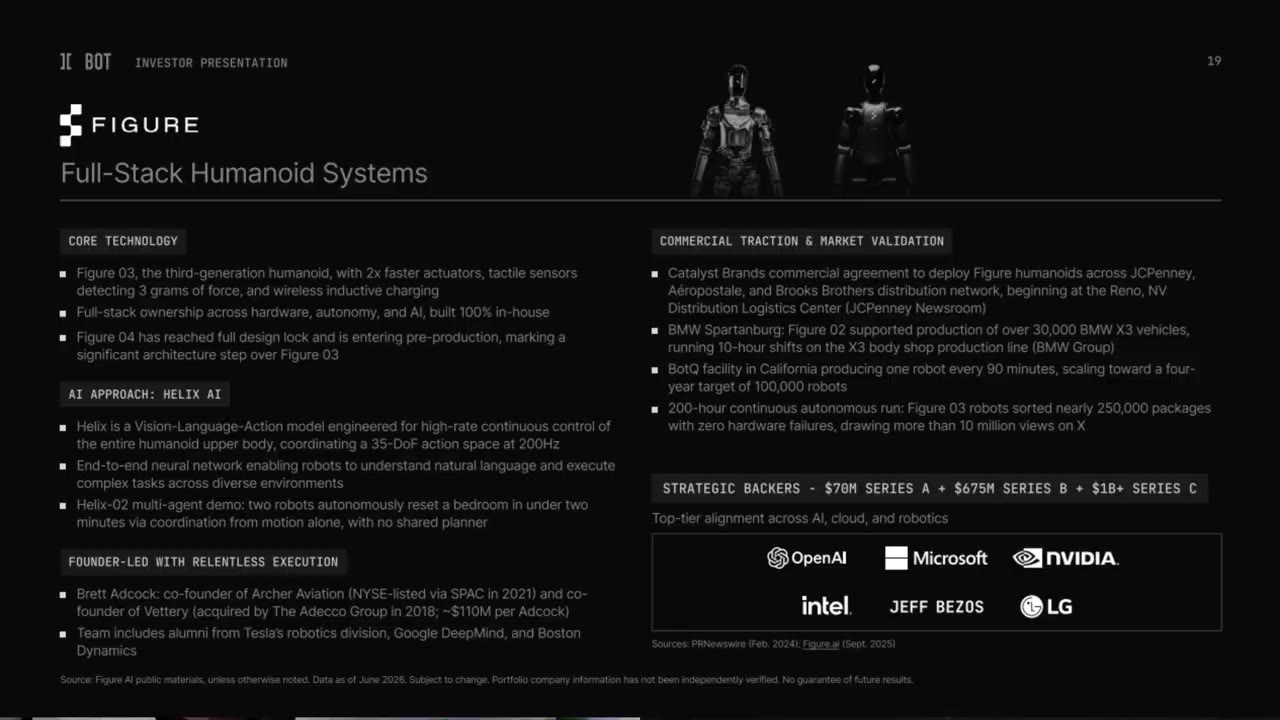
And he took that company public. It was around the 2020, 2021, 2022 era. And that's still a five or ten billion dollar company today.
And a lot of the challenges that you see in humanoid robots, you also see with basically creating flying cars. You have to basically create a machine that is capable of doing things that wasn't possible before. It's very different from, say, like the engineering challenge that people at hardware engineers at Apple face, which is just kind of like, how do I make this thing incrementally better generation after generation?
And so that kind of like ability to invent completely new machines is an incredibly rare background that we didn't see of many other humanoid founders or just people in the US in general, because we were just not inventing as much stuff in the physical world over the last few decades. A lot of that work has moved overseas to places like China. And, you know, you look at the team that he had built.
It was experts from Boston Dynamics, from Tesla, from Google DeepMind. So really all the places that had the had the exceptional talent that was needed for a company like Figure. And you look at their pace of development as well.
Right. You know, when we invested, they'd been around for a little bit over a year. But at that time, right, like they were able to already get their first prototype up and walking.
And the movement and the controls were already similar to that of a human today. And to do that right in a year and a half at that time was completely unprecedented. It took, you know, Tesla years to get to that point, took other university labs many years to get to that same point.
And that's a great marker of how well a company is going to do is basically how fast they're able to move and how much they've accomplished in the past. And so you look at Figure today, you know, now they have their robots across a variety of tasks and logistics and manufacturing. And you can also just kind of get a sense of it looking at the product itself.
It's really a work of art. It's something that really tells you that there's true craftsmanship. This is a premium product.
And, you know, one of the other hardest parts, the AI, the understanding the world around it, that has also been solved to a certain extent. You know, they've gotten it basically at production level intelligence for a handful of tasks ready. And they've also proven that they have a data recipe that if they scale it, the intelligence level increases over time.
And so now they're in that place where they're confident investing more money into compute, into collecting more data so that their robot can go from what's essentially GPT-3 today to say GPT-4, GPT-5 within the next year or so.
Joseph Hogue: So the growth is definitely there, right? The potential market size, everything is set in place, except you mentioned Archer's IPO. And I think it transitions us into really what I see is the biggest hurdle for investors is that so many of these companies, they're not publicly traded.
I've seen this over the last couple of years back from my venture capital days where I was an analyst in venture capital that we could set an exit window three to five, maybe at most seven years from even seed stage funding. And now it just seems companies are waiting so long to go public. Why is so much technology value creation shifting into those private markets and staying private for so long?
Andrew Kang: Yeah, it is really, I would say, a crazy trend that we're seeing with the increased privatization of these companies. You used to be able to buy Apple, Amazon, NVIDIA at valuations that were close to a billion dollars. And now those companies are multiple trillions of dollars.
And but you look at the companies today that are kind of the high tech companies, really, you know, the really strong growers like OpenAI and Anthropic and SpaceX. These companies are not going public until they're trillions of dollars. And that you look at kind of the reason behind is because, well, one, a lot of regulation changed after, right, 2000, 2008, where it became a lot more onerous to run a public company.
You had a lot more reporting requirements, you had a lot more compliance requirements. You know, you have to have a public board of directors, which also gives you the risk of losing control of your company. And you look at what happened in the private markets.
There's just a lot more capital going into this space. And so you have VC funds that are getting bigger and bigger. You have PE funds and corporate funds that are now kind of crossing over into late stage venture.
You even have sovereign wealth fund, the funds of entire countries investing into these private companies. And so and as long as those returns are there, I think more capital is going to enter the private markets and allow these companies to stay private longer and longer. It's not it's it's only until the point at which these companies basically are kind of tapped out of funding in the private markets that they really do go public.
But I think that trend is only going to continue. And so really, the question is, like, how can people get exposure to what's going to be the next wave of the most exciting companies in the world? And we believe those are the companies in physical AI and humanoid robotics.
And I think it's going to be through vehicles like RoboStrategy, what we've been building. Because what we do is we essentially just, you know, we find these companies early. We build a relationship with the founders and we make investments out of RoboStrategy itself.
And it's through a company like this that public market investors are able to get access into these companies before they reach the trillions of dollars in the future. So that's that's kind of what we're doing.
Joseph Hogue: Okay. So helping to address that problem of, you know, I read one stat the other day that companies are tech companies are waiting an average 14 years now to to go public. Whereas when I was VC, it was it was closer to probably about eight.
So much longer. Give us an overview then of the RoboStrategy portfolio. What parts of robotics, the robotics ecosystem are you are you trying to own?
Andrew Kang: So we want to own really anything that we believe is going to accrue a lot of value in the future. And so that means general purpose robotics companies. Right.
The human companies that we talked about before. You look at some of the biggest companies in the world today, like Apple and NVIDIA. These are companies that are producing general purpose devices.
[On-screen: RoboStrategy portfolio company logos]

And we believe there's an incredible moat and incredible economies to scale for building general purpose machines, which humans are humanoids are. But we also have a significant part of our portfolio that are general purpose robots that look like industrial arms or robots. So these are robots have been around for a long time, but they've never been intelligent.
Right. They've been point. They've been programmed to go from point A to point B.
And they haven't been able to adapt to the physical world. But once these AI models reach the point that now these robot arms can perceive the world and act in the world like humans can do. We believe that the opportunity for them gets almost as big as the opportunity for for humanoids, because a lot of the factory work that you do today, you don't really need legs to do them.
You can either be stationary or you can have wheels, a wheel base to get you from one side of a facility to another side. You don't really have to go up and down stairs. And so that's two of the biggest categories that we're investing in today.
And then the third category is really up and down the supply chain. There's a lot of companies today, like if you look at CATL, for example, right, they produce the batteries for electric vehicles. They're worth more than the electric vehicle companies themselves.
But not every single component of the supply chain is going to generate a large company. You need to look at how much of a moat can a company create in that specific vertical. And so that vertical that we've identified in humanoids are actuators.
Actuators are essentially the muscles and joints behind humanoids, right? They're composed of motors, of electrical components, of gears, and they are what allow humans or humanoids to move. And, you know, because robots have only been produced in, say, the hundreds of thousands per year traditionally, there isn't a mature supply chain for actuators.
And this is exactly what's being built out today is an actuator ecosystem that we hope can scale to meet the demands of the humanoid and the robotics market of the future, in which we will likely demand, you know, billions of actuators on an annual basis. You know, a humanoid or robot arm that can be composed of dozens of actuators for each single robot. And they make up somewhere around 30 to 50 percent of the total BOM cost of a robot.
So that's kind of where we see a lot of opportunity today. And, you know, I would say the fourth category is probably application-specific robotics. So we have companies in our portfolio like Path Robotics, where they focus on AI automated welding.
Welding is an industry that's been around for a while. And it's something that is also becoming a lost art because we have less people going to trade skills, less people that want to do welding jobs. And in the U.S. alone, we have a shortage of a few hundred thousand welders on an annual basis. And that really can only be fulfilled by these AI robotic solutions. And so Path actually released the PR last month, announcing a $600 million contract with HII. Huntington Ingalls is one of the largest shipbuilders in the world.
[On-screen: RoboStrategy investor presentation slide, “Path Robotics: Autonomous Welding”]

[On-screen: RoboStrategy investor presentation slide, “Targeting the Breakout Winners of the Robotics Revolution,” shown as an inset over the interview]

And so, you know, this is kind of just showing that we're at the early stages of robotics and physical AI, unlocking new opportunities for companies that have basically existed today, but have been bottlenecked by their ability to find enough, you know, basically skilled workers to do the job that they need.
Joseph Hogue: And I love that idea of following the supply chain, really digging in to see where the shortages are, because that's really where the best returns have been in just the general AI trade. You know, first with the NVIDIA GPUs, then with memory chips, accelerators, things like that. So really digging in and finding where that value creation is.
Now, one thing that kind of interested me when I first started looking at RoboStrategy, just as a market technician kind of point of view, why create RoboStrategy as a publicly traded closed-end fund? So it's publicly traded, trades under the ticker symbol BOT, but it's a closed-end fund instead of a traditional maybe a venture capital fund or an ETF.
Andrew Kang: Yeah. So the closed-end fund structure is very similar to an ETF. It's different in the sense that, you know, there's no creation redemption process because what we're investing in is essentially private equity, right?
It's equity of companies that are private. And that means we can't be buying and selling them on a daily basis because there is no stock market that these companies trade on. And we also have a very long term view of these companies.
You know, when we invest, right, we have a relationship with these founders. We want to be on this journey with them for the long haul because the value of creation is not going to happen overnight. It's going to happen over months and years and decades.
And, you know, one of the biggest lessons that we've learned as investors, many investors have learned, is that, you know, if you find a really special company, right, a really big opportunity, it doesn't happen often. You just got to hold, right? You look at some of the most famous investors today, like Chamath or Peter Thiel, where, you know, they've done great over the last few years.
But if they had just held their Facebook stock from when they first got in, right, they would have outperformed all of the investing and trading that they've done, you know, basically since Facebook Meta went public. And so we take a very long term view. We don't think there's kind of necessity to trade in and out of positions on a very frequent basis.
And that, you know, really generational companies don't come along very often.
Joseph Hogue: So strategic long term investments in some of these, these private, still private companies that, so this allows investors, retail, Main Street investors to get access into these that they otherwise couldn't buy. Now, RoboStrategy is unusual because investors aren't simply betting on the underlying portfolio, right? How I understand it, you've talked about two potential engines for NAV per share growth.
What are those two and how do they, how do they play into the thesis here?
Andrew Kang: Yeah. So the first is, you know, what a typical fund would offer, which is the portfolio growth, right? The companies in the underlying portfolio generating to overturn and that kind of rolling up into the fund level returns.
Where our structure is a little bit different is that because we're a closed-end fund structure, we can trade at a premium or a discount to NAV. And of course, you know, that means there's risk, right? The premium can go down, can also go up over time.
[On-screen: RoboStrategy website, “NAV and market price are not the same.”]

And what we've kind of innovated is this mechanism to basically crystallize the value of the premium and give it back to investors. And we do that by essentially, you know, raising capital whenever there is a premium to NAV, right? And when we raise capital, we take new cash in the door and then we're able to deploy it into new or existing robotics companies that we're invested in.
[On-screen: RoboStrategy investor presentation slide, “Issuance at a Premium is Accretive”]

And so you look at this strategy, what this allows you to do is now that I have kind of more cash on a per share basis, if I'm selling shares at a premium, I can actually increase my exposure to a specific company on a per share basis of RoboStrategy. And so hypothetically, if RoboStrategy owned one share of Figure per share of RoboStrategy, that could increase to three shares of Figure per share of RoboStrategy over time, right? If this kind of strategy is continuously executed on.
[On-screen: RoboStrategy investor presentation slide, “Accretive, Not Dilutive”]

And so this is actually not too foreign of a concept. If you look at some companies out there like TransDigm or Constellation Software, they've been executing on this strategy for decades. They just call it in their world multiple arbitrage.
This is a very kind of common concept in the private equity world, right? Where you have companies, right, like Constellation Software, they could trade at a 15 to 40 times earnings in the public markets because, you know, maybe the public market is bigger, right, there's more investors in it, there's more demand. And they buy companies, right, in the private markets that trade at lower earnings multiples, right, say it's a 3x multiple to 8x multiple. And so what they can do is they can spend, say, $100 million to acquire a company, and once it's on their balance sheet, now those cash flows are rerated to a public market multiple. So, you know, that $100 million could be worth $400 million of enterprise value once the transaction is complete and on their books, right? Which creates this $300 million of essentially, you know, we call it multiple arbitrage gain.
And that's the same kind of concept that we're applying to venture capital today, where we believe that, hey, look, you know, we're at a premium today. RoboStrategy is at a premium today. It could partially because, maybe because, you know, the public market is demanding more, right? They're assigning higher value than the private market is, and we are basically taking that difference and using it to the benefit of shareholders.
Joseph Hogue: Anytime someone says arbitrage, my ears perk up, right, because I love the idea. I love how the technicals work in this to actually, you know, leverage higher on that. Now, we've talked a lot about the potential upside, the growth in the market, how RoboStrategy is helping Main Street investors reach that growth through those still private companies. But what are the risks here, right? Give me the bear case. So, just so we can fill everything out, what could make that robotics revolution take longer than you expect?
Andrew Kang: So, these are incredibly difficult challenges. And I would say the biggest constraining factor is probably manufacturing capacity. Because as you know, right, I can't just snap my fingers and create a million robots overnight, even if the robots were really capable. I got to build out the facility, right? I got to find the land. I got to find the people, right, that are the skilled tradesmen that are able to kind of help me produce these robots. And that takes time, right? It takes years to build a facility that is able to output robots in the millions.
And that's what some of the companies are doing today, right? You know, Figure is continuing to expand their manufacturing capabilities. So is Tesla Optimus. So is Apptronik, right? Apptronik is doing it with a partnership with Jabil, which is one of the largest contract manufacturers in the Northeast. They have dozens of manufacturing facilities across the US and Mexico. And so that is going to be, you know, one of the challenges.
And, you know, there's also the other kind of risk of, well, say, like the AI development, you know, maybe instead of getting to GPT-5 level in one or two years, maybe it takes three to four years. But I don't think it's going to take something like 50 years, right? You look at the pace of AI development today, where it was three years ago, it's a complete difference. And you look at the revenues of these companies, right? That speaks to the difference in capabilities, because people find it so much more useful and they're using a lot more today. And a lot of that actually innovation that you see in AI is also accelerating the development of robotics AI research, because a lot of that same tooling can be used to, you know, design experiments, to run evaluations, to, you know, do a lot of the research process that are involved in, you know, robotics AI, to make those systems get better and better.
And, you know, of course, there's just the risks involved with the public markets in general, right? The volatility on a day-to-day basis, the ability for the market to kind of shift their sentiment or the perception of, you know, what these opportunities are going to look like, and for that NAV premium to, you know, potentially decrease or expand, right? These are all different factors that can happen. But we don't think this is going to be a 50-year thing. And we also think that the market is going to be forward-looking. They're going to price innovation ahead of time.
So you saw this with Tesla, right? Elon, he made a lot of big promises. He delivered on them, but he was also, you know, a little bit, I would say, like, he was a little bit more bullish on the estimates that it would take to get to, you know, full self-driving. And at the same time, the market, right, it picked it up, the fact that, hey, look, we're actually going to get full self-driving, we're going to sell a lot of vehicles. And, you know, once the market realizes it, that doesn't change, right? Maybe your estimates are moved back by one or two or even three years. But that doesn't mean, you know, the companies are going to zero, as long as they manage their cash burn well, right? As long as they're able to raise more capital and that they've budgeted in a way that is appropriate.
Joseph Hogue: Okay. So, definitely some risks. I think I see a lot of them as those short-term market dislocation risks, not necessarily the kind of strategic long-term risks that we're investing in these companies, because you said something that was really interesting to me. You talked about manufacturing capacity as a risk. I see it as almost kind of an opportunity, though, too, from an investing standpoint, because really it's that capacity in memory chip production that has really been the big story for 2026 here, you know, driving 12x returns on Micron, 47x returns on something like a SanDisk, because that capacity just isn't there. So if we see that same kind of capacity bottleneck in, well, things like you talked about, like actuators, then it could be an opportunity actually.
You know, I know private company valuations, they're not continuously marked to market. How does that play into the asset value versus the share price? How should investors think about kind of that uncertainty around the fund's net asset value and its share price?
Andrew Kang: Yeah, that's a really good point, and that's one of the reasons why the fund share price can maybe dislocate from the NAV itself. And it's important to understand how NAV is calculated. We use a third-party valuation service provider, and the framework that we've kind of worked with them on is a framework that looks at the last round price to mark the value of the companies. And it could be at a small discount to last round price as well, right, if we hold, for example, Series B shares versus Series C shares.
[On-screen: RoboStrategy website, “NAV and market price are not the same.” (shown again; see image above)]
And the nuance here is that that last round, right, in venture capital could be one year in the past, could be two years in the past, right? These rounds don't happen every single day. There could be a 12-month, 18-month, 24-month or more gap between these rounds. And what that means is that there's a lag in, you know, the valuation mark of these companies over time. And it's not until, right, a new financing round happens that the NAV for these companies is then updated. And then, of course, we have to run our audit process or our valuation process internally before we can even update those numbers, and that could take, you know, a few weeks, could take a month.
And one analogy I like to look at is, you know, look at a house. If a house was last transacted around 3 weeks ago, or sorry, not 3 weeks ago, but 3 years ago, you wouldn't necessarily look at the value of that house and say this is the value of that house today. So, in New York or, you know, another area where things are changing a lot in a very short period of time, that price could be worth significantly, you know, higher, but it also could be lower. It just depends. And that's kind of what you get in public companies, which is, hey, if a company is growing, if they're constantly beating earnings expectations, if they're growing revenue, if they're making technological breakthroughs, then the market is able to price those changes on an almost daily basis. And that's something that you kind of don't get with the underlying NAV that you get with, you know, the company itself, RoboStrategy, that is traded on the public markets on pretty much a daily basis.
And, you know, that's one reason. You know, the other reasons are, you know, some of the idiosyncratic benefits to the structure that we have as a fund, right, because we're trading on Nasdaq, compared to, you know, alternatives, which is a VC fund or SPVs. These are liquid versus illiquid, and there's, you know, sometimes value that people ascribe to liquidity. There's the fact that we only charge on the fund itself a 2.5% management fee versus the other fees that you typically have in a VC fund or an SPV, which typically they also charge a performance fee as well, right? They call it a 2 and 20 model. And that performance fee can be something that drags on the performance of the underlying investment over time.
And I would say, you know, the last factor, which we talked about before, is that public companies and private companies, they have different subsets of investors, right? The private markets, that might be tens of thousands of people, or maybe hundreds of thousands of people if it's a really, you know, popular company, that can actually be able to access these companies. And the public markets, that is hundreds of millions of people, maybe up to a billion people, that are involved in that market. And when you have different market participants, they're going to come up with different market prices. An example I like to give is, you take, say, a software engineer from somewhere like China, you put them in the US, the same skill set, the same job, they could be paid four times more, right? And it's not because there's anything that's fundamentally different. The thing that's fundamentally different is that the market that they're in in the US has different supply and demand dynamics, which is also the case for basically, you know, private companies versus, you know, how they're valued in a public company fund.
Joseph Hogue: I'm glad you brought up the expense ratio, because I wanted to talk about that. It's one of the biggest sources of feedback that we got from that first video. A lot of investors pointing out the 2.5% expense ratio on a fund and comparing that to, you know, obviously a lot of other funds under half a percent, 50 basis points, even some of the Vanguards much lower. But, you know, my input was, when I saw those comments, was, but look at what you're getting. This isn't the same as your typical ETF, right? You talked about the 2 and 20 model, or I come from venture capital, you know, all our funds, it was always 2 and 20. You charge 2% management fee a year and then 20% of profits, right? So we would collect 2% off the total investments each year just as an operational expense, that kind of thing, and then when there was exits, then we would charge 20% of the profit. So much higher. And I think that's how investors need to look at this, in terms of you're getting that private companies growth story in a fund that is publicly traded, has all the liquidity of the stock market, and for, you know, extremely low, actually, two and a half percent, basically just the management fee that we used to collect in venture capital. So really kind of a different animal there.
What's your best estimate here? So 5 years from now, how different does the world look because of robotics and going into all of this?
Andrew Kang: Yeah. So I'll answer that, because really great question. But going back on the management fee side, so our management fee is 2.5%. The expense ratio is a little bit higher. There were some, I would say, idiosyncratic costs associated with an IPO, you know, sorry, a direct listing, and some follow-on transactions that we think, you know, are going to, not going to, you know, they were kind of one time, that won't be the case going forward. And so that should kind of compress, hopefully, closer to the management fee over time.
And you look at just kind of the returns as well, right? Venture capital is a pretty fast-moving industry. You know, of course, you have to make good investments, because if you don't make good investments, you won't have good returns. But you look at, you know, our NAV per share increase since we launched. I would say it's around four months ago now. NAV per share has increased around, is above 50%, right, close to 55%, in those four months. And that is actually without even very many markups. It's only, you know, some markups in our portfolio, and actually a lot of that NAV per share gain has come from us executing on the strategy of doing that multiple arbitrage that I talked about before. Hopefully, you know, this is going to be able to continue. You know, we do more volume on a daily basis than Robinhood Ventures on average and actually most other closed-end funds in the industry. And, you know, we're able to kind of maintain, you know, strong interest in the fund based on that volume, based on the feedback that we're hearing, based on, you know, the premium, which could actually flip into, you know, from a risk into something that we create as a benefit for shareholders.
And, you know, going back into, like, your question of, like, well, how fast does the world change? You know, manufacturing is going to be a bottleneck. We're not going to have robots in every single home two years from now. But we will have a lot of robots, I would say, in manufacturing areas within the next, say, 2 to 3 years. That change is going to happen really fast. We're probably going to have hundreds of thousands to millions within, say, the next two years. And then I think early 2030 is when you start to get to the tens of millions, maybe even hundreds of millions of robots across the world and across every industry, across homes, where it starts to become like a common appearance, right, where you have robots walking up and down the street doing, you know, the chores, doing the errands that, you know, otherwise you would be doing yourself, taking care of your parents, all the things that you would find a robot personally very helpful for.
Joseph Hogue: Wow. Yeah. You talk about tens of millions, hundreds of millions of robots. Even just on that math that we talked about, just one million robots, it justifies trillion dollar companies. That is really interesting. I want to thank Andrew Kang, CEO of RoboStrategy, for his insight.

FREE Breaking News Alerts from StreetInsider.com!
StreetInsider.com Top Tickers, 10/27/2026
- Wall Street ends higher on revived AI momentum
- Meta's $97.5B AI money grab: why Zuckerberg is racing to raise cash before rivals
- Deutsche Bank’s Reid sees potential final dip this year before Santa rally
- UPS tops estimates as efficiency drive gains momentum
- GM to move stock listing to Nasdaq in November, shares gain
Serious News for Serious Traders! Try StreetInsider.com Premium Free!
You May Also Be Interested In
- Sweet Security Offers All Organizations Affected by HTTP2Shell Virtual Patching Protection at No Cost
- Twelve Egan Nelson Attorneys Named to 2027 Lawdragon 500 Leading Dealmakers in America Guide
- Wealthsimple Raises $425 Million at $13.8 Billion Valuation to Accelerate Growth
Create E-mail Alert Related Categories
SEC FilingsSign up for StreetInsider Free!
Receive full access to all new and archived articles, unlimited portfolio tracking, e-mail alerts, custom newswires and RSS feeds - and more!
