




Form 497AD RoboStrategy, Inc.
 Tweet
 Share
 E-mail
Filed Pursuant to Rule 497(a)
File No. 333-295823
Rule 482ad
RoboStrategy, Inc. Video Script
Topic: “ONE Stock is All You Need in This $5 Trillion Opportunity,” sponsored video by Joseph Hogue, CFA, on the Let’s Talk Money! YouTube channel (published October 6, 2026)
Script
Joseph Hogue: AI has already created trillions of dollars in wealth, but the next wave could be even bigger. Robotics is approaching an inflection point that Morgan Stanley says could create a $5 trillion plus market. And I've found one investment that gives you access to some of the biggest pre-IPO robotics companies before they ever hit the stock market.
Hey Bowtie Nation, Joseph Hogue with a deep research video for you today and one of the biggest market themes coming. I'm going to show you exactly how to invest, but to give you an idea for just how big this could Morgan Stanley estimates the humanoid robotics market could surpass $5 trillion by 2050, with nearly 1 billion humanoid robots in operation worldwide. For perspective, that would make it nearly as large as the entire worldwide IT spending this year, including software, devices, and services.
But even that might understate the opportunity. RoboStrategy, a closed-end fund of public and private investments, estimates a $60 trillion total addressable market for robotics and physical AI. In its estimate, Morgan Stanley forecasts about 930 million humanoid robots will be used by 2050.
[On-screen: RoboStrategy investor presentation slide, “Market Size: A Trillion-Dollar Horizon”]

RoboStrategy uses that 1 billion robots as a top, but also shows how quickly this market can expand. On an assumption of 50,000 revenue per robot, just 100 million robots in use gets us to that $5 trillion market, with trillions more in software, service, and more to 1 billion robots forecast. And while that 2050 timeline is more than two decades from now, the speed of change here could be just as amazing as the market size.
Morgan Stanley estimates the humanoid cost could come down from $200,000 in 2024 to $150,000 each by 2028, with RoboStrategy estimating 12 million robots in use by the end of this decade. Now, those aren't forecasts, just scenarios of how fast and how big this could get, but they do show the scale of what we're talking about and start to hint at the investment opportunity. For example, Gartner estimates the global memory chip market at $837 billion a year.
Now, that supports a market cap of over $4 trillion in just four companies, including SK Hynix and Micron. Micron alone had a market cap of over $1.1 trillion, that that $5 trillion robotics market could birth the next trillion dollar companies to beat the next big wave on Wall Street. But I know what you're because I was thinking the same thing when I started researching this.
We've heard this story for decades. Hell, I grew up watching Rosie on the Jetsons and even she glitched half the time. While it's true that we've had simple robotics in warehousing, industrial and manufacturing for decades, long before AI became that hot acronym for investors, but those robots were built for a very different world.
Traditional industrial robots are incredibly good at doing one predefined tasks in one controlled environment thousands of times over. Change the object though, move the workstation or introduce something that robot wasn't programmed to expect and suddenly that million dollar automation system is a Roomba spreading the dog's crap all over the floor. But here is why we're approaching an inflection point, a trigger for that $5 trillion opportunity, generative AI.
The models being created by OpenAI, Anthropic and others are beginning to give robots something they've never really had, the ability to perceive their surroundings, learn new tasks and then adapt when the environment changes. That's how we get things like Google DeepMind developing vision language action models that translate what a robot sees and hears directly into physical actions, while NVIDIA's GR00T models are being trained across human demonstrations, simulations and real world robot data. We've spent decades building increasingly capable robot bodies.
AI is finally starting to give those bodies a general purpose brain and that is when the market momentum begins. Now I'm going to show you why I'm investing next, but don't think that robotics is going to be just one market or one winner. The opportunity here stretches across very different industries and why I think you need a broad strategy for investing.
A general purpose and humanoid robots could be the biggest prize because they're designed around the world, already built for humans are tools, factories, stairs and workstations. That means instead of rebuilding a factory around the robot, the robot potentially learns how to work in that factory that we've already built and that means robots could do everything. Morgan Stanley estimates nearly 1 billion humanoids could be operating by 2050, with roughly 90% working in industrial and commercial applications, helping create that market exceeding 5 trillion dollars.
But those general purpose robots, those could take longer. We're already seeing major opportunities in other segments here. Industrial automation is the most established market.
More than 542,000 industrial robots were installed in 2024 alone, more than double the number a decade earlier. Grand View Research forecasts industrial robotics will grow from about 42 billion dollars in 2026 to 79 billion by 2033. Then there's logistics, robots moving, sorting and picking products through warehouses and fulfillment centers.
Now that market is forecast to grow from about 19 billion dollars today to 35 billion just by 2030. And don't tell my wife, the nurse, but medical robots could be another huge opportunity. Medical robot sales jumped 91% in 2024, including a 41% increase in surgical robots.
The total market for medical service robots is expected to reach 3.9 billion by 2033 for growth of 14% a year, one of the fastest growing segments, where I think even this forecast is way understated. Now defense robots is where we're already seeing the biggest movement. Autonomous land systems, drones and surveillance, already almost a 20 billion dollar market, but forecast to reach 32.5 billion by 2030. So you see the winners here aren't going to be building that one robot that does everything. We're looking at an entire robotics ecosystem from hardware to software services, trillions of dollars in revenue and multiple companies. But then here's the problem for investors.
Robotics is still a highly technical fragmented industry and many of these companies with the most potential, we're talking Figure, Apptronik, Dyna Robotics are still private. And I've seen this problem firsthand over the last couple of years. When I worked in venture capital, you could reasonably underwrite an investment around a three to five year exit.
That meant you invested early, helped the company grow and would expect an acquisition or an IPO in that three to five year window to unlock your returns. But that timeline has completely changed. The median technology company now goes public at around 14 years old compared with about eight years during the 90s.
And that means potentially more growth and value creation, but it also means investors are locked in for much longer. And that's if you can even get access. Because of SEC rules, most main street investors still can't get access to these pre-IPO private company investments.
Beyond that, even if you can get into these private deals, which ones do you buy? You're trying to evaluate foundational models, actuators, sensors, manufacturing capabilities and dozens of competing robotics platforms. On the long shot, you can invest.
You need an engineering degree just to find the winners. But then that's where RoboStrategy comes in. RoboStrategy ticker BOT is a publicly traded closed-end investment fund built specifically around robotics and physical AI.
[On-screen: Nasdaq quote page, “Robostrategy, Inc. (BOT)” price chart]
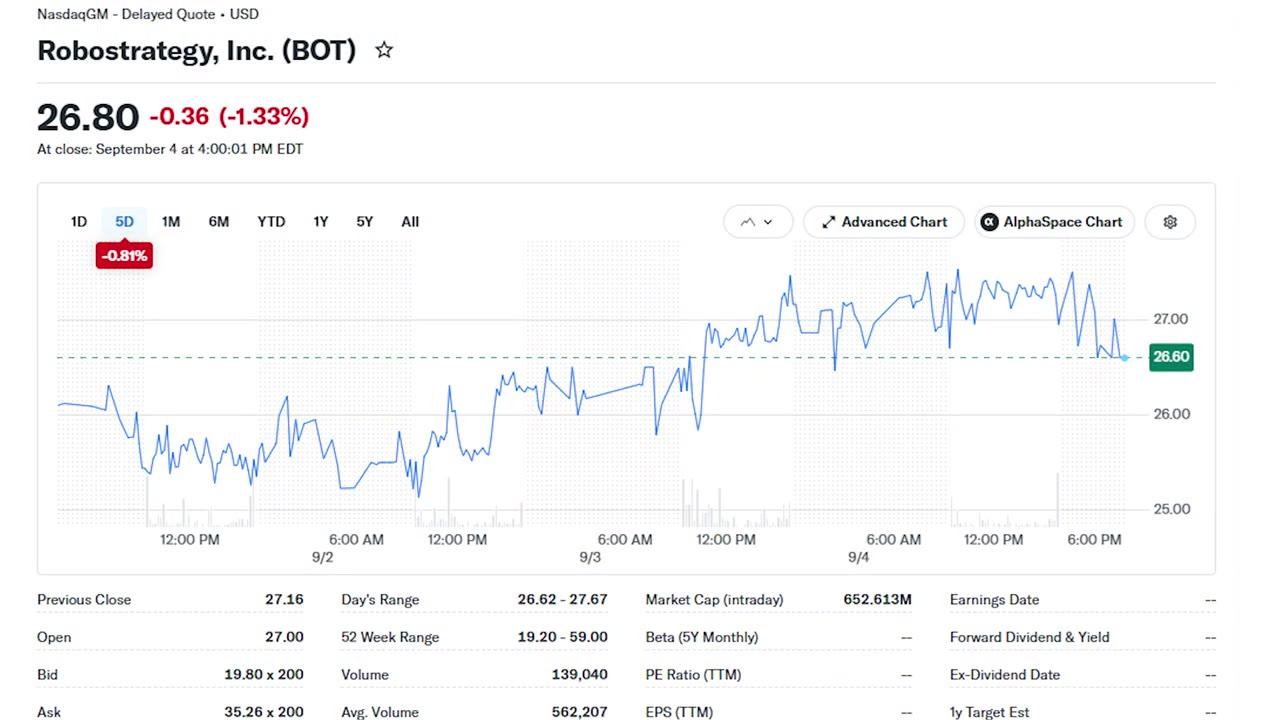
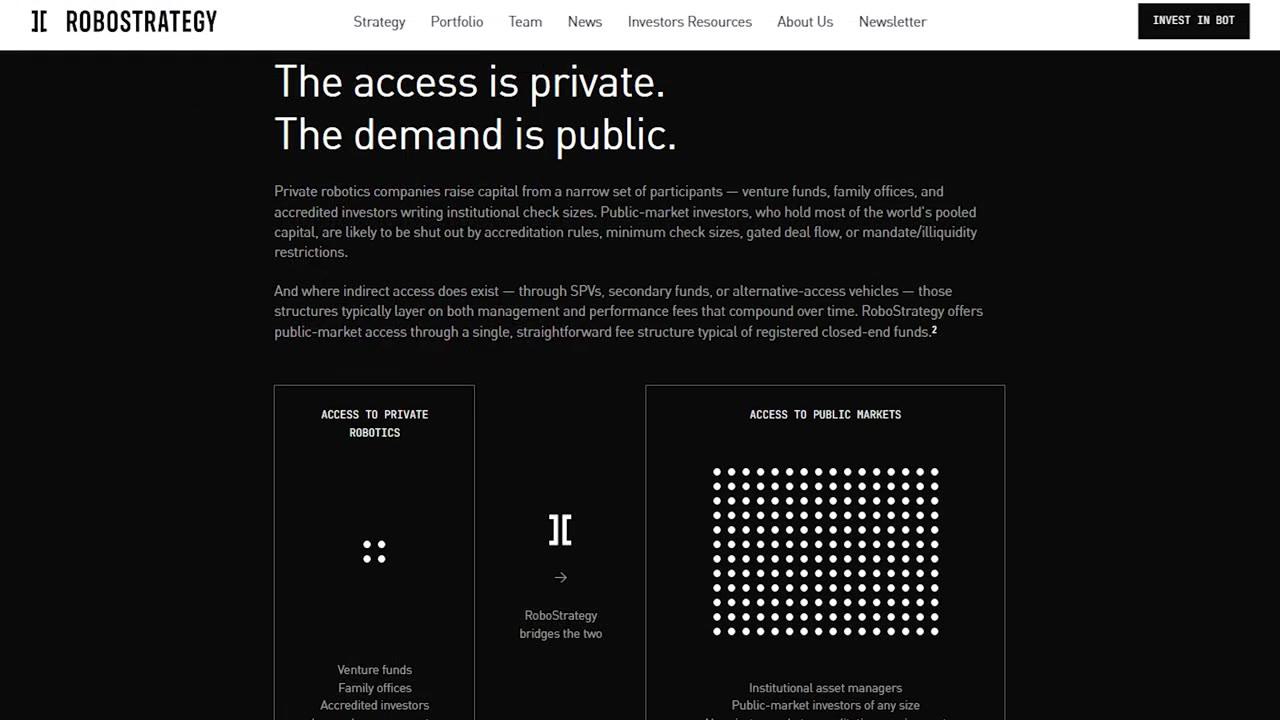
The idea is to give regular investors something that traditionally required being inside that venture capital accredited investor network access to a portfolio of private robotics companies through one publicly traded investment. RoboStrategy invests from seed stage companies through later venture rounds and eventually even public companies, allowing it to build those relationships with founders early and potentially continue investing as those companies scale. Now that's important in a market where some of the biggest opportunities may be created years before an IPO.
[On-screen: RoboStrategy website, “The access is private. The demand is public.”]
[On-screen: RoboStrategy investor presentation slide, “Targeting the Breakout Winners of the Robotics Revolution”]
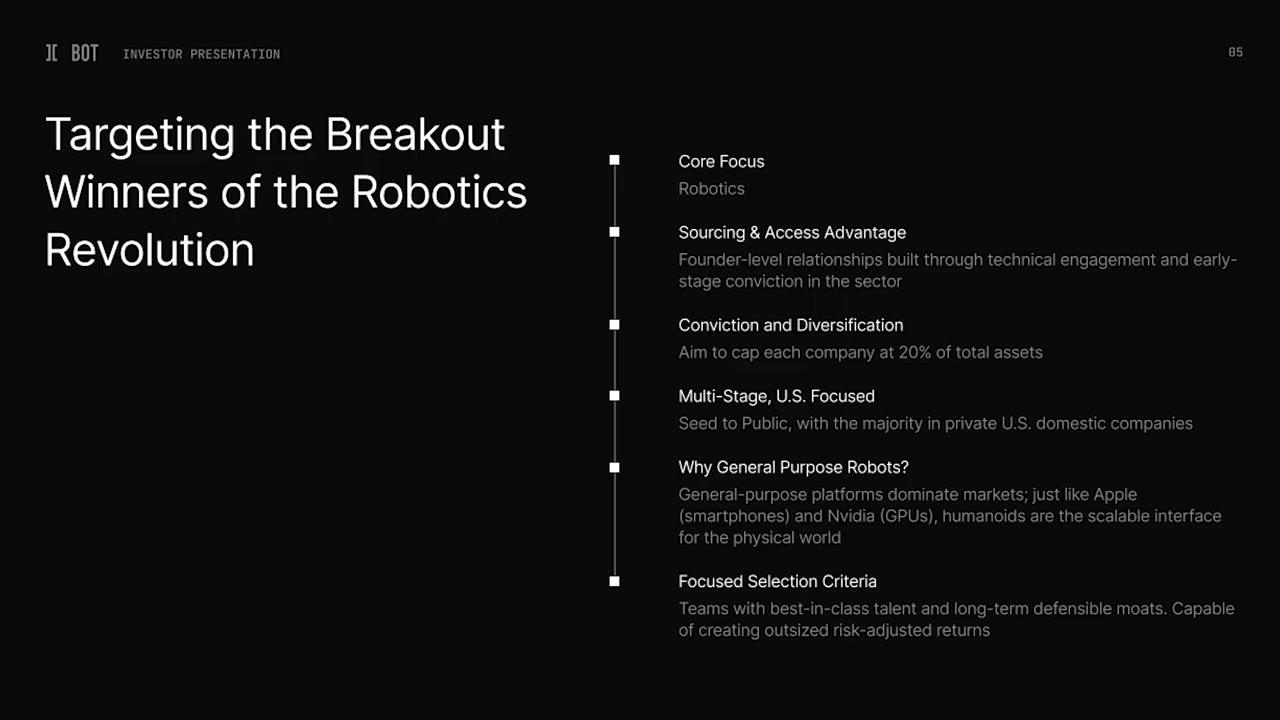
The fund targets a multi-stage US focused strategy of primarily private companies built around those founder level relationships for investments you just couldn't get otherwise. Now as a finance guy with a communication studies degree, what I really like here is a deep bench of knowledge and technical research behind these investments, evaluating everything from robot foundation models and training data to those actuators, manufacturing constraints and production capacity. That means instead of you having to try to figure out which robotics startup ultimately wins and then somehow get access to that deal, RoboStrategy is essentially building that portfolio for you while giving you the liquidity of a Nasdaq traded security.
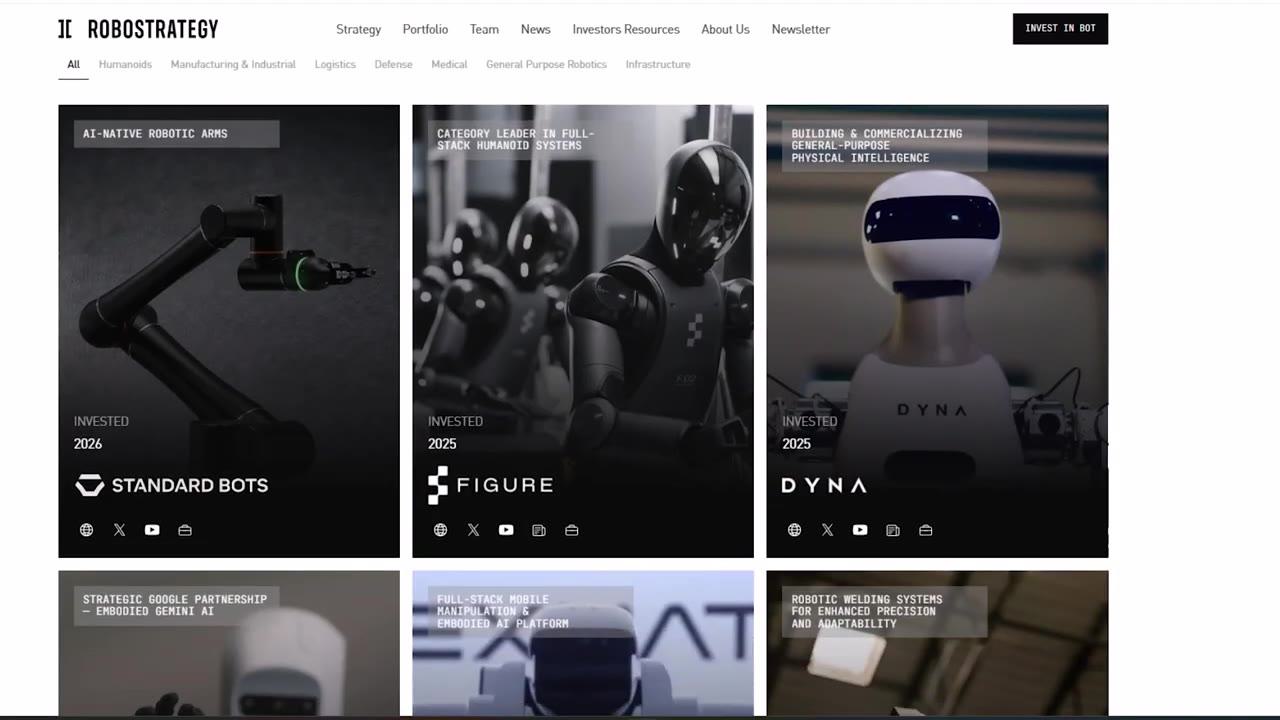
I want to highlight a few of the biggest investments here, then evaluation on the fund and milestones for robotics to watch for. The largest investment is Standard Bots, an American industrial robotics company bringing AI into the robotic arm, the workhorse already used throughout manufacturing. Its Core and Thor systems target jobs like welding, machining, palletizing, and inspection with 100 plus customers across aerospace, defense, and industrial.
RoboStrategy led its $200 million Series C at a $1 billion valuation just this June. At that more general purpose end is Figure, developing humanoid robots designed to operate in environments built for people. This isn't just a laboratory project though.
[On-screen: RoboStrategy website, portfolio company feature (Figure AI)]
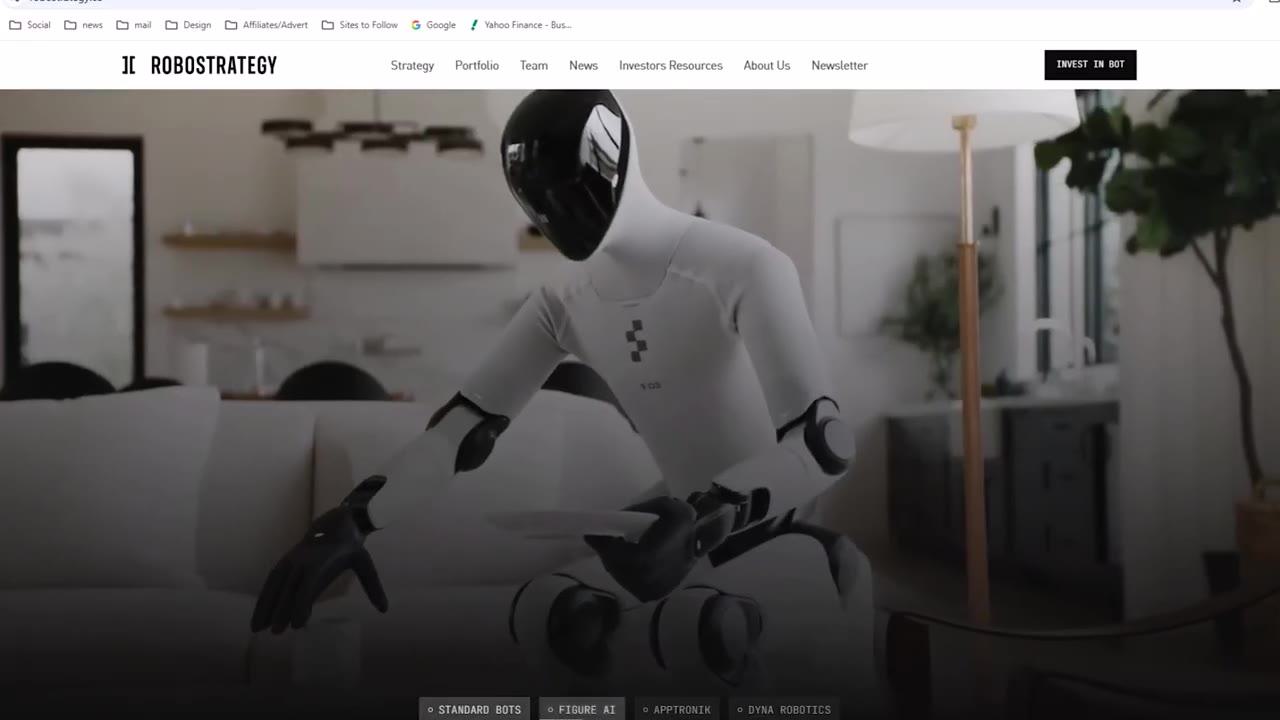
Figure 2 logged more than 1,250 hours at BMW, handled 90,000 parts and contributed to production of more than 30,000 vehicles. In Figure 3 there is now tackling more complex logistics work there, along with Catalyst Brands and a commercial agreement to deploy across retailers Aeropostale and Brooks Brothers. Also targeting that giant humanoid market is Apptronik with its Apollo model.
The company has partnerships with Mercedes-Benz and GXO Logistics, along with a deepening Google DeepMind collaboration, and has already raised nearly a billion dollars including backing from Google, Mercedes-Benz, and John Deere. Its latest financing valued the company at approximately $5 billion. Then there's Dyna Robotics, focused less on one particular robot body and more on the intelligence controlling it.
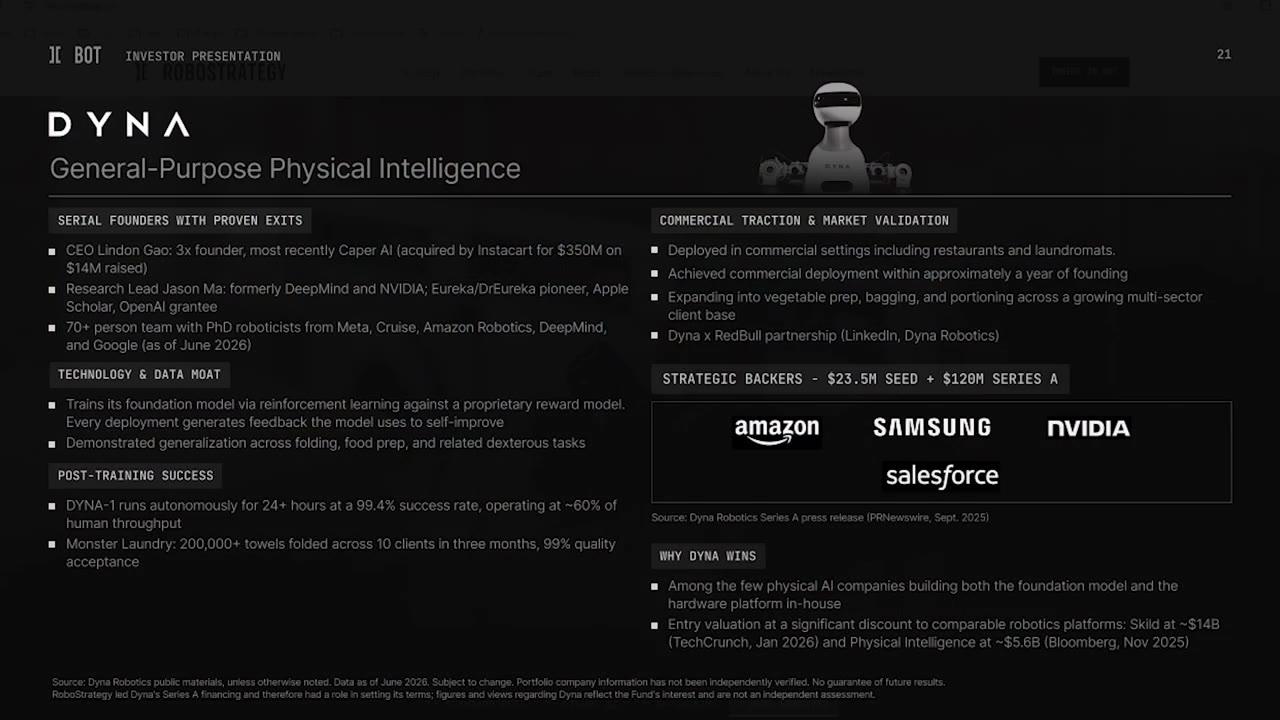
Its DYNA-1 foundation model has achieved 99% plus success during a 24-hour continuous operation with robots deployed in hotels, restaurants, laundromats, and gyms. RoboStrategy co-led Dyna's $120 million Series A round alongside CRV and First Round Capital. But then rather than trying to pick between Standard Bots, Figure, Apptronik, or Dyna, or somehow getting access to those private investments yourself, RoboStrategy brings them together with a broader portfolio of robotics and physical AI companies into one publicly traded fund.
[On-screen: RoboStrategy investor presentation slide, “Dyna: General-Purpose Physical Intelligence”]
[On-screen: RoboStrategy website, portfolio page (Standard Bots, Figure, Dyna)]
You get private company access with public market liquidity, while the team handles all the technical research, the due diligence, and ongoing monitoring behind those investments. Now I want you to understand here, that convenience doesn't make the risks disappear, but it does help spread them around a little. Robotics is still an emerging industry.
Adoption could take longer than expected, technologies can become obsolete, and today's leaders might not ultimately be the winners. So like the early stage venture capital deals I worked on, there's industry and investing risk here, and it's important to have a portfolio of investments rather than just one or two bets. That's going to be especially important looking at what you're paying for shares on RoboStrategy.
And so that brings us to probably the most important thing investors need to understand about RoboStrategy. The share price and the value of its investments could be two different numbers. Because BOT is a closed-end fund, it has a net asset value, or an NAV, representing the estimated value of its portfolio divided by shares outstanding.
[On-screen: RoboStrategy website, “Portfolio Diversification” holdings table]
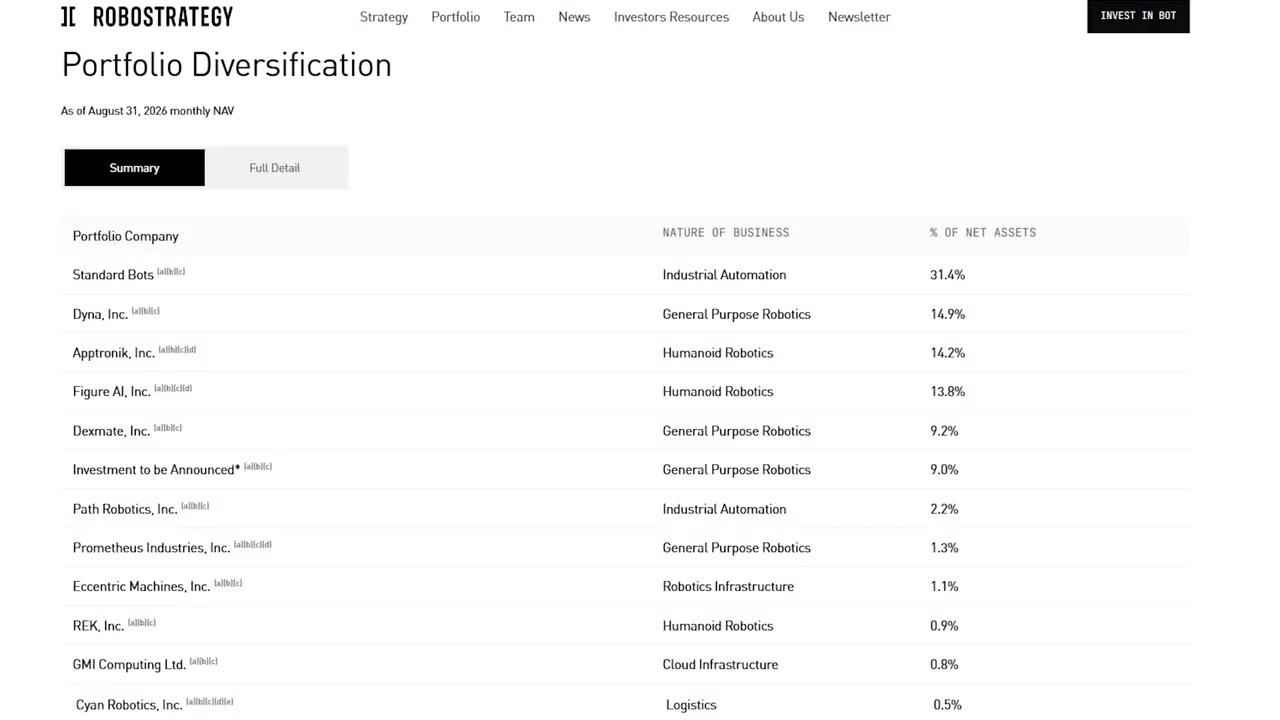
Now the fund lists out the portfolio of companies, percentage of assets, and the total NAV. As of August 31st, RoboStrategy reported an NAV of $11.35 per share based on approximately $277 million in net assets. But then the BOT also trades on the Nasdaq, where supply and demand determine the market price.
[On-screen: RoboStrategy website, “NAV and market price are not the same.”]
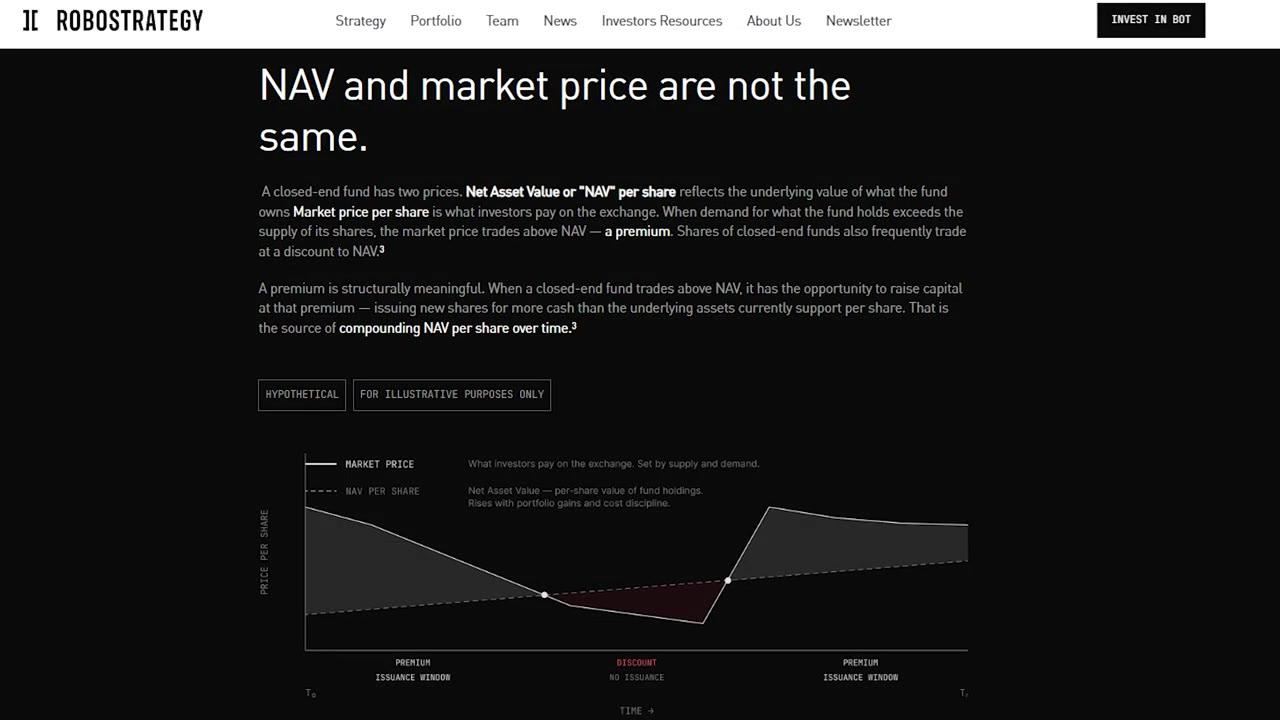
That means investors can pay substantially more or potentially less than that NAV. If BOT trades at $25 while NAV is $11.35, for example, you're paying more than twice the underlying reported value per share. Now a lot of that difference though comes from the fact that because most of these companies are private and you don't see those values updated daily with the stock price, the estimate could be outdated here.
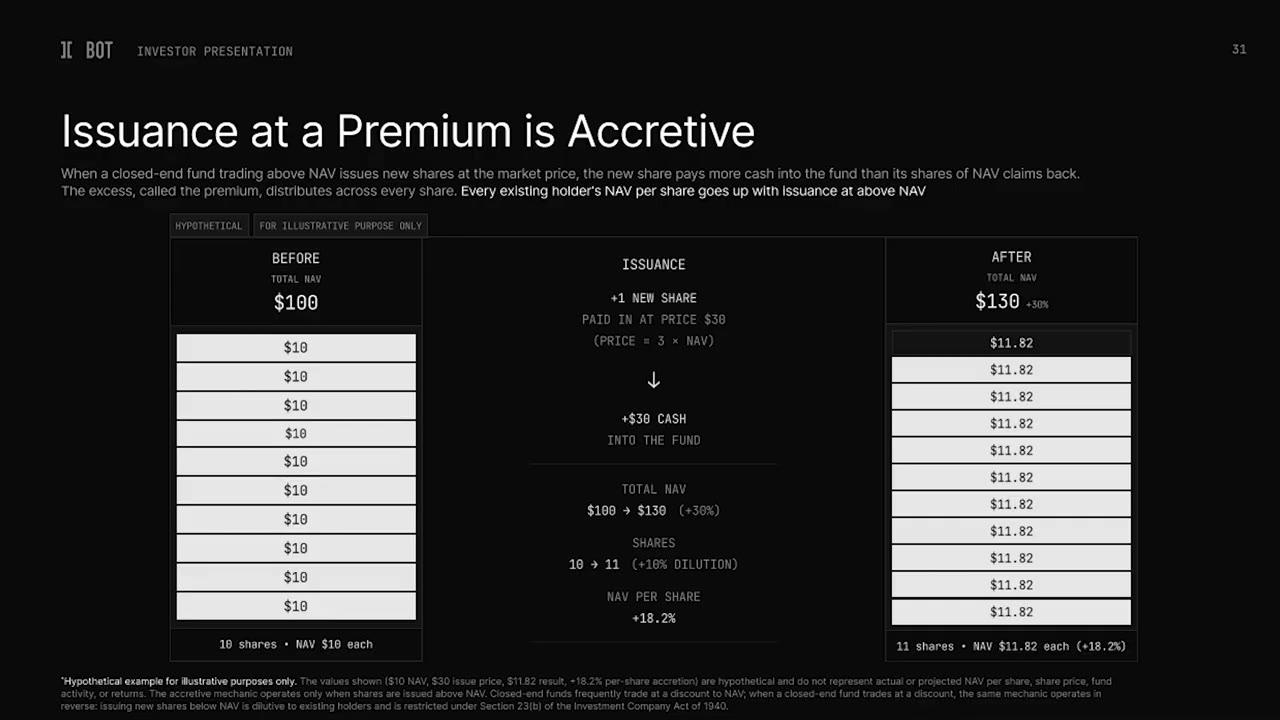
That difference though might actually benefit both investors and RoboStrategy. First, RoboStrategy can issue additional shares above its NAV, raising more cash per new share than the NAV those shares represent. That can actually increase the net asset value per share for existing investors, along with providing RoboStrategy funds to invest in more companies.
[On-screen: RoboStrategy website, holdings table (continued) with Total Net Assets (NAV)]
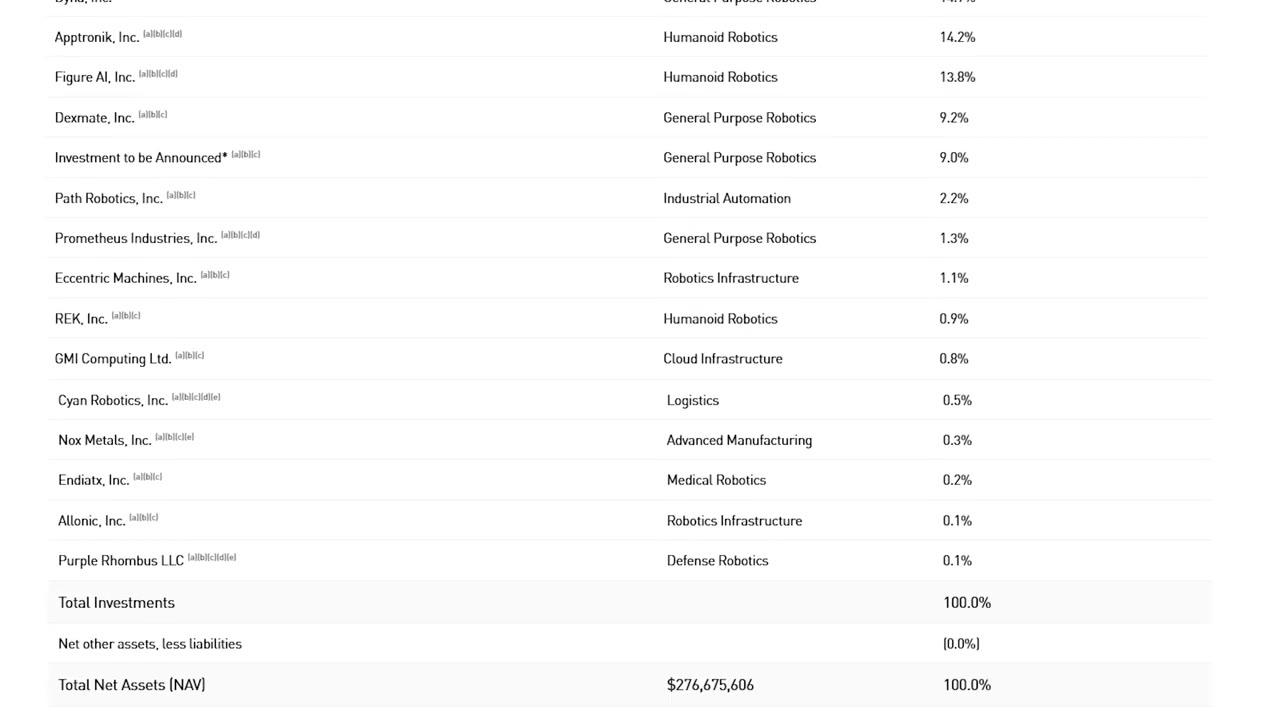
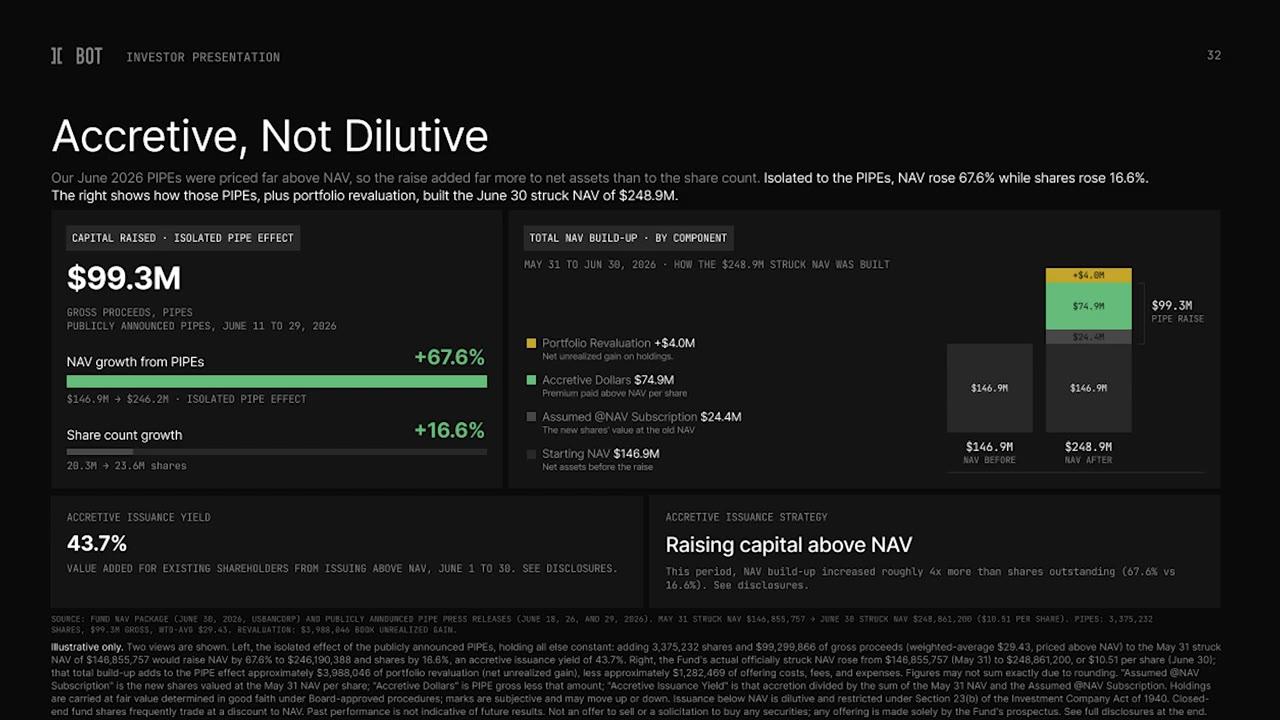
Also, since the company has been pricing its PIPE capital raises above the net asset value, that funding adds more to the net assets than it did to the share count. That means these capital raises help build investable assets without as much dilution to investors. Now, of course, like all investments, I don't think this has to be an all-in, all-at-once idea.
[On-screen: RoboStrategy investor presentation slide, “Issuance at a Premium is Accretive”]
[On-screen: RoboStrategy investor presentation slide, “Accretive, Not Dilutive”]
We could see robotics reach that inflection point over the next few years and you want to be invested ahead of it, but we can also watch for milestones to invest along the way. Among these milestones, many of which you can follow through RoboStrategy presentations and updates, watch for deployments from pilot programs to productive work. Autonomous operating hours, intervention rates, and reliability are also going to be important metrics to follow because a robot that works for 10 minutes in a demonstration is very different from one working 10-hour shifts in a factory.
[On-screen: RoboStrategy website, “Leading robotics companies are still private. $BOT gives you access to them.”]
[On-screen: RoboStrategy website, “Portfolio Updates”]
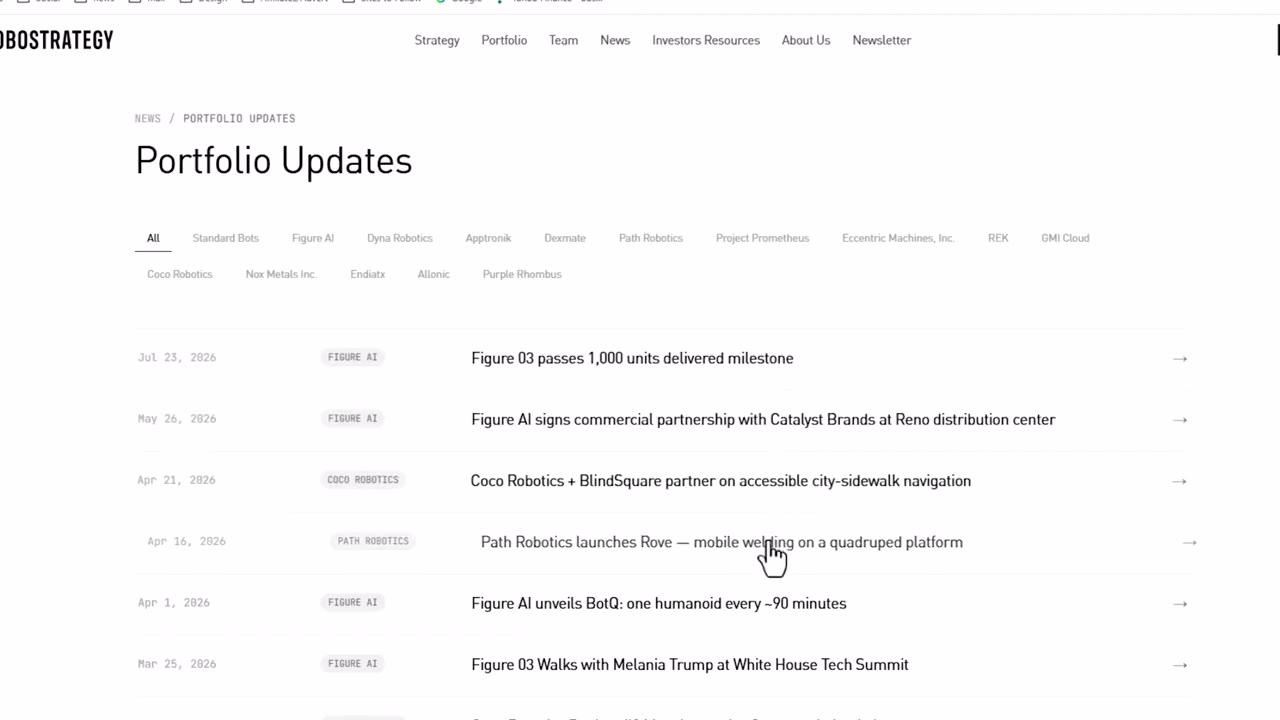
For example, Figure's previous generation already logged more than 1,250 hours at BMW, and Figure 3 has moved into more complex logistics work. And maybe most important, watch the economics and the intelligence here. Cost per robot, cost per productive hour, how quickly robots learn new jobs, and whether one AI model can generalize across increasingly different tasks and environments.
Nation, you can try picking up individual public robotics stocks, waiting for companies like Figure or Apptronik to eventually IPO, or just use RoboStrategy to grow BOT for exposure to many of these private companies today. Just remember, this has got to be a long-term investment. That $5 trillion plus market won't appear overnight, but it is coming, and when it does, you want to have access to this investment.
Check out RoboStrategy to grow BOT and the race for robotics with the link below. Don't forget to join the Let's Talk Money community by tapping that subscribe button.

FREE Breaking News Alerts from StreetInsider.com!
StreetInsider.com Top Tickers, 10/27/2026
- Wall Street ends higher on revived AI momentum
- Meta's $97.5B AI money grab: why Zuckerberg is racing to raise cash before rivals
- Deutsche Bank’s Reid sees potential final dip this year before Santa rally
- UPS tops estimates as efficiency drive gains momentum
- GM to move stock listing to Nasdaq in November, shares gain
Serious News for Serious Traders! Try StreetInsider.com Premium Free!
You May Also Be Interested In
- Sweet Security Offers All Organizations Affected by HTTP2Shell Virtual Patching Protection at No Cost
- Icahn Enterprises L.P. Announces Q3 2026 Earnings Conference Call
- Lufax Reports Third Quarter 2026 Financial Results
Create E-mail Alert Related Categories
SEC FilingsSign up for StreetInsider Free!
Receive full access to all new and archived articles, unlimited portfolio tracking, e-mail alerts, custom newswires and RSS feeds - and more!
