



Form 485APOS AMERICAN FUNDS INSURANCE
 Tweet
Tweet Share
Share E-mail
SEC. File Nos. 002-86838
811-03857
UNITED STATES
SECURITIES AND EXCHANGE COMMISSION
Washington, D.C. 20549
__________________
FORM N-1A
Registration Statement
Under
the Securities Act of 1933
Post-Effective Amendment No. 90
and
Registration Statement
Under
the Investment Company Act of 1940
Amendment No. 90
__________________
AMERICAN FUNDS INSURANCE SERIES
(Exact Name of Registrant as Specified in Charter)
333 South Hope Street
Los Angeles, California 90071-1406
(Address of Principal Executive Offices)
Registrant's telephone number, including area code:
(213) 486-9200
__________________
Steven I. Koszalka, Secretary
American Funds Insurance Series
333 South Hope Street
Los Angeles, California 90071-1406
(Name and Address of Agent for Service)
__________________
Copies to:
Lea Anne Copenhefer
Morgan, Lewis & Bockius LLP
One Federal Street
Boston, MA 02110-1726
(Counsel for the Registrant)
__________________
Approximate date of proposed public offering:
It is proposed that this filing become effective on December 6, 2019, pursuant to paragraph (a) of Rule 485.
SUBJECT TO COMPLETION, DATED SEPTEMBER 13, 2019
THE INFORMATION IN THIS PROSPECTUS IS NOT COMPLETE AND MAY BE CHANGED. WE MAY NOT SELL THESE SECURITIES UNTIL THE REGISTRATION STATEMENT FILED WITH THE U.S. SECURITIES AND EXCHANGE COMMISSION IS EFFECTIVE. THIS PROSPECTUS IS NOT AN OFFER TO SELL THESE SECURITIES AND IS NOT A SOLICITATION OF AN OFFER TO BUY THESE SECURITIES IN ANY STATE WHERE SUCH OFFER OR SALE IS NOT PERMITTED.
|
American Funds Insurance Series® Target Date SeriesSM Prospectus [December 6, 2019] |
 |
| American Funds IS 2035 Target Date FundSM | |
| American Funds IS 2030 Target Date FundSM | |
| American Funds IS 2025 Target Date FundSM | |
| American Funds IS 2020 Target Date FundSM | |
| American Funds IS 2015 Target Date FundSM | |
| American Funds IS 2010 Target Date FundSM | |
Table of contents
| Summaries: | Investment objectives, strategies and risks | 37 | ||
| American Funds IS 2035 Target Date Fund | 1 | Information regarding the underlying funds | 42 | |
| American Funds IS 2030 Target Date Fund | 7 | Management and organization | 49 | |
| American Funds IS 2025 Target Date Fund | 13 | Purchases and redemptions of shares | 51 | |
| American Funds IS 2020 Target Date Fund | 19 | Plan of distribution | 53 | |
| American Funds IS 2015 Target Date Fund | 25 | Other compensation to dealers | 53 | |
| American Funds IS 2010 Target Date Fund | 31 | Fund expenses | 54 | |
| Distributions and taxes | 54 |
Beginning on January 1, 2021, as permitted by regulations adopted by the U.S. Securities and Exchange Commission, you may not receive paper copies of the series’ shareholder reports from the insurance company that offers your contract unless you specifically request paper copies from the insurance company or from your financial intermediary. Instead, the shareholder reports will be made available on a website, and the insurance company will notify you by mail each time a report is posted and provide you with a website link to access the report. Instructions for requesting paper copies will be provided by your insurance company. If you have already elected to receive shareholder reports electronically, you will not be affected by this change and do not need to take any action. You may elect to receive shareholder reports and other communications from the insurance company electronically by following the instructions provided by the insurance company.
You may elect to receive paper copies of all future reports free of charge from the insurance company. You can inform the insurance company that you wish to continue receiving paper copies of your shareholder reports by following the instructions provided by the insurance company. Your election to receive paper reports will apply to all investment options available under your contract.
| The U.S. Securities and Exchange Commission has not approved or disapproved of these securities. Further, it has not determined that this prospectus is accurate or complete. Any representation to the contrary is a criminal offense. |
American Funds IS 2035 Target Date Fund
Investment objectives Depending on the proximity to its target date, the fund will seek to achieve the following objectives to varying degrees: growth, income and conservation of capital. The fund will increasingly emphasize income and conservation of capital by investing a greater portion of its assets in bond, equity-income and balanced funds as it approaches and passes its target date. In this way, the fund seeks to balance total return and stability over time.
Fees and expenses of the fund This table describes the fees and expenses that you may pay if you buy and hold an interest in Class 1, Class 1A or Class 2 shares of the fund. It does not reflect insurance contract fees and expenses. If insurance contract fees and expenses were reflected, expenses shown would be higher.
| Annual fund operating expenses (expenses that you pay each year as a percentage of the value of your investment) | Class 1 | Class 1A | Class 2 |
| Management fees | None | None | None |
| Distribution fees | [__]% | [__]% | [__]% |
| Other expenses1 | [__] | [__] | [__] |
| Acquired (underlying) fund fees and expenses | [__] | [__] | [__] |
| Total annual fund operating expenses | [__] | [__] | [__] |
1 Based on estimated amounts for the current fiscal year.
Example This example is intended to help you compare the cost of investing in Class 1, Class 1A and Class 2 shares of the fund with the cost of investing in other mutual funds.
The example assumes that you invest $10,000 in the fund for the time periods indicated and then redeem all of your shares at the end of those periods. The example also assumes that your investment has a 5% return each year and that the fund’s operating expenses remain the same. The example does not reflect insurance contract expenses. If insurance contract expenses were reflected, expenses shown would be higher. Although your actual costs may be higher or lower, based on these assumptions your costs would be:
| 1 year | 3 years | |
| Class 1 | $[__] | $[__] |
| Class 1A | [__] | [__] |
| Class 2 | [__] | [__] |
Portfolio turnover The fund may pay transaction costs, such as commissions, when it buys and sells securities (or “turns over” its portfolio). A higher portfolio turnover rate may indicate higher transaction costs. These costs, which are not reflected in annual fund operating expenses or in the example, affect the fund’s investment results.
Principal investment strategies The fund will attempt to achieve its investment objectives by investing in a mix of American Funds in different combinations and weightings. The underlying American Funds represent a variety of fund categories, including growth funds, growth-and-income funds, equity-income funds, balanced funds and fixed income funds. The fund categories represent differing investment objectives. For example, growth funds seek long-term growth primarily through investing in both U.S. stocks and stocks of issuers domiciled outside the U.S. Growth-and-income funds seek long-term growth and income primarily through investments in stocks. Equity-income and balanced funds generally strive for income and growth through stocks and/or bond investments, while bond funds seek current income through bond investments. The fund is designed for investors who plan to retire in, or close to, the year designated in the fund’s name.
The investment adviser may periodically rebalance or modify the asset mix of the funds and change the underlying fund investments. According to its current investment approach, the investment adviser will continue to manage the fund for approximately thirty years after the fund reaches its target date. Thirty years after its target date, the fund may be combined with other funds in a single portfolio with an investment allocation that will not evolve beyond that which is in effect at that time.
American Funds Insurance Series – Target Date Series / Prospectus 1
The following chart illustrates the investment approach of the fund by showing how its investment in the various fund categories will change over time. The allocations shown reflect the fund’s target allocations as of [December 6, 2019].
Investment approach
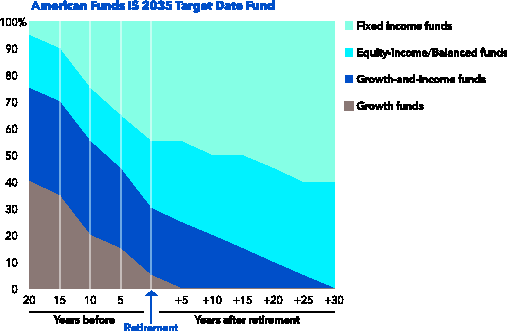
The investment adviser anticipates that the fund will invest its assets within a range that deviates no more than 10% above or below the investment approach set forth above. For example, a 40% target allocation to growth funds is not expected to be greater than 50% nor less than 30%. The investment adviser will continuously monitor the fund and may make modifications to either the investment approach or the underlying fund allocations that the investment adviser believes could benefit shareholders.
American Funds Insurance Series – Target Date Series / Prospectus 2
Principal risks
This section describes the principal risks associated with investing in the fund and its underlying funds. You may lose money by investing in the fund. The likelihood of loss may be greater if you invest for a shorter period of time. Investors in the fund should have a long-term perspective and be able to tolerate potentially sharp declines in value.
The following are principal risks associated with the fund’s investment strategies.
Allocation risk — Investments in the fund are subject to risks related to the investment adviser’s allocation choices. The selection of the underlying funds and the allocation of the fund’s assets could cause the fund to lose value or its results to lag relevant benchmarks or other funds with similar objectives. For investors who are close to or in retirement, the fund’s equity exposure may result in investment volatility that could reduce an investor’s available retirement assets at a time when the investor has a need to withdraw funds. For investors who are farther from retirement, there is a risk the fund may invest too much in investments designed to ensure capital conservation and current income, which may prevent the investor from meeting his or her retirement goals.
Fund structure — The fund invests in underlying funds and incurs expenses related to the underlying funds. In addition, investors in the fund will incur fees to pay for certain expenses related to the operations of the fund. An investor holding the underlying funds directly and in the same proportions as the fund would incur lower overall expenses but would not receive the benefit of the portfolio management and other services provided by the fund.
Underlying fund risks — Because the fund’s investments consist of underlying funds, the fund’s risks are directly related to the risks of the underlying funds. For this reason, it is important to understand the risks associated with investing in the underlying funds, as described below.
The following are principal risks associated with the underlying funds’ investment strategies.
Market conditions — The prices of, and the income generated by, the common stocks, bonds and other securities held by the underlying funds may decline – sometimes rapidly or unpredictably – due to various factors, including events or conditions affecting the general economy or particular industries; overall market changes; local, regional or global political, social or economic instability; governmental, governmental agency or central bank responses to economic conditions; and currency exchange rate, interest rate and commodity price fluctuations.
Issuer risks — The prices of, and the income generated by, securities held by the underlying funds may decline in response to various factors directly related to the issuers of such securities, including reduced demand for an issuer’s goods or services, poor management performance, major litigation related to the issuer, changes in government regulations affecting the issuer or its competitive environment and strategic initiatives such as mergers, acquisitions or dispositions and the market response to any such initiatives.
Investing in stocks — Investing in stocks may involve larger price swings and greater potential for loss than other types of investments. As a result, the value of the underlying funds may be subject to sharp, short-term declines in value. Income provided by an underlying fund may be reduced by changes in the dividend policies of, and the capital resources available at, the companies in which the underlying fund invests. As the fund nears its target date, a decreasing proportion of the fund’s assets will be invested in underlying funds that invest primarily in stocks. Accordingly, these risks are expected to be more significant the further the fund is removed from its target date and are expected to lessen as the fund approaches its target date.
Investing in debt instruments — The prices of, and the income generated by, bonds and other debt securities held by an underlying fund may be affected by changing interest rates and by changes in the effective maturities and credit ratings of these securities.
Rising interest rates will generally cause the prices of bonds and other debt securities to fall. A general rise in interest rates may cause investors to sell debt securities on a large scale, which could also adversely affect the price and liquidity of debt securities and could also result in increased redemptions from the fund. Falling interest rates may cause an issuer to redeem, call or refinance a debt security before its stated maturity, which may result in the fund failing to recoup the full amount of its initial investment and having to reinvest the proceeds in lower yielding securities. Longer maturity debt securities generally have greater sensitivity to changes in interest rates and may be subject to greater price fluctuations than shorter maturity debt securities.
Bonds and other debt securities are also subject to credit risk, which is the possibility that the credit strength of an issuer or guarantor will weaken or be perceived to be weaker, and/or an issuer of a debt security will fail to make timely payments of principal or interest and the security will go into default. A downgrade or default affecting any of the underlying funds’ securities could cause the value of the underlying funds’ shares to decrease. Lower quality debt securities generally have higher rates of interest and may be subject to greater price fluctuations than higher quality debt securities. Credit risk is gauged, in part, by the credit ratings of the debt securities in which the underlying fund invests. However, ratings are only the opinions of the rating agencies issuing them and are not guarantees as to credit quality or an evaluation of market risk. The underlying funds’ investment adviser relies on its own credit analysts to research issuers and issues in seeking to assess credit and default risks. These risks will be more significant as the fund approaches and passes its target date because a greater proportion of the fund’s assets will consist of underlying funds that primarily invest in bonds.
Investing in lower rated debt instruments — Lower rated bonds and other lower rated debt securities generally have higher rates of interest and involve greater risk of default or price declines due to changes in the issuer’s creditworthiness than those of higher quality debt securities. The market prices of these securities may fluctuate more than the prices of higher quality debt securities and may decline significantly in periods of general economic difficulty. These risks may be increased with respect to investments in lower quality, higher yielding debt securities rated Ba1 or below and BB+ or below by Nationally Recognized Statistical Rating Organizations designated by the fund’s investment adviser or unrated but determined by the investment adviser to be of equivalent quality, which securities are sometimes referred to as “junk bonds.”
American Funds Insurance Series – Target Date Series / Prospectus 3
Liquidity risk — Certain underlying fund holdings may be or become difficult or impossible to sell, particularly during times of market turmoil. Liquidity may be impacted by the lack of an active market for a holding, legal or contractual restrictions on resale, or the reduced number and capacity of market participants to make a market in such holding. Market prices for less liquid or illiquid holdings may be volatile, and reduced liquidity may have an adverse impact on the market price of such holdings. Additionally, the sale of less liquid or illiquid holdings may involve substantial delays (including delays in settlement) and additional costs and the underlying fund may be unable to sell such holdings when necessary to meet its liquidity needs or may be forced to sell at a loss.
Investing in mortgage-related and other asset-backed securities — Mortgage-related securities, such as mortgage-backed securities, and other asset-backed securities, include debt obligations that represent interests in pools of mortgages or other income-bearing assets, such as consumer loans or receivables. Such securities often involve risks that are different from or more acute than the risks associated with investing in other types of debt securities. Mortgage-backed and other asset-backed securities are subject to changes in the payment patterns of borrowers of the underlying debt, potentially increasing the volatility of the securities and an underlying fund’s net asset value. When interest rates fall, borrowers are more likely to refinance or prepay their debt before its stated maturity. This may result in an underlying fund having to reinvest the proceeds in lower yielding securities, effectively reducing the underlying fund’s income. Conversely, if interest rates rise and borrowers repay their debt more slowly than expected, the time in which the mortgage-backed and other asset-backed securities are paid off could be extended, reducing an underlying fund’s cash available for reinvestment in higher yielding securities. Mortgage-backed securities are also subject to the risk that underlying borrowers will be unable to meet their obligations and the value of property that secures the mortgages may decline in value and be insufficient, upon foreclosure, to repay the associated loans. Investments in asset-backed securities are subject to similar risks.
Investing in securities backed by the U.S. government — Securities backed by the U.S. Treasury or the full faith and credit of the U.S. government are guaranteed only as to the timely payment of interest and principal when held to maturity. Accordingly, the current market values for these securities will fluctuate with changes in interest rates and the credit rating of the U.S. government. Securities issued by government-sponsored entities and federal agencies and instrumentalities that are not backed by the full faith and credit of the U.S. government are neither issued nor guaranteed by the U.S. government.
Investing in future delivery contracts — An underlying fund may enter into contracts, such as to-be-announced contracts and mortgage dollar rolls, that involve an underlying fund selling mortgage-related securities and simultaneously contracting to repurchase similar securities for delivery at a future date at a predetermined price. This can increase the underlying fund’s market exposure, and the market price of the securities that the underlying fund contracts to repurchase could drop below their purchase price. While an underlying fund can preserve and generate capital through the use of such contracts by, for example, realizing the difference between the sale price and the future purchase price, the income generated by the underlying fund may be reduced by engaging in such transactions. In addition, these transactions may increase the turnover rate of the underlying fund.
Investing in small companies — Investing in smaller companies may pose additional risks. For example, it is often more difficult to value or dispose of small company stocks and more difficult to obtain information about smaller companies than about larger companies. Furthermore, smaller companies often have limited product lines, operating histories, markets and/or financial resources, may be dependent on one or a few key persons for management, and can be more susceptible to losses. Moreover, the prices of their stocks may be more volatile than stocks of larger, more established companies, particularly during times of market turmoil.
Investing outside the United States — Securities of issuers domiciled outside the United States, or with significant operations or revenues outside the United States, may lose value because of adverse political, social, economic or market developments (including social instability, regional conflicts, terrorism and war) in the countries or regions in which the issuers operate or generate revenue. These securities may also lose value due to changes in foreign currency exchange rates against the U.S. dollar and/or currencies of other countries. Issuers of these securities may be more susceptible to actions of foreign governments, such as nationalization, currency blockage or the imposition of price controls or punitive taxes, each of which could adversely impact the value of these securities. Securities markets in certain countries may be more volatile and/or less liquid than those in the United States. Investments outside the United States may also be subject to different accounting practices and different regulatory, legal and reporting standards and practices, and may be more difficult to value, than those in the United States. In addition, the value of investments outside the United States may be reduced by foreign taxes, including foreign withholding taxes on interest and dividends. Further, there may be increased risks of delayed settlement of securities purchased or sold by an underlying fund. The risks of investing outside the United States may be heightened in connection with investments in emerging markets.
Investing in emerging markets — Investing in emerging markets may involve risks in addition to and greater than those generally associated with investing in the securities markets of developed countries. For instance, emerging market countries may have less developed legal and accounting systems than those in developed countries. The governments of these countries may be less stable and more likely to impose capital controls, nationalize a company or industry, place restrictions on foreign ownership and on withdrawing sale proceeds of securities from the country, and/or impose punitive taxes that could adversely affect the prices of securities. In addition, the economies of these countries may be dependent on relatively few industries that are more susceptible to local and global changes. Securities markets in these countries can also be relatively small and have substantially lower trading volumes. As a result, securities issued in these countries may be more volatile and less liquid, and may be more difficult to value, than securities issued in countries with more developed economies and/or markets. Less certainty with respect to security valuations may lead to additional challenges and risks in calculating the underlying fund’s net asset value. Additionally, emerging markets are more likely to experience problems with the clearing and settling of trades and the holding of securities by banks, agents and depositories that are less established than those in developed countries.
Investing in derivatives — The use of derivatives involves a variety of risks, which may be different from, or greater than, the risks associated with investing in traditional securities, such as stocks and bonds. Changes in the value of a derivative may not correlate perfectly with, and may be more sensitive to market events than, the underlying asset, rate or index, and a derivative instrument may expose the underlying
American Funds Insurance Series – Target Date Series / Prospectus 4
fund to losses in excess of its initial investment. Derivatives may be difficult to value, difficult for the underlying fund to buy or sell at an opportune time or price and difficult, or even impossible, to terminate or otherwise offset. The underlying fund’s use of derivatives may result in losses to the underlying fund, and investing in derivatives may reduce the underlying fund’s returns and increase the underlying fund’s price volatility. The underlying fund’s counterparty to a derivative transaction (including, if applicable, the underlying fund’s clearing broker, the derivatives exchange or the clearinghouse) may be unable or unwilling to honor its financial obligations in respect of the transaction. In certain cases, the underlying fund may be hindered or delayed in exercising remedies against or closing out derivative instruments with a counterparty, which may result in additional losses.
Management — The investment adviser to the fund and to the underlying funds actively manages each underlying fund’s investments. Consequently, the underlying funds are subject to the risk that the methods and analyses, including models, tools and data, employed by the investment adviser in this process may be flawed or incorrect and may not produce the desired results. This could cause an underlying fund to lose value or its investment results to lag relevant benchmarks or other funds with similar objectives.
Your investment in the fund is not a bank deposit and is not insured or guaranteed by the Federal Deposit Insurance Corporation or any other governmental agency, entity or person. You should consider how this fund fits into your overall investment program.
American Funds Insurance Series – Target Date Series / Prospectus 5
Investment results Because the fund intends to begin investment operations on [December 6, 2019], information regarding investment results is not available as of the date of this prospectus
Management
Investment adviser Capital Research and Management
CompanySM
Target date solutions committee The investment adviser’s Target Date Solutions Committee develops the allocation approach
and selects the underlying funds in which the fund invests. The members of the Target Date Solutions Committee are:
| Investment professional/ Series title (if applicable) |
Investment professional experience in this fund |
Primary title with investment adviser |
| [__] [__] | Less than 1 year (since the fund’s inception) | [__] |
| [__] [__] | Less than 1 year (since the fund’s inception) | [__] |
| [__] [__] | Less than 1 year (since the fund’s inception) | [__] |
| [__] [__] | Less than 1 year (since the fund’s inception) | [__] |
| [__] [__] | Less than 1 year (since the fund’s inception) | [__] |
| [__] [__] | Less than 1 year (since the fund’s inception) | [__] |
| [__] [__] | Less than 1 year (since the fund’s inception) | [__] |
Tax information See your variable insurance contract prospectus for information regarding the federal income tax treatment of your variable insurance contract and related distributions.
Payments to broker-dealers and other financial intermediaries If you purchase shares of the fund through a broker-dealer or other financial intermediary (such as an insurance company), the fund and the fund’s distributor or its affiliates may pay the intermediary for the sale of fund shares and related services. These payments may create a conflict of interest by influencing the broker-dealer or other intermediary and your individual financial advisor to recommend the fund over another investment. Ask your individual financial advisor or visit your financial intermediary’s website for more information. The fund is not sold directly to the general public but instead is offered as an underlying investment option for variable insurance contracts. In addition to payments described above, the fund and its related companies may make payments to the sponsoring insurance company (or its affiliates) for distribution and/or other services. These payments may be a factor that the insurance company considers in including the fund as an underlying investment option in the variable insurance contract. The prospectus (or other offering document) for your variable insurance contract may contain additional information about these payments.
American Funds Insurance Series – Target Date Series / Prospectus 6
American Funds IS 2030 Target Date Fund
Investment objectives Depending on the proximity to its target date, the fund will seek to achieve the following objectives to varying degrees: growth, income and conservation of capital. The fund will increasingly emphasize income and conservation of capital by investing a greater portion of its assets in bond, equity-income and balanced funds as it approaches and passes its target date. In this way, the fund seeks to balance total return and stability over time.
Fees and expenses of the fund This table describes the fees and expenses that you may pay if you buy and hold an interest in Class 1, Class 1A or Class 2 shares of the fund. It does not reflect insurance contract fees and expenses. If insurance contract fees and expenses were reflected, expenses shown would be higher.
| Annual fund operating expenses (expenses that you pay each year as a percentage of the value of your investment) | Class 1 | Class 1A | Class 2 |
| Management fees | None | None | None |
| Distribution fees | [__]% | [__]% | [__]% |
| Other expenses1 | [__] | [__] | [__] |
| Acquired (underlying) fund fees and expenses | [__] | [__] | [__] |
| Total annual fund operating expenses | [__] | [__] | [__] |
1 Based on estimated amounts for the current fiscal year.
Example This example is intended to help you compare the cost of investing in Class 1, Class 1A and Class 2 shares of the fund with the cost of investing in other mutual funds.
The example assumes that you invest $10,000 in the fund for the time periods indicated and then redeem all of your shares at the end of those periods. The example also assumes that your investment has a 5% return each year and that the fund’s operating expenses remain the same. The example does not reflect insurance contract expenses. If insurance contract expenses were reflected, expenses shown would be higher. Although your actual costs may be higher or lower, based on these assumptions your costs would be:
| 1 year | 3 years | |
| Class 1 | $[__] | $[__] |
| Class 1A | [__] | [__] |
| Class 2 | [__] | [__] |
Portfolio turnover The fund may pay transaction costs, such as commissions, when it buys and sells securities (or “turns over” its portfolio). A higher portfolio turnover rate may indicate higher transaction costs. These costs, which are not reflected in annual fund operating expenses or in the example, affect the fund’s investment results.
Principal investment strategies The fund will attempt to achieve its investment objectives by investing in a mix of American Funds in different combinations and weightings. The underlying American Funds represent a variety of fund categories, including growth funds, growth-and-income funds, equity-income funds, balanced funds and fixed income funds. The fund categories represent differing investment objectives. For example, growth funds seek long-term growth primarily through investing in both U.S. stocks and stocks of issuers domiciled outside the U.S. Growth-and-income funds seek long-term growth and income primarily through investments in stocks. Equity-income and balanced funds generally strive for income and growth through stocks and/or bond investments, while bond funds seek current income through bond investments. The fund is designed for investors who plan to retire in, or close to, the year designated in the fund’s name.
The investment adviser may periodically rebalance or modify the asset mix of the funds and change the underlying fund investments. According to its current investment approach, the investment adviser will continue to manage the fund for approximately thirty years after the fund reaches its target date. Thirty years after its target date, the fund may be combined with other funds in a single portfolio with an investment allocation that will not evolve beyond that which is in effect at that time.
American Funds Insurance Series – Target Date Series / Prospectus 7
The following chart illustrates the investment approach of the fund by showing how its investment in the various fund categories will change over time. The allocations shown reflect the fund’s target allocations as of [December 6, 2019].
Investment approach

The investment adviser anticipates that the fund will invest its assets within a range that deviates no more than 10% above or below the investment approach set forth above. For example, a 40% target allocation to growth funds is not expected to be greater than 50% nor less than 30%. The investment adviser will continuously monitor the fund and may make modifications to either the investment approach or the underlying fund allocations that the investment adviser believes could benefit shareholders.
American Funds Insurance Series – Target Date Series / Prospectus 8
Principal risks
This section describes the principal risks associated with investing in the fund and its underlying funds. You may lose money by investing in the fund. The likelihood of loss may be greater if you invest for a shorter period of time. Investors in the fund should have a long-term perspective and be able to tolerate potentially sharp declines in value.
The following are principal risks associated with the fund’s investment strategies.
Allocation risk — Investments in the fund are subject to risks related to the investment adviser’s allocation choices. The selection of the underlying funds and the allocation of the fund’s assets could cause the fund to lose value or its results to lag relevant benchmarks or other funds with similar objectives. For investors who are close to or in retirement, the fund’s equity exposure may result in investment volatility that could reduce an investor’s available retirement assets at a time when the investor has a need to withdraw funds. For investors who are farther from retirement, there is a risk the fund may invest too much in investments designed to ensure capital conservation and current income, which may prevent the investor from meeting his or her retirement goals.
Fund structure — The fund invests in underlying funds and incurs expenses related to the underlying funds. In addition, investors in the fund will incur fees to pay for certain expenses related to the operations of the fund. An investor holding the underlying funds directly and in the same proportions as the fund would incur lower overall expenses but would not receive the benefit of the portfolio management and other services provided by the fund.
Underlying fund risks — Because the fund’s investments consist of underlying funds, the fund’s risks are directly related to the risks of the underlying funds. For this reason, it is important to understand the risks associated with investing in the underlying funds, as described below.
The following are principal risks associated with the underlying funds’ investment strategies.
Market conditions — The prices of, and the income generated by, the common stocks, bonds and other securities held by the underlying funds may decline – sometimes rapidly or unpredictably – due to various factors, including events or conditions affecting the general economy or particular industries; overall market changes; local, regional or global political, social or economic instability; governmental, governmental agency or central bank responses to economic conditions; and currency exchange rate, interest rate and commodity price fluctuations.
Issuer risks — The prices of, and the income generated by, securities held by the underlying funds may decline in response to various factors directly related to the issuers of such securities, including reduced demand for an issuer’s goods or services, poor management performance, major litigation related to the issuer, changes in government regulations affecting the issuer or its competitive environment and strategic initiatives such as mergers, acquisitions or dispositions and the market response to any such initiatives.
Investing in stocks — Investing in stocks may involve larger price swings and greater potential for loss than other types of investments. As a result, the value of the underlying funds may be subject to sharp, short-term declines in value. Income provided by an underlying fund may be reduced by changes in the dividend policies of, and the capital resources available at, the companies in which the underlying fund invests. As the fund nears its target date, a decreasing proportion of the fund’s assets will be invested in underlying funds that invest primarily in stocks. Accordingly, these risks are expected to be more significant the further the fund is removed from its target date and are expected to lessen as the fund approaches its target date.
Investing in debt instruments — The prices of, and the income generated by, bonds and other debt securities held by an underlying fund may be affected by changing interest rates and by changes in the effective maturities and credit ratings of these securities.
Rising interest rates will generally cause the prices of bonds and other debt securities to fall. A general rise in interest rates may cause investors to sell debt securities on a large scale, which could also adversely affect the price and liquidity of debt securities and could also result in increased redemptions from the fund. Falling interest rates may cause an issuer to redeem, call or refinance a debt security before its stated maturity, which may result in the fund failing to recoup the full amount of its initial investment and having to reinvest the proceeds in lower yielding securities. Longer maturity debt securities generally have greater sensitivity to changes in interest rates and may be subject to greater price fluctuations than shorter maturity debt securities.
Bonds and other debt securities are also subject to credit risk, which is the possibility that the credit strength of an issuer or guarantor will weaken or be perceived to be weaker, and/or an issuer of a debt security will fail to make timely payments of principal or interest and the security will go into default. A downgrade or default affecting any of the underlying funds’ securities could cause the value of the underlying funds’ shares to decrease. Lower quality debt securities generally have higher rates of interest and may be subject to greater price fluctuations than higher quality debt securities. Credit risk is gauged, in part, by the credit ratings of the debt securities in which the underlying fund invests. However, ratings are only the opinions of the rating agencies issuing them and are not guarantees as to credit quality or an evaluation of market risk. The underlying funds’ investment adviser relies on its own credit analysts to research issuers and issues in seeking to assess credit and default risks. These risks will be more significant as the fund approaches and passes its target date because a greater proportion of the fund’s assets will consist of underlying funds that primarily invest in bonds.
Investing in lower rated debt instruments — Lower rated bonds and other lower rated debt securities generally have higher rates of interest and involve greater risk of default or price declines due to changes in the issuer’s creditworthiness than those of higher quality debt securities. The market prices of these securities may fluctuate more than the prices of higher quality debt securities and may decline significantly in periods of general economic difficulty. These risks may be increased with respect to investments in lower quality, higher yielding debt securities rated Ba1 or below and BB+ or below by Nationally Recognized Statistical Rating Organizations designated by the fund’s investment adviser or unrated but determined by the investment adviser to be of equivalent quality, which securities are sometimes referred to as “junk bonds.”
American Funds Insurance Series – Target Date Series / Prospectus 9
Liquidity risk — Certain underlying fund holdings may be or become difficult or impossible to sell, particularly during times of market turmoil. Liquidity may be impacted by the lack of an active market for a holding, legal or contractual restrictions on resale, or the reduced number and capacity of market participants to make a market in such holding. Market prices for less liquid or illiquid holdings may be volatile, and reduced liquidity may have an adverse impact on the market price of such holdings. Additionally, the sale of less liquid or illiquid holdings may involve substantial delays (including delays in settlement) and additional costs and the underlying fund may be unable to sell such holdings when necessary to meet its liquidity needs or may be forced to sell at a loss.
Investing in mortgage-related and other asset-backed securities — Mortgage-related securities, such as mortgage-backed securities, and other asset-backed securities, include debt obligations that represent interests in pools of mortgages or other income-bearing assets, such as consumer loans or receivables. Such securities often involve risks that are different from or more acute than the risks associated with investing in other types of debt securities. Mortgage-backed and other asset-backed securities are subject to changes in the payment patterns of borrowers of the underlying debt, potentially increasing the volatility of the securities and an underlying fund’s net asset value. When interest rates fall, borrowers are more likely to refinance or prepay their debt before its stated maturity. This may result in an underlying fund having to reinvest the proceeds in lower yielding securities, effectively reducing the underlying fund’s income. Conversely, if interest rates rise and borrowers repay their debt more slowly than expected, the time in which the mortgage-backed and other asset-backed securities are paid off could be extended, reducing an underlying fund’s cash available for reinvestment in higher yielding securities. Mortgage-backed securities are also subject to the risk that underlying borrowers will be unable to meet their obligations and the value of property that secures the mortgages may decline in value and be insufficient, upon foreclosure, to repay the associated loans. Investments in asset-backed securities are subject to similar risks.
Investing in securities backed by the U.S. government — Securities backed by the U.S. Treasury or the full faith and credit of the U.S. government are guaranteed only as to the timely payment of interest and principal when held to maturity. Accordingly, the current market values for these securities will fluctuate with changes in interest rates and the credit rating of the U.S. government. Securities issued by government-sponsored entities and federal agencies and instrumentalities that are not backed by the full faith and credit of the U.S. government are neither issued nor guaranteed by the U.S. government.
Investing in future delivery contracts — An underlying fund may enter into contracts, such as to-be-announced contracts and mortgage dollar rolls, that involve an underlying fund selling mortgage-related securities and simultaneously contracting to repurchase similar securities for delivery at a future date at a predetermined price. This can increase the underlying fund’s market exposure, and the market price of the securities that the underlying fund contracts to repurchase could drop below their purchase price. While an underlying fund can preserve and generate capital through the use of such contracts by, for example, realizing the difference between the sale price and the future purchase price, the income generated by the underlying fund may be reduced by engaging in such transactions. In addition, these transactions may increase the turnover rate of the underlying fund.
Investing in small companies — Investing in smaller companies may pose additional risks. For example, it is often more difficult to value or dispose of small company stocks and more difficult to obtain information about smaller companies than about larger companies. Furthermore, smaller companies often have limited product lines, operating histories, markets and/or financial resources, may be dependent on one or a few key persons for management, and can be more susceptible to losses. Moreover, the prices of their stocks may be more volatile than stocks of larger, more established companies, particularly during times of market turmoil.
Investing outside the United States — Securities of issuers domiciled outside the United States, or with significant operations or revenues outside the United States, may lose value because of adverse political, social, economic or market developments (including social instability, regional conflicts, terrorism and war) in the countries or regions in which the issuers operate or generate revenue. These securities may also lose value due to changes in foreign currency exchange rates against the U.S. dollar and/or currencies of other countries. Issuers of these securities may be more susceptible to actions of foreign governments, such as nationalization, currency blockage or the imposition of price controls or punitive taxes, each of which could adversely impact the value of these securities. Securities markets in certain countries may be more volatile and/or less liquid than those in the United States. Investments outside the United States may also be subject to different accounting practices and different regulatory, legal and reporting standards and practices, and may be more difficult to value, than those in the United States. In addition, the value of investments outside the United States may be reduced by foreign taxes, including foreign withholding taxes on interest and dividends. Further, there may be increased risks of delayed settlement of securities purchased or sold by an underlying fund. The risks of investing outside the United States may be heightened in connection with investments in emerging markets.
Investing in emerging markets — Investing in emerging markets may involve risks in addition to and greater than those generally associated with investing in the securities markets of developed countries. For instance, emerging market countries may have less developed legal and accounting systems than those in developed countries. The governments of these countries may be less stable and more likely to impose capital controls, nationalize a company or industry, place restrictions on foreign ownership and on withdrawing sale proceeds of securities from the country, and/or impose punitive taxes that could adversely affect the prices of securities. In addition, the economies of these countries may be dependent on relatively few industries that are more susceptible to local and global changes. Securities markets in these countries can also be relatively small and have substantially lower trading volumes. As a result, securities issued in these countries may be more volatile and less liquid, and may be more difficult to value, than securities issued in countries with more developed economies and/or markets. Less certainty with respect to security valuations may lead to additional challenges and risks in calculating the underlying fund’s net asset value. Additionally, emerging markets are more likely to experience problems with the clearing and settling of trades and the holding of securities by banks, agents and depositories that are less established than those in developed countries.
Investing in derivatives — The use of derivatives involves a variety of risks, which may be different from, or greater than, the risks associated with investing in traditional securities, such as stocks and bonds. Changes in the value of a derivative may not correlate perfectly with, and may be more sensitive to market events than, the underlying asset, rate or index, and a derivative instrument may expose the underlying
American Funds Insurance Series – Target Date Series / Prospectus 10
fund to losses in excess of its initial investment. Derivatives may be difficult to value, difficult for the underlying fund to buy or sell at an opportune time or price and difficult, or even impossible, to terminate or otherwise offset. The underlying fund’s use of derivatives may result in losses to the underlying fund, and investing in derivatives may reduce the underlying fund’s returns and increase the underlying fund’s price volatility. The underlying fund’s counterparty to a derivative transaction (including, if applicable, the underlying fund’s clearing broker, the derivatives exchange or the clearinghouse) may be unable or unwilling to honor its financial obligations in respect of the transaction. In certain cases, the underlying fund may be hindered or delayed in exercising remedies against or closing out derivative instruments with a counterparty, which may result in additional losses.
Management — The investment adviser to the fund and to the underlying funds actively manages each underlying fund’s investments. Consequently, the underlying funds are subject to the risk that the methods and analyses, including models, tools and data, employed by the investment adviser in this process may be flawed or incorrect and may not produce the desired results. This could cause an underlying fund to lose value or its investment results to lag relevant benchmarks or other funds with similar objectives.
Your investment in the fund is not a bank deposit and is not insured or guaranteed by the Federal Deposit Insurance Corporation or any other governmental agency, entity or person. You should consider how this fund fits into your overall investment program.
American Funds Insurance Series – Target Date Series / Prospectus 11
Investment results Because the fund intends to begin investment operations on [December 6, 2019], information regarding investment results is not available as of the date of this prospectus.
Management
Investment adviser Capital Research and Management
CompanySM
Target date solutions committee The investment adviser’s Target Date Solutions Committee develops the allocation approach
and selects the underlying funds in which the fund invests. The members of the Target Date Solutions Committee are:
| Investment professional/ Series title (if applicable) |
Investment professional experience in this fund |
Primary title with investment adviser |
| [__] [__] | Less than 1 year (since the fund’s inception) | [__] |
| [__] [__] | Less than 1 year (since the fund’s inception) | [__] |
| [__] [__] | Less than 1 year (since the fund’s inception) | [__] |
| [__] [__] | Less than 1 year (since the fund’s inception) | [__] |
| [__] [__] | Less than 1 year (since the fund’s inception) | [__] |
| [__] [__] | Less than 1 year (since the fund’s inception) | [__] |
| [__] [__] | Less than 1 year (since the fund’s inception) | [__] |
Tax information See your variable insurance contract prospectus for information regarding the federal income tax treatment of your variable insurance contract and related distributions.
Payments to broker-dealers and other financial intermediaries If you purchase shares of the fund through a broker-dealer or other financial intermediary (such as an insurance company), the fund and the fund’s distributor or its affiliates may pay the intermediary for the sale of fund shares and related services. These payments may create a conflict of interest by influencing the broker-dealer or other intermediary and your individual financial advisor to recommend the fund over another investment. Ask your individual financial advisor or visit your financial intermediary’s website for more information. The fund is not sold directly to the general public but instead is offered as an underlying investment option for variable insurance contracts. In addition to payments described above, the fund and its related companies may make payments to the sponsoring insurance company (or its affiliates) for distribution and/or other services. These payments may be a factor that the insurance company considers in including the fund as an underlying investment option in the variable insurance contract. The prospectus (or other offering document) for your variable insurance contract may contain additional information about these payments.
American Funds Insurance Series – Target Date Series / Prospectus 12
American Funds IS 2025 Target Date Fund
Investment objectives Depending on the proximity to its target date, the fund will seek to achieve the following objectives to varying degrees: growth, income and conservation of capital. The fund will increasingly emphasize income and conservation of capital by investing a greater portion of its assets in bond, equity-income and balanced funds as it approaches and passes its target date. In this way, the fund seeks to balance total return and stability over time.
Fees and expenses of the fund This table describes the fees and expenses that you may pay if you buy and hold an interest in Class 1, Class 1A or Class 2 shares of the fund. It does not reflect insurance contract fees and expenses. If insurance contract fees and expenses were reflected, expenses shown would be higher.
| Annual fund operating expenses (expenses that you pay each year as a percentage of the value of your investment) | Class 1 | Class 1A | Class 2 |
| Management fees | None | None | None |
| Distribution fees | [__]% | [__]% | [__]% |
| Other expenses1 | [__] | [__] | [__] |
| Acquired (underlying) fund fees and expenses | [__] | [__] | [__] |
| Total annual fund operating expenses | [__] | [__] | [__] |
1 Based on estimated amounts for the current fiscal year.
Example This example is intended to help you compare the cost of investing in Class 1, Class 1A and Class 2 shares of the fund with the cost of investing in other mutual funds.
The example assumes that you invest $10,000 in the fund for the time periods indicated and then redeem all of your shares at the end of those periods. The example also assumes that your investment has a 5% return each year and that the fund’s operating expenses remain the same. The example does not reflect insurance contract expenses. If insurance contract expenses were reflected, expenses shown would be higher. Although your actual costs may be higher or lower, based on these assumptions your costs would be:
| 1 year | 3 years | |
| Class 1 | $[__] | $[__] |
| Class 1A | [__] | [__] |
| Class 2 | [__] | [__] |
Portfolio turnover The fund may pay transaction costs, such as commissions, when it buys and sells securities (or “turns over” its portfolio). A higher portfolio turnover rate may indicate higher transaction costs. These costs, which are not reflected in annual fund operating expenses or in the example, affect the fund’s investment results.
Principal investment strategies The fund will attempt to achieve its investment objectives by investing in a mix of American Funds in different combinations and weightings. The underlying American Funds represent a variety of fund categories, including growth funds, growth-and-income funds, equity-income funds, balanced funds and fixed income funds. The fund categories represent differing investment objectives. For example, growth funds seek long-term growth primarily through investing in both U.S. stocks and stocks of issuers domiciled outside the U.S. Growth-and-income funds seek long-term growth and income primarily through investments in stocks. Equity-income and balanced funds generally strive for income and growth through stocks and/or bond investments, while bond funds seek current income through bond investments. The fund is designed for investors who plan to retire in, or close to, the year designated in the fund’s name.
The investment adviser may periodically rebalance or modify the asset mix of the funds and change the underlying fund investments. According to its current investment approach, the investment adviser will continue to manage the fund for approximately thirty years after the fund reaches its target date. Thirty years after its target date, the fund may be combined with other funds in a single portfolio with an investment allocation that will not evolve beyond that which is in effect at that time.
American Funds Insurance Series – Target Date Series / Prospectus 13
The following chart illustrates the investment approach of the fund by showing how its investment in the various fund categories will change over time. The allocations shown reflect the fund’s target allocations as of [December 6, 2019].
Investment approach

The investment adviser anticipates that the fund will invest its assets within a range that deviates no more than 10% above or below the investment approach set forth above. For example, a 40% target allocation to growth funds is not expected to be greater than 50% nor less than 30%. The investment adviser will continuously monitor the fund and may make modifications to either the investment approach or the underlying fund allocations that the investment adviser believes could benefit shareholders.
American Funds Insurance Series – Target Date Series / Prospectus 14
Principal risks
This section describes the principal risks associated with investing in the fund and its underlying funds. You may lose money by investing in the fund. The likelihood of loss may be greater if you invest for a shorter period of time. Investors in the fund should have a long-term perspective and be able to tolerate potentially sharp declines in value.
The following are principal risks associated with the fund’s investment strategies.
Allocation risk — Investments in the fund are subject to risks related to the investment adviser’s allocation choices. The selection of the underlying funds and the allocation of the fund’s assets could cause the fund to lose value or its results to lag relevant benchmarks or other funds with similar objectives. For investors who are close to or in retirement, the fund’s equity exposure may result in investment volatility that could reduce an investor’s available retirement assets at a time when the investor has a need to withdraw funds. For investors who are farther from retirement, there is a risk the fund may invest too much in investments designed to ensure capital conservation and current income, which may prevent the investor from meeting his or her retirement goals.
Fund structure — The fund invests in underlying funds and incurs expenses related to the underlying funds. In addition, investors in the fund will incur fees to pay for certain expenses related to the operations of the fund. An investor holding the underlying funds directly and in the same proportions as the fund would incur lower overall expenses but would not receive the benefit of the portfolio management and other services provided by the fund.
Underlying fund risks — Because the fund’s investments consist of underlying funds, the fund’s risks are directly related to the risks of the underlying funds. For this reason, it is important to understand the risks associated with investing in the underlying funds, as described below.
The following are principal risks associated with the underlying funds’ investment strategies.
Market conditions — The prices of, and the income generated by, the common stocks, bonds and other securities held by the underlying funds may decline – sometimes rapidly or unpredictably – due to various factors, including events or conditions affecting the general economy or particular industries; overall market changes; local, regional or global political, social or economic instability; governmental, governmental agency or central bank responses to economic conditions; and currency exchange rate, interest rate and commodity price fluctuations.
Issuer risks — The prices of, and the income generated by, securities held by the underlying funds may decline in response to various factors directly related to the issuers of such securities, including reduced demand for an issuer’s goods or services, poor management performance, major litigation related to the issuer, changes in government regulations affecting the issuer or its competitive environment and strategic initiatives such as mergers, acquisitions or dispositions and the market response to any such initiatives.
Investing in stocks — Investing in stocks may involve larger price swings and greater potential for loss than other types of investments. As a result, the value of the underlying funds may be subject to sharp, short-term declines in value. Income provided by an underlying fund may be reduced by changes in the dividend policies of, and the capital resources available at, the companies in which the underlying fund invests. As the fund nears its target date, a decreasing proportion of the fund’s assets will be invested in underlying funds that invest primarily in stocks. Accordingly, these risks are expected to be more significant the further the fund is removed from its target date and are expected to lessen as the fund approaches its target date.
Investing in debt instruments — The prices of, and the income generated by, bonds and other debt securities held by an underlying fund may be affected by changing interest rates and by changes in the effective maturities and credit ratings of these securities.
Rising interest rates will generally cause the prices of bonds and other debt securities to fall. A general rise in interest rates may cause investors to sell debt securities on a large scale, which could also adversely affect the price and liquidity of debt securities and could also result in increased redemptions from the fund. Falling interest rates may cause an issuer to redeem, call or refinance a debt security before its stated maturity, which may result in the fund failing to recoup the full amount of its initial investment and having to reinvest the proceeds in lower yielding securities. Longer maturity debt securities generally have greater sensitivity to changes in interest rates and may be subject to greater price fluctuations than shorter maturity debt securities.
Bonds and other debt securities are also subject to credit risk, which is the possibility that the credit strength of an issuer or guarantor will weaken or be perceived to be weaker, and/or an issuer of a debt security will fail to make timely payments of principal or interest and the security will go into default. A downgrade or default affecting any of the underlying funds’ securities could cause the value of the underlying funds’ shares to decrease. Lower quality debt securities generally have higher rates of interest and may be subject to greater price fluctuations than higher quality debt securities. Credit risk is gauged, in part, by the credit ratings of the debt securities in which the underlying fund invests. However, ratings are only the opinions of the rating agencies issuing them and are not guarantees as to credit quality or an evaluation of market risk. The underlying funds’ investment adviser relies on its own credit analysts to research issuers and issues in seeking to assess credit and default risks. These risks will be more significant as the fund approaches and passes its target date because a greater proportion of the fund’s assets will consist of underlying funds that primarily invest in bonds.
Investing in lower rated debt instruments — Lower rated bonds and other lower rated debt securities generally have higher rates of interest and involve greater risk of default or price declines due to changes in the issuer’s creditworthiness than those of higher quality debt securities. The market prices of these securities may fluctuate more than the prices of higher quality debt securities and may decline significantly in periods of general economic difficulty. These risks may be increased with respect to investments in lower quality, higher yielding debt securities rated Ba1 or below and BB+ or below by Nationally Recognized Statistical Rating Organizations designated by the fund’s investment adviser or unrated but determined by the investment adviser to be of equivalent quality, which securities are sometimes referred to as “junk bonds.”
American Funds Insurance Series – Target Date Series / Prospectus 15
Liquidity risk — Certain underlying fund holdings may be or become difficult or impossible to sell, particularly during times of market turmoil. Liquidity may be impacted by the lack of an active market for a holding, legal or contractual restrictions on resale, or the reduced number and capacity of market participants to make a market in such holding. Market prices for less liquid or illiquid holdings may be volatile, and reduced liquidity may have an adverse impact on the market price of such holdings. Additionally, the sale of less liquid or illiquid holdings may involve substantial delays (including delays in settlement) and additional costs and the underlying fund may be unable to sell such holdings when necessary to meet its liquidity needs or may be forced to sell at a loss.
Investing in mortgage-related and other asset-backed securities — Mortgage-related securities, such as mortgage-backed securities, and other asset-backed securities, include debt obligations that represent interests in pools of mortgages or other income-bearing assets, such as consumer loans or receivables. Such securities often involve risks that are different from or more acute than the risks associated with investing in other types of debt securities. Mortgage-backed and other asset-backed securities are subject to changes in the payment patterns of borrowers of the underlying debt, potentially increasing the volatility of the securities and an underlying fund’s net asset value. When interest rates fall, borrowers are more likely to refinance or prepay their debt before its stated maturity. This may result in an underlying fund having to reinvest the proceeds in lower yielding securities, effectively reducing the underlying fund’s income. Conversely, if interest rates rise and borrowers repay their debt more slowly than expected, the time in which the mortgage-backed and other asset-backed securities are paid off could be extended, reducing an underlying fund’s cash available for reinvestment in higher yielding securities. Mortgage-backed securities are also subject to the risk that underlying borrowers will be unable to meet their obligations and the value of property that secures the mortgages may decline in value and be insufficient, upon foreclosure, to repay the associated loans. Investments in asset-backed securities are subject to similar risks.
Investing in securities backed by the U.S. government — Securities backed by the U.S. Treasury or the full faith and credit of the U.S. government are guaranteed only as to the timely payment of interest and principal when held to maturity. Accordingly, the current market values for these securities will fluctuate with changes in interest rates and the credit rating of the U.S. government. Securities issued by government-sponsored entities and federal agencies and instrumentalities that are not backed by the full faith and credit of the U.S. government are neither issued nor guaranteed by the U.S. government.
Investing in future delivery contracts — An underlying fund may enter into contracts, such as to-be-announced contracts and mortgage dollar rolls, that involve an underlying fund selling mortgage-related securities and simultaneously contracting to repurchase similar securities for delivery at a future date at a predetermined price. This can increase the underlying fund’s market exposure, and the market price of the securities that the underlying fund contracts to repurchase could drop below their purchase price. While an underlying fund can preserve and generate capital through the use of such contracts by, for example, realizing the difference between the sale price and the future purchase price, the income generated by the underlying fund may be reduced by engaging in such transactions. In addition, these transactions may increase the turnover rate of the underlying fund.
Investing in small companies — Investing in smaller companies may pose additional risks. For example, it is often more difficult to value or dispose of small company stocks and more difficult to obtain information about smaller companies than about larger companies. Furthermore, smaller companies often have limited product lines, operating histories, markets and/or financial resources, may be dependent on one or a few key persons for management, and can be more susceptible to losses. Moreover, the prices of their stocks may be more volatile than stocks of larger, more established companies, particularly during times of market turmoil.
Investing outside the United States — Securities of issuers domiciled outside the United States, or with significant operations or revenues outside the United States, may lose value because of adverse political, social, economic or market developments (including social instability, regional conflicts, terrorism and war) in the countries or regions in which the issuers operate or generate revenue. These securities may also lose value due to changes in foreign currency exchange rates against the U.S. dollar and/or currencies of other countries. Issuers of these securities may be more susceptible to actions of foreign governments, such as nationalization, currency blockage or the imposition of price controls or punitive taxes, each of which could adversely impact the value of these securities. Securities markets in certain countries may be more volatile and/or less liquid than those in the United States. Investments outside the United States may also be subject to different accounting practices and different regulatory, legal and reporting standards and practices, and may be more difficult to value, than those in the United States. In addition, the value of investments outside the United States may be reduced by foreign taxes, including foreign withholding taxes on interest and dividends. Further, there may be increased risks of delayed settlement of securities purchased or sold by an underlying fund. The risks of investing outside the United States may be heightened in connection with investments in emerging markets.
Investing in emerging markets — Investing in emerging markets may involve risks in addition to and greater than those generally associated with investing in the securities markets of developed countries. For instance, emerging market countries may have less developed legal and accounting systems than those in developed countries. The governments of these countries may be less stable and more likely to impose capital controls, nationalize a company or industry, place restrictions on foreign ownership and on withdrawing sale proceeds of securities from the country, and/or impose punitive taxes that could adversely affect the prices of securities. In addition, the economies of these countries may be dependent on relatively few industries that are more susceptible to local and global changes. Securities markets in these countries can also be relatively small and have substantially lower trading volumes. As a result, securities issued in these countries may be more volatile and less liquid, and may be more difficult to value, than securities issued in countries with more developed economies and/or markets. Less certainty with respect to security valuations may lead to additional challenges and risks in calculating the underlying fund’s net asset value. Additionally, emerging markets are more likely to experience problems with the clearing and settling of trades and the holding of securities by banks, agents and depositories that are less established than those in developed countries.
Investing in derivatives — The use of derivatives involves a variety of risks, which may be different from, or greater than, the risks associated with investing in traditional securities, such as stocks and bonds. Changes in the value of a derivative may not correlate perfectly with, and may be more sensitive to market events than, the underlying asset, rate or index, and a derivative instrument may expose the underlying
American Funds Insurance Series – Target Date Series / Prospectus 16
fund to losses in excess of its initial investment. Derivatives may be difficult to value, difficult for the underlying fund to buy or sell at an opportune time or price and difficult, or even impossible, to terminate or otherwise offset. The underlying fund’s use of derivatives may result in losses to the underlying fund, and investing in derivatives may reduce the underlying fund’s returns and increase the underlying fund’s price volatility. The underlying fund’s counterparty to a derivative transaction (including, if applicable, the underlying fund’s clearing broker, the derivatives exchange or the clearinghouse) may be unable or unwilling to honor its financial obligations in respect of the transaction. In certain cases, the underlying fund may be hindered or delayed in exercising remedies against or closing out derivative instruments with a counterparty, which may result in additional losses.
Management — The investment adviser to the fund and to the underlying funds actively manages each underlying fund’s investments. Consequently, the underlying funds are subject to the risk that the methods and analyses, including models, tools and data, employed by the investment adviser in this process may be flawed or incorrect and may not produce the desired results. This could cause an underlying fund to lose value or its investment results to lag relevant benchmarks or other funds with similar objectives.
Your investment in the fund is not a bank deposit and is not insured or guaranteed by the Federal Deposit Insurance Corporation or any other governmental agency, entity or person. You should consider how this fund fits into your overall investment program.
American Funds Insurance Series – Target Date Series / Prospectus 17
Investment results Because the fund intends to begin investment operations on [December 6, 2019], information regarding investment results is not available as of the date of this prospectus.
Management
Investment adviser Capital Research and Management
CompanySM
Target date solutions committee The investment adviser’s Target Date Solutions Committee develops the allocation approach
and selects the underlying funds in which the fund invests. The members of the Target Date Solutions Committee are:
| Investment professional/ Series title (if applicable) |
Investment professional experience in this fund |
Primary title with investment adviser |
| [__] [__] | Less than 1 year (since the fund’s inception) | [__] |
| [__] [__] | Less than 1 year (since the fund’s inception) | [__] |
| [__] [__] | Less than 1 year (since the fund’s inception) | [__] |
| [__] [__] | Less than 1 year (since the fund’s inception) | [__] |
| [__] [__] | Less than 1 year (since the fund’s inception) | [__] |
| [__] [__] | Less than 1 year (since the fund’s inception) | [__] |
| [__] [__] | Less than 1 year (since the fund’s inception) | [__] |
Tax information See your variable insurance contract prospectus for information regarding the federal income tax treatment of your variable insurance contract and related distributions.
Payments to broker-dealers and other financial intermediaries If you purchase shares of the fund through a broker-dealer or other financial intermediary (such as an insurance company), the fund and the fund’s distributor or its affiliates may pay the intermediary for the sale of fund shares and related services. These payments may create a conflict of interest by influencing the broker-dealer or other intermediary and your individual financial advisor to recommend the fund over another investment. Ask your individual financial advisor or visit your financial intermediary’s website for more information. The fund is not sold directly to the general public but instead is offered as an underlying investment option for variable insurance contracts. In addition to payments described above, the fund and its related companies may make payments to the sponsoring insurance company (or its affiliates) for distribution and/or other services. These payments may be a factor that the insurance company considers in including the fund as an underlying investment option in the variable insurance contract. The prospectus (or other offering document) for your variable insurance contract may contain additional information about these payments.
American Funds Insurance Series – Target Date Series / Prospectus 18
American Funds IS 2020 Target Date Fund
Investment objectives Depending on the proximity to its target date, the fund will seek to achieve the following objectives to varying degrees: growth, income and conservation of capital. The fund will increasingly emphasize income and conservation of capital by investing a greater portion of its assets in bond, equity-income and balanced funds as it approaches and passes its target date. In this way, the fund seeks to balance total return and stability over time.
Fees and expenses of the fund This table describes the fees and expenses that you may pay if you buy and hold an interest in Class 1, Class 1A or Class 2 shares of the fund. It does not reflect insurance contract fees and expenses. If insurance contract fees and expenses were reflected, expenses shown would be higher.
| Annual fund operating expenses (expenses that you pay each year as a percentage of the value of your investment) | Class 1 | Class 1A | Class 2 |
| Management fees | None | None | None |
| Distribution fees | [__]% | [__]% | [__]% |
| Other expenses1 | [__] | [__] | [__] |
| Acquired (underlying) fund fees and expenses | [__] | [__] | [__] |
| Total annual fund operating expenses | [__] | [__] | [__] |
1 Based on estimated amounts for the current fiscal year.
Example This example is intended to help you compare the cost of investing in Class 1, Class 1A and Class 2 shares of the fund with the cost of investing in other mutual funds.
The example assumes that you invest $10,000 in the fund for the time periods indicated and then redeem all of your shares at the end of those periods. The example also assumes that your investment has a 5% return each year and that the fund’s operating expenses remain the same. The example does not reflect insurance contract expenses. If insurance contract expenses were reflected, expenses shown would be higher. Although your actual costs may be higher or lower, based on these assumptions your costs would be:
| 1 year | 3 years | |
| Class 1 | $[__] | $[__] |
| Class 1A | [__] | [__] |
| Class 2 | [__] | [__] |
Portfolio turnover The fund may pay transaction costs, such as commissions, when it buys and sells securities (or “turns over” its portfolio). A higher portfolio turnover rate may indicate higher transaction costs. These costs, which are not reflected in annual fund operating expenses or in the example, affect the fund’s investment results.
Principal investment strategies The fund will attempt to achieve its investment objectives by investing in a mix of American Funds in different combinations and weightings. The underlying American Funds represent a variety of fund categories, including growth funds, growth-and-income funds, equity-income funds, balanced funds and fixed income funds. The fund categories represent differing investment objectives. For example, growth funds seek long-term growth primarily through investing in both U.S. stocks and stocks of issuers domiciled outside the U.S. Growth-and-income funds seek long-term growth and income primarily through investments in stocks. Equity-income and balanced funds generally strive for income and growth through stocks and/or bond investments, while bond funds seek current income through bond investments. The fund is designed for investors who plan to retire in, or close to, the year designated in the fund’s name.
The investment adviser may periodically rebalance or modify the asset mix of the funds and change the underlying fund investments. According to its current investment approach, the investment adviser will continue to manage the fund for approximately thirty years after the fund reaches its target date. Thirty years after its target date, the fund may be combined with other funds in a single portfolio with an investment allocation that will not evolve beyond that which is in effect at that time.
American Funds Insurance Series – Target Date Series / Prospectus 19
The following chart illustrates the investment approach of the fund by showing how its investment in the various fund categories will change over time. The allocations shown reflect the fund’s target allocations as of [December 6, 2019].
Investment approach

The investment adviser anticipates that the fund will invest its assets within a range that deviates no more than 10% above or below the investment approach set forth above. For example, a 40% target allocation to growth funds is not expected to be greater than 50% nor less than 30%. The investment adviser will continuously monitor the fund and may make modifications to either the investment approach or the underlying fund allocations that the investment adviser believes could benefit shareholders.
American Funds Insurance Series – Target Date Series / Prospectus 20
Principal risks
This section describes the principal risks associated with investing in the fund and its underlying funds. You may lose money by investing in the fund. The likelihood of loss may be greater if you invest for a shorter period of time. Investors in the fund should have a long-term perspective and be able to tolerate potentially sharp declines in value.
The following are principal risks associated with the fund’s investment strategies.
Allocation risk — Investments in the fund are subject to risks related to the investment adviser’s allocation choices. The selection of the underlying funds and the allocation of the fund’s assets could cause the fund to lose value or its results to lag relevant benchmarks or other funds with similar objectives. For investors who are close to or in retirement, the fund’s equity exposure may result in investment volatility that could reduce an investor’s available retirement assets at a time when the investor has a need to withdraw funds. For investors who are farther from retirement, there is a risk the fund may invest too much in investments designed to ensure capital conservation and current income, which may prevent the investor from meeting his or her retirement goals.
Fund structure — The fund invests in underlying funds and incurs expenses related to the underlying funds. In addition, investors in the fund will incur fees to pay for certain expenses related to the operations of the fund. An investor holding the underlying funds directly and in the same proportions as the fund would incur lower overall expenses but would not receive the benefit of the portfolio management and other services provided by the fund.
Underlying fund risks — Because the fund’s investments consist of underlying funds, the fund’s risks are directly related to the risks of the underlying funds. For this reason, it is important to understand the risks associated with investing in the underlying funds, as described below.
The following are principal risks associated with the underlying funds’ investment strategies.
Market conditions — The prices of, and the income generated by, the common stocks, bonds and other securities held by the underlying funds may decline – sometimes rapidly or unpredictably – due to various factors, including events or conditions affecting the general economy or particular industries; overall market changes; local, regional or global political, social or economic instability; governmental, governmental agency or central bank responses to economic conditions; and currency exchange rate, interest rate and commodity price fluctuations.
Issuer risks — The prices of, and the income generated by, securities held by the underlying funds may decline in response to various factors directly related to the issuers of such securities, including reduced demand for an issuer’s goods or services, poor management performance, major litigation related to the issuer, changes in government regulations affecting the issuer or its competitive environment and strategic initiatives such as mergers, acquisitions or dispositions and the market response to any such initiatives.
Investing in stocks — Investing in stocks may involve larger price swings and greater potential for loss than other types of investments. As a result, the value of the underlying funds may be subject to sharp, short-term declines in value. Income provided by an underlying fund may be reduced by changes in the dividend policies of, and the capital resources available at, the companies in which the underlying fund invests. As the fund nears its target date, a decreasing proportion of the fund’s assets will be invested in underlying funds that invest primarily in stocks. Accordingly, these risks are expected to be more significant the further the fund is removed from its target date and are expected to lessen as the fund approaches its target date.
Investing in debt instruments — The prices of, and the income generated by, bonds and other debt securities held by an underlying fund may be affected by changing interest rates and by changes in the effective maturities and credit ratings of these securities.
Rising interest rates will generally cause the prices of bonds and other debt securities to fall. A general rise in interest rates may cause investors to sell debt securities on a large scale, which could also adversely affect the price and liquidity of debt securities and could also result in increased redemptions from the fund. Falling interest rates may cause an issuer to redeem, call or refinance a debt security before its stated maturity, which may result in the fund failing to recoup the full amount of its initial investment and having to reinvest the proceeds in lower yielding securities. Longer maturity debt securities generally have greater sensitivity to changes in interest rates and may be subject to greater price fluctuations than shorter maturity debt securities.
Bonds and other debt securities are also subject to credit risk, which is the possibility that the credit strength of an issuer or guarantor will weaken or be perceived to be weaker, and/or an issuer of a debt security will fail to make timely payments of principal or interest and the security will go into default. A downgrade or default affecting any of the underlying funds’ securities could cause the value of the underlying funds’ shares to decrease. Lower quality debt securities generally have higher rates of interest and may be subject to greater price fluctuations than higher quality debt securities. Credit risk is gauged, in part, by the credit ratings of the debt securities in which the underlying fund invests. However, ratings are only the opinions of the rating agencies issuing them and are not guarantees as to credit quality or an evaluation of market risk. The underlying funds’ investment adviser relies on its own credit analysts to research issuers and issues in seeking to assess credit and default risks. These risks will be more significant as the fund approaches and passes its target date because a greater proportion of the fund’s assets will consist of underlying funds that primarily invest in bonds.
Investing in lower rated debt instruments — Lower rated bonds and other lower rated debt securities generally have higher rates of interest and involve greater risk of default or price declines due to changes in the issuer’s creditworthiness than those of higher quality debt securities. The market prices of these securities may fluctuate more than the prices of higher quality debt securities and may decline significantly in periods of general economic difficulty. These risks may be increased with respect to investments in lower quality, higher yielding debt securities rated Ba1 or below and BB+ or below by Nationally Recognized Statistical Rating Organizations designated by the fund’s investment adviser or unrated but determined by the investment adviser to be of equivalent quality, which securities are sometimes referred to as “junk bonds.”
American Funds Insurance Series – Target Date Series / Prospectus 21
Liquidity risk — Certain underlying fund holdings may be or become difficult or impossible to sell, particularly during times of market turmoil. Liquidity may be impacted by the lack of an active market for a holding, legal or contractual restrictions on resale, or the reduced number and capacity of market participants to make a market in such holding. Market prices for less liquid or illiquid holdings may be volatile, and reduced liquidity may have an adverse impact on the market price of such holdings. Additionally, the sale of less liquid or illiquid holdings may involve substantial delays (including delays in settlement) and additional costs and the underlying fund may be unable to sell such holdings when necessary to meet its liquidity needs or may be forced to sell at a loss.
Investing in mortgage-related and other asset-backed securities — Mortgage-related securities, such as mortgage-backed securities, and other asset-backed securities, include debt obligations that represent interests in pools of mortgages or other income-bearing assets, such as consumer loans or receivables. Such securities often involve risks that are different from or more acute than the risks associated with investing in other types of debt securities. Mortgage-backed and other asset-backed securities are subject to changes in the payment patterns of borrowers of the underlying debt, potentially increasing the volatility of the securities and an underlying fund’s net asset value. When interest rates fall, borrowers are more likely to refinance or prepay their debt before its stated maturity. This may result in an underlying fund having to reinvest the proceeds in lower yielding securities, effectively reducing the underlying fund’s income. Conversely, if interest rates rise and borrowers repay their debt more slowly than expected, the time in which the mortgage-backed and other asset-backed securities are paid off could be extended, reducing an underlying fund’s cash available for reinvestment in higher yielding securities. Mortgage-backed securities are also subject to the risk that underlying borrowers will be unable to meet their obligations and the value of property that secures the mortgages may decline in value and be insufficient, upon foreclosure, to repay the associated loans. Investments in asset-backed securities are subject to similar risks.
Investing in securities backed by the U.S. government — Securities backed by the U.S. Treasury or the full faith and credit of the U.S. government are guaranteed only as to the timely payment of interest and principal when held to maturity. Accordingly, the current market values for these securities will fluctuate with changes in interest rates and the credit rating of the U.S. government. Securities issued by government-sponsored entities and federal agencies and instrumentalities that are not backed by the full faith and credit of the U.S. government are neither issued nor guaranteed by the U.S. government.
Investing in future delivery contracts — An underlying fund may enter into contracts, such as to-be-announced contracts and mortgage dollar rolls, that involve an underlying fund selling mortgage-related securities and simultaneously contracting to repurchase similar securities for delivery at a future date at a predetermined price. This can increase the underlying fund’s market exposure, and the market price of the securities that the underlying fund contracts to repurchase could drop below their purchase price. While an underlying fund can preserve and generate capital through the use of such contracts by, for example, realizing the difference between the sale price and the future purchase price, the income generated by the underlying fund may be reduced by engaging in such transactions. In addition, these transactions may increase the turnover rate of the underlying fund.
Investing in small companies — Investing in smaller companies may pose additional risks. For example, it is often more difficult to value or dispose of small company stocks and more difficult to obtain information about smaller companies than about larger companies. Furthermore, smaller companies often have limited product lines, operating histories, markets and/or financial resources, may be dependent on one or a few key persons for management, and can be more susceptible to losses. Moreover, the prices of their stocks may be more volatile than stocks of larger, more established companies, particularly during times of market turmoil.
Investing outside the United States — Securities of issuers domiciled outside the United States, or with significant operations or revenues outside the United States, may lose value because of adverse political, social, economic or market developments (including social instability, regional conflicts, terrorism and war) in the countries or regions in which the issuers operate or generate revenue. These securities may also lose value due to changes in foreign currency exchange rates against the U.S. dollar and/or currencies of other countries. Issuers of these securities may be more susceptible to actions of foreign governments, such as nationalization, currency blockage or the imposition of price controls or punitive taxes, each of which could adversely impact the value of these securities. Securities markets in certain countries may be more volatile and/or less liquid than those in the United States. Investments outside the United States may also be subject to different accounting practices and different regulatory, legal and reporting standards and practices, and may be more difficult to value, than those in the United States. In addition, the value of investments outside the United States may be reduced by foreign taxes, including foreign withholding taxes on interest and dividends. Further, there may be increased risks of delayed settlement of securities purchased or sold by an underlying fund. The risks of investing outside the United States may be heightened in connection with investments in emerging markets.
Investing in emerging markets — Investing in emerging markets may involve risks in addition to and greater than those generally associated with investing in the securities markets of developed countries. For instance, emerging market countries may have less developed legal and accounting systems than those in developed countries. The governments of these countries may be less stable and more likely to impose capital controls, nationalize a company or industry, place restrictions on foreign ownership and on withdrawing sale proceeds of securities from the country, and/or impose punitive taxes that could adversely affect the prices of securities. In addition, the economies of these countries may be dependent on relatively few industries that are more susceptible to local and global changes. Securities markets in these countries can also be relatively small and have substantially lower trading volumes. As a result, securities issued in these countries may be more volatile and less liquid, and may be more difficult to value, than securities issued in countries with more developed economies and/or markets. Less certainty with respect to security valuations may lead to additional challenges and risks in calculating the underlying fund’s net asset value. Additionally, emerging markets are more likely to experience problems with the clearing and settling of trades and the holding of securities by banks, agents and depositories that are less established than those in developed countries.
Investing in derivatives — The use of derivatives involves a variety of risks, which may be different from, or greater than, the risks associated with investing in traditional securities, such as stocks and bonds. Changes in the value of a derivative may not correlate perfectly with, and may be more sensitive to market events than, the underlying asset, rate or index, and a derivative instrument may expose the underlying
American Funds Insurance Series – Target Date Series / Prospectus 22
fund to losses in excess of its initial investment. Derivatives may be difficult to value, difficult for the underlying fund to buy or sell at an opportune time or price and difficult, or even impossible, to terminate or otherwise offset. The underlying fund’s use of derivatives may result in losses to the underlying fund, and investing in derivatives may reduce the underlying fund’s returns and increase the underlying fund’s price volatility. The underlying fund’s counterparty to a derivative transaction (including, if applicable, the underlying fund’s clearing broker, the derivatives exchange or the clearinghouse) may be unable or unwilling to honor its financial obligations in respect of the transaction. In certain cases, the underlying fund may be hindered or delayed in exercising remedies against or closing out derivative instruments with a counterparty, which may result in additional losses.
Management — The investment adviser to the fund and to the underlying funds actively manages each underlying fund’s investments. Consequently, the underlying funds are subject to the risk that the methods and analyses, including models, tools and data, employed by the investment adviser in this process may be flawed or incorrect and may not produce the desired results. This could cause an underlying fund to lose value or its investment results to lag relevant benchmarks or other funds with similar objectives.
Your investment in the fund is not a bank deposit and is not insured or guaranteed by the Federal Deposit Insurance Corporation or any other governmental agency, entity or person. You should consider how this fund fits into your overall investment program.
American Funds Insurance Series – Target Date Series / Prospectus 23
Investment results Because the fund intends to begin investment operations on [December 6, 2019], information regarding investment results is not available as of the date of this prospectus.
Management
Investment adviser Capital Research and Management
CompanySM
Target date solutions committee The investment adviser’s Target Date Solutions Committee develops the allocation approach
and selects the underlying funds in which the fund invests. The members of the Target Date Solutions Committee are:
| Investment professional/ Series title (if applicable) |
Investment professional experience in this fund |
Primary title with investment adviser |
| [__] [__] | Less than 1 year (since the fund’s inception) | [__] |
| [__] [__] | Less than 1 year (since the fund’s inception) | [__] |
| [__] [__] | Less than 1 year (since the fund’s inception) | [__] |
| [__] [__] | Less than 1 year (since the fund’s inception) | [__] |
| [__] [__] | Less than 1 year (since the fund’s inception) | [__] |
| [__] [__] | Less than 1 year (since the fund’s inception) | [__] |
| [__] [__] | Less than 1 year (since the fund’s inception) | [__] |
Tax information See your variable insurance contract prospectus for information regarding the federal income tax treatment of your variable insurance contract and related distributions.
Payments to broker-dealers and other financial intermediaries If you purchase shares of the fund through a broker-dealer or other financial intermediary (such as an insurance company), the fund and the fund’s distributor or its affiliates may pay the intermediary for the sale of fund shares and related services. These payments may create a conflict of interest by influencing the broker-dealer or other intermediary and your individual financial advisor to recommend the fund over another investment. Ask your individual financial advisor or visit your financial intermediary’s website for more information. The fund is not sold directly to the general public but instead is offered as an underlying investment option for variable insurance contracts. In addition to payments described above, the fund and its related companies may make payments to the sponsoring insurance company (or its affiliates) for distribution and/or other services. These payments may be a factor that the insurance company considers in including the fund as an underlying investment option in the variable insurance contract. The prospectus (or other offering document) for your variable insurance contract may contain additional information about these payments.
American Funds Insurance Series – Target Date Series / Prospectus 24
American Funds IS 2015 Target Date Fund
Investment objectives Depending on the proximity to its target date, the fund will seek to achieve the following objectives to varying degrees: growth, income and conservation of capital. The fund will increasingly emphasize income and conservation of capital by investing a greater portion of its assets in bond, equity-income and balanced funds as it approaches and passes its target date. In this way, the fund seeks to balance total return and stability over time.
Fees and expenses of the fund This table describes the fees and expenses that you may pay if you buy and hold an interest in Class 1, Class 1A or Class 2 shares of the fund. It does not reflect insurance contract fees and expenses. If insurance contract fees and expenses were reflected, expenses shown would be higher.
| Annual fund operating expenses (expenses that you pay each year as a percentage of the value of your investment) | Class 1 | Class 1A | Class 2 |
| Management fees | None | None | None |
| Distribution fees | [__]% | [__]% | [__]% |
| Other expenses1 | [__] | [__] | [__] |
| Acquired (underlying) fund fees and expenses | [__] | [__] | [__] |
| Total annual fund operating expenses | [__] | [__] | [__] |
1 Based on estimated amounts for the current fiscal year.
Example This example is intended to help you compare the cost of investing in Class 1, Class 1A and Class 2 shares of the fund with the cost of investing in other mutual funds.
The example assumes that you invest $10,000 in the fund for the time periods indicated and then redeem all of your shares at the end of those periods. The example also assumes that your investment has a 5% return each year and that the fund’s operating expenses remain the same. The example does not reflect insurance contract expenses. If insurance contract expenses were reflected, expenses shown would be higher. Although your actual costs may be higher or lower, based on these assumptions your costs would be:
| 1 year | 3 years | |
| Class 1 | $[__] | $[__] |
| Class 1A | [__] | [__] |
| Class 2 | [__] | [__] |
Portfolio turnover The fund may pay transaction costs, such as commissions, when it buys and sells securities (or “turns over” its portfolio). A higher portfolio turnover rate may indicate higher transaction costs. These costs, which are not reflected in annual fund operating expenses or in the example, affect the fund’s investment results.
Principal investment strategies The fund will attempt to achieve its investment objectives by investing in a mix of American Funds in different combinations and weightings. The underlying American Funds represent a variety of fund categories, including growth funds, growth-and-income funds, equity-income funds, balanced funds and fixed income funds. The fund categories represent differing investment objectives. For example, growth funds seek long-term growth primarily through investing in both U.S. stocks and stocks of issuers domiciled outside the U.S. Growth-and-income funds seek long-term growth and income primarily through investments in stocks. Equity-income and balanced funds generally strive for income and growth through stocks and/or bond investments, while bond funds seek current income through bond investments. The fund is designed for investors who have retired in, or close to, the year designated in the fund’s name.
The investment adviser may periodically rebalance or modify the asset mix of the funds and change the underlying fund investments. According to its current investment approach, the investment adviser will continue to manage the fund for approximately thirty years after the fund reaches its target date. Thirty years after its target date, the fund may be combined with other funds in a single portfolio with an investment allocation that will not evolve beyond that which is in effect at that time.
American Funds Insurance Series – Target Date Series / Prospectus 25
The following chart illustrates the investment approach of the fund by showing how its investment in the various fund categories will change over time. The allocations shown reflect the fund’s target allocations as of [December 6, 2019].
Investment approach

The investment adviser anticipates that the fund will invest its assets within a range that deviates no more than 10% above or below the investment approach set forth above. For example, a 40% target allocation to growth funds is not expected to be greater than 50% nor less than 30%. The investment adviser will continuously monitor the fund and may make modifications to either the investment approach or the underlying fund allocations that the investment adviser believes could benefit shareholders.
American Funds Insurance Series – Target Date Series / Prospectus 26
Principal risks
This section describes the principal risks associated with investing in the fund and its underlying funds. You may lose money by investing in the fund. The likelihood of loss may be greater if you invest for a shorter period of time. Investors in the fund should have a long-term perspective and be able to tolerate potentially sharp declines in value.
The following are principal risks associated with the fund’s investment strategies.
Allocation risk — Investments in the fund are subject to risks related to the investment adviser’s allocation choices. The selection of the underlying funds and the allocation of the fund’s assets could cause the fund to lose value or its results to lag relevant benchmarks or other funds with similar objectives. For investors who are close to or in retirement, the fund’s equity exposure may result in investment volatility that could reduce an investor’s available retirement assets at a time when the investor has a need to withdraw funds. For investors who are farther from retirement, there is a risk the fund may invest too much in investments designed to ensure capital conservation and current income, which may prevent the investor from meeting his or her retirement goals.
Fund structure — The fund invests in underlying funds and incurs expenses related to the underlying funds. In addition, investors in the fund will incur fees to pay for certain expenses related to the operations of the fund. An investor holding the underlying funds directly and in the same proportions as the fund would incur lower overall expenses but would not receive the benefit of the portfolio management and other services provided by the fund.
Underlying fund risks — Because the fund’s investments consist of underlying funds, the fund’s risks are directly related to the risks of the underlying funds. For this reason, it is important to understand the risks associated with investing in the underlying funds, as described below.
The following are principal risks associated with the underlying funds’ investment strategies.
Market conditions — The prices of, and the income generated by, the common stocks, bonds and other securities held by the underlying funds may decline – sometimes rapidly or unpredictably – due to various factors, including events or conditions affecting the general economy or particular industries; overall market changes; local, regional or global political, social or economic instability; governmental, governmental agency or central bank responses to economic conditions; and currency exchange rate, interest rate and commodity price fluctuations.
Issuer risks — The prices of, and the income generated by, securities held by the underlying funds may decline in response to various factors directly related to the issuers of such securities, including reduced demand for an issuer’s goods or services, poor management performance, major litigation related to the issuer, changes in government regulations affecting the issuer or its competitive environment and strategic initiatives such as mergers, acquisitions or dispositions and the market response to any such initiatives.
Investing in stocks — Investing in stocks may involve larger price swings and greater potential for loss than other types of investments. As a result, the value of the underlying funds may be subject to sharp, short-term declines in value. Income provided by an underlying fund may be reduced by changes in the dividend policies of, and the capital resources available at, the companies in which the underlying fund invests. As the fund nears its target date, a decreasing proportion of the fund’s assets will be invested in underlying funds that invest primarily in stocks. Accordingly, these risks are expected to be more significant the further the fund is removed from its target date and are expected to lessen as the fund approaches its target date.
Investing in debt instruments — The prices of, and the income generated by, bonds and other debt securities held by an underlying fund may be affected by changing interest rates and by changes in the effective maturities and credit ratings of these securities.
Rising interest rates will generally cause the prices of bonds and other debt securities to fall. A general rise in interest rates may cause investors to sell debt securities on a large scale, which could also adversely affect the price and liquidity of debt securities and could also result in increased redemptions from the fund. Falling interest rates may cause an issuer to redeem, call or refinance a debt security before its stated maturity, which may result in the fund failing to recoup the full amount of its initial investment and having to reinvest the proceeds in lower yielding securities. Longer maturity debt securities generally have greater sensitivity to changes in interest rates and may be subject to greater price fluctuations than shorter maturity debt securities.
Bonds and other debt securities are also subject to credit risk, which is the possibility that the credit strength of an issuer or guarantor will weaken or be perceived to be weaker, and/or an issuer of a debt security will fail to make timely payments of principal or interest and the security will go into default. A downgrade or default affecting any of the underlying funds’ securities could cause the value of the underlying funds’ shares to decrease. Lower quality debt securities generally have higher rates of interest and may be subject to greater price fluctuations than higher quality debt securities. Credit risk is gauged, in part, by the credit ratings of the debt securities in which the underlying fund invests. However, ratings are only the opinions of the rating agencies issuing them and are not guarantees as to credit quality or an evaluation of market risk. The underlying funds’ investment adviser relies on its own credit analysts to research issuers and issues in seeking to assess credit and default risks. These risks will be more significant as the fund approaches and passes its target date because a greater proportion of the fund’s assets will consist of underlying funds that primarily invest in bonds.
Investing in lower rated debt instruments — Lower rated bonds and other lower rated debt securities generally have higher rates of interest and involve greater risk of default or price declines due to changes in the issuer’s creditworthiness than those of higher quality debt securities. The market prices of these securities may fluctuate more than the prices of higher quality debt securities and may decline significantly in periods of general economic difficulty. These risks may be increased with respect to investments in lower quality, higher yielding debt securities rated Ba1 or below and BB+ or below by Nationally Recognized Statistical Rating Organizations designated by the fund’s investment adviser or unrated but determined by the investment adviser to be of equivalent quality, which securities are sometimes referred to as “junk bonds.”
American Funds Insurance Series – Target Date Series / Prospectus 27
Liquidity risk — Certain underlying fund holdings may be or become difficult or impossible to sell, particularly during times of market turmoil. Liquidity may be impacted by the lack of an active market for a holding, legal or contractual restrictions on resale, or the reduced number and capacity of market participants to make a market in such holding. Market prices for less liquid or illiquid holdings may be volatile, and reduced liquidity may have an adverse impact on the market price of such holdings. Additionally, the sale of less liquid or illiquid holdings may involve substantial delays (including delays in settlement) and additional costs and the underlying fund may be unable to sell such holdings when necessary to meet its liquidity needs or may be forced to sell at a loss.
Investing in mortgage-related and other asset-backed securities — Mortgage-related securities, such as mortgage-backed securities, and other asset-backed securities, include debt obligations that represent interests in pools of mortgages or other income-bearing assets, such as consumer loans or receivables. Such securities often involve risks that are different from or more acute than the risks associated with investing in other types of debt securities. Mortgage-backed and other asset-backed securities are subject to changes in the payment patterns of borrowers of the underlying debt, potentially increasing the volatility of the securities and an underlying fund’s net asset value. When interest rates fall, borrowers are more likely to refinance or prepay their debt before its stated maturity. This may result in an underlying fund having to reinvest the proceeds in lower yielding securities, effectively reducing the underlying fund’s income. Conversely, if interest rates rise and borrowers repay their debt more slowly than expected, the time in which the mortgage-backed and other asset-backed securities are paid off could be extended, reducing an underlying fund’s cash available for reinvestment in higher yielding securities. Mortgage-backed securities are also subject to the risk that underlying borrowers will be unable to meet their obligations and the value of property that secures the mortgages may decline in value and be insufficient, upon foreclosure, to repay the associated loans. Investments in asset-backed securities are subject to similar risks.
Investing in securities backed by the U.S. government — Securities backed by the U.S. Treasury or the full faith and credit of the U.S. government are guaranteed only as to the timely payment of interest and principal when held to maturity. Accordingly, the current market values for these securities will fluctuate with changes in interest rates and the credit rating of the U.S. government. Securities issued by government-sponsored entities and federal agencies and instrumentalities that are not backed by the full faith and credit of the U.S. government are neither issued nor guaranteed by the U.S. government.
Investing in future delivery contracts — An underlying fund may enter into contracts, such as to-be-announced contracts and mortgage dollar rolls, that involve an underlying fund selling mortgage-related securities and simultaneously contracting to repurchase similar securities for delivery at a future date at a predetermined price. This can increase the underlying fund’s market exposure, and the market price of the securities that the underlying fund contracts to repurchase could drop below their purchase price. While an underlying fund can preserve and generate capital through the use of such contracts by, for example, realizing the difference between the sale price and the future purchase price, the income generated by the underlying fund may be reduced by engaging in such transactions. In addition, these transactions may increase the turnover rate of the underlying fund.
Investing in small companies — Investing in smaller companies may pose additional risks. For example, it is often more difficult to value or dispose of small company stocks and more difficult to obtain information about smaller companies than about larger companies. Furthermore, smaller companies often have limited product lines, operating histories, markets and/or financial resources, may be dependent on one or a few key persons for management, and can be more susceptible to losses. Moreover, the prices of their stocks may be more volatile than stocks of larger, more established companies, particularly during times of market turmoil.
Investing outside the United States — Securities of issuers domiciled outside the United States, or with significant operations or revenues outside the United States, may lose value because of adverse political, social, economic or market developments (including social instability, regional conflicts, terrorism and war) in the countries or regions in which the issuers operate or generate revenue. These securities may also lose value due to changes in foreign currency exchange rates against the U.S. dollar and/or currencies of other countries. Issuers of these securities may be more susceptible to actions of foreign governments, such as nationalization, currency blockage or the imposition of price controls or punitive taxes, each of which could adversely impact the value of these securities. Securities markets in certain countries may be more volatile and/or less liquid than those in the United States. Investments outside the United States may also be subject to different accounting practices and different regulatory, legal and reporting standards and practices, and may be more difficult to value, than those in the United States. In addition, the value of investments outside the United States may be reduced by foreign taxes, including foreign withholding taxes on interest and dividends. Further, there may be increased risks of delayed settlement of securities purchased or sold by an underlying fund. The risks of investing outside the United States may be heightened in connection with investments in emerging markets.
Investing in emerging markets — Investing in emerging markets may involve risks in addition to and greater than those generally associated with investing in the securities markets of developed countries. For instance, emerging market countries may have less developed legal and accounting systems than those in developed countries. The governments of these countries may be less stable and more likely to impose capital controls, nationalize a company or industry, place restrictions on foreign ownership and on withdrawing sale proceeds of securities from the country, and/or impose punitive taxes that could adversely affect the prices of securities. In addition, the economies of these countries may be dependent on relatively few industries that are more susceptible to local and global changes. Securities markets in these countries can also be relatively small and have substantially lower trading volumes. As a result, securities issued in these countries may be more volatile and less liquid, and may be more difficult to value, than securities issued in countries with more developed economies and/or markets. Less certainty with respect to security valuations may lead to additional challenges and risks in calculating the underlying fund’s net asset value. Additionally, emerging markets are more likely to experience problems with the clearing and settling of trades and the holding of securities by banks, agents and depositories that are less established than those in developed countries.
Investing in derivatives — The use of derivatives involves a variety of risks, which may be different from, or greater than, the risks associated with investing in traditional securities, such as stocks and bonds. Changes in the value of a derivative may not correlate perfectly with, and may be more sensitive to market events than, the underlying asset, rate or index, and a derivative instrument may expose the underlying
American Funds Insurance Series – Target Date Series / Prospectus 28
fund to losses in excess of its initial investment. Derivatives may be difficult to value, difficult for the underlying fund to buy or sell at an opportune time or price and difficult, or even impossible, to terminate or otherwise offset. The underlying fund’s use of derivatives may result in losses to the underlying fund, and investing in derivatives may reduce the underlying fund’s returns and increase the underlying fund’s price volatility. The underlying fund’s counterparty to a derivative transaction (including, if applicable, the underlying fund’s clearing broker, the derivatives exchange or the clearinghouse) may be unable or unwilling to honor its financial obligations in respect of the transaction. In certain cases, the underlying fund may be hindered or delayed in exercising remedies against or closing out derivative instruments with a counterparty, which may result in additional losses.
Management — The investment adviser to the fund and to the underlying funds actively manages each underlying fund’s investments. Consequently, the underlying funds are subject to the risk that the methods and analyses, including models, tools and data, employed by the investment adviser in this process may be flawed or incorrect and may not produce the desired results. This could cause an underlying fund to lose value or its investment results to lag relevant benchmarks or other funds with similar objectives.
Your investment in the fund is not a bank deposit and is not insured or guaranteed by the Federal Deposit Insurance Corporation or any other governmental agency, entity or person. You should consider how this fund fits into your overall investment program.
American Funds Insurance Series – Target Date Series / Prospectus 29
Investment results Because the fund intends to begin investment operations on [December 6, 2019], information regarding investment results is not available as of the date of this prospectus.
Management
Investment adviser Capital Research and Management
CompanySM
Target date solutions committee The investment adviser’s Target Date Solutions Committee develops the allocation approach
and selects the underlying funds in which the fund invests. The members of the Target Date Solutions Committee are:
| Investment professional/ Series title (if applicable) |
Investment professional experience in this fund |
Primary title with investment adviser |
| [__] [__] | Less than 1 year (since the fund’s inception) | [__] |
| [__] [__] | Less than 1 year (since the fund’s inception) | [__] |
| [__] [__] | Less than 1 year (since the fund’s inception) | [__] |
| [__] [__] | Less than 1 year (since the fund’s inception) | [__] |
| [__] [__] | Less than 1 year (since the fund’s inception) | [__] |
| [__] [__] | Less than 1 year (since the fund’s inception) | [__] |
| [__] [__] | Less than 1 year (since the fund’s inception) | [__] |
Tax information See your variable insurance contract prospectus for information regarding the federal income tax treatment of your variable insurance contract and related distributions.
Payments to broker-dealers and other financial intermediaries If you purchase shares of the fund through a broker-dealer or other financial intermediary (such as an insurance company), the fund and the fund’s distributor or its affiliates may pay the intermediary for the sale of fund shares and related services. These payments may create a conflict of interest by influencing the broker-dealer or other intermediary and your individual financial advisor to recommend the fund over another investment. Ask your individual financial advisor or visit your financial intermediary’s website for more information. The fund is not sold directly to the general public but instead is offered as an underlying investment option for variable insurance contracts. In addition to payments described above, the fund and its related companies may make payments to the sponsoring insurance company (or its affiliates) for distribution and/or other services. These payments may be a factor that the insurance company considers in including the fund as an underlying investment option in the variable insurance contract. The prospectus (or other offering document) for your variable insurance contract may contain additional information about these payments.
American Funds Insurance Series – Target Date Series / Prospectus 30
American Funds IS 2010 Target Date Fund
Investment objectives Depending on the proximity to its target date, the fund will seek to achieve the following objectives to varying degrees: growth, income and conservation of capital. The fund will increasingly emphasize income and conservation of capital by investing a greater portion of its assets in bond, equity-income and balanced funds as it passes its target date. In this way, the fund seeks to balance total return and stability over time.
Fees and expenses of the fund This table describes the fees and expenses that you may pay if you buy and hold an interest in Class 1, Class 1A or Class 2 shares of the fund. It does not reflect insurance contract fees and expenses. If insurance contract fees and expenses were reflected, expenses shown would be higher.
| Annual fund operating expenses (expenses that you pay each year as a percentage of the value of your investment) | Class 1 | Class 1A | Class 2 |
| Management fees | None | None | None |
| Distribution fees | [__]% | [__]% | [__]% |
| Other expenses1 | [__] | [__] | [__] |
| Acquired (underlying) fund fees and expenses | [__] | [__] | [__] |
| Total annual fund operating expenses | [__] | [__] | [__] |
1 Based on estimated amounts for the current fiscal year.
Example This example is intended to help you compare the cost of investing in Class 1, Class 1A and Class 2 shares of the fund with the cost of investing in other mutual funds.
The example assumes that you invest $10,000 in the fund for the time periods indicated and then redeem all of your shares at the end of those periods. The example also assumes that your investment has a 5% return each year and that the fund’s operating expenses remain the same. The example does not reflect insurance contract expenses. If insurance contract expenses were reflected, expenses shown would be higher. Although your actual costs may be higher or lower, based on these assumptions your costs would be:
| 1 year | 3 years | |
| Class 1 | $[__] | $[__] |
| Class 1A | [__] | [__] |
| Class 2 | [__] | [__] |
Portfolio turnover The fund may pay transaction costs, such as commissions, when it buys and sells securities (or “turns over” its portfolio). A higher portfolio turnover rate may indicate higher transaction costs. These costs, which are not reflected in annual fund operating expenses or in the example, affect the fund’s investment results.
Principal investment strategies The fund will attempt to achieve its investment objectives by investing in a mix of American Funds in different combinations and weightings. The underlying American Funds represent a variety of fund categories, including growth-and-income funds, equity-income funds, balanced funds and fixed income funds. The fund categories represent differing investment objectives. For example, growth-and-income funds seek long-term growth and income primarily through investments in stocks. Equity-income and balanced funds generally strive for income and growth through stocks and/or bond investments, while bond funds seek current income through bond investments. The fund is designed for investors who have retired in, or close to, the year designated in the fund’s name.
The investment adviser may periodically rebalance or modify the asset mix of the funds and change the underlying fund investments. According to its current investment approach, the investment adviser will continue to manage the fund for approximately thirty years after the fund reaches its target date. Thirty years after its target date, the fund’s investment allocation will not evolve beyond that which is in effect at that time.
American Funds Insurance Series – Target Date Series / Prospectus 31
The following chart illustrates the investment approach of the fund by showing how its investment in the various fund categories will change over time. The allocations shown reflect the fund’s target allocations as of [December 6, 2019].
Investment approach

The investment adviser anticipates that the fund will invest its assets within a range that deviates no more than 10% above or below the investment approach set forth above. For example, a 40% target allocation to growth-and-income funds is not expected to be greater than 50% nor less than 30%. The investment adviser will continuously monitor the fund and may make modifications to either the investment approach or the underlying fund allocations that the investment adviser believes could benefit shareholders.
American Funds Insurance Series – Target Date Series / Prospectus 32
Principal risks
This section describes the principal risks associated with investing in the fund and its underlying funds. You may lose money by investing in the fund. The likelihood of loss may be greater if you invest for a shorter period of time. Investors in the fund should have a long-term perspective and be able to tolerate potentially sharp declines in value.
The following are principal risks associated with the fund’s investment strategies.
Allocation risk — Investments in the fund are subject to risks related to the investment adviser’s allocation choices. The selection of the underlying funds and the allocation of the fund’s assets could cause the fund to lose value or its results to lag relevant benchmarks or other funds with similar objectives. For investors who are close to or in retirement, the fund’s equity exposure may result in investment volatility that could reduce an investor’s available retirement assets at a time when the investor has a need to withdraw funds. For investors who are farther from retirement, there is a risk the fund may invest too much in investments designed to ensure capital conservation and current income, which may prevent the investor from meeting his or her retirement goals.
Fund structure — The fund invests in underlying funds and incurs expenses related to the underlying funds. In addition, investors in the fund will incur fees to pay for certain expenses related to the operations of the fund. An investor holding the underlying funds directly and in the same proportions as the fund would incur lower overall expenses but would not receive the benefit of the portfolio management and other services provided by the fund.
Underlying fund risks — Because the fund’s investments consist of underlying funds, the fund’s risks are directly related to the risks of the underlying funds. For this reason, it is important to understand the risks associated with investing in the underlying funds, as described below.
The following are principal risks associated with the underlying funds’ investment strategies.
Market conditions — The prices of, and the income generated by, the common stocks, bonds and other securities held by the underlying funds may decline – sometimes rapidly or unpredictably – due to various factors, including events or conditions affecting the general economy or particular industries; overall market changes; local, regional or global political, social or economic instability; governmental, governmental agency or central bank responses to economic conditions; and currency exchange rate, interest rate and commodity price fluctuations.
Issuer risks — The prices of, and the income generated by, securities held by the underlying funds may decline in response to various factors directly related to the issuers of such securities, including reduced demand for an issuer’s goods or services, poor management performance, major litigation related to the issuer, changes in government regulations affecting the issuer or its competitive environment and strategic initiatives such as mergers, acquisitions or dispositions and the market response to any such initiatives.
Investing in stocks — Investing in stocks may involve larger price swings and greater potential for loss than other types of investments. As a result, the value of the underlying funds may be subject to sharp, short-term declines in value. Income provided by an underlying fund may be reduced by changes in the dividend policies of, and the capital resources available at, the companies in which the underlying fund invests. As the fund nears its target date, a decreasing proportion of the fund’s assets will be invested in underlying funds that invest primarily in stocks. Accordingly, these risks are expected to be more significant the further the fund is removed from its target date and are expected to lessen as the fund approaches its target date.
Investing in debt instruments — The prices of, and the income generated by, bonds and other debt securities held by an underlying fund may be affected by changing interest rates and by changes in the effective maturities and credit ratings of these securities.
Rising interest rates will generally cause the prices of bonds and other debt securities to fall. A general rise in interest rates may cause investors to sell debt securities on a large scale, which could also adversely affect the price and liquidity of debt securities and could also result in increased redemptions from the fund. Falling interest rates may cause an issuer to redeem, call or refinance a debt security before its stated maturity, which may result in the fund failing to recoup the full amount of its initial investment and having to reinvest the proceeds in lower yielding securities. Longer maturity debt securities generally have greater sensitivity to changes in interest rates and may be subject to greater price fluctuations than shorter maturity debt securities.
Bonds and other debt securities are also subject to credit risk, which is the possibility that the credit strength of an issuer or guarantor will weaken or be perceived to be weaker, and/or an issuer of a debt security will fail to make timely payments of principal or interest and the security will go into default. A downgrade or default affecting any of the underlying funds’ securities could cause the value of the underlying funds’ shares to decrease. Lower quality debt securities generally have higher rates of interest and may be subject to greater price fluctuations than higher quality debt securities. Credit risk is gauged, in part, by the credit ratings of the debt securities in which the underlying fund invests. However, ratings are only the opinions of the rating agencies issuing them and are not guarantees as to credit quality or an evaluation of market risk. The underlying funds’ investment adviser relies on its own credit analysts to research issuers and issues in seeking to assess credit and default risks. These risks will be more significant as the fund approaches and passes its target date because a greater proportion of the fund’s assets will consist of underlying funds that primarily invest in bonds.
Investing in lower rated debt instruments — Lower rated bonds and other lower rated debt securities generally have higher rates of interest and involve greater risk of default or price declines due to changes in the issuer’s creditworthiness than those of higher quality debt securities. The market prices of these securities may fluctuate more than the prices of higher quality debt securities and may decline significantly in periods of general economic difficulty. These risks may be increased with respect to investments in lower quality, higher yielding debt securities rated Ba1 or below and BB+ or below by Nationally Recognized Statistical Rating Organizations designated by the fund’s investment adviser or unrated but determined by the investment adviser to be of equivalent quality, which securities are sometimes referred to as “junk bonds.”
American Funds Insurance Series – Target Date Series / Prospectus 33
Liquidity risk — Certain underlying fund holdings may be or become difficult or impossible to sell, particularly during times of market turmoil. Liquidity may be impacted by the lack of an active market for a holding, legal or contractual restrictions on resale, or the reduced number and capacity of market participants to make a market in such holding. Market prices for less liquid or illiquid holdings may be volatile, and reduced liquidity may have an adverse impact on the market price of such holdings. Additionally, the sale of less liquid or illiquid holdings may involve substantial delays (including delays in settlement) and additional costs and the underlying fund may be unable to sell such holdings when necessary to meet its liquidity needs or may be forced to sell at a loss.
Investing in mortgage-related and other asset-backed securities — Mortgage-related securities, such as mortgage-backed securities, and other asset-backed securities, include debt obligations that represent interests in pools of mortgages or other income-bearing assets, such as consumer loans or receivables. Such securities often involve risks that are different from or more acute than the risks associated with investing in other types of debt securities. Mortgage-backed and other asset-backed securities are subject to changes in the payment patterns of borrowers of the underlying debt, potentially increasing the volatility of the securities and an underlying fund’s net asset value. When interest rates fall, borrowers are more likely to refinance or prepay their debt before its stated maturity. This may result in an underlying fund having to reinvest the proceeds in lower yielding securities, effectively reducing the underlying fund’s income. Conversely, if interest rates rise and borrowers repay their debt more slowly than expected, the time in which the mortgage-backed and other asset-backed securities are paid off could be extended, reducing an underlying fund’s cash available for reinvestment in higher yielding securities. Mortgage-backed securities are also subject to the risk that underlying borrowers will be unable to meet their obligations and the value of property that secures the mortgages may decline in value and be insufficient, upon foreclosure, to repay the associated loans. Investments in asset-backed securities are subject to similar risks.
Investing in securities backed by the U.S. government — Securities backed by the U.S. Treasury or the full faith and credit of the U.S. government are guaranteed only as to the timely payment of interest and principal when held to maturity. Accordingly, the current market values for these securities will fluctuate with changes in interest rates and the credit rating of the U.S. government. Securities issued by government-sponsored entities and federal agencies and instrumentalities that are not backed by the full faith and credit of the U.S. government are neither issued nor guaranteed by the U.S. government.
Investing in future delivery contracts — An underlying fund may enter into contracts, such as to-be-announced contracts and mortgage dollar rolls, that involve an underlying fund selling mortgage-related securities and simultaneously contracting to repurchase similar securities for delivery at a future date at a predetermined price. This can increase the underlying fund’s market exposure, and the market price of the securities that the underlying fund contracts to repurchase could drop below their purchase price. While an underlying fund can preserve and generate capital through the use of such contracts by, for example, realizing the difference between the sale price and the future purchase price, the income generated by the underlying fund may be reduced by engaging in such transactions. In addition, these transactions may increase the turnover rate of the underlying fund.
Investing in small companies — Investing in smaller companies may pose additional risks. For example, it is often more difficult to value or dispose of small company stocks and more difficult to obtain information about smaller companies than about larger companies. Furthermore, smaller companies often have limited product lines, operating histories, markets and/or financial resources, may be dependent on one or a few key persons for management, and can be more susceptible to losses. Moreover, the prices of their stocks may be more volatile than stocks of larger, more established companies, particularly during times of market turmoil.
Investing outside the United States — Securities of issuers domiciled outside the United States, or with significant operations or revenues outside the United States, may lose value because of adverse political, social, economic or market developments (including social instability, regional conflicts, terrorism and war) in the countries or regions in which the issuers operate or generate revenue. These securities may also lose value due to changes in foreign currency exchange rates against the U.S. dollar and/or currencies of other countries. Issuers of these securities may be more susceptible to actions of foreign governments, such as nationalization, currency blockage or the imposition of price controls or punitive taxes, each of which could adversely impact the value of these securities. Securities markets in certain countries may be more volatile and/or less liquid than those in the United States. Investments outside the United States may also be subject to different accounting practices and different regulatory, legal and reporting standards and practices, and may be more difficult to value, than those in the United States. In addition, the value of investments outside the United States may be reduced by foreign taxes, including foreign withholding taxes on interest and dividends. Further, there may be increased risks of delayed settlement of securities purchased or sold by an underlying fund. The risks of investing outside the United States may be heightened in connection with investments in emerging markets.
Investing in emerging markets — Investing in emerging markets may involve risks in addition to and greater than those generally associated with investing in the securities markets of developed countries. For instance, emerging market countries may have less developed legal and accounting systems than those in developed countries. The governments of these countries may be less stable and more likely to impose capital controls, nationalize a company or industry, place restrictions on foreign ownership and on withdrawing sale proceeds of securities from the country, and/or impose punitive taxes that could adversely affect the prices of securities. In addition, the economies of these countries may be dependent on relatively few industries that are more susceptible to local and global changes. Securities markets in these countries can also be relatively small and have substantially lower trading volumes. As a result, securities issued in these countries may be more volatile and less liquid, and may be more difficult to value, than securities issued in countries with more developed economies and/or markets. Less certainty with respect to security valuations may lead to additional challenges and risks in calculating the underlying fund’s net asset value. Additionally, emerging markets are more likely to experience problems with the clearing and settling of trades and the holding of securities by banks, agents and depositories that are less established than those in developed countries.
Investing in derivatives — The use of derivatives involves a variety of risks, which may be different from, or greater than, the risks associated with investing in traditional securities, such as stocks and bonds. Changes in the value of a derivative may not correlate perfectly with, and may be more sensitive to market events than, the underlying asset, rate or index, and a derivative instrument may expose the underlying
American Funds Insurance Series – Target Date Series / Prospectus 34
fund to losses in excess of its initial investment. Derivatives may be difficult to value, difficult for the underlying fund to buy or sell at an opportune time or price and difficult, or even impossible, to terminate or otherwise offset. The underlying fund’s use of derivatives may result in losses to the underlying fund, and investing in derivatives may reduce the underlying fund’s returns and increase the underlying fund’s price volatility. The underlying fund’s counterparty to a derivative transaction (including, if applicable, the underlying fund’s clearing broker, the derivatives exchange or the clearinghouse) may be unable or unwilling to honor its financial obligations in respect of the transaction. In certain cases, the underlying fund may be hindered or delayed in exercising remedies against or closing out derivative instruments with a counterparty, which may result in additional losses.
Management — The investment adviser to the fund and to the underlying funds actively manages each underlying fund’s investments. Consequently, the underlying funds are subject to the risk that the methods and analyses, including models, tools and data, employed by the investment adviser in this process may be flawed or incorrect and may not produce the desired results. This could cause an underlying fund to lose value or its investment results to lag relevant benchmarks or other funds with similar objectives.
Your investment in the fund is not a bank deposit and is not insured or guaranteed by the Federal Deposit Insurance Corporation or any other governmental agency, entity or person. You should consider how this fund fits into your overall investment program.
American Funds Insurance Series – Target Date Series / Prospectus 35
Investment results Because the fund intends to begin investment operations on [December 6, 2019], information regarding investment results is not available as of the date of this prospectus.
Management
Investment adviser Capital Research and Management
CompanySM
Target date solutions committee The investment adviser’s Target Date Solutions Committee develops the allocation approach
and selects the underlying funds in which the fund invests. The members of the Target Date Solutions Committee are:
| Investment professional/ Series title (if applicable) |
Investment professional experience in this fund |
Primary title with investment adviser |
| [__] [__] | Less than 1 year (since the fund’s inception) | [__] |
| [__] [__] | Less than 1 year (since the fund’s inception) | [__] |
| [__] [__] | Less than 1 year (since the fund’s inception) | [__] |
| [__] [__] | Less than 1 year (since the fund’s inception) | [__] |
| [__] [__] | Less than 1 year (since the fund’s inception) | [__] |
| [__] [__] | Less than 1 year (since the fund’s inception) | [__] |
| [__] [__] | Less than 1 year (since the fund’s inception) | [__] |
Tax information See your variable insurance contract prospectus for information regarding the federal income tax treatment of your variable insurance contract and related distributions.
Payments to broker-dealers and other financial intermediaries If you purchase shares of the fund through a broker-dealer or other financial intermediary (such as an insurance company), the fund and the fund’s distributor or its affiliates may pay the intermediary for the sale of fund shares and related services. These payments may create a conflict of interest by influencing the broker-dealer or other intermediary and your individual financial advisor to recommend the fund over another investment. Ask your individual financial advisor or visit your financial intermediary’s website for more information. The fund is not sold directly to the general public but instead is offered as an underlying investment option for variable insurance contracts. In addition to payments described above, the fund and its related companies may make payments to the sponsoring insurance company (or its affiliates) for distribution and/or other services. These payments may be a factor that the insurance company considers in including the fund as an underlying investment option in the variable insurance contract. The prospectus (or other offering document) for your variable insurance contract may contain additional information about these payments.
American Funds Insurance Series – Target Date Series / Prospectus 36
Investment objectives, strategies and risks
All references herein to the “target date series” refer to American Funds Insurance Series – Target Date Series and all references herein to the “Series” refer to American Funds Insurance Series. Except where the context indicates otherwise, all references herein to the “fund” apply to each of the funds in the target date series.
The investment objectives, strategies and risks of each fund are summarized below:
Each fund in the target date series is designed for investors who plan to retire in, or close to, the year designated in the fund’s name. Depending on its proximity to its target date, each fund will seek to achieve the following objectives to varying degrees: growth, income and conservation of capital. For example, the 2035 Fund, a fund with more years before its target date, will emphasize growth more than a fund closer to its target date such as the 2010 Fund. As each fund approaches and passes its target date, it will increasingly emphasize income and conservation of capital by investing a greater portion of its assets in bond, equity-income and balanced funds. In this way, each fund seeks to balance total return and stability over time.
The investment adviser may periodically rebalance or modify the asset mix of the funds and change the underlying fund investments. According to its current investment approach, the investment adviser will continue to manage each fund for approximately thirty years after the fund reaches its target date. Thirty years after its target date, each fund may be combined with other funds in a single portfolio with an investment allocation that will not evolve beyond that which is in effect at that time.
The following chart illustrates the current investment approach of each fund by showing how its investment in the various fund categories will change over time. The allocations shown reflect the funds’ target allocations as of [December 6, 2019].
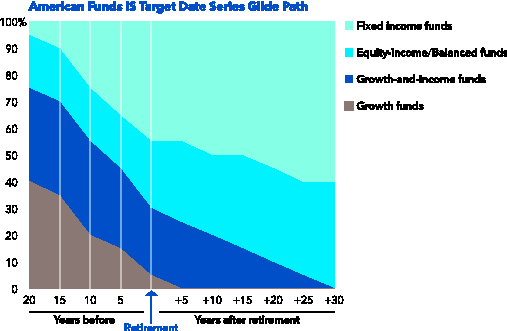
The investment adviser anticipates that each fund will invest its assets within a range that deviates no more than 10% above or below the investment approach set forth above. For example, a 40% target allocation to growth funds is not expected to be greater than 50% nor less than 30%. The investment adviser will continuously monitor the funds and may make modifications to either the investment approach or the underlying fund allocations that the investment adviser believes could benefit shareholders.
Each fund may, from time to time, take temporary defensive positions by holding all, or a significant portion, of its assets in cash, cash equivalents or other securities that may be deemed appropriate by the fund’s investment adviser.
While it has no present intention to do so, the Series’ board may change the fund’s investment objectives without shareholder approval upon 60 days’ written notice to shareholders. Each fund will attempt to achieve its investment objectives by investing in a mix of American Funds in different combinations and weightings. The underlying American Funds represent a variety of fund categories, including growth funds, growth-and-income funds, equity-income funds, balanced funds and fixed income funds. Further, the fund categories represent differing investment objectives. For example, growth funds seek long-term growth primarily through investing in both U.S. stocks and stocks of issuers domiciled outside the U.S. Growth-and-income funds seek long-term growth and income primarily through investments in stocks. Equity-income and balanced funds generally strive for income and growth through stocks and/or bond investments, while bond funds seek current income through bond investments.
When a fund invests in one or more underlying American Funds, it will invest in Class R-6 shares of such underlying funds. Class R-6 shares have relatively low expenses, which reduce overall fund expenses. An investor holding the underlying funds directly and in the same proportions as the fund would incur lower overall expenses but would not receive the benefit of the portfolio management and other services provided by the fund. In addition to investing in a mix of American Funds, each fund may also invest in funds in the Series or other
American Funds Insurance Series – Target Date Series / Prospectus 37
funds managed by Capital Research and Management Company and its affiliates, subject to obtaining any necessary regulatory approvals and notifying shareholders in advance.
Investments in each fund are subject to risks related to the investment adviser's allocation choices. The selection of the underlying funds and the allocation of the fund's assets could cause the fund to lose value or its results to lag relevant benchmarks or other funds with similar objectives. For investors who are close to, or in retirement, each fund's equity exposure may result in investment volatility that could reduce an investor's available retirement assets at a time when the investor has a need to withdraw funds. For investors who are further from retirement, there is a risk a fund may invest too much in investments designed to ensure capital conservation and current income, which may prevent the investor from meeting his or her retirement goals.
The success of each fund will be impacted by the results of the underlying funds. For this reason, it is important to understand the risks associated with investing in the underlying funds. For more information, please refer to “Information regarding the underlying funds” section of this prospectus.
An underlying fund may also hold cash or cash equivalents. The percentage of an underlying fund invested in such holdings varies and depends on various factors, including market conditions and purchases and redemptions of fund shares. For temporary defensive purposes, an underlying fund may hold all, or a significant portion, of its assets in cash, cash equivalents (including shares of money market or similar funds managed by the investment adviser or its affiliates) or other securities that may be deemed appropriate by the underlying fund’s investment adviser. The investment adviser may determine that it is appropriate to take such action in response to certain circumstances, such as periods of market turmoil. A larger amount of such holdings could negatively affect an underlying fund’s investment results in a period of rising market prices. A larger percentage of cash or cash equivalents could reduce an underlying fund’s magnitude of loss in the event of falling market prices and provide liquidity to make additional investments or to meet redemptions.
An underlying fund’s daily cash balance may be invested in one or more money market or similar funds managed by the investment adviser or its affiliates (“Central Funds”). Shares of Central Funds are not offered to the public and are only purchased by the fund’s investment adviser and its affiliates and other funds, investment vehicles and accounts managed by the fund’s investment adviser and its affiliates. When an underlying fund invests in Central Funds, the fund bears its proportionate share of the expenses of the Central Funds in which the underlying fund invests but does not bear additional management fees through the underlying fund’s investment in such Central Funds. The investment results of the portions of an underlying fund’s assets invested in the Central Funds will be based upon the investment results of the Central Funds.
The following are principal risks associated with the fund’s investment strategies.
Allocation risk — Investments in the fund are subject to risks related to the investment adviser’s allocation choices. The selection of the underlying funds and the allocation of the fund’s assets could cause the fund to lose value or its results to lag relevant benchmarks or other funds with similar objectives. For investors who are close to or in retirement, the fund’s equity exposure may result in investment volatility that could reduce an investor’s available retirement assets at a time when the investor has a need to withdraw funds. For investors who are farther from retirement, there is a risk the fund may invest too much in investments designed to ensure capital conservation and current income, which may prevent the investor from meeting his or her retirement goals.
Fund structure — The fund invests in underlying funds and incurs expenses related to the underlying funds. In addition, investors in the fund will incur fees to pay for certain expenses related to the operations of the fund. An investor holding the underlying funds directly and in the same proportions as the fund would incur lower overall expenses but would not receive the benefit of the portfolio management and other services provided by the fund.
Underlying fund risks — Because the fund’s investments consist of underlying funds, the fund’s risks are directly related to the risks of the underlying funds. For this reason, it is important to understand the risks associated with investing in the underlying funds, as described below.
The following are principal risks associated with the underlying funds’ investment strategies.
Market conditions — The prices of, and the income generated by, the common stocks, bonds and other securities held by the underlying funds may decline – sometimes rapidly or unpredictably – due to various factors, including events or conditions affecting the general economy or particular industries; overall market changes; local, regional or global political, social or economic instability; governmental, governmental agency or central bank responses to economic conditions; and currency exchange rate, interest rate and commodity price fluctuations.
Economies and financial markets throughout the world are interconnected. Economic, financial or political events, trading and tariff arrangements, wars, terrorism, cybersecurity events, natural disasters and other circumstances in one country or region could have impacts on global economies or markets. As a result, whether or not the underlying fund invests in securities of issuers located in or with significant exposure to the countries affected, the value and liquidity of the underlying fund’s investments may be negatively affected by developments in other countries and regions.
Issuer risks — The prices of, and the income generated by, securities held by the underlying funds may decline in response to various factors directly related to the issuers of such securities, including reduced demand for an issuer’s goods or services, poor management performance, major litigation related to the issuer, changes in government regulations affecting the issuer or its competitive environment and strategic initiatives such as mergers, acquisitions or dispositions and the market response to any such initiatives.
Investing in stocks — Investing in stocks may involve larger price swings and greater potential for loss than other types of investments. As a result, the value of the underlying funds may be subject to sharp, short-term declines in value. Income provided by an underlying fund may
American Funds Insurance Series – Target Date Series / Prospectus 38
be reduced by changes in the dividend policies of, and the capital resources available at, the companies in which the underlying fund invests. As the fund nears its target date, a decreasing proportion of the fund’s assets will be invested in underlying funds that invest primarily in stocks. Accordingly, these risks are expected to be more significant the further the fund is removed from its target date and are expected to lessen as the fund approaches its target date.
Investing in debt instruments — The prices of, and the income generated by, bonds and other debt securities held by an underlying fund may be affected by changing interest rates and by changes in the effective maturities and credit ratings of these securities.
Rising interest rates will generally cause the prices of bonds and other debt securities to fall. A general rise in interest rates may cause investors to sell debt securities on a large scale, which could also adversely affect the price and liquidity of debt securities and could also result in increased redemptions from the fund. Falling interest rates may cause an issuer to redeem, call or refinance a debt security before its stated maturity, which may result in the fund failing to recoup the full amount of its initial investment and having to reinvest the proceeds in lower yielding securities. Longer maturity debt securities generally have greater sensitivity to changes in interest rates and may be subject to greater price fluctuations than shorter maturity debt securities.
Bonds and other debt securities are also subject to credit risk, which is the possibility that the credit strength of an issuer or guarantor will weaken or be perceived to be weaker, and/or an issuer of a debt security will fail to make timely payments of principal or interest and the security will go into default. A downgrade or default affecting any of the underlying funds’ securities could cause the value of the underlying funds’ shares to decrease. Lower quality debt securities generally have higher rates of interest and may be subject to greater price fluctuations than higher quality debt securities. Credit risk is gauged, in part, by the credit ratings of the debt securities in which the underlying fund invests. However, ratings are only the opinions of the rating agencies issuing them and are not guarantees as to credit quality or an evaluation of market risk. The underlying funds’ investment adviser relies on its own credit analysts to research issuers and issues in seeking to assess credit and default risks. These risks will be more significant as the fund approaches and passes its target date because a greater proportion of the fund’s assets will consist of underlying funds that primarily invest in bonds.
Investing in lower rated debt instruments — Lower rated bonds and other lower rated debt securities generally have higher rates of interest and involve greater risk of default or price declines due to changes in the issuer’s creditworthiness than those of higher quality debt securities. The market prices of these securities may fluctuate more than the prices of higher quality debt securities and may decline significantly in periods of general economic difficulty. These risks may be increased with respect to investments in lower quality, higher yielding debt securities rated Ba1 or below and BB+ or below by Nationally Recognized Statistical Rating Organizations designated by the fund’s investment adviser or unrated but determined by the investment adviser to be of equivalent quality, which securities are sometimes referred to as “junk bonds.”
Liquidity risk — Certain underlying fund holdings may be or become difficult or impossible to sell, particularly during times of market turmoil. Liquidity may be impacted by the lack of an active market for a holding, legal or contractual restrictions on resale, or the reduced number and capacity of market participants to make a market in such holding. Market prices for less liquid or illiquid holdings may be volatile, and reduced liquidity may have an adverse impact on the market price of such holdings. Additionally, the sale of less liquid or illiquid holdings may involve substantial delays (including delays in settlement) and additional costs and the underlying fund may be unable to sell such holdings when necessary to meet its liquidity needs or may be forced to sell at a loss.
Investing in mortgage-related and other asset-backed securities — Mortgage-related securities, such as mortgage-backed securities, and other asset-backed securities, include debt obligations that represent interests in pools of mortgages or other income-bearing assets, such as residential mortgage loans, home equity loans, mortgages on commercial buildings, consumer loans and equipment leases. In addition to the risks associated with investments in debt instruments generally (for example, credit, extension and interest rate risks), such securities often involve risks that are different from or more acute than the risks associated with investing in other types of debt securities. Mortgage-backed and other asset-backed securities are subject to changes in the payment patterns of borrowers of the underlying debt, potentially increasing the volatility of the securities and an underlying fund’s net asset value. When interest rates fall, borrowers are more likely to refinance or prepay their debt before its stated maturity. This may result in an underlying fund having to reinvest the proceeds in lower yielding securities, effectively reducing the underlying fund’s income. Conversely, if interest rates rise and borrowers repay their debt more slowly than expected, the time in which the mortgage-backed and other asset-backed securities are paid off could be extended, reducing an underlying fund’s cash available for reinvestment in higher yielding securities. Mortgage-backed securities are also subject to the risk that underlying borrowers will be unable to meet their obligations and the value of property that secures the mortgages may decline in value and be insufficient, upon foreclosure, to repay the associated loans. Investments in asset-backed securities are subject to similar risks, as well as additional risks associated with the nature of the assets and the servicing of those assets.
Investing in securities backed by the U.S. government — Securities backed by the U.S. Treasury or the full faith and credit of the U.S. government are guaranteed only as to the timely payment of interest and principal when held to maturity. Accordingly, the current market values for these securities will fluctuate with changes in interest rates and the credit rating of the U.S. government. Securities issued by government-sponsored entities and federal agencies and instrumentalities that are not backed by the full faith and credit of the U.S. government are neither issued nor guaranteed by the U.S. government.
Investing in future delivery contracts — An underlying fund may enter into contracts, such as to-be-announced contracts and mortgage dollar rolls, that involve an underlying fund selling mortgage-related securities and simultaneously contracting to repurchase similar securities for delivery at a future date at a predetermined price. This can increase the underlying fund’s market exposure, and the market price of the securities that the underlying fund contracts to repurchase could drop below their purchase price. While an underlying fund can preserve and generate capital through the use of such contracts by, for example, realizing the difference between the sale price and the future purchase price, the income generated by the underlying fund may be reduced by engaging in such transactions. In addition, these transactions may increase the turnover rate of the underlying fund.
American Funds Insurance Series – Target Date Series / Prospectus 39
Investing in small companies — Investing in smaller companies may pose additional risks. For example, it is often more difficult to value or dispose of small company stocks and more difficult to obtain information about smaller companies than about larger companies. Furthermore, smaller companies often have limited product lines, operating histories, markets and/or financial resources, may be dependent on one or a few key persons for management, and can be more susceptible to losses. Moreover, the prices of their stocks may be more volatile than stocks of larger, more established companies, particularly during times of market turmoil.
Investing outside the United States — Securities of issuers domiciled outside the United States, or with significant operations or revenues outside the United States, may lose value because of adverse political, social, economic or market developments (including social instability, regional conflicts, terrorism and war) in the countries or regions in which the issuers operate or generate revenue. These securities may also lose value due to changes in foreign currency exchange rates against the U.S. dollar and/or currencies of other countries. Issuers of these securities may be more susceptible to actions of foreign governments, such as nationalization, currency blockage or the imposition of price controls or punitive taxes, each of which could adversely impact the value of these securities. Securities markets in certain countries may be more volatile and/or less liquid than those in the United States. Investments outside the United States may also be subject to different accounting practices and different regulatory, legal and reporting standards and practices, and may be more difficult to value, than those in the United States. In addition, the value of investments outside the United States may be reduced by foreign taxes, including foreign withholding taxes on interest and dividends. Further, there may be increased risks of delayed settlement of securities purchased or sold by an underlying fund. The risks of investing outside the United States may be heightened in connection with investments in emerging markets.
Investing in emerging markets — Investing in emerging markets may involve risks in addition to and greater than those generally associated with investing in the securities markets of developed countries. For instance, emerging market countries may have less developed legal and accounting systems than those in developed countries. The governments of these countries may be less stable and more likely to impose capital controls, nationalize a company or industry, place restrictions on foreign ownership and on withdrawing sale proceeds of securities from the country, and/or impose punitive taxes that could adversely affect the prices of securities. In addition, the economies of these countries may be dependent on relatively few industries that are more susceptible to local and global changes. Securities markets in these countries can also be relatively small and have substantially lower trading volumes. As a result, securities issued in these countries may be more volatile and less liquid, and may be more difficult to value, than securities issued in countries with more developed economies and/or markets. Less certainty with respect to security valuations may lead to additional challenges and risks in calculating the underlying fund’s net asset value. Additionally, emerging markets are more likely to experience problems with the clearing and settling of trades and the holding of securities by banks, agents and depositories that are less established than those in developed countries.
Investing in derivatives — The use of derivatives involves a variety of risks, which may be different from, or greater than, the risks associated with investing in traditional securities, such as stocks and bonds. Changes in the value of a derivative may not correlate perfectly with, and may be more sensitive to market events than, the underlying asset, rate or index, and a derivative instrument may expose the underlying fund to losses in excess of its initial investment. Derivatives may be difficult to value, difficult for the underlying fund to buy or sell at an opportune time or price and difficult, or even impossible, to terminate or otherwise offset. The underlying fund’s use of derivatives may result in losses to the underlying fund, and investing in derivatives may reduce the underlying fund’s returns and increase the underlying fund’s price volatility. The underlying fund’s counterparty to a derivative transaction (including, if applicable, the underlying fund’s clearing broker, the derivatives exchange or the clearinghouse) may be unable or unwilling to honor its financial obligations in respect of the transaction. In certain cases, the underlying fund may be hindered or delayed in exercising remedies against or closing out derivative instruments with a counterparty, which may result in additional losses.
Management — The investment adviser to the fund and to the underlying funds actively manages each underlying fund’s investments. Consequently, the underlying funds are subject to the risk that the methods and analyses, including models, tools and data, employed by the investment adviser in this process may be flawed or incorrect and may not produce the desired results. This could cause an underlying fund to lose value or its investment results to lag relevant benchmarks or other funds with similar objectives.
The following are additional risks associated with investing in the underlying funds.
Interest rate risk — The values and liquidity of the securities held by the fund may be affected by changing interest rates. For example, the values of these securities may decline when interest rates rise and increase when interest rates fall. Longer maturity debt securities generally have greater sensitivity to changes in interest rates and may be subject to greater price fluctuations than shorter maturity debt securities. The fund may invest in variable and floating rate securities. When the fund holds variable or floating rate securities, a decrease in market interest rates will adversely affect the income received from such securities and the net asset value of the fund’s shares. Although the values of such securities are generally less sensitive to interest rate changes than those of other debt securities, the value of variable and floating rate securities may decline if their interest rates do not rise as quickly, or as much, as market interest rates. Conversely, floating rate securities will not generally increase in value if interest rates decline. During periods of extremely low short-term interest rates, the fund may not be able to maintain a positive yield and, given the current low interest rate environment, risks associated with rising rates are currently heightened.
Investing in income-oriented stocks — The value of the underlying fund‘s securities and income provided by the underlying fund may be reduced by changes in the dividend policies of, and the capital resources available for dividend payments at, the companies in which the underlying fund invests.
Investing in futures contracts — In addition to the risks generally associated with investing in derivative instruments, futures contracts are subject to the creditworthiness of the clearing organizations, exchanges and futures commission merchants with which the underlying fund transacts. Additionally, although futures require only a small initial investment in the form of a deposit of initial margin, the amount of a potential loss on a futures contract could greatly exceed the initial amount invested. While futures contracts are generally liquid
American Funds Insurance Series – Target Date Series / Prospectus 40
instruments, under certain market conditions futures may be deemed to be illiquid. For example, the underlying fund may be temporarily prohibited from closing out its position in a futures contract if intraday price change limits or limits on trading volume imposed by the applicable futures exchange are triggered. If the underlying fund is unable to close out a position on a futures contract, the underlying fund would remain subject to the risk of adverse price movements until the underlying fund is able to close out the futures position. The ability of the underlying fund to successfully utilize futures contracts may depend in part upon the ability of the underlying fund’s investment adviser to accurately forecast interest rates and other economic factors and to assess and predict the impact of such economic factors on the futures in which the underlying fund invests. If the investment adviser incorrectly forecasts economic developments or incorrectly predicts the impact of such developments on the futures in which it invests, the underlying fund could be exposed to the risk of loss.
Investing in swaps — Swaps, including interest rate swaps and credit default swap indices, or CDX, are subject to many of the risks generally associated with investing in derivative instruments. Additionally, although swaps require no or only a small initial investment in the form of a deposit of initial margin, the amount of a potential loss on a swap contract could greatly exceed the initial amount invested. The use of swaps involves the risk that the investment adviser will not accurately predict anticipated changes in interest rates or other economic factors, which may result in losses to the underlying fund. If the underlying fund enters into a bilaterally negotiated swap transaction, the counterparty may fail to perform in accordance with the terms of the swap agreement. If a counterparty defaults on its obligations under a swap agreement, the underlying fund may lose any amount it expected to receive from the counterparty, potentially including amounts in excess of the underlying fund’s initial investment. Certain swap transactions are subject to mandatory central clearing or may be eligible for voluntary central clearing. Although clearing interposes a central clearinghouse as the ultimate counterparty to each participant’s swap, central clearing will not eliminate (but may decrease) counterparty risk relative to uncleared bilateral swaps. Some swaps, such as CDX, may be dependent on both the individual credit of the underlying fund’s counterparty and on the credit of one or more issuers of any underlying assets. If the underlying fund does not correctly evaluate the creditworthiness of its counterparty and, where applicable, of issuers of any underlying reference assets, the underlying fund’s investment in a swap may result in losses to the underlying fund.
Exposure to country, region, industry or sector — Subject to the fund’s investment limitations, the underlying fund may have significant exposure to a particular country, region, industry or sector. Such exposure may cause the underlying fund to be more impacted by risks relating to and developments affecting the country, region, industry or sector, and thus its net asset value may be more volatile, than a fund without such levels of exposure. For example, if the underlying fund has significant exposure in a particular country, then social, economic, regulatory or other issues that negatively affect that country may have a greater impact on the underlying fund than on a fund that is more geographically diversified.
American Funds Insurance Series – Target Date Series / Prospectus 41
Information regarding the underlying funds The investment objectives and principal investment strategies of the underlying funds are summarized below and on the following pages. They should not be construed as an offer to purchase or sell the underlying funds. For additional and more current information regarding the underlying funds, investors should read the current prospectuses and statements of additional information of the underlying funds.
Each fund will invest in some, but not all, of the underlying funds listed below. Some underlying funds may not be underlying investments for any fund, while others may serve as underlying investments for multiple funds.
The fund relies on the professional judgment of the investment adviser to the fund and to the underlying funds to make decisions about the underlying fund’s portfolio investments. The basic investment philosophy of the investment adviser is to seek to invest in attractively valued companies that, in its opinion, represent good, long-term investment opportunities. The investment adviser believes that an important way to accomplish this is through fundamental analysis, which may include meeting with company executives and employees, suppliers, customers and competitors. Securities may be sold when the investment adviser believes that they no longer represent relatively attractive investment opportunities.
Underlying funds – Growth funds
AMCAP Fund® The fund’s investment objective is to provide you with long-term growth of capital.
The fund invests primarily in common stocks of U.S. companies that have solid long-term growth records and the potential for good future growth. The fund may invest in common stocks and other securities of issuers domiciled outside the United States to a limited extent.
EuroPacific Growth Fund® The fund’s investment objective is to provide you with long-term growth of capital.
The fund invests primarily in common stocks of issuers in Europe and the Pacific Basin that the investment adviser believes have the potential for growth. Growth stocks are stocks that the investment adviser believes have the potential for above-average capital appreciation.
Normally the fund will invest at least 80% of its net assets in securities of issuers in Europe and the Pacific Basin. A country will be considered part of Europe if it is part of the MSCI European indexes, and part of the Pacific Basin if any of its borders touches the Pacific Ocean. In determining the domicile of an issuer, the fund’s investment adviser will consider the domicile determination of a leading provider of global indexes, such as Morgan Stanley Capital International, and may also take into account such factors as where the company’s securities are listed and where the company is legally organized, maintains principal corporate offices, conducts its principal operations and/or generates revenues. The fund may invest a portion of its assets in common stocks and other securities of companies in emerging markets.
The Growth Fund of America® The fund’s investment objective is to provide you with growth of capital.
The fund invests primarily in common stocks and seeks to invest in companies that appear to offer superior opportunities for growth of capital. The fund invests primarily in common stocks of large and mid-capitalization issuers. The fund may invest up to 25% of its assets in securities of issuers domiciled outside the United States.
The New Economy Fund® The investment objective of the fund is long-term growth of capital. Current income is a secondary consideration. Effective February 1, 2020, the fund’s investment objective will be long-term growth of capital. However, current income will remain a consideration in the management of the fund.
The fund seeks to achieve its objectives by investing in securities of companies that can benefit from innovation, exploit new technologies or provide products and services that meet the demands of an evolving global economy.
In pursuing its investment objectives, the fund invests primarily in common stocks that the investment adviser believes have the potential for growth. The fund also invests in common stocks with the potential to pay dividends. However, current income is not expected to be significant, particularly in low yield environments. The fund may invest a significant portion of its assets in issuers based outside the United States, including those based in developing countries.
New Perspective Fund® The fund’s investment objective is to provide you with long-term growth of capital.
The fund seeks to take advantage of investment opportunities generated by changes in international trade patterns and economic and political relationships by investing in common stocks of companies located around the world.
In pursuing its primary investment objective, the fund invests primarily in common stocks that the investment adviser believes have the potential for growth. In pursuing its secondary objective, the fund invests in common stocks of companies with the potential to pay dividends in the future.
American Funds Insurance Series – Target Date Series / Prospectus 42
New World Fund® The fund’s investment objective is long-term capital appreciation.
The fund invests primarily in common stocks of companies with significant exposure to countries with developing economies and/or markets. The securities markets of these countries may be referred to as emerging markets. The fund may also invest in debt securities of issuers, including issuers of lower rated bonds (rated Ba1 or below and BB+ or below by Nationally Recognized Statistical Rating Organizations designated by the fund’s investment adviser or unrated but determined to be of equivalent quality by the fund’s investment adviser), with exposure to these countries. Bonds rated Ba1 or BB+ or below are sometimes referred to as “junk bonds.”
Under normal market conditions, the fund will invest at least 35% of its assets in equity and debt securities of issuers primarily based in qualified countries that have developing economies and/or markets.
In determining whether a country is qualified, the fund’s investment adviser will consider such factors as the country’s per capita gross domestic product, the percentage of the country’s economy that is industrialized, market capital as a percentage of gross domestic product, the overall regulatory environment, the presence of government regulation limiting or banning foreign ownership, and restrictions on repatriation of initial capital, dividends, interest and/or capital gains.
The fund may invest in equity securities of any company, regardless of where it is based, if the fund’s investment adviser determines that a significant portion of the company’s assets or revenues (generally 20% or more) is attributable to developing countries. In addition, the fund may invest in nonconvertible debt securities of issuers, including issuers of lower rated bonds and government bonds, that are primarily based in qualified countries or that have a significant portion of their assets or revenues attributable to developing countries. The fund may also, to a limited extent, invest in securities of issuers based in nonqualified developing countries.
SMALLCAP World Fund® The fund’s investment objective is to provide you with long-term growth of capital.
Normally the fund invests at least 80% of its net assets in growth-oriented common stocks and other equity-type securities (such as preferred stocks, convertible preferred stocks and convertible bonds) of companies with small market capitalizations. The investment adviser currently defines “small market capitalization” companies to be companies with market capitalizations of $6.0 billion or less. The investment adviser has periodically re-evaluated and adjusted this definition and may continue to do so in the future. The fund may continue to hold securities of a portfolio company that subsequently appreciates above the small market capitalization threshold. Because of this, the fund may have less than 80% of its net assets in small market capitalization stocks at any given time. Under normal circumstances, the fund will invest a significant portion of its assets outside the United States, including in emerging markets.
Underlying funds – Growth-and-income funds
American Mutual Fund® The fund strives for the balanced accomplishment of three objectives: current income, growth of capital and conservation of principal.
The fund seeks to invest primarily in common stocks of companies that are likely to participate in the growth of the American economy and whose dividends appear to be sustainable. The fund invests primarily in securities of issuers domiciled in the United States and Canada.
The fund’s equity investments are limited to securities of companies that are included on its eligible list. Securities are added to, or deleted from, the eligible list based upon a number of factors, such as the fund’s investment objectives and policies, whether a company is deemed to be an established company of sufficient quality and a company’s dividend payment prospects. Although the fund focuses on investments in medium to larger capitalization companies, the fund’s investments are not limited to a particular capitalization size.
The fund may also invest in bonds and other debt securities, including those issued by the U.S. government and by federal agencies and instrumentalities. Debt securities purchased by the fund are rated investment grade or better or determined by the fund’s investment adviser to be of equivalent quality.
Capital World Growth and Income Fund® The fund’s investment objective is to provide you with long-term growth of capital while providing current income.
The fund invests primarily in common stocks of well-established companies located around the world, many of which have the potential to pay dividends. The fund invests, on a global basis, in common stocks that are denominated in U.S. dollars or other currencies. Under normal market circumstances the fund will invest a significant portion of its assets in securities of issuers domiciled outside the United States, including those based in developing countries.
The fund is designed for investors seeking both capital appreciation and income. In pursuing its objective, the fund tends to invest in stocks that the investment adviser believes to be relatively resilient to market declines.
American Funds Insurance Series – Target Date Series / Prospectus 43
Fundamental Investors® The fund’s investment objective is to achieve long-term growth of capital and income.
The fund seeks to invest primarily in common stocks of companies that appear to offer superior opportunities for capital growth and most of which have a history of paying dividends. In addition, the fund may invest significantly in securities of issuers domiciled outside the United States.
International Growth and Income FundSM The fund’s investment objective is to provide you with long-term growth of capital while providing current income.
The fund invests primarily in stocks of larger, well-established companies domiciled outside the United States, including in emerging markets and developing countries, that the investment adviser believes have the potential for growth and/or to pay dividends. The fund currently intends to invest at least 90% of its assets in securities of issuers domiciled outside the United States and whose securities are listed primarily on exchanges outside the United States and in cash and cash equivalents (including shares of money market or similar funds managed by the investment adviser or its affiliates) and securities held as collateral issued by U.S. issuers. The fund therefore expects to be invested in numerous countries outside the United States.
The fund is designed for investors seeking both capital appreciation and income. In pursuing its objective, the fund focuses on stocks of companies with strong earnings that pay dividends.
The Investment Company of America® The fund’s investment objectives are to achieve long-term growth of capital and income.
The fund invests primarily in common stocks, most of which have a history of paying dividends. The fund’s equity investments are limited to securities of companies that are included on its eligible list. Securities are added to, or deleted from, the eligible list based upon a number of factors, such as the fund’s investment objectives and policies, whether a company is deemed to be an established company of sufficient quality and a company’s dividend payment prospects. Although the fund focuses on investments in medium to larger capitalization companies, the fund’s investments are not limited to a particular capitalization size. In the selection of common stocks and other securities for investment, potential for capital appreciation and future dividends are given more weight than current yield.
The fund may invest up to 15% of its assets, at the time of purchase, in securities of issuers domiciled outside the United States.
Washington Mutual Investors FundSM The fund’s investment objective is to produce income and to provide an opportunity for growth of principal consistent with sound common stock investing.
The fund invests primarily in common stocks of established companies that are listed on, or meet the financial listing requirements of, the New York Stock Exchange and have a strong record of earnings and dividends. The fund strives to accomplish its objective through fundamental research, careful selection and broad diversification. In the selection of common stocks and other securities for investment, current and potential income as well as the potential for long-term capital appreciation are considered. The fund seeks to provide an above-average yield in its quarterly income distribution in relation to the S&P 500 Index (a broad, unmanaged index). The fund strives to maintain a fully invested, diversified portfolio, consisting primarily of high-quality common stocks.
The fund has Investment Standards originally based upon criteria established by the United States District Court for the District of Columbia for determining eligibility under the Court’s Legal List procedure, which was in effect for many years. The fund has an “Eligible List” — based on the Investment Standards — of investments considered appropriate for a prudent investor seeking opportunities for income and growth of principal consistent with common stock investing. The investment adviser generates and maintains the Eligible List in compliance with the fund’s Investment Standards and selects the fund’s investments exclusively from the issuers on the Eligible List.
American Funds Insurance Series – Target Date Series / Prospectus 44
Underlying funds – Equity-income and balanced funds
American Balanced Fund® The investment objectives of the fund are: (1) conservation of capital, (2) current income and (3) long-term growth of capital and income.
The fund uses a balanced approach to invest in a broad range of securities, including common stocks and investment-grade bonds (rated Baa3 or better or BBB- or better by Nationally Recognized Statistical Rating Organizations designated by the fund’s investment adviser or unrated but determined to be of equivalent quality). The fund also invests in securities issued and guaranteed by the U.S. government and by federal agencies and instrumentalities. The fund invests in debt securities with a wide range of maturities. In addition, the fund may invest a portion of its assets in common stocks, most of which have a history of paying dividends, bonds and other securities of issuers domiciled outside the United States.
Normally the fund will maintain at least 50% of the value of its assets in common stocks and at least 25% of the value of its assets in debt securities, including money market securities. Although the fund focuses on investments in medium to larger capitalization companies, the fund’s investments are not limited to a particular capitalization size.
American Funds Global Balanced FundSM This fund seeks the balanced accomplishment of three objectives: long-term growth of capital, conservation of principal and current income.
As a balanced fund with global scope, the fund seeks to invest in equity and debt securities around the world that offer the opportunity for growth and/or provide dividend income, while also constructing the portfolio to protect principal and limit volatility.
Normally the fund will maintain at least 45% of the value of its assets in common stocks and other equity investments. Although the fund’s equity investments focus on medium to larger capitalization companies, the fund’s investments are not limited to a particular capitalization size.
Normally the fund will invest at least 25% of the value of its assets in bonds and other debt securities (including money market instruments). These will consist of investment-grade securities (rated Baa3 or better or BBB– or better by Nationally Recognized Statistical Rating Organizations designated by the fund’s investment adviser or unrated but determined to be of equivalent quality by the fund’s investment adviser).
The fund will allocate its assets among various countries, including the United States (but in no fewer than three countries). Under normal market conditions, the fund will invest at least 40% of its net assets in issuers outside the United States, unless market conditions are not deemed favorable by the fund’s investment adviser, in which case the fund would invest at least 30% of its net assets in issuers outside the United States.
The fund’s ability to invest in issuers outside the United States includes investing in emerging markets.
The fund may invest in bonds and other debt securities, including securities issued and guaranteed by the U.S. government, securities issued by federal agencies and instrumentalities and securities backed by mortgages or other assets. The fund may also invest in securities of governments, agencies, corporations and other entities domiciled outside the United States. These investments will typically be denominated in currencies other than U.S. dollars.
Capital Income Builder® The fund has two primary investment objectives. It seeks (1) to provide a level of current income that exceeds the average yield on U.S. stocks generally and (2) to provide a growing stream of income over the years. The fund’s secondary objective is to provide growth of capital.
The fund normally will invest at least 90% of its assets in income-producing securities (with at least 50% of its assets in common stocks and other equity securities). The fund invests primarily in a broad range of income-producing securities, including common stocks and bonds. In seeking to provide a level of current income that exceeds the average yield on U.S. stocks, the fund generally looks to the average yield on stocks of companies listed on the S&P 500 Index. The fund may also invest significantly in common stocks, bonds and other securities of issuers domiciled outside the United States.
The Income Fund of America® The fund’s investment objectives are to provide you with current income while secondarily striving for capital growth.
Normally the fund invests primarily in income-producing securities. These include equity securities, such as dividend-paying common stocks, and debt securities, such as interest-paying bonds.
Generally at least 60% of the fund’s assets will be invested in common stocks and other equity-type securities. However, the composition of the fund’s investments in equity, debt and cash or money market instruments may vary substantially depending on various factors, including market conditions. The fund may also invest up to 30% of its assets in equity securities of issuers domiciled outside the United States, including issuers in developing countries. In addition, the fund may invest up to 20% of its assets in lower quality, higher yielding nonconvertible debt securities (rated Ba1 and BB+ or below by Nationally Recognized Statistical Rating Organizations designated by the fund’s investment adviser or unrated but determined to be of equivalent quality by the fund’s investment adviser); such securities are sometimes referred to as “junk bonds.” The fund may also invest up to 10% of its assets in debt securities of issuers domiciled outside the United States; however, these securities must be denominated in U.S. dollars.
American Funds Insurance Series – Target Date Series / Prospectus 45
Underlying funds – Fixed income funds
American Funds Inflation Linked Bond Fund® The fund’s investment objective is to provide inflation protection and income consistent with investment in inflation-linked securities.
The fund seeks to provide inflation protection and income by investing primarily in inflation-linked securities. Normally, at least 80% of the fund’s assets will be invested in inflation-linked bonds issued by U.S. and non-U.S. governments, their agencies or instrumentalities, and corporations. Inflation-linked bonds are structured to protect against inflation by linking the bond’s principal and interest payments to an inflation index so that principal and interest adjust to reflect changes in the index. For example, U.S. Treasury Inflation-Protected Securities (TIPS) are linked to the Consumer Price Index for Urban Consumers (CPURNSA). Other sovereign governments and corporations also issue inflation-linked securities that are tied to their own local consumer price index or the CPURNSA.
The fund will invest at least 80% of its assets in securities guaranteed or sponsored by the U.S. government without regard to the quality rating assigned to the U.S. government by a Nationally Recognized Statistical Rating Organization (NRSRO). To the extent the fund invests in other debt securities, the fund will invest in debt securities with quality ratings of Baa3 or better or BBB- or better by NRSROs designated by the fund’s investment adviser or in debt securities that are unrated but determined to be of equivalent quality by the fund’s investment adviser. The fund may invest in debt securities with a wide range of maturities.
The fund may also invest in certain derivative instruments, such as futures contracts and swaps. A derivative is a financial contract, the value of which is based on the value of an underlying financial asset (such as a stock, bond or currency), a reference rate or a market index. The fund may invest in a derivative only if, in the opinion of the investment adviser, the expected risks and rewards of the proposed investment are consistent with the investment objective and strategies of the fund as disclosed in this prospectus and in the fund’s statement of additional information.
American Funds Mortgage Fund® The fund’s investment objective is to provide current income and preservation of capital.
Normally at least 80% of the fund’s assets will be invested in mortgage-related securities, including securities collateralized by mortgage loans and contracts for future delivery of such securities (such as to be announced contracts and mortgage dollar rolls). The fund will invest primarily in mortgage-related securities that are sponsored or guaranteed by the U.S. government, such as securities issued by government-sponsored entities that are not backed by the full faith and credit of the U.S. government, and nongovernment mortgage-related securities that are rated in the Aaa or AAA rating category (by Nationally Recognized Statistical Rating Organizations designated by the fund’s investment adviser) or unrated but determined to be of equivalent quality by the fund’s investment adviser. The fund may also invest in debt issued by federal agencies. In the case of to be announced contracts, each contract for future delivery is normally of short duration.
The fund may also invest in certain derivative instruments. A derivative is a financial contract, the value of which is based on the value of an underlying financial asset (such as a stock, bond or currency), a reference rate or a market index. The fund may invest in a derivative only if, in the opinion of the investment adviser, the expected risks and rewards of the proposed investment are consistent with the investment objective and strategies of the fund as disclosed in this prospectus and in the fund’s statement of additional information.
American High-Income Trust® The fund’s primary investment objective is to provide you with a high level of current income. Its secondary investment objective is capital appreciation.
The fund invests primarily in higher yielding and generally lower quality debt securities (rated Ba1 or below or BB+ or below by Nationally Recognized Statistical Rating Organizations or unrated but determined by the fund’s investment adviser to be of equivalent quality), including corporate loan obligations. Such securities are sometimes referred to as “junk bonds.” The fund may also invest a portion of its assets in securities of issuers domiciled outside the United States.
The fund may also invest in certain derivative instruments. A derivative is a financial contract, the value of which is based on the value of an underlying financial asset (such as a stock, bond or currency), a reference rate or a market index. The fund may invest in a derivative only if, in the opinion of the investment adviser, the expected risks and rewards of the proposed investment are consistent with the investment objectives and strategies of the fund as disclosed in this prospectus and in the fund’s statement of additional information.
The fund is designed for investors seeking a high level of current income and who are able to tolerate greater credit risk and price fluctuations than those that exist in funds investing in higher quality debt securities.
The Bond Fund of America® The fund’s investment objective is to provide as high a level of current income as is consistent with the preservation of capital.
The fund seeks to maximize your level of current income and preserve your capital by investing primarily in bonds. Normally the fund invests at least 80% of its assets in bonds and other debt securities, which may be represented by other investment instruments, including derivatives. The fund invests a majority of its assets in debt securities rated A3 or better or A- or better by Nationally Recognized Statistical Ratings Organizations designated by the fund’s investment adviser, or in debt securities that are unrated but determined to be of equivalent quality by the fund’s investment adviser, including U.S. government securities, money market instruments or cash.
The fund may invest in debt securities and mortgage-backed securities issued by government-sponsored entities and federal agencies and instrumentalities that are not backed by the full faith and credit of the U.S. government. The fund invests in debt securities with a wide range of maturities.
The fund may invest in inflation-linked bonds issued by U.S. and non-U.S. governments, their agencies or instrumentalities, and corporations. Inflation-linked bonds are structured to protect against inflation by linking the bond’s principal and interest payments to an inflation index, such as the Consumer Price Index for Urban Consumers, so that principal and interest adjust to reflect changes in the index.
American Funds Insurance Series – Target Date Series / Prospectus 46
The fund may invest in certain derivative instruments, such as futures contracts and swaps. A derivative is a financial contract, the value of which is based on the value of an underlying financial asset (such as a stock, bond or currency), a reference rate or a market index. The fund may invest in a derivative only if, in the opinion of the investment adviser, the expected risks and rewards of the proposed investment are consistent with the investment objective and strategies of the fund as disclosed in this prospectus and in the fund’s statement of additional information.
The fund may invest up to 10% of its assets in debt securities rated Ba1 or below and BB+ or below by Nationally Recognized Statistical Ratings Organizations designated by the fund’s investment adviser, or in debt securities that are unrated but determined to be of equivalent quality by the fund’s investment adviser. Securities rated Ba1 or below and BB+ or below are sometimes referred to as “junk bonds.”
Capital World Bond Fund® The fund’s investment objective is to provide you, over the long term, with a high level of total return consistent with prudent investment management. Total return comprises the income generated by the fund and the changes in the market value of the fund’s investments.
Under normal market circumstances, the fund will invest at least 80% of its assets in bonds and other debt securities, which may be represented by other investment instruments, including derivatives. The fund invests primarily in debt securities, including asset-backed and mortgage-backed securities and securities of governmental, supranational and corporate issuers denominated in various currencies, including U.S. dollars. The fund may invest substantially in securities of issuers domiciled outside the United States, including issuers domiciled in developing countries. Normally, the fund will invest substantially in investment-grade bonds (rated Baa3 or better or BBB– or better by Nationally Recognized Statistical Rating Organizations designated by the fund’s investment adviser or unrated but determined to be of equivalent quality by the fund’s investment adviser). The fund may also invest up to 25% of its assets in lower quality, higher yielding debt securities (rated Ba1 or below and BB+ or below by Nationally Recognized Statistical Rating Organizations designated by the fund’s investment adviser or unrated but determined to be of equivalent quality by the fund’s investment adviser). Such securities are sometimes referred to as “junk bonds.” The total return of the fund will be the result of interest income, changes in the market value of the fund’s investments and changes in the values of other currencies relative to the U.S. dollar. The fund may invest in debt securities of any maturity or duration.
The fund may invest in certain derivative instruments. A derivative is a financial contract, the value of which is based on the value of an underlying financial asset (such as a stock, bond or currency), a reference rate or a market index. The fund may invest in a derivative only if, in the opinion of the investment adviser, the expected risks and rewards of the proposed investment are consistent with the investment objective and strategies of the fund as disclosed in this prospectus and in the fund’s statement of additional information.
The fund is nondiversified, which allows it to invest a greater percentage of its assets in any one issuer than would otherwise be the case. However, the fund intends to limit its investments in the securities of any single issuer.
Intermediate Bond Fund of America® The fund’s investment objective is to provide you with current income consistent with the maturity and quality standards described in its prospectus and preservation of capital.
The fund will invest at least 80% of its assets in bonds (bonds include any debt instrument and money market instrument) which may be represented by other investment instruments, including derivatives. The fund maintains a portfolio of bonds, other debt securities and money market instruments having a dollar-weighted average effective maturity of no less than three years and no greater than five years under normal market conditions. The fund invests primarily in bonds and other debt securities with quality ratings of A– or better or A3 or better (by a Nationally Recognized Statistical Rating Organization designated by the fund’s investment adviser) or unrated but determined to be of equivalent quality by the fund’s investment adviser. The fund may invest up to 10% of its assets in bonds and other debt securities rated in the BBB or Baa rating category (by a Nationally Recognized Statistical Rating Organization designated by the fund’s investment adviser) or unrated but determined to be of equivalent quality by the fund’s investment adviser.
The fund primarily invests in debt securities denominated in U.S. dollars. These include securities issued and guaranteed by the U.S. government, debt securities and mortgage-backed securities issued by government-sponsored entities and federal agencies, and instrumentalities that are not backed by the full faith and credit of the U.S. government. In addition, the fund may invest in mortgage-backed securities issued by private issuers and asset-backed securities (securities backed by assets such as auto loans, credit card receivables or other providers of credit).
The fund may invest in inflation-linked bonds issued by U.S. and non-U.S. governments, their agencies or instrumentalities, and corporations. Inflation-linked bonds are structured to protect against inflation by linking the bond’s principal and interest payments to an inflation index, such as the Consumer Price Index for Urban Consumers, so that principal and interest adjust to reflect changes in the index.
The fund may also invest in certain derivative instruments. A derivative is a financial contract, the value of which is based on the value of an underlying financial asset (such as a stock, bond or currency), a reference rate or a market index. The fund may invest in a derivative only if, in the opinion of the investment adviser, the expected risks and rewards of the proposed investment are consistent with the investment objective and strategies of the fund as disclosed in this prospectus and in the fund’s statement of additional information.
American Funds Insurance Series – Target Date Series / Prospectus 47
Short-Term Bond Fund of America® The fund’s investment objective is to provide you with current income, consistent with the maturity and quality standards described in its prospectus, and preservation of capital.
The fund will invest at least 80% of its assets in bonds (bonds include any debt instrument and cash equivalents, and may be represented by other investment instruments, including derivatives). The fund maintains a portfolio of bonds, other debt securities and money market instruments having a dollar-weighted average effective maturity no greater than three years and consisting primarily of debt securities rated AA– or Aa3 or better by Nationally Recognized Statistical Rating Organizations designated by the fund’s investment adviser or unrated but determined to be of equivalent quality by the fund’s investment adviser. The fund may invest up to 10% of its assets in debt securities in the A rating category or in unrated securities determined by the fund’s investment adviser to be of equivalent quality.
The fund primarily invests in debt securities denominated in U.S. dollars, including securities issued and guaranteed by the U.S. government, securities of corporate issuers, mortgage-backed securities and debt securities and mortgage-backed securities issued by government sponsored entities and federal agencies and instrumentalities that are not backed by the full faith and credit of the U.S. government. In addition, the fund may invest in asset-backed securities (securities backed by assets such as auto loans, credit card receivables or other providers of credit).
The fund may invest in inflation-linked bonds issued by U.S. and non-U.S. governments, their agencies or instrumentalities, and corporations. Inflation-linked bonds are structured to protect against inflation by linking the bond’s principal and interest payments to an inflation index, such as the Consumer Price Index for Urban Consumers, so that principal and interest adjust to reflect changes in the index.
The fund may also invest in certain derivative instruments. A derivative is a financial contract, the value of which is based on the value of an underlying financial asset (such as a stock, bond or currency), a reference rate or a market index. The fund may invest in a derivative only if, in the opinion of the investment adviser, the expected risks and rewards of the proposed investment are consistent with the investment objective and strategies of the fund as disclosed in this prospectus and in the fund’s statement of additional information.
U.S. Government Securities Fund® The fund’s investment objective is to provide a high level of current income consistent with prudent investment risk and preservation of capital.
Normally at least 80% of the fund’s assets will be invested in securities that are guaranteed or sponsored by the U.S. government, its agencies and instrumentalities, including bonds and other debt securities denominated in U.S. dollars, which may be represented by other investment instruments, including derivatives. The fund may also invest in mortgage-backed securities issued by federal agencies and instrumentalities that are not backed by the full faith and credit of the U.S. government. The fund invests in debt securities with a wide range of maturities.
The fund may invest in inflation-linked bonds issued by U.S. and non-U.S. governments, their agencies or instrumentalities, and corporations. Inflation-linked bonds are structured to protect against inflation by linking the bond’s principal and interest payments to an inflation index, such as the Consumer Price Index for Urban Consumers, so that principal and interest adjust to reflect changes in the index.
The fund may invest in certain derivative instruments. A derivative is a financial contract, the value of which is based on the value of an underlying financial asset (such as a stock, bond or currency), a reference rate or a market index. The fund may invest in a derivative only if, in the opinion of the investment adviser, the expected risks and rewards of the proposed investment are consistent with the investment objective and strategies of the fund as disclosed in this prospectus and in the fund’s statement of additional information.
American Funds Insurance Series – Target Date Series / Prospectus 48
Management and organization
Investment adviser Capital Research and Management Company, an experienced investment management organization founded in 1931, serves as the investment adviser to the Series and other mutual funds, including the underlying American Funds. Capital Research and Management Company is a wholly owned subsidiary of The Capital Group Companies, Inc. and is located at 333 South Hope Street, Los Angeles, California 90071. Capital Research and Management Company manages the investment portfolios and business affairs of the Series. As reflected in the "Annual fund operating expenses" table for each fund under "Fees and expenses of the fund," no management fees are paid by each fund to the investment adviser. A discussion regarding the basis for the approval of the Series’ Investment Advisory and Service Agreement by the Series’ board of trustees will be contained in the Series’ annual report to shareholders for the fiscal period ended December 31, 2019.
Capital Research and Management Company manages equity assets through three equity investment divisions and fixed income assets through its fixed income investment division, Capital Fixed Income Investors. The three equity investment divisions — Capital International Investors, Capital Research Global Investors and Capital World Investors — make investment decisions independently of one another.
The equity investment divisions may, in the future, be incorporated as wholly owned subsidiaries of Capital Research and Management Company. In that event, Capital Research and Management Company would continue to be the investment adviser, and day-to-day investment management of equity assets would continue to be carried out through one or more of these subsidiaries. Although not currently contemplated, Capital Research and Management Company could incorporate its fixed income investment division in the future and engage it to provide day-to-day investment management of fixed income assets. Capital Research and Management Company and each of the funds it advises have received an exemptive order from the U.S. Securities and Exchange Commission that allows Capital Research and Management Company to use, upon approval of the funds’ boards, its management subsidiaries and affiliates to provide day-to-day investment management services to the funds, including making changes to the management subsidiaries and affiliates providing such services. The Series’ shareholders approved this arrangement; however, there is no assurance that Capital Research and Management Company will incorporate its investment divisions or exercise any authority granted to it under the exemptive order.
In addition, shareholders of the Series have approved a proposal to reorganize the Series into a Delaware statutory trust. However, the Series reserved the right to delay implementing the reorganization and has elected to do so.
Portfolio holdings A description of the funds’ policies and procedures regarding disclosure of information about their portfolio holdings is available in the statement of additional information.
The Capital SystemSM for the underlying funds Capital Research and Management Company uses a system of multiple portfolio managers in managing mutual fund assets for the underlying funds. Under this approach, the portfolio of each underlying fund is divided into segments managed by individual managers. In addition, Capital Research and Management Company’s investment analysts may make investment decisions with respect to a portion of an underlying fund’s portfolio. Investment decisions are subject to the underlying fund’s objective(s), policies and restrictions and the oversight of the appropriate investment-related committees of Capital Research and Management Company and its investment divisions.
Certain senior members of Capital Fixed Income Investors, the investment adviser’s fixed income investment division, serve on the Portfolio Strategy Group. The group utilizes a research-driven process with input from the investment adviser’s analysts, portfolio managers and economists to define investment themes on a range of macroeconomic factors, including duration, yield curve and sector allocation. Where applicable, the investment decisions made by an underlying fund’s fixed income portfolio managers are informed by the investment themes discussed by the group.
American Funds Insurance Series – Target Date Series / Prospectus 49
Portfolio management for the target date series Capital Research and Management Company is the investment adviser to the target date series. For each fund in the target date series, the Target Date Solutions Committee develops the allocation approach and selects the underlying funds in which each fund invests.
The table below shows the investment experience and role in management for each of the target date series’ investment professionals.
| Investment professional | Investment experience | Experience in the target date series | Role in management of the target date series |
| [__] | [__] |
Less than 1 year (since the target date series’ inception) |
Serves as a member of the Target Date Solutions Committee |
| [__] | [__] |
Less than 1 year (since the target date series’ inception) |
Serves as a member of the Target Date Solutions Committee |
| [__] | [__] |
Less than 1 year (since the target date series’ inception) |
Serves as a member of the Target Date Solutions Committee |
| [__] | [__] |
Less than 1 year (since the target date series’ inception) |
Serves as a member of the Target Date Solutions Committee |
| [__] | [__] |
Less than 1 year (since the target date series’ inception) |
Serves as a member of the Target Date Solutions Committee |
| [__] | [__] |
Less than 1 year (since the target date series’ inception) |
Serves as a member of the Target Date Solutions Committee |
| [__] | [__] |
Less than 1 year (since the target date series’ inception) |
Serves as a member of the Target Date Solutions Committee |
Information regarding the investment professionals’ compensation, their ownership of securities in the Series and other accounts they manage is in the statement of additional information.
American Funds Insurance Series – Target Date Series / Prospectus 50
Purchases and redemptions of shares Shares of the Series are currently offered only to insurance company separate accounts as well as so-called “feeder funds” under master-feeder arrangements sponsored by insurance companies as underlying investments for such insurance companies’ variable annuity contracts and variable life insurance policies. All such shares may be purchased or redeemed by the insurance company separate accounts (or feeder funds) at net asset value without any sales or redemption charges. These purchases and redemptions are made at the price next determined after such purchases and redemptions of units of the separate accounts (or feeder funds). The Series typically expects to remit redemption proceeds one business day following receipt and acceptance of a redemption order, regardless of the method the Series uses to make such payment (e.g., check, wire or automated clearing house transfer). However, payment may take longer than one business day and may take up to seven days as generally permitted by the Investment Company Act of 1940, as amended (“1940 Act”). Under the 1940 Act, the Series may be permitted to pay redemption proceeds beyond seven days under certain limited circumstances.
Under normal conditions, the Series typically expects to meet shareholder redemptions by monitoring the Series’ portfolio and redemption activities and by regularly holding a reserve of highly liquid assets, such as cash or cash equivalents. The Series may use additional methods to meet shareholder redemptions, if they become necessary. These methods may include, but are not limited to, the sale of portfolio assets, the use of overdraft protection afforded by the Series’ custodian bank, borrowing from a line of credit and making payment with fund securities or other fund assets rather than in cash (as further discussed in the following paragraph).
Although payment of redemptions normally will be in cash, the Series may pay the redemption price wholly or partly with portfolio securities or other fund assets under conditions and circumstances determined by the Series’ board of trustees. On the same redemption date, some shareholders may be paid in whole or in part in securities (which may differ among those shareholders), while other shareholders may be paid entirely in cash. In general, in-kind redemptions to affiliated shareholders will as closely as practicable represent the affiliated shareholder’s pro rata share of the Series’ securities, subject to certain exceptions. Securities distributed in-kind to unaffiliated shareholders will be selected by the investment adviser in a manner the investment adviser deems to be fair and reasonable to the Series’ shareholders. The disposal of the securities received in-kind may be subject to brokerage costs and, until sold, such securities remain at market risk and liquidity risk, including the risk that such securities are or become difficult to sell. If the Series pays your redemption with illiquid or less liquid securities, you will bear the risk of not being able to sell such securities.
Frequent trading of fund shares The Series and American Funds Distributors, Inc., the Series’ distributor, reserve the right to reject any purchase order for any reason. The funds are not designed to serve as vehicles for frequent trading. Frequent trading of fund shares may lead to increased costs to the funds and less efficient management of the funds’ portfolios, potentially resulting in dilution of the value of the shares held by long-term shareholders. Accordingly, purchases, including those that are part of exchange activity, that the Series or American Funds Distributors has determined could involve actual or potential harm to a fund may be rejected.
The Series, through its transfer agent, American Funds Service Company, has agreements with the Series’ insurance relationships to maintain its surveillance procedures that are designed to detect frequent trading in fund shares. The agreements generally require the insurance companies to (i) provide, upon request from a fund, the Series or their agent, certain identifying and account information regarding contract owners who invest in fund shares through an insurance company account and (ii) execute instructions from a fund, the Series or their agent to restrict further purchases or exchanges of fund shares by a contract owner who the Series has identified as having engaged in potentially harmful market timing or frequent trading. Under these procedures, various analytics are used to evaluate factors that may be indicative of frequent trading. For example, transactions in fund shares that exceed certain monetary thresholds may be scrutinized. American Funds Service Company may work with the insurance company separate accounts or feeder funds to apply their procedures that American Funds Service Company believes are reasonably designed to enforce the frequent trading policies of the Series. You should refer to disclosures provided by the insurance company with which you have a contract to determine the specific trading restrictions that apply to you.
Under its procedures, American Funds Service Company also may review transactions that occur close in time to other transactions in the same account or in multiple accounts under common ownership or influence. Trading activity that is identified through these procedures or as a result of any other information available to the funds will be evaluated to determine whether such activity might constitute frequent trading. These procedures may be modified from time to time as appropriate to improve the detection of frequent trading, to facilitate monitoring for frequent trading in particular retirement plans or other accounts and to comply with applicable laws.
In addition to the Series’ broad ability to restrict potentially harmful trading as described previously, the Series’ board of trustees has adopted a “purchase blocking policy” under which any contract owner redeeming units representing a beneficial interest in any fund (including redemptions that are part of an exchange transaction) having a value of $5,000 or more will be precluded from investing units of beneficial interest in that fund (including investments that are part of an exchange transaction) for 30 calendar days after the redemption transaction. Under this purchase blocking policy, certain purchases will not be prevented and certain redemptions will not trigger a purchase block, such as:
| · | purchases and redemptions of units representing a beneficial interest in a fund having a value of less than $5,000; |
| · | retirement plan contributions, loans and distributions (including hardship withdrawals) identified as such on the retirement plan recordkeeper’s system; |
| · | purchases and redemptions in community foundation accounts; |
| · | purchase transactions involving in-kind transfers of fund shares, if the entity maintaining the contract owner’s account is able to identify the transaction as one of these types of transactions; and |
American Funds Insurance Series – Target Date Series / Prospectus 51
| · | systematic redemptions and purchases if the entity maintaining the contract owner’s account is able to identify the transaction as a systematic redemption or purchase. |
Generally, purchases and redemptions will not be considered “systematic” unless the transaction is prescheduled for a specific date.
The Series reserves the right to waive the purchase blocking policy if American Funds Service Company determines that its surveillance procedures are adequate to detect frequent trading in fund shares in such accounts.
If American Funds Service Company identifies any activity that may constitute frequent trading, it reserves the right to contact the insurance company separate account or feeder fund and request that the separate account or feeder fund either provide information regarding an account owner’s transactions or restrict the account owner’s trading. If American Funds Service Company is not satisfied that insurance company separate account or feeder fund has taken appropriate action, American Funds Service Company may terminate the separate account’s or feeder fund’s ability to transact in fund shares.
There is no guarantee that all instances of frequent trading in fund shares will be prevented.
Notwithstanding the Series’ surveillance procedures and purchase blocking policy described above, all transactions in fund shares remain subject to the right of the Series, American Funds Distributors and American Funds Service Company to restrict potentially abusive trading generally (including the types of transactions described above that will not be prevented or trigger a block under the purchase blocking policy). See the statement of additional information for more information about how American Funds Service Company may address other potentially abusive trading activity in the Series.
Valuing shares The net asset value of each share class of each fund is calculated based upon the net asset values of the underlying funds in which each fund invests. The prospectuses for the underlying funds explain the circumstances under which the underlying funds will use fair value pricing and the effects of using fair value pricing. The net asset value of each share class of a fund is the value of a single share of that class. Each fund calculates the net asset value each day the New York Stock Exchange is open for trading as of approximately 4 p.m. New York time, the normal close of regular trading. If, for example, the New York Stock Exchange closes at 1 p.m. New York time, the funds’ net asset values would still be determined as of 4 p.m. New York time. In this example, portfolio securities traded on the New York Stock Exchange would be valued at their closing prices unless the investment adviser determines that a “fair value” adjustment is appropriate due to subsequent events.
Equity securities are valued primarily on the basis of market quotations, and debt securities are valued primarily on the basis of prices from third-party pricing services. Futures contracts are valued primarily on the basis of settlement prices. The underlying funds have adopted procedures for making fair value determinations if market quotations or prices from third-party pricing services, as applicable, are not readily available or are not considered reliable. For example, if events occur between the close of markets outside the United States and the close of regular trading on the New York Stock Exchange that, in the opinion of the investment adviser, materially affect the value of any of the underlying funds’ equity securities that trade principally in those international markets, those securities will be valued in accordance with fair value procedures. Similarly, fair value procedures may be employed if an issuer defaults on its debt securities and there is no market for its securities. Use of these procedures is intended to result in more appropriate net asset values and, where applicable, to reduce potential arbitrage opportunities otherwise available to short-term investors.
Because the underlying funds may hold securities that are listed primarily on foreign exchanges that trade on weekends or days when the funds do not price their shares, the values of securities held in the funds may change on days when you will not be able to purchase or redeem fund shares.
Shares of the funds will be purchased or sold at the net asset value next determined after receipt of requests from the appropriate insurance company. Requests received by the appropriate insurance company prior to 4 p.m. New York time and communicated by the insurance company to the Series or its agent will be purchased or sold at that day’s net asset value.
American Funds Insurance Series – Target Date Series / Prospectus 52
Plan of distribution The Series has not adopted (and does not presently intend to adopt) a plan of distribution, or “12b-1 plan,” for Class 1 shares. However, the Series has adopted 12b-1 plans for Class 1A and Class 2 shares. Under the plans, the Series may finance activities primarily intended to sell shares, provided the categories of expenses are approved in advance by the Series’ board of trustees. The plans provide for annual expenses of .25% for Class 1A and Class 2 shares; however, the Series’ board of trustees has not authorized any payments under the plan for Class 1A shares. Amounts paid under the 12b-1 plan for Class 2 shares are used by insurance company contract issuers to cover distribution expenses and/or the expenses of certain contract owner services. The estimated 12b-1 fees expected to be paid by each fund, as a percentage of average net assets, for the current fiscal year, are indicated in the prospectus in the Annual Fund Operating Expenses table for each fund. Since these fees are paid out of each fund’s assets on an ongoing basis, over time they may cost you more than paying other types of sales charges or service fees and reduce the return of an investment in Class 2 shares.
Other compensation to dealers American Funds Distributors, at its expense, provides additional compensation to insurance companies. These payments may be made, at the discretion of American Funds Distributors, to insurance companies (or their affiliates) that have sold shares of the funds of the American Funds Insurance Series and American Funds as the exclusive underlying investments to their variable contracts. A number of factors will be considered in determining payments, including the sales, assets, and the quality of the company’s relationship with American Funds Distributors. The payment will be determined using a formula applied consistently to insurance companies based on the relevant facts and circumstances. The level of payments made to a qualifying firm in any given year will vary and (excluding payments for meetings as described below) will represent the sum of (a) up to .14% of the current year’s American Funds Insurance Series new deposits in the contracts, (b) up to .07% of the current and previous year’s American Funds Insurance Series new deposits in the contracts, and (c) up to .0084% of American Funds Insurance Series assets attributable to the contracts, with an adjustment made for the quality of the company’s relationship with American Funds Distributors. Aggregate payments made by American Funds Distributors to insurance companies may also change from year to year. Only assets and deposits in variable annuity contracts that offer exclusively shares of the American Funds Insurance Series and American Funds are included in the formula. Further, assets for which the insurance company, or an affiliated broker-dealer, acts as an ERISA investment fiduciary are generally excluded from the formula. American Funds Distributors makes these payments to help defray the costs incurred by qualifying insurance companies in connection with efforts to educate its sales force about the American Funds Insurance Series so that they help financial advisers make recommendations and provide services that are suitable and meet contractholders needs. These payments may also be made to help defray the costs associated with the insurance company’s provision of account related services and activities. American Funds Distributors will, on an annual basis, determine the advisability of continuing these payments.
Firms receiving additional compensation payments must sign a letter acknowledging the purpose of the payment and American Funds Distributors’ goal that the payment will help facilitate education of the firm’s sales force about the American Funds Insurance Series and American Funds to help advisors make suitable recommendations and better serve their clients who invest in the funds as underlying investments to variable contracts. The letters generally require the firms to (1) have significant assets invested in the American Funds, (2) provide American Funds Distributors broad access to their sales force and product platforms and develop a business plan to achieve such access, and (3) agree to maintain American Funds within their existing products.
American Funds Distributors may also pay expenses associated with meetings and other training and educational opportunities conducted by insurance companies, selling dealers, advisory platform providers and other intermediaries to facilitate educating financial advisors and shareholders about the American Funds. For example, some of these expenses may include, but not be limited to, meeting sponsor fees, meeting location fees, and fees to obtain lists of financial advisors to better tailor training and education opportunities.
If investment advisers, distributors or other affiliates of mutual funds pay additional compensation or other incentives to insurance companies in differing amounts, insurance companies and the advisors with which they interact may have financial incentives for recommending a particular mutual fund over other mutual funds or investments. You should consult with your financial advisor and review carefully any disclosure by your financial advisor’s firm as to compensation received.
American Funds Insurance Series – Target Date Series / Prospectus 53
Fund expenses In periods of market volatility, assets of the funds and/or the applicable underlying funds may decline significantly, causing total annual fund operating expenses (as a percentage of the value of your investment) to become higher than the numbers shown in the Annual Fund Operating Expenses tables in this prospectus.
Each fund will invest in Class R-6 of the applicable underlying funds. Accordingly, fees and expenses of the underlying funds reflect current expenses of the Class R-6 shares of the underlying funds. The “Other expenses” items in the Annual Fund Operating Expenses tables in this prospectus are based on estimated amounts for the current fiscal year. These items include third-party expenses, such as custodial, legal, audit, accounting, regulatory reporting and pricing vendor services. In addition, solely with respect to Class 1A shares, the “Other expenses” items include fees for administrative services provided by the insurance companies that include Class 1A shares of any of the funds as underlying investments in their variable contracts. Each fund will pay an insurance administration fee of .25% of Class 1A share assets to these insurance companies for providing certain services pursuant to an insurance administrative services plan adopted by the Series.
Distributions and taxes Each fund of the Series intends to qualify as a “regulated investment company” under the Internal Revenue Code. In any fiscal year in which a fund so qualifies and distributes to shareholders its investment company taxable income and net realized capital gain, the fund itself is relieved of federal income tax.
It is the Series’ policy to distribute to the shareholders (the insurance company separate accounts) all of its investment company taxable income and capital gain for each fiscal year.
See the applicable contract prospectus for information regarding the federal income tax treatment of the contracts and distributions to the separate accounts.
American Funds Insurance Series – Target Date Series / Prospectus 54
Notes
American Funds Insurance Series – Target Date Series / Prospectus 55
Other fund information Shares of the Series are currently offered to insurance company separate accounts funding both variable annuity contracts and variable life insurance policies. Interests of various contract owners participating in the Series may be in conflict. The board of trustees of the Series will monitor for the existence of any material conflicts and determine what action, if any, should be taken. Shares may be purchased or redeemed by the separate accounts without any sales or redemption charges at net asset value.
Annual/Semi-annual report to shareholders The shareholder reports contain additional information about the Series, including financial statements, investment results, portfolio holdings, a discussion of market conditions and the Series’ investment strategies, and the independent registered public accounting firm’s report (in the annual report).
Statement of additional information (SAI) and codes of ethics The current SAI, as amended from time to time, contains more detailed information about the Series, including the funds’ financial statements, and is incorporated by reference into this prospectus. This means that the current SAI, for legal purposes, is part of this prospectus. The codes of ethics describe the personal investing policies adopted by the Series, the Series’ investment adviser and its affiliated companies.
The codes of ethics and current SAI are on file with the U.S. Securities and Exchange Commission (SEC). These and other related materials about the Series are available for review on the EDGAR database on the SEC’s website at sec.gov or, after payment of a duplicating fee, via email request to [email protected].
The current SAI and annual/semi-annual reports to shareholders can be found online at capitalgroup.com/afis and may be available on the website of the company that issued your insurance contract. You also may request a free copy of these documents or the codes of ethics by calling American Funds at (800) 421-9900, ext. 65413 or writing to the Secretary at 333 South Hope Street, Los Angeles, California 90071.
| [__] Printed in USA [__] | Investment Company File No. 811-03857 |
SUBJECT TO COMPLETION, DATED SEPTEMBER 13, 2019
THE INFORMATION IN THIS PROSPECTUS IS NOT COMPLETE AND MAY BE CHANGED. WE MAY NOT SELL THESE SECURITIES UNTIL THE REGISTRATION STATEMENT FILED WITH THE U.S. SECURITIES AND EXCHANGE COMMISSION IS EFFECTIVE. THIS PROSPECTUS IS NOT AN OFFER TO SELL THESE SECURITIES AND IS NOT A SOLICITATION OF AN OFFER TO BUY THESE SECURITIES IN ANY STATE WHERE SUCH OFFER OR SALE IS NOT PERMITTED.
|
American Funds Insurance Series® Target Date SeriesSM Prospectus [December 6, 2019] |
 |
| American Funds IS 2035 Target Date FundSM | |
| American Funds IS 2030 Target Date FundSM | |
| American Funds IS 2025 Target Date FundSM | |
| American Funds IS 2020 Target Date FundSM | |
| American Funds IS 2015 Target Date FundSM | |
| American Funds IS 2010 Target Date FundSM | |
Table of contents
| Summaries: | Investment objectives, strategies and risks | 37 | ||
| American Funds IS 2035 Target Date Fund | 1 | Information regarding the underlying funds | 42 | |
| American Funds IS 2030 Target Date Fund | 7 | Management and organization | 49 | |
| American Funds IS 2025 Target Date Fund | 13 | Purchases and redemptions of shares | 51 | |
| American Funds IS 2020 Target Date Fund | 19 | Plan of distribution | 53 | |
| American Funds IS 2015 Target Date Fund | 25 | Other compensation to dealers | 53 | |
| American Funds IS 2010 Target Date Fund | 31 | Fund expenses | 54 | |
| Distributions and taxes | 54 |
Beginning on January 1, 2021, as permitted by regulations adopted by the U.S. Securities and Exchange Commission, you may not receive paper copies of the series’ shareholder reports from the insurance company that offers your contract unless you specifically request paper copies from the insurance company or from your financial intermediary. Instead, the shareholder reports will be made available on a website, and the insurance company will notify you by mail each time a report is posted and provide you with a website link to access the report. Instructions for requesting paper copies will be provided by your insurance company. If you have already elected to receive shareholder reports electronically, you will not be affected by this change and do not need to take any action. You may elect to receive shareholder reports and other communications from the insurance company electronically by following the instructions provided by the insurance company.
You may elect to receive paper copies of all future reports free of charge from the insurance company. You can inform the insurance company that you wish to continue receiving paper copies of your shareholder reports by following the instructions provided by the insurance company. Your election to receive paper reports will apply to all investment options available under your contract.
| The U.S. Securities and Exchange Commission has not approved or disapproved of these securities. Further, it has not determined that this prospectus is accurate or complete. Any representation to the contrary is a criminal offense. |
American Funds IS 2035 Target Date Fund
Investment objectives Depending on the proximity to its target date, the fund will seek to achieve the following objectives to varying degrees: growth, income and conservation of capital. The fund will increasingly emphasize income and conservation of capital by investing a greater portion of its assets in bond, equity-income and balanced funds as it approaches and passes its target date. In this way, the fund seeks to balance total return and stability over time.
Fees and expenses of the fund This table describes the fees and expenses that you may pay if you buy and hold an interest in Class 4 shares of the fund. It does not reflect insurance contract fees and expenses. If insurance contract fees and expenses were reflected, expenses shown would be higher.
| Annual fund operating expenses (expenses that you pay each year as a percentage of the value of your investment) | Class 4 |
| Management fees | None |
| Distribution fees | [__]% |
| Other expenses1 | [__] |
| Acquired (underlying) fund fees and expenses | [__] |
| Total annual fund operating expenses | [__] |
1 Based on estimated amounts for the current fiscal year.
Example This example is intended to help you compare the cost of investing in Class 4 shares of the fund with the cost of investing in other mutual funds.
The example assumes that you invest $10,000 in the fund for the time periods indicated and then redeem all of your shares at the end of those periods. The example also assumes that your investment has a 5% return each year and that the fund’s operating expenses remain the same. The example does not reflect insurance contract expenses. If insurance contract expenses were reflected, expenses shown would be higher. Although your actual costs may be higher or lower, based on these assumptions your costs would be:
| 1 year | 3 years | |
| Class 4 | $[__] | $[__] |
Portfolio turnover The fund may pay transaction costs, such as commissions, when it buys and sells securities (or “turns over” its portfolio). A higher portfolio turnover rate may indicate higher transaction costs. These costs, which are not reflected in annual fund operating expenses or in the example, affect the fund’s investment results.
Principal investment strategies The fund will attempt to achieve its investment objectives by investing in a mix of American Funds in different combinations and weightings. The underlying American Funds represent a variety of fund categories, including growth funds, growth-and-income funds, equity-income funds, balanced funds and fixed income funds. The fund categories represent differing investment objectives. For example, growth funds seek long-term growth primarily through investing in both U.S. stocks and stocks of issuers domiciled outside the U.S. Growth-and-income funds seek long-term growth and income primarily through investments in stocks. Equity-income and balanced funds generally strive for income and growth through stocks and/or bond investments, while bond funds seek current income through bond investments. The fund is designed for investors who plan to retire in, or close to, the year designated in the fund’s name.
The investment adviser may periodically rebalance or modify the asset mix of the funds and change the underlying fund investments. According to its current investment approach, the investment adviser will continue to manage the fund for approximately thirty years after the fund reaches its target date. Thirty years after its target date, the fund may be combined with other funds in a single portfolio with an investment allocation that will not evolve beyond that which is in effect at that time.
American Funds Insurance Series – Target Date Series / Prospectus 1
The following chart illustrates the investment approach of the fund by showing how its investment in the various fund categories will change over time. The allocations shown reflect the fund’s target allocations as of [December 6, 2019].
Investment approach

The investment adviser anticipates that the fund will invest its assets within a range that deviates no more than 10% above or below the investment approach set forth above. For example, a 40% target allocation to growth funds is not expected to be greater than 50% nor less than 30%. The investment adviser will continuously monitor the fund and may make modifications to either the investment approach or the underlying fund allocations that the investment adviser believes could benefit shareholders.
American Funds Insurance Series – Target Date Series / Prospectus 2
Principal risks
This section describes the principal risks associated with investing in the fund and its underlying funds. You may lose money by investing in the fund. The likelihood of loss may be greater if you invest for a shorter period of time. Investors in the fund should have a long-term perspective and be able to tolerate potentially sharp declines in value.
The following are principal risks associated with the fund’s investment strategies.
Allocation risk — Investments in the fund are subject to risks related to the investment adviser’s allocation choices. The selection of the underlying funds and the allocation of the fund’s assets could cause the fund to lose value or its results to lag relevant benchmarks or other funds with similar objectives. For investors who are close to or in retirement, the fund’s equity exposure may result in investment volatility that could reduce an investor’s available retirement assets at a time when the investor has a need to withdraw funds. For investors who are farther from retirement, there is a risk the fund may invest too much in investments designed to ensure capital conservation and current income, which may prevent the investor from meeting his or her retirement goals.
Fund structure — The fund invests in underlying funds and incurs expenses related to the underlying funds. In addition, investors in the fund will incur fees to pay for certain expenses related to the operations of the fund. An investor holding the underlying funds directly and in the same proportions as the fund would incur lower overall expenses but would not receive the benefit of the portfolio management and other services provided by the fund.
Underlying fund risks — Because the fund’s investments consist of underlying funds, the fund’s risks are directly related to the risks of the underlying funds. For this reason, it is important to understand the risks associated with investing in the underlying funds, as described below.
The following are principal risks associated with the underlying funds’ investment strategies.
Market conditions — The prices of, and the income generated by, the common stocks, bonds and other securities held by the underlying funds may decline – sometimes rapidly or unpredictably – due to various factors, including events or conditions affecting the general economy or particular industries; overall market changes; local, regional or global political, social or economic instability; governmental, governmental agency or central bank responses to economic conditions; and currency exchange rate, interest rate and commodity price fluctuations.
Issuer risks — The prices of, and the income generated by, securities held by the underlying funds may decline in response to various factors directly related to the issuers of such securities, including reduced demand for an issuer’s goods or services, poor management performance, major litigation related to the issuer, changes in government regulations affecting the issuer or its competitive environment and strategic initiatives such as mergers, acquisitions or dispositions and the market response to any such initiatives.
Investing in stocks — Investing in stocks may involve larger price swings and greater potential for loss than other types of investments. As a result, the value of the underlying funds may be subject to sharp, short-term declines in value. Income provided by an underlying fund may be reduced by changes in the dividend policies of, and the capital resources available at, the companies in which the underlying fund invests. As the fund nears its target date, a decreasing proportion of the fund’s assets will be invested in underlying funds that invest primarily in stocks. Accordingly, these risks are expected to be more significant the further the fund is removed from its target date and are expected to lessen as the fund approaches its target date.
Investing in debt instruments — The prices of, and the income generated by, bonds and other debt securities held by an underlying fund may be affected by changing interest rates and by changes in the effective maturities and credit ratings of these securities.
Rising interest rates will generally cause the prices of bonds and other debt securities to fall. A general rise in interest rates may cause investors to sell debt securities on a large scale, which could also adversely affect the price and liquidity of debt securities and could also result in increased redemptions from the fund. Falling interest rates may cause an issuer to redeem, call or refinance a debt security before its stated maturity, which may result in the fund failing to recoup the full amount of its initial investment and having to reinvest the proceeds in lower yielding securities. Longer maturity debt securities generally have greater sensitivity to changes in interest rates and may be subject to greater price fluctuations than shorter maturity debt securities.
Bonds and other debt securities are also subject to credit risk, which is the possibility that the credit strength of an issuer or guarantor will weaken or be perceived to be weaker, and/or an issuer of a debt security will fail to make timely payments of principal or interest and the security will go into default. A downgrade or default affecting any of the underlying funds’ securities could cause the value of the underlying funds’ shares to decrease. Lower quality debt securities generally have higher rates of interest and may be subject to greater price fluctuations than higher quality debt securities. Credit risk is gauged, in part, by the credit ratings of the debt securities in which the underlying fund invests. However, ratings are only the opinions of the rating agencies issuing them and are not guarantees as to credit quality or an evaluation of market risk. The underlying funds’ investment adviser relies on its own credit analysts to research issuers and issues in seeking to assess credit and default risks. These risks will be more significant as the fund approaches and passes its target date because a greater proportion of the fund’s assets will consist of underlying funds that primarily invest in bonds.
Investing in lower rated debt instruments — Lower rated bonds and other lower rated debt securities generally have higher rates of interest and involve greater risk of default or price declines due to changes in the issuer’s creditworthiness than those of higher quality debt securities. The market prices of these securities may fluctuate more than the prices of higher quality debt securities and may decline significantly in periods of general economic difficulty. These risks may be increased with respect to investments in lower quality, higher yielding debt securities rated Ba1 or below and BB+ or below by Nationally Recognized Statistical Rating Organizations designated by the fund’s investment adviser or unrated but determined by the investment adviser to be of equivalent quality, which securities are sometimes referred to as “junk bonds.”
American Funds Insurance Series – Target Date Series / Prospectus 3
Liquidity risk — Certain underlying fund holdings may be or become difficult or impossible to sell, particularly during times of market turmoil. Liquidity may be impacted by the lack of an active market for a holding, legal or contractual restrictions on resale, or the reduced number and capacity of market participants to make a market in such holding. Market prices for less liquid or illiquid holdings may be volatile, and reduced liquidity may have an adverse impact on the market price of such holdings. Additionally, the sale of less liquid or illiquid holdings may involve substantial delays (including delays in settlement) and additional costs and the underlying fund may be unable to sell such holdings when necessary to meet its liquidity needs or may be forced to sell at a loss.
Investing in mortgage-related and other asset-backed securities — Mortgage-related securities, such as mortgage-backed securities, and other asset-backed securities, include debt obligations that represent interests in pools of mortgages or other income-bearing assets, such as consumer loans or receivables. Such securities often involve risks that are different from or more acute than the risks associated with investing in other types of debt securities. Mortgage-backed and other asset-backed securities are subject to changes in the payment patterns of borrowers of the underlying debt, potentially increasing the volatility of the securities and an underlying fund’s net asset value. When interest rates fall, borrowers are more likely to refinance or prepay their debt before its stated maturity. This may result in an underlying fund having to reinvest the proceeds in lower yielding securities, effectively reducing the underlying fund’s income. Conversely, if interest rates rise and borrowers repay their debt more slowly than expected, the time in which the mortgage-backed and other asset-backed securities are paid off could be extended, reducing an underlying fund’s cash available for reinvestment in higher yielding securities. Mortgage-backed securities are also subject to the risk that underlying borrowers will be unable to meet their obligations and the value of property that secures the mortgages may decline in value and be insufficient, upon foreclosure, to repay the associated loans. Investments in asset-backed securities are subject to similar risks.
Investing in securities backed by the U.S. government — Securities backed by the U.S. Treasury or the full faith and credit of the U.S. government are guaranteed only as to the timely payment of interest and principal when held to maturity. Accordingly, the current market values for these securities will fluctuate with changes in interest rates and the credit rating of the U.S. government. Securities issued by government-sponsored entities and federal agencies and instrumentalities that are not backed by the full faith and credit of the U.S. government are neither issued nor guaranteed by the U.S. government.
Investing in future delivery contracts — An underlying fund may enter into contracts, such as to-be-announced contracts and mortgage dollar rolls, that involve an underlying fund selling mortgage-related securities and simultaneously contracting to repurchase similar securities for delivery at a future date at a predetermined price. This can increase the underlying fund’s market exposure, and the market price of the securities that the underlying fund contracts to repurchase could drop below their purchase price. While an underlying fund can preserve and generate capital through the use of such contracts by, for example, realizing the difference between the sale price and the future purchase price, the income generated by the underlying fund may be reduced by engaging in such transactions. In addition, these transactions may increase the turnover rate of the underlying fund.
Investing in small companies — Investing in smaller companies may pose additional risks. For example, it is often more difficult to value or dispose of small company stocks and more difficult to obtain information about smaller companies than about larger companies. Furthermore, smaller companies often have limited product lines, operating histories, markets and/or financial resources, may be dependent on one or a few key persons for management, and can be more susceptible to losses. Moreover, the prices of their stocks may be more volatile than stocks of larger, more established companies, particularly during times of market turmoil.
Investing outside the United States — Securities of issuers domiciled outside the United States, or with significant operations or revenues outside the United States, may lose value because of adverse political, social, economic or market developments (including social instability, regional conflicts, terrorism and war) in the countries or regions in which the issuers operate or generate revenue. These securities may also lose value due to changes in foreign currency exchange rates against the U.S. dollar and/or currencies of other countries. Issuers of these securities may be more susceptible to actions of foreign governments, such as nationalization, currency blockage or the imposition of price controls or punitive taxes, each of which could adversely impact the value of these securities. Securities markets in certain countries may be more volatile and/or less liquid than those in the United States. Investments outside the United States may also be subject to different accounting practices and different regulatory, legal and reporting standards and practices, and may be more difficult to value, than those in the United States. In addition, the value of investments outside the United States may be reduced by foreign taxes, including foreign withholding taxes on interest and dividends. Further, there may be increased risks of delayed settlement of securities purchased or sold by an underlying fund. The risks of investing outside the United States may be heightened in connection with investments in emerging markets.
Investing in emerging markets — Investing in emerging markets may involve risks in addition to and greater than those generally associated with investing in the securities markets of developed countries. For instance, emerging market countries may have less developed legal and accounting systems than those in developed countries. The governments of these countries may be less stable and more likely to impose capital controls, nationalize a company or industry, place restrictions on foreign ownership and on withdrawing sale proceeds of securities from the country, and/or impose punitive taxes that could adversely affect the prices of securities. In addition, the economies of these countries may be dependent on relatively few industries that are more susceptible to local and global changes. Securities markets in these countries can also be relatively small and have substantially lower trading volumes. As a result, securities issued in these countries may be more volatile and less liquid, and may be more difficult to value, than securities issued in countries with more developed economies and/or markets. Less certainty with respect to security valuations may lead to additional challenges and risks in calculating the underlying fund’s net asset value. Additionally, emerging markets are more likely to experience problems with the clearing and settling of trades and the holding of securities by banks, agents and depositories that are less established than those in developed countries.
Investing in derivatives — The use of derivatives involves a variety of risks, which may be different from, or greater than, the risks associated with investing in traditional securities, such as stocks and bonds. Changes in the value of a derivative may not correlate perfectly with, and may be more sensitive to market events than, the underlying asset, rate or index, and a derivative instrument may expose the underlying
American Funds Insurance Series – Target Date Series / Prospectus 4
fund to losses in excess of its initial investment. Derivatives may be difficult to value, difficult for the underlying fund to buy or sell at an opportune time or price and difficult, or even impossible, to terminate or otherwise offset. The underlying fund’s use of derivatives may result in losses to the underlying fund, and investing in derivatives may reduce the underlying fund’s returns and increase the underlying fund’s price volatility. The underlying fund’s counterparty to a derivative transaction (including, if applicable, the underlying fund’s clearing broker, the derivatives exchange or the clearinghouse) may be unable or unwilling to honor its financial obligations in respect of the transaction. In certain cases, the underlying fund may be hindered or delayed in exercising remedies against or closing out derivative instruments with a counterparty, which may result in additional losses.
Management — The investment adviser to the fund and to the underlying funds actively manages each underlying fund’s investments. Consequently, the underlying funds are subject to the risk that the methods and analyses, including models, tools and data, employed by the investment adviser in this process may be flawed or incorrect and may not produce the desired results. This could cause an underlying fund to lose value or its investment results to lag relevant benchmarks or other funds with similar objectives.
Your investment in the fund is not a bank deposit and is not insured or guaranteed by the Federal Deposit Insurance Corporation or any other governmental agency, entity or person. You should consider how this fund fits into your overall investment program.
American Funds Insurance Series – Target Date Series / Prospectus 5
Investment results Because the fund intends to begin investment operations on [December 6, 2019], information regarding investment results is not available as of the date of this prospectus
Management
Investment adviser Capital Research and Management
CompanySM
Target date solutions committee The investment adviser’s Target Date Solutions Committee develops the allocation approach
and selects the underlying funds in which the fund invests. The members of the Target Date Solutions Committee are:
| Investment professional/ Series title (if applicable) |
Investment professional experience in this fund |
Primary title with investment adviser |
| [__] [__] | Less than 1 year (since the fund’s inception) | [__] |
| [__] [__] | Less than 1 year (since the fund’s inception) | [__] |
| [__] [__] | Less than 1 year (since the fund’s inception) | [__] |
| [__] [__] | Less than 1 year (since the fund’s inception) | [__] |
| [__] [__] | Less than 1 year (since the fund’s inception) | [__] |
| [__] [__] | Less than 1 year (since the fund’s inception) | [__] |
| [__] [__] | Less than 1 year (since the fund’s inception) | [__] |
Tax information See your variable insurance contract prospectus for information regarding the federal income tax treatment of your variable insurance contract and related distributions.
Payments to broker-dealers and other financial intermediaries If you purchase shares of the fund through a broker-dealer or other financial intermediary (such as an insurance company), the fund and the fund’s distributor or its affiliates may pay the intermediary for the sale of fund shares and related services. These payments may create a conflict of interest by influencing the broker-dealer or other intermediary and your individual financial advisor to recommend the fund over another investment. Ask your individual financial advisor or visit your financial intermediary’s website for more information. The fund is not sold directly to the general public but instead is offered as an underlying investment option for variable insurance contracts. In addition to payments described above, the fund and its related companies may make payments to the sponsoring insurance company (or its affiliates) for distribution and/or other services. These payments may be a factor that the insurance company considers in including the fund as an underlying investment option in the variable insurance contract. The prospectus (or other offering document) for your variable insurance contract may contain additional information about these payments.
American Funds Insurance Series – Target Date Series / Prospectus 6
American Funds IS 2030 Target Date Fund
Investment objectives Depending on the proximity to its target date, the fund will seek to achieve the following objectives to varying degrees: growth, income and conservation of capital. The fund will increasingly emphasize income and conservation of capital by investing a greater portion of its assets in bond, equity-income and balanced funds as it approaches and passes its target date. In this way, the fund seeks to balance total return and stability over time.
Fees and expenses of the fund This table describes the fees and expenses that you may pay if you buy and hold an interest in Class 4 shares of the fund. It does not reflect insurance contract fees and expenses. If insurance contract fees and expenses were reflected, expenses shown would be higher.
| Annual fund operating expenses (expenses that you pay each year as a percentage of the value of your investment) | Class 4 |
| Management fees | None |
| Distribution fees | [__]% |
| Other expenses1 | [__] |
| Acquired (underlying) fund fees and expenses | [__] |
| Total annual fund operating expenses | [__] |
1 Based on estimated amounts for the current fiscal year.
Example This example is intended to help you compare the cost of investing in Class 4 shares of the fund with the cost of investing in other mutual funds.
The example assumes that you invest $10,000 in the fund for the time periods indicated and then redeem all of your shares at the end of those periods. The example also assumes that your investment has a 5% return each year and that the fund’s operating expenses remain the same. The example does not reflect insurance contract expenses. If insurance contract expenses were reflected, expenses shown would be higher. Although your actual costs may be higher or lower, based on these assumptions your costs would be:
| 1 year | 3 years | |
| Class 4 | $[__] | $[__] |
Portfolio turnover The fund may pay transaction costs, such as commissions, when it buys and sells securities (or “turns over” its portfolio). A higher portfolio turnover rate may indicate higher transaction costs. These costs, which are not reflected in annual fund operating expenses or in the example, affect the fund’s investment results.
Principal investment strategies The fund will attempt to achieve its investment objectives by investing in a mix of American Funds in different combinations and weightings. The underlying American Funds represent a variety of fund categories, including growth funds, growth-and-income funds, equity-income funds, balanced funds and fixed income funds. The fund categories represent differing investment objectives. For example, growth funds seek long-term growth primarily through investing in both U.S. stocks and stocks of issuers domiciled outside the U.S. Growth-and-income funds seek long-term growth and income primarily through investments in stocks. Equity-income and balanced funds generally strive for income and growth through stocks and/or bond investments, while bond funds seek current income through bond investments. The fund is designed for investors who plan to retire in, or close to, the year designated in the fund’s name.
The investment adviser may periodically rebalance or modify the asset mix of the funds and change the underlying fund investments. According to its current investment approach, the investment adviser will continue to manage the fund for approximately thirty years after the fund reaches its target date. Thirty years after its target date, the fund may be combined with other funds in a single portfolio with an investment allocation that will not evolve beyond that which is in effect at that time.
American Funds Insurance Series – Target Date Series / Prospectus 7
The following chart illustrates the investment approach of the fund by showing how its investment in the various fund categories will change over time. The allocations shown reflect the fund’s target allocations as of [December 6, 2019].
Investment approach

The investment adviser anticipates that the fund will invest its assets within a range that deviates no more than 10% above or below the investment approach set forth above. For example, a 40% target allocation to growth funds is not expected to be greater than 50% nor less than 30%. The investment adviser will continuously monitor the fund and may make modifications to either the investment approach or the underlying fund allocations that the investment adviser believes could benefit shareholders.
American Funds Insurance Series – Target Date Series / Prospectus 8
Principal risks
This section describes the principal risks associated with investing in the fund and its underlying funds. You may lose money by investing in the fund. The likelihood of loss may be greater if you invest for a shorter period of time. Investors in the fund should have a long-term perspective and be able to tolerate potentially sharp declines in value.
The following are principal risks associated with the fund’s investment strategies.
Allocation risk — Investments in the fund are subject to risks related to the investment adviser’s allocation choices. The selection of the underlying funds and the allocation of the fund’s assets could cause the fund to lose value or its results to lag relevant benchmarks or other funds with similar objectives. For investors who are close to or in retirement, the fund’s equity exposure may result in investment volatility that could reduce an investor’s available retirement assets at a time when the investor has a need to withdraw funds. For investors who are farther from retirement, there is a risk the fund may invest too much in investments designed to ensure capital conservation and current income, which may prevent the investor from meeting his or her retirement goals.
Fund structure — The fund invests in underlying funds and incurs expenses related to the underlying funds. In addition, investors in the fund will incur fees to pay for certain expenses related to the operations of the fund. An investor holding the underlying funds directly and in the same proportions as the fund would incur lower overall expenses but would not receive the benefit of the portfolio management and other services provided by the fund.
Underlying fund risks — Because the fund’s investments consist of underlying funds, the fund’s risks are directly related to the risks of the underlying funds. For this reason, it is important to understand the risks associated with investing in the underlying funds, as described below.
The following are principal risks associated with the underlying funds’ investment strategies.
Market conditions — The prices of, and the income generated by, the common stocks, bonds and other securities held by the underlying funds may decline – sometimes rapidly or unpredictably – due to various factors, including events or conditions affecting the general economy or particular industries; overall market changes; local, regional or global political, social or economic instability; governmental, governmental agency or central bank responses to economic conditions; and currency exchange rate, interest rate and commodity price fluctuations.
Issuer risks — The prices of, and the income generated by, securities held by the underlying funds may decline in response to various factors directly related to the issuers of such securities, including reduced demand for an issuer’s goods or services, poor management performance, major litigation related to the issuer, changes in government regulations affecting the issuer or its competitive environment and strategic initiatives such as mergers, acquisitions or dispositions and the market response to any such initiatives.
Investing in stocks — Investing in stocks may involve larger price swings and greater potential for loss than other types of investments. As a result, the value of the underlying funds may be subject to sharp, short-term declines in value. Income provided by an underlying fund may be reduced by changes in the dividend policies of, and the capital resources available at, the companies in which the underlying fund invests. As the fund nears its target date, a decreasing proportion of the fund’s assets will be invested in underlying funds that invest primarily in stocks. Accordingly, these risks are expected to be more significant the further the fund is removed from its target date and are expected to lessen as the fund approaches its target date.
Investing in debt instruments — The prices of, and the income generated by, bonds and other debt securities held by an underlying fund may be affected by changing interest rates and by changes in the effective maturities and credit ratings of these securities.
Rising interest rates will generally cause the prices of bonds and other debt securities to fall. A general rise in interest rates may cause investors to sell debt securities on a large scale, which could also adversely affect the price and liquidity of debt securities and could also result in increased redemptions from the fund. Falling interest rates may cause an issuer to redeem, call or refinance a debt security before its stated maturity, which may result in the fund failing to recoup the full amount of its initial investment and having to reinvest the proceeds in lower yielding securities. Longer maturity debt securities generally have greater sensitivity to changes in interest rates and may be subject to greater price fluctuations than shorter maturity debt securities.
Bonds and other debt securities are also subject to credit risk, which is the possibility that the credit strength of an issuer or guarantor will weaken or be perceived to be weaker, and/or an issuer of a debt security will fail to make timely payments of principal or interest and the security will go into default. A downgrade or default affecting any of the underlying funds’ securities could cause the value of the underlying funds’ shares to decrease. Lower quality debt securities generally have higher rates of interest and may be subject to greater price fluctuations than higher quality debt securities. Credit risk is gauged, in part, by the credit ratings of the debt securities in which the underlying fund invests. However, ratings are only the opinions of the rating agencies issuing them and are not guarantees as to credit quality or an evaluation of market risk. The underlying funds’ investment adviser relies on its own credit analysts to research issuers and issues in seeking to assess credit and default risks. These risks will be more significant as the fund approaches and passes its target date because a greater proportion of the fund’s assets will consist of underlying funds that primarily invest in bonds.
Investing in lower rated debt instruments — Lower rated bonds and other lower rated debt securities generally have higher rates of interest and involve greater risk of default or price declines due to changes in the issuer’s creditworthiness than those of higher quality debt securities. The market prices of these securities may fluctuate more than the prices of higher quality debt securities and may decline significantly in periods of general economic difficulty. These risks may be increased with respect to investments in lower quality, higher yielding debt securities rated Ba1 or below and BB+ or below by Nationally Recognized Statistical Rating Organizations designated by the fund’s investment adviser or unrated but determined by the investment adviser to be of equivalent quality, which securities are sometimes referred to as “junk bonds.”
American Funds Insurance Series – Target Date Series / Prospectus 9
Liquidity risk — Certain underlying fund holdings may be or become difficult or impossible to sell, particularly during times of market turmoil. Liquidity may be impacted by the lack of an active market for a holding, legal or contractual restrictions on resale, or the reduced number and capacity of market participants to make a market in such holding. Market prices for less liquid or illiquid holdings may be volatile, and reduced liquidity may have an adverse impact on the market price of such holdings. Additionally, the sale of less liquid or illiquid holdings may involve substantial delays (including delays in settlement) and additional costs and the underlying fund may be unable to sell such holdings when necessary to meet its liquidity needs or may be forced to sell at a loss.
Investing in mortgage-related and other asset-backed securities — Mortgage-related securities, such as mortgage-backed securities, and other asset-backed securities, include debt obligations that represent interests in pools of mortgages or other income-bearing assets, such as consumer loans or receivables. Such securities often involve risks that are different from or more acute than the risks associated with investing in other types of debt securities. Mortgage-backed and other asset-backed securities are subject to changes in the payment patterns of borrowers of the underlying debt, potentially increasing the volatility of the securities and an underlying fund’s net asset value. When interest rates fall, borrowers are more likely to refinance or prepay their debt before its stated maturity. This may result in an underlying fund having to reinvest the proceeds in lower yielding securities, effectively reducing the underlying fund’s income. Conversely, if interest rates rise and borrowers repay their debt more slowly than expected, the time in which the mortgage-backed and other asset-backed securities are paid off could be extended, reducing an underlying fund’s cash available for reinvestment in higher yielding securities. Mortgage-backed securities are also subject to the risk that underlying borrowers will be unable to meet their obligations and the value of property that secures the mortgages may decline in value and be insufficient, upon foreclosure, to repay the associated loans. Investments in asset-backed securities are subject to similar risks.
Investing in securities backed by the U.S. government — Securities backed by the U.S. Treasury or the full faith and credit of the U.S. government are guaranteed only as to the timely payment of interest and principal when held to maturity. Accordingly, the current market values for these securities will fluctuate with changes in interest rates and the credit rating of the U.S. government. Securities issued by government-sponsored entities and federal agencies and instrumentalities that are not backed by the full faith and credit of the U.S. government are neither issued nor guaranteed by the U.S. government.
Investing in future delivery contracts — An underlying fund may enter into contracts, such as to-be-announced contracts and mortgage dollar rolls, that involve an underlying fund selling mortgage-related securities and simultaneously contracting to repurchase similar securities for delivery at a future date at a predetermined price. This can increase the underlying fund’s market exposure, and the market price of the securities that the underlying fund contracts to repurchase could drop below their purchase price. While an underlying fund can preserve and generate capital through the use of such contracts by, for example, realizing the difference between the sale price and the future purchase price, the income generated by the underlying fund may be reduced by engaging in such transactions. In addition, these transactions may increase the turnover rate of the underlying fund.
Investing in small companies — Investing in smaller companies may pose additional risks. For example, it is often more difficult to value or dispose of small company stocks and more difficult to obtain information about smaller companies than about larger companies. Furthermore, smaller companies often have limited product lines, operating histories, markets and/or financial resources, may be dependent on one or a few key persons for management, and can be more susceptible to losses. Moreover, the prices of their stocks may be more volatile than stocks of larger, more established companies, particularly during times of market turmoil.
Investing outside the United States — Securities of issuers domiciled outside the United States, or with significant operations or revenues outside the United States, may lose value because of adverse political, social, economic or market developments (including social instability, regional conflicts, terrorism and war) in the countries or regions in which the issuers operate or generate revenue. These securities may also lose value due to changes in foreign currency exchange rates against the U.S. dollar and/or currencies of other countries. Issuers of these securities may be more susceptible to actions of foreign governments, such as nationalization, currency blockage or the imposition of price controls or punitive taxes, each of which could adversely impact the value of these securities. Securities markets in certain countries may be more volatile and/or less liquid than those in the United States. Investments outside the United States may also be subject to different accounting practices and different regulatory, legal and reporting standards and practices, and may be more difficult to value, than those in the United States. In addition, the value of investments outside the United States may be reduced by foreign taxes, including foreign withholding taxes on interest and dividends. Further, there may be increased risks of delayed settlement of securities purchased or sold by an underlying fund. The risks of investing outside the United States may be heightened in connection with investments in emerging markets.
Investing in emerging markets — Investing in emerging markets may involve risks in addition to and greater than those generally associated with investing in the securities markets of developed countries. For instance, emerging market countries may have less developed legal and accounting systems than those in developed countries. The governments of these countries may be less stable and more likely to impose capital controls, nationalize a company or industry, place restrictions on foreign ownership and on withdrawing sale proceeds of securities from the country, and/or impose punitive taxes that could adversely affect the prices of securities. In addition, the economies of these countries may be dependent on relatively few industries that are more susceptible to local and global changes. Securities markets in these countries can also be relatively small and have substantially lower trading volumes. As a result, securities issued in these countries may be more volatile and less liquid, and may be more difficult to value, than securities issued in countries with more developed economies and/or markets. Less certainty with respect to security valuations may lead to additional challenges and risks in calculating the underlying fund’s net asset value. Additionally, emerging markets are more likely to experience problems with the clearing and settling of trades and the holding of securities by banks, agents and depositories that are less established than those in developed countries.
Investing in derivatives — The use of derivatives involves a variety of risks, which may be different from, or greater than, the risks associated with investing in traditional securities, such as stocks and bonds. Changes in the value of a derivative may not correlate perfectly with, and may be more sensitive to market events than, the underlying asset, rate or index, and a derivative instrument may expose the underlying
American Funds Insurance Series – Target Date Series / Prospectus 10
fund to losses in excess of its initial investment. Derivatives may be difficult to value, difficult for the underlying fund to buy or sell at an opportune time or price and difficult, or even impossible, to terminate or otherwise offset. The underlying fund’s use of derivatives may result in losses to the underlying fund, and investing in derivatives may reduce the underlying fund’s returns and increase the underlying fund’s price volatility. The underlying fund’s counterparty to a derivative transaction (including, if applicable, the underlying fund’s clearing broker, the derivatives exchange or the clearinghouse) may be unable or unwilling to honor its financial obligations in respect of the transaction. In certain cases, the underlying fund may be hindered or delayed in exercising remedies against or closing out derivative instruments with a counterparty, which may result in additional losses.
Management — The investment adviser to the fund and to the underlying funds actively manages each underlying fund’s investments. Consequently, the underlying funds are subject to the risk that the methods and analyses, including models, tools and data, employed by the investment adviser in this process may be flawed or incorrect and may not produce the desired results. This could cause an underlying fund to lose value or its investment results to lag relevant benchmarks or other funds with similar objectives.
Your investment in the fund is not a bank deposit and is not insured or guaranteed by the Federal Deposit Insurance Corporation or any other governmental agency, entity or person. You should consider how this fund fits into your overall investment program.
American Funds Insurance Series – Target Date Series / Prospectus 11
Investment results Because the fund intends to begin investment operations on [December 6, 2019], information regarding investment results is not available as of the date of this prospectus.
Management
Investment adviser Capital Research and Management
CompanySM
Target date solutions committee The investment adviser’s Target Date Solutions Committee develops the allocation approach
and selects the underlying funds in which the fund invests. The members of the Target Date Solutions Committee are:
| Investment professional/ Series title (if applicable) |
Investment professional experience in this fund |
Primary title with investment adviser |
| [__] [__] | Less than 1 year (since the fund’s inception) | [__] |
| [__] [__] | Less than 1 year (since the fund’s inception) | [__] |
| [__] [__] | Less than 1 year (since the fund’s inception) | [__] |
| [__] [__] | Less than 1 year (since the fund’s inception) | [__] |
| [__] [__] | Less than 1 year (since the fund’s inception) | [__] |
| [__] [__] | Less than 1 year (since the fund’s inception) | [__] |
| [__] [__] | Less than 1 year (since the fund’s inception) | [__] |
Tax information See your variable insurance contract prospectus for information regarding the federal income tax treatment of your variable insurance contract and related distributions.
Payments to broker-dealers and other financial intermediaries If you purchase shares of the fund through a broker-dealer or other financial intermediary (such as an insurance company), the fund and the fund’s distributor or its affiliates may pay the intermediary for the sale of fund shares and related services. These payments may create a conflict of interest by influencing the broker-dealer or other intermediary and your individual financial advisor to recommend the fund over another investment. Ask your individual financial advisor or visit your financial intermediary’s website for more information. The fund is not sold directly to the general public but instead is offered as an underlying investment option for variable insurance contracts. In addition to payments described above, the fund and its related companies may make payments to the sponsoring insurance company (or its affiliates) for distribution and/or other services. These payments may be a factor that the insurance company considers in including the fund as an underlying investment option in the variable insurance contract. The prospectus (or other offering document) for your variable insurance contract may contain additional information about these payments.
American Funds Insurance Series – Target Date Series / Prospectus 12
American Funds IS 2025 Target Date Fund
Investment objectives Depending on the proximity to its target date, the fund will seek to achieve the following objectives to varying degrees: growth, income and conservation of capital. The fund will increasingly emphasize income and conservation of capital by investing a greater portion of its assets in bond, equity-income and balanced funds as it approaches and passes its target date. In this way, the fund seeks to balance total return and stability over time.
Fees and expenses of the fund This table describes the fees and expenses that you may pay if you buy and hold an interest in Class 4 shares of the fund. It does not reflect insurance contract fees and expenses. If insurance contract fees and expenses were reflected, expenses shown would be higher.
| Annual fund operating expenses (expenses that you pay each year as a percentage of the value of your investment) | Class 4 |
| Management fees | None |
| Distribution fees | [__]% |
| Other expenses1 | [__] |
| Acquired (underlying) fund fees and expenses | [__] |
| Total annual fund operating expenses | [__] |
1 Based on estimated amounts for the current fiscal year.
Example This example is intended to help you compare the cost of investing in Class 4 shares of the fund with the cost of investing in other mutual funds.
The example assumes that you invest $10,000 in the fund for the time periods indicated and then redeem all of your shares at the end of those periods. The example also assumes that your investment has a 5% return each year and that the fund’s operating expenses remain the same. The example does not reflect insurance contract expenses. If insurance contract expenses were reflected, expenses shown would be higher. Although your actual costs may be higher or lower, based on these assumptions your costs would be:
| 1 year | 3 years | |
| Class 4 | $[__] | $[__] |
Portfolio turnover The fund may pay transaction costs, such as commissions, when it buys and sells securities (or “turns over” its portfolio). A higher portfolio turnover rate may indicate higher transaction costs. These costs, which are not reflected in annual fund operating expenses or in the example, affect the fund’s investment results.
Principal investment strategies The fund will attempt to achieve its investment objectives by investing in a mix of American Funds in different combinations and weightings. The underlying American Funds represent a variety of fund categories, including growth funds, growth-and-income funds, equity-income funds, balanced funds and fixed income funds. The fund categories represent differing investment objectives. For example, growth funds seek long-term growth primarily through investing in both U.S. stocks and stocks of issuers domiciled outside the U.S. Growth-and-income funds seek long-term growth and income primarily through investments in stocks. Equity-income and balanced funds generally strive for income and growth through stocks and/or bond investments, while bond funds seek current income through bond investments. The fund is designed for investors who plan to retire in, or close to, the year designated in the fund’s name.
The investment adviser may periodically rebalance or modify the asset mix of the funds and change the underlying fund investments. According to its current investment approach, the investment adviser will continue to manage the fund for approximately thirty years after the fund reaches its target date. Thirty years after its target date, the fund may be combined with other funds in a single portfolio with an investment allocation that will not evolve beyond that which is in effect at that time.
American Funds Insurance Series – Target Date Series / Prospectus 13
The following chart illustrates the investment approach of the fund by showing how its investment in the various fund categories will change over time. The allocations shown reflect the fund’s target allocations as of [December 6, 2019].
Investment approach

The investment adviser anticipates that the fund will invest its assets within a range that deviates no more than 10% above or below the investment approach set forth above. For example, a 40% target allocation to growth funds is not expected to be greater than 50% nor less than 30%. The investment adviser will continuously monitor the fund and may make modifications to either the investment approach or the underlying fund allocations that the investment adviser believes could benefit shareholders.
American Funds Insurance Series – Target Date Series / Prospectus 14
Principal risks
This section describes the principal risks associated with investing in the fund and its underlying funds. You may lose money by investing in the fund. The likelihood of loss may be greater if you invest for a shorter period of time. Investors in the fund should have a long-term perspective and be able to tolerate potentially sharp declines in value.
The following are principal risks associated with the fund’s investment strategies.
Allocation risk — Investments in the fund are subject to risks related to the investment adviser’s allocation choices. The selection of the underlying funds and the allocation of the fund’s assets could cause the fund to lose value or its results to lag relevant benchmarks or other funds with similar objectives. For investors who are close to or in retirement, the fund’s equity exposure may result in investment volatility that could reduce an investor’s available retirement assets at a time when the investor has a need to withdraw funds. For investors who are farther from retirement, there is a risk the fund may invest too much in investments designed to ensure capital conservation and current income, which may prevent the investor from meeting his or her retirement goals.
Fund structure — The fund invests in underlying funds and incurs expenses related to the underlying funds. In addition, investors in the fund will incur fees to pay for certain expenses related to the operations of the fund. An investor holding the underlying funds directly and in the same proportions as the fund would incur lower overall expenses but would not receive the benefit of the portfolio management and other services provided by the fund.
Underlying fund risks — Because the fund’s investments consist of underlying funds, the fund’s risks are directly related to the risks of the underlying funds. For this reason, it is important to understand the risks associated with investing in the underlying funds, as described below.
The following are principal risks associated with the underlying funds’ investment strategies.
Market conditions — The prices of, and the income generated by, the common stocks, bonds and other securities held by the underlying funds may decline – sometimes rapidly or unpredictably – due to various factors, including events or conditions affecting the general economy or particular industries; overall market changes; local, regional or global political, social or economic instability; governmental, governmental agency or central bank responses to economic conditions; and currency exchange rate, interest rate and commodity price fluctuations.
Issuer risks — The prices of, and the income generated by, securities held by the underlying funds may decline in response to various factors directly related to the issuers of such securities, including reduced demand for an issuer’s goods or services, poor management performance, major litigation related to the issuer, changes in government regulations affecting the issuer or its competitive environment and strategic initiatives such as mergers, acquisitions or dispositions and the market response to any such initiatives.
Investing in stocks — Investing in stocks may involve larger price swings and greater potential for loss than other types of investments. As a result, the value of the underlying funds may be subject to sharp, short-term declines in value. Income provided by an underlying fund may be reduced by changes in the dividend policies of, and the capital resources available at, the companies in which the underlying fund invests. As the fund nears its target date, a decreasing proportion of the fund’s assets will be invested in underlying funds that invest primarily in stocks. Accordingly, these risks are expected to be more significant the further the fund is removed from its target date and are expected to lessen as the fund approaches its target date.
Investing in debt instruments — The prices of, and the income generated by, bonds and other debt securities held by an underlying fund may be affected by changing interest rates and by changes in the effective maturities and credit ratings of these securities.
Rising interest rates will generally cause the prices of bonds and other debt securities to fall. A general rise in interest rates may cause investors to sell debt securities on a large scale, which could also adversely affect the price and liquidity of debt securities and could also result in increased redemptions from the fund. Falling interest rates may cause an issuer to redeem, call or refinance a debt security before its stated maturity, which may result in the fund failing to recoup the full amount of its initial investment and having to reinvest the proceeds in lower yielding securities. Longer maturity debt securities generally have greater sensitivity to changes in interest rates and may be subject to greater price fluctuations than shorter maturity debt securities.
Bonds and other debt securities are also subject to credit risk, which is the possibility that the credit strength of an issuer or guarantor will weaken or be perceived to be weaker, and/or an issuer of a debt security will fail to make timely payments of principal or interest and the security will go into default. A downgrade or default affecting any of the underlying funds’ securities could cause the value of the underlying funds’ shares to decrease. Lower quality debt securities generally have higher rates of interest and may be subject to greater price fluctuations than higher quality debt securities. Credit risk is gauged, in part, by the credit ratings of the debt securities in which the underlying fund invests. However, ratings are only the opinions of the rating agencies issuing them and are not guarantees as to credit quality or an evaluation of market risk. The underlying funds’ investment adviser relies on its own credit analysts to research issuers and issues in seeking to assess credit and default risks. These risks will be more significant as the fund approaches and passes its target date because a greater proportion of the fund’s assets will consist of underlying funds that primarily invest in bonds.
Investing in lower rated debt instruments — Lower rated bonds and other lower rated debt securities generally have higher rates of interest and involve greater risk of default or price declines due to changes in the issuer’s creditworthiness than those of higher quality debt securities. The market prices of these securities may fluctuate more than the prices of higher quality debt securities and may decline significantly in periods of general economic difficulty. These risks may be increased with respect to investments in lower quality, higher yielding debt securities rated Ba1 or below and BB+ or below by Nationally Recognized Statistical Rating Organizations designated by the fund’s investment adviser or unrated but determined by the investment adviser to be of equivalent quality, which securities are sometimes referred to as “junk bonds.”
American Funds Insurance Series – Target Date Series / Prospectus 15
Liquidity risk — Certain underlying fund holdings may be or become difficult or impossible to sell, particularly during times of market turmoil. Liquidity may be impacted by the lack of an active market for a holding, legal or contractual restrictions on resale, or the reduced number and capacity of market participants to make a market in such holding. Market prices for less liquid or illiquid holdings may be volatile, and reduced liquidity may have an adverse impact on the market price of such holdings. Additionally, the sale of less liquid or illiquid holdings may involve substantial delays (including delays in settlement) and additional costs and the underlying fund may be unable to sell such holdings when necessary to meet its liquidity needs or may be forced to sell at a loss.
Investing in mortgage-related and other asset-backed securities — Mortgage-related securities, such as mortgage-backed securities, and other asset-backed securities, include debt obligations that represent interests in pools of mortgages or other income-bearing assets, such as consumer loans or receivables. Such securities often involve risks that are different from or more acute than the risks associated with investing in other types of debt securities. Mortgage-backed and other asset-backed securities are subject to changes in the payment patterns of borrowers of the underlying debt, potentially increasing the volatility of the securities and an underlying fund’s net asset value. When interest rates fall, borrowers are more likely to refinance or prepay their debt before its stated maturity. This may result in an underlying fund having to reinvest the proceeds in lower yielding securities, effectively reducing the underlying fund’s income. Conversely, if interest rates rise and borrowers repay their debt more slowly than expected, the time in which the mortgage-backed and other asset-backed securities are paid off could be extended, reducing an underlying fund’s cash available for reinvestment in higher yielding securities. Mortgage-backed securities are also subject to the risk that underlying borrowers will be unable to meet their obligations and the value of property that secures the mortgages may decline in value and be insufficient, upon foreclosure, to repay the associated loans. Investments in asset-backed securities are subject to similar risks.
Investing in securities backed by the U.S. government — Securities backed by the U.S. Treasury or the full faith and credit of the U.S. government are guaranteed only as to the timely payment of interest and principal when held to maturity. Accordingly, the current market values for these securities will fluctuate with changes in interest rates and the credit rating of the U.S. government. Securities issued by government-sponsored entities and federal agencies and instrumentalities that are not backed by the full faith and credit of the U.S. government are neither issued nor guaranteed by the U.S. government.
Investing in future delivery contracts — An underlying fund may enter into contracts, such as to-be-announced contracts and mortgage dollar rolls, that involve an underlying fund selling mortgage-related securities and simultaneously contracting to repurchase similar securities for delivery at a future date at a predetermined price. This can increase the underlying fund’s market exposure, and the market price of the securities that the underlying fund contracts to repurchase could drop below their purchase price. While an underlying fund can preserve and generate capital through the use of such contracts by, for example, realizing the difference between the sale price and the future purchase price, the income generated by the underlying fund may be reduced by engaging in such transactions. In addition, these transactions may increase the turnover rate of the underlying fund.
Investing in small companies — Investing in smaller companies may pose additional risks. For example, it is often more difficult to value or dispose of small company stocks and more difficult to obtain information about smaller companies than about larger companies. Furthermore, smaller companies often have limited product lines, operating histories, markets and/or financial resources, may be dependent on one or a few key persons for management, and can be more susceptible to losses. Moreover, the prices of their stocks may be more volatile than stocks of larger, more established companies, particularly during times of market turmoil.
Investing outside the United States — Securities of issuers domiciled outside the United States, or with significant operations or revenues outside the United States, may lose value because of adverse political, social, economic or market developments (including social instability, regional conflicts, terrorism and war) in the countries or regions in which the issuers operate or generate revenue. These securities may also lose value due to changes in foreign currency exchange rates against the U.S. dollar and/or currencies of other countries. Issuers of these securities may be more susceptible to actions of foreign governments, such as nationalization, currency blockage or the imposition of price controls or punitive taxes, each of which could adversely impact the value of these securities. Securities markets in certain countries may be more volatile and/or less liquid than those in the United States. Investments outside the United States may also be subject to different accounting practices and different regulatory, legal and reporting standards and practices, and may be more difficult to value, than those in the United States. In addition, the value of investments outside the United States may be reduced by foreign taxes, including foreign withholding taxes on interest and dividends. Further, there may be increased risks of delayed settlement of securities purchased or sold by an underlying fund. The risks of investing outside the United States may be heightened in connection with investments in emerging markets.
Investing in emerging markets — Investing in emerging markets may involve risks in addition to and greater than those generally associated with investing in the securities markets of developed countries. For instance, emerging market countries may have less developed legal and accounting systems than those in developed countries. The governments of these countries may be less stable and more likely to impose capital controls, nationalize a company or industry, place restrictions on foreign ownership and on withdrawing sale proceeds of securities from the country, and/or impose punitive taxes that could adversely affect the prices of securities. In addition, the economies of these countries may be dependent on relatively few industries that are more susceptible to local and global changes. Securities markets in these countries can also be relatively small and have substantially lower trading volumes. As a result, securities issued in these countries may be more volatile and less liquid, and may be more difficult to value, than securities issued in countries with more developed economies and/or markets. Less certainty with respect to security valuations may lead to additional challenges and risks in calculating the underlying fund’s net asset value. Additionally, emerging markets are more likely to experience problems with the clearing and settling of trades and the holding of securities by banks, agents and depositories that are less established than those in developed countries.
Investing in derivatives — The use of derivatives involves a variety of risks, which may be different from, or greater than, the risks associated with investing in traditional securities, such as stocks and bonds. Changes in the value of a derivative may not correlate perfectly with, and may be more sensitive to market events than, the underlying asset, rate or index, and a derivative instrument may expose the underlying
American Funds Insurance Series – Target Date Series / Prospectus 16
fund to losses in excess of its initial investment. Derivatives may be difficult to value, difficult for the underlying fund to buy or sell at an opportune time or price and difficult, or even impossible, to terminate or otherwise offset. The underlying fund’s use of derivatives may result in losses to the underlying fund, and investing in derivatives may reduce the underlying fund’s returns and increase the underlying fund’s price volatility. The underlying fund’s counterparty to a derivative transaction (including, if applicable, the underlying fund’s clearing broker, the derivatives exchange or the clearinghouse) may be unable or unwilling to honor its financial obligations in respect of the transaction. In certain cases, the underlying fund may be hindered or delayed in exercising remedies against or closing out derivative instruments with a counterparty, which may result in additional losses.
Management — The investment adviser to the fund and to the underlying funds actively manages each underlying fund’s investments. Consequently, the underlying funds are subject to the risk that the methods and analyses, including models, tools and data, employed by the investment adviser in this process may be flawed or incorrect and may not produce the desired results. This could cause an underlying fund to lose value or its investment results to lag relevant benchmarks or other funds with similar objectives.
Your investment in the fund is not a bank deposit and is not insured or guaranteed by the Federal Deposit Insurance Corporation or any other governmental agency, entity or person. You should consider how this fund fits into your overall investment program.
American Funds Insurance Series – Target Date Series / Prospectus 17
Investment results Because the fund intends to begin investment operations on [December 6, 2019], information regarding investment results is not available as of the date of this prospectus.
Management
Investment adviser Capital Research and Management
CompanySM
Target date solutions committee The investment adviser’s Target Date Solutions Committee develops the allocation approach
and selects the underlying funds in which the fund invests. The members of the Target Date Solutions Committee are:
| Investment professional/ Series title (if applicable) |
Investment professional experience in this fund |
Primary title with investment adviser |
| [__] [__] | Less than 1 year (since the fund’s inception) | [__] |
| [__] [__] | Less than 1 year (since the fund’s inception) | [__] |
| [__] [__] | Less than 1 year (since the fund’s inception) | [__] |
| [__] [__] | Less than 1 year (since the fund’s inception) | [__] |
| [__] [__] | Less than 1 year (since the fund’s inception) | [__] |
| [__] [__] | Less than 1 year (since the fund’s inception) | [__] |
| [__] [__] | Less than 1 year (since the fund’s inception) | [__] |
Tax information See your variable insurance contract prospectus for information regarding the federal income tax treatment of your variable insurance contract and related distributions.
Payments to broker-dealers and other financial intermediaries If you purchase shares of the fund through a broker-dealer or other financial intermediary (such as an insurance company), the fund and the fund’s distributor or its affiliates may pay the intermediary for the sale of fund shares and related services. These payments may create a conflict of interest by influencing the broker-dealer or other intermediary and your individual financial advisor to recommend the fund over another investment. Ask your individual financial advisor or visit your financial intermediary’s website for more information. The fund is not sold directly to the general public but instead is offered as an underlying investment option for variable insurance contracts. In addition to payments described above, the fund and its related companies may make payments to the sponsoring insurance company (or its affiliates) for distribution and/or other services. These payments may be a factor that the insurance company considers in including the fund as an underlying investment option in the variable insurance contract. The prospectus (or other offering document) for your variable insurance contract may contain additional information about these payments.
American Funds Insurance Series – Target Date Series / Prospectus 18
American Funds IS 2020 Target Date Fund
Investment objectives Depending on the proximity to its target date, the fund will seek to achieve the following objectives to varying degrees: growth, income and conservation of capital. The fund will increasingly emphasize income and conservation of capital by investing a greater portion of its assets in bond, equity-income and balanced funds as it approaches and passes its target date. In this way, the fund seeks to balance total return and stability over time.
Fees and expenses of the fund This table describes the fees and expenses that you may pay if you buy and hold an interest in Class 4 shares of the fund. It does not reflect insurance contract fees and expenses. If insurance contract fees and expenses were reflected, expenses shown would be higher.
| Annual fund operating expenses (expenses that you pay each year as a percentage of the value of your investment) | Class 4 |
| Management fees | None |
| Distribution fees | [__]% |
| Other expenses1 | [__] |
| Acquired (underlying) fund fees and expenses | [__] |
| Total annual fund operating expenses | [__] |
1 Based on estimated amounts for the current fiscal year.
Example This example is intended to help you compare the cost of investing in Class 4 shares of the fund with the cost of investing in other mutual funds.
The example assumes that you invest $10,000 in the fund for the time periods indicated and then redeem all of your shares at the end of those periods. The example also assumes that your investment has a 5% return each year and that the fund’s operating expenses remain the same. The example does not reflect insurance contract expenses. If insurance contract expenses were reflected, expenses shown would be higher. Although your actual costs may be higher or lower, based on these assumptions your costs would be:
| 1 year | 3 years | |
| Class 4 | $[__] | $[__] |
Portfolio turnover The fund may pay transaction costs, such as commissions, when it buys and sells securities (or “turns over” its portfolio). A higher portfolio turnover rate may indicate higher transaction costs. These costs, which are not reflected in annual fund operating expenses or in the example, affect the fund’s investment results.
Principal investment strategies The fund will attempt to achieve its investment objectives by investing in a mix of American Funds in different combinations and weightings. The underlying American Funds represent a variety of fund categories, including growth funds, growth-and-income funds, equity-income funds, balanced funds and fixed income funds. The fund categories represent differing investment objectives. For example, growth funds seek long-term growth primarily through investing in both U.S. stocks and stocks of issuers domiciled outside the U.S. Growth-and-income funds seek long-term growth and income primarily through investments in stocks. Equity-income and balanced funds generally strive for income and growth through stocks and/or bond investments, while bond funds seek current income through bond investments. The fund is designed for investors who plan to retire in, or close to, the year designated in the fund’s name.
The investment adviser may periodically rebalance or modify the asset mix of the funds and change the underlying fund investments. According to its current investment approach, the investment adviser will continue to manage the fund for approximately thirty years after the fund reaches its target date. Thirty years after its target date, the fund may be combined with other funds in a single portfolio with an investment allocation that will not evolve beyond that which is in effect at that time.
American Funds Insurance Series – Target Date Series / Prospectus 19
The following chart illustrates the investment approach of the fund by showing how its investment in the various fund categories will change over time. The allocations shown reflect the fund’s target allocations as of [December 6, 2019].
Investment approach

The investment adviser anticipates that the fund will invest its assets within a range that deviates no more than 10% above or below the investment approach set forth above. For example, a 40% target allocation to growth funds is not expected to be greater than 50% nor less than 30%. The investment adviser will continuously monitor the fund and may make modifications to either the investment approach or the underlying fund allocations that the investment adviser believes could benefit shareholders.
American Funds Insurance Series – Target Date Series / Prospectus 20
Principal risks
This section describes the principal risks associated with investing in the fund and its underlying funds. You may lose money by investing in the fund. The likelihood of loss may be greater if you invest for a shorter period of time. Investors in the fund should have a long-term perspective and be able to tolerate potentially sharp declines in value.
The following are principal risks associated with the fund’s investment strategies.
Allocation risk — Investments in the fund are subject to risks related to the investment adviser’s allocation choices. The selection of the underlying funds and the allocation of the fund’s assets could cause the fund to lose value or its results to lag relevant benchmarks or other funds with similar objectives. For investors who are close to or in retirement, the fund’s equity exposure may result in investment volatility that could reduce an investor’s available retirement assets at a time when the investor has a need to withdraw funds. For investors who are farther from retirement, there is a risk the fund may invest too much in investments designed to ensure capital conservation and current income, which may prevent the investor from meeting his or her retirement goals.
Fund structure — The fund invests in underlying funds and incurs expenses related to the underlying funds. In addition, investors in the fund will incur fees to pay for certain expenses related to the operations of the fund. An investor holding the underlying funds directly and in the same proportions as the fund would incur lower overall expenses but would not receive the benefit of the portfolio management and other services provided by the fund.
Underlying fund risks — Because the fund’s investments consist of underlying funds, the fund’s risks are directly related to the risks of the underlying funds. For this reason, it is important to understand the risks associated with investing in the underlying funds, as described below.
The following are principal risks associated with the underlying funds’ investment strategies.
Market conditions — The prices of, and the income generated by, the common stocks, bonds and other securities held by the underlying funds may decline – sometimes rapidly or unpredictably – due to various factors, including events or conditions affecting the general economy or particular industries; overall market changes; local, regional or global political, social or economic instability; governmental, governmental agency or central bank responses to economic conditions; and currency exchange rate, interest rate and commodity price fluctuations.
Issuer risks — The prices of, and the income generated by, securities held by the underlying funds may decline in response to various factors directly related to the issuers of such securities, including reduced demand for an issuer’s goods or services, poor management performance, major litigation related to the issuer, changes in government regulations affecting the issuer or its competitive environment and strategic initiatives such as mergers, acquisitions or dispositions and the market response to any such initiatives.
Investing in stocks — Investing in stocks may involve larger price swings and greater potential for loss than other types of investments. As a result, the value of the underlying funds may be subject to sharp, short-term declines in value. Income provided by an underlying fund may be reduced by changes in the dividend policies of, and the capital resources available at, the companies in which the underlying fund invests. As the fund nears its target date, a decreasing proportion of the fund’s assets will be invested in underlying funds that invest primarily in stocks. Accordingly, these risks are expected to be more significant the further the fund is removed from its target date and are expected to lessen as the fund approaches its target date.
Investing in debt instruments — The prices of, and the income generated by, bonds and other debt securities held by an underlying fund may be affected by changing interest rates and by changes in the effective maturities and credit ratings of these securities.
Rising interest rates will generally cause the prices of bonds and other debt securities to fall. A general rise in interest rates may cause investors to sell debt securities on a large scale, which could also adversely affect the price and liquidity of debt securities and could also result in increased redemptions from the fund. Falling interest rates may cause an issuer to redeem, call or refinance a debt security before its stated maturity, which may result in the fund failing to recoup the full amount of its initial investment and having to reinvest the proceeds in lower yielding securities. Longer maturity debt securities generally have greater sensitivity to changes in interest rates and may be subject to greater price fluctuations than shorter maturity debt securities.
Bonds and other debt securities are also subject to credit risk, which is the possibility that the credit strength of an issuer or guarantor will weaken or be perceived to be weaker, and/or an issuer of a debt security will fail to make timely payments of principal or interest and the security will go into default. A downgrade or default affecting any of the underlying funds’ securities could cause the value of the underlying funds’ shares to decrease. Lower quality debt securities generally have higher rates of interest and may be subject to greater price fluctuations than higher quality debt securities. Credit risk is gauged, in part, by the credit ratings of the debt securities in which the underlying fund invests. However, ratings are only the opinions of the rating agencies issuing them and are not guarantees as to credit quality or an evaluation of market risk. The underlying funds’ investment adviser relies on its own credit analysts to research issuers and issues in seeking to assess credit and default risks. These risks will be more significant as the fund approaches and passes its target date because a greater proportion of the fund’s assets will consist of underlying funds that primarily invest in bonds.
Investing in lower rated debt instruments — Lower rated bonds and other lower rated debt securities generally have higher rates of interest and involve greater risk of default or price declines due to changes in the issuer’s creditworthiness than those of higher quality debt securities. The market prices of these securities may fluctuate more than the prices of higher quality debt securities and may decline significantly in periods of general economic difficulty. These risks may be increased with respect to investments in lower quality, higher yielding debt securities rated Ba1 or below and BB+ or below by Nationally Recognized Statistical Rating Organizations designated by the fund’s investment adviser or unrated but determined by the investment adviser to be of equivalent quality, which securities are sometimes referred to as “junk bonds.”
American Funds Insurance Series – Target Date Series / Prospectus 21
Liquidity risk — Certain underlying fund holdings may be or become difficult or impossible to sell, particularly during times of market turmoil. Liquidity may be impacted by the lack of an active market for a holding, legal or contractual restrictions on resale, or the reduced number and capacity of market participants to make a market in such holding. Market prices for less liquid or illiquid holdings may be volatile, and reduced liquidity may have an adverse impact on the market price of such holdings. Additionally, the sale of less liquid or illiquid holdings may involve substantial delays (including delays in settlement) and additional costs and the underlying fund may be unable to sell such holdings when necessary to meet its liquidity needs or may be forced to sell at a loss.
Investing in mortgage-related and other asset-backed securities — Mortgage-related securities, such as mortgage-backed securities, and other asset-backed securities, include debt obligations that represent interests in pools of mortgages or other income-bearing assets, such as consumer loans or receivables. Such securities often involve risks that are different from or more acute than the risks associated with investing in other types of debt securities. Mortgage-backed and other asset-backed securities are subject to changes in the payment patterns of borrowers of the underlying debt, potentially increasing the volatility of the securities and an underlying fund’s net asset value. When interest rates fall, borrowers are more likely to refinance or prepay their debt before its stated maturity. This may result in an underlying fund having to reinvest the proceeds in lower yielding securities, effectively reducing the underlying fund’s income. Conversely, if interest rates rise and borrowers repay their debt more slowly than expected, the time in which the mortgage-backed and other asset-backed securities are paid off could be extended, reducing an underlying fund’s cash available for reinvestment in higher yielding securities. Mortgage-backed securities are also subject to the risk that underlying borrowers will be unable to meet their obligations and the value of property that secures the mortgages may decline in value and be insufficient, upon foreclosure, to repay the associated loans. Investments in asset-backed securities are subject to similar risks.
Investing in securities backed by the U.S. government — Securities backed by the U.S. Treasury or the full faith and credit of the U.S. government are guaranteed only as to the timely payment of interest and principal when held to maturity. Accordingly, the current market values for these securities will fluctuate with changes in interest rates and the credit rating of the U.S. government. Securities issued by government-sponsored entities and federal agencies and instrumentalities that are not backed by the full faith and credit of the U.S. government are neither issued nor guaranteed by the U.S. government.
Investing in future delivery contracts — An underlying fund may enter into contracts, such as to-be-announced contracts and mortgage dollar rolls, that involve an underlying fund selling mortgage-related securities and simultaneously contracting to repurchase similar securities for delivery at a future date at a predetermined price. This can increase the underlying fund’s market exposure, and the market price of the securities that the underlying fund contracts to repurchase could drop below their purchase price. While an underlying fund can preserve and generate capital through the use of such contracts by, for example, realizing the difference between the sale price and the future purchase price, the income generated by the underlying fund may be reduced by engaging in such transactions. In addition, these transactions may increase the turnover rate of the underlying fund.
Investing in small companies — Investing in smaller companies may pose additional risks. For example, it is often more difficult to value or dispose of small company stocks and more difficult to obtain information about smaller companies than about larger companies. Furthermore, smaller companies often have limited product lines, operating histories, markets and/or financial resources, may be dependent on one or a few key persons for management, and can be more susceptible to losses. Moreover, the prices of their stocks may be more volatile than stocks of larger, more established companies, particularly during times of market turmoil.
Investing outside the United States — Securities of issuers domiciled outside the United States, or with significant operations or revenues outside the United States, may lose value because of adverse political, social, economic or market developments (including social instability, regional conflicts, terrorism and war) in the countries or regions in which the issuers operate or generate revenue. These securities may also lose value due to changes in foreign currency exchange rates against the U.S. dollar and/or currencies of other countries. Issuers of these securities may be more susceptible to actions of foreign governments, such as nationalization, currency blockage or the imposition of price controls or punitive taxes, each of which could adversely impact the value of these securities. Securities markets in certain countries may be more volatile and/or less liquid than those in the United States. Investments outside the United States may also be subject to different accounting practices and different regulatory, legal and reporting standards and practices, and may be more difficult to value, than those in the United States. In addition, the value of investments outside the United States may be reduced by foreign taxes, including foreign withholding taxes on interest and dividends. Further, there may be increased risks of delayed settlement of securities purchased or sold by an underlying fund. The risks of investing outside the United States may be heightened in connection with investments in emerging markets.
Investing in emerging markets — Investing in emerging markets may involve risks in addition to and greater than those generally associated with investing in the securities markets of developed countries. For instance, emerging market countries may have less developed legal and accounting systems than those in developed countries. The governments of these countries may be less stable and more likely to impose capital controls, nationalize a company or industry, place restrictions on foreign ownership and on withdrawing sale proceeds of securities from the country, and/or impose punitive taxes that could adversely affect the prices of securities. In addition, the economies of these countries may be dependent on relatively few industries that are more susceptible to local and global changes. Securities markets in these countries can also be relatively small and have substantially lower trading volumes. As a result, securities issued in these countries may be more volatile and less liquid, and may be more difficult to value, than securities issued in countries with more developed economies and/or markets. Less certainty with respect to security valuations may lead to additional challenges and risks in calculating the underlying fund’s net asset value. Additionally, emerging markets are more likely to experience problems with the clearing and settling of trades and the holding of securities by banks, agents and depositories that are less established than those in developed countries.
Investing in derivatives — The use of derivatives involves a variety of risks, which may be different from, or greater than, the risks associated with investing in traditional securities, such as stocks and bonds. Changes in the value of a derivative may not correlate perfectly with, and may be more sensitive to market events than, the underlying asset, rate or index, and a derivative instrument may expose the underlying
American Funds Insurance Series – Target Date Series / Prospectus 22
fund to losses in excess of its initial investment. Derivatives may be difficult to value, difficult for the underlying fund to buy or sell at an opportune time or price and difficult, or even impossible, to terminate or otherwise offset. The underlying fund’s use of derivatives may result in losses to the underlying fund, and investing in derivatives may reduce the underlying fund’s returns and increase the underlying fund’s price volatility. The underlying fund’s counterparty to a derivative transaction (including, if applicable, the underlying fund’s clearing broker, the derivatives exchange or the clearinghouse) may be unable or unwilling to honor its financial obligations in respect of the transaction. In certain cases, the underlying fund may be hindered or delayed in exercising remedies against or closing out derivative instruments with a counterparty, which may result in additional losses.
Management — The investment adviser to the fund and to the underlying funds actively manages each underlying fund’s investments. Consequently, the underlying funds are subject to the risk that the methods and analyses, including models, tools and data, employed by the investment adviser in this process may be flawed or incorrect and may not produce the desired results. This could cause an underlying fund to lose value or its investment results to lag relevant benchmarks or other funds with similar objectives.
Your investment in the fund is not a bank deposit and is not insured or guaranteed by the Federal Deposit Insurance Corporation or any other governmental agency, entity or person. You should consider how this fund fits into your overall investment program.
American Funds Insurance Series – Target Date Series / Prospectus 23
Investment results Because the fund intends to begin investment operations on [December 6, 2019], information regarding investment results is not available as of the date of this prospectus.
Management
Investment adviser Capital Research and Management
CompanySM
Target date solutions committee The investment adviser’s Target Date Solutions Committee develops the allocation approach
and selects the underlying funds in which the fund invests. The members of the Target Date Solutions Committee are:
| Investment professional/ Series title (if applicable) |
Investment professional experience in this fund |
Primary title with investment adviser |
| [__] [__] | Less than 1 year (since the fund’s inception) | [__] |
| [__] [__] | Less than 1 year (since the fund’s inception) | [__] |
| [__] [__] | Less than 1 year (since the fund’s inception) | [__] |
| [__] [__] | Less than 1 year (since the fund’s inception) | [__] |
| [__] [__] | Less than 1 year (since the fund’s inception) | [__] |
| [__] [__] | Less than 1 year (since the fund’s inception) | [__] |
| [__] [__] | Less than 1 year (since the fund’s inception) | [__] |
Tax information See your variable insurance contract prospectus for information regarding the federal income tax treatment of your variable insurance contract and related distributions.
Payments to broker-dealers and other financial intermediaries If you purchase shares of the fund through a broker-dealer or other financial intermediary (such as an insurance company), the fund and the fund’s distributor or its affiliates may pay the intermediary for the sale of fund shares and related services. These payments may create a conflict of interest by influencing the broker-dealer or other intermediary and your individual financial advisor to recommend the fund over another investment. Ask your individual financial advisor or visit your financial intermediary’s website for more information. The fund is not sold directly to the general public but instead is offered as an underlying investment option for variable insurance contracts. In addition to payments described above, the fund and its related companies may make payments to the sponsoring insurance company (or its affiliates) for distribution and/or other services. These payments may be a factor that the insurance company considers in including the fund as an underlying investment option in the variable insurance contract. The prospectus (or other offering document) for your variable insurance contract may contain additional information about these payments.
American Funds Insurance Series – Target Date Series / Prospectus 24
American Funds IS 2015 Target Date Fund
Investment objectives Depending on the proximity to its target date, the fund will seek to achieve the following objectives to varying degrees: growth, income and conservation of capital. The fund will increasingly emphasize income and conservation of capital by investing a greater portion of its assets in bond, equity-income and balanced funds as it approaches and passes its target date. In this way, the fund seeks to balance total return and stability over time.
Fees and expenses of the fund This table describes the fees and expenses that you may pay if you buy and hold an interest in Class 4 shares of the fund. It does not reflect insurance contract fees and expenses. If insurance contract fees and expenses were reflected, expenses shown would be higher.
| Annual fund operating expenses (expenses that you pay each year as a percentage of the value of your investment) | Class 4 |
| Management fees | None |
| Distribution fees | [__]% |
| Other expenses1 | [__] |
| Acquired (underlying) fund fees and expenses | [__] |
| Total annual fund operating expenses | [__] |
1 Based on estimated amounts for the current fiscal year.
Example This example is intended to help you compare the cost of investing in Class 4 shares of the fund with the cost of investing in other mutual funds.
The example assumes that you invest $10,000 in the fund for the time periods indicated and then redeem all of your shares at the end of those periods. The example also assumes that your investment has a 5% return each year and that the fund’s operating expenses remain the same. The example does not reflect insurance contract expenses. If insurance contract expenses were reflected, expenses shown would be higher. Although your actual costs may be higher or lower, based on these assumptions your costs would be:
| 1 year | 3 years | |
| Class 4 | $[__] | $[__] |
Portfolio turnover The fund may pay transaction costs, such as commissions, when it buys and sells securities (or “turns over” its portfolio). A higher portfolio turnover rate may indicate higher transaction costs. These costs, which are not reflected in annual fund operating expenses or in the example, affect the fund’s investment results.
Principal investment strategies The fund will attempt to achieve its investment objectives by investing in a mix of American Funds in different combinations and weightings. The underlying American Funds represent a variety of fund categories, including growth funds, growth-and-income funds, equity-income funds, balanced funds and fixed income funds. The fund categories represent differing investment objectives. For example, growth funds seek long-term growth primarily through investing in both U.S. stocks and stocks of issuers domiciled outside the U.S. Growth-and-income funds seek long-term growth and income primarily through investments in stocks. Equity-income and balanced funds generally strive for income and growth through stocks and/or bond investments, while bond funds seek current income through bond investments. The fund is designed for investors who have retired in, or close to, the year designated in the fund’s name.
The investment adviser may periodically rebalance or modify the asset mix of the funds and change the underlying fund investments. According to its current investment approach, the investment adviser will continue to manage the fund for approximately thirty years after the fund reaches its target date. Thirty years after its target date, the fund may be combined with other funds in a single portfolio with an investment allocation that will not evolve beyond that which is in effect at that time.
American Funds Insurance Series – Target Date Series / Prospectus 25
The following chart illustrates the investment approach of the fund by showing how its investment in the various fund categories will change over time. The allocations shown reflect the fund’s target allocations as of [December 6, 2019].
Investment approach

The investment adviser anticipates that the fund will invest its assets within a range that deviates no more than 10% above or below the investment approach set forth above. For example, a 40% target allocation to growth funds is not expected to be greater than 50% nor less than 30%. The investment adviser will continuously monitor the fund and may make modifications to either the investment approach or the underlying fund allocations that the investment adviser believes could benefit shareholders.
American Funds Insurance Series – Target Date Series / Prospectus 26
Principal risks
This section describes the principal risks associated with investing in the fund and its underlying funds. You may lose money by investing in the fund. The likelihood of loss may be greater if you invest for a shorter period of time. Investors in the fund should have a long-term perspective and be able to tolerate potentially sharp declines in value.
The following are principal risks associated with the fund’s investment strategies.
Allocation risk — Investments in the fund are subject to risks related to the investment adviser’s allocation choices. The selection of the underlying funds and the allocation of the fund’s assets could cause the fund to lose value or its results to lag relevant benchmarks or other funds with similar objectives. For investors who are close to or in retirement, the fund’s equity exposure may result in investment volatility that could reduce an investor’s available retirement assets at a time when the investor has a need to withdraw funds. For investors who are farther from retirement, there is a risk the fund may invest too much in investments designed to ensure capital conservation and current income, which may prevent the investor from meeting his or her retirement goals.
Fund structure — The fund invests in underlying funds and incurs expenses related to the underlying funds. In addition, investors in the fund will incur fees to pay for certain expenses related to the operations of the fund. An investor holding the underlying funds directly and in the same proportions as the fund would incur lower overall expenses but would not receive the benefit of the portfolio management and other services provided by the fund.
Underlying fund risks — Because the fund’s investments consist of underlying funds, the fund’s risks are directly related to the risks of the underlying funds. For this reason, it is important to understand the risks associated with investing in the underlying funds, as described below.
The following are principal risks associated with the underlying funds’ investment strategies.
Market conditions — The prices of, and the income generated by, the common stocks, bonds and other securities held by the underlying funds may decline – sometimes rapidly or unpredictably – due to various factors, including events or conditions affecting the general economy or particular industries; overall market changes; local, regional or global political, social or economic instability; governmental, governmental agency or central bank responses to economic conditions; and currency exchange rate, interest rate and commodity price fluctuations.
Issuer risks — The prices of, and the income generated by, securities held by the underlying funds may decline in response to various factors directly related to the issuers of such securities, including reduced demand for an issuer’s goods or services, poor management performance, major litigation related to the issuer, changes in government regulations affecting the issuer or its competitive environment and strategic initiatives such as mergers, acquisitions or dispositions and the market response to any such initiatives.
Investing in stocks — Investing in stocks may involve larger price swings and greater potential for loss than other types of investments. As a result, the value of the underlying funds may be subject to sharp, short-term declines in value. Income provided by an underlying fund may be reduced by changes in the dividend policies of, and the capital resources available at, the companies in which the underlying fund invests. As the fund nears its target date, a decreasing proportion of the fund’s assets will be invested in underlying funds that invest primarily in stocks. Accordingly, these risks are expected to be more significant the further the fund is removed from its target date and are expected to lessen as the fund approaches its target date.
Investing in debt instruments — The prices of, and the income generated by, bonds and other debt securities held by an underlying fund may be affected by changing interest rates and by changes in the effective maturities and credit ratings of these securities.
Rising interest rates will generally cause the prices of bonds and other debt securities to fall. A general rise in interest rates may cause investors to sell debt securities on a large scale, which could also adversely affect the price and liquidity of debt securities and could also result in increased redemptions from the fund. Falling interest rates may cause an issuer to redeem, call or refinance a debt security before its stated maturity, which may result in the fund failing to recoup the full amount of its initial investment and having to reinvest the proceeds in lower yielding securities. Longer maturity debt securities generally have greater sensitivity to changes in interest rates and may be subject to greater price fluctuations than shorter maturity debt securities.
Bonds and other debt securities are also subject to credit risk, which is the possibility that the credit strength of an issuer or guarantor will weaken or be perceived to be weaker, and/or an issuer of a debt security will fail to make timely payments of principal or interest and the security will go into default. A downgrade or default affecting any of the underlying funds’ securities could cause the value of the underlying funds’ shares to decrease. Lower quality debt securities generally have higher rates of interest and may be subject to greater price fluctuations than higher quality debt securities. Credit risk is gauged, in part, by the credit ratings of the debt securities in which the underlying fund invests. However, ratings are only the opinions of the rating agencies issuing them and are not guarantees as to credit quality or an evaluation of market risk. The underlying funds’ investment adviser relies on its own credit analysts to research issuers and issues in seeking to assess credit and default risks. These risks will be more significant as the fund approaches and passes its target date because a greater proportion of the fund’s assets will consist of underlying funds that primarily invest in bonds.
Investing in lower rated debt instruments — Lower rated bonds and other lower rated debt securities generally have higher rates of interest and involve greater risk of default or price declines due to changes in the issuer’s creditworthiness than those of higher quality debt securities. The market prices of these securities may fluctuate more than the prices of higher quality debt securities and may decline significantly in periods of general economic difficulty. These risks may be increased with respect to investments in lower quality, higher yielding debt securities rated Ba1 or below and BB+ or below by Nationally Recognized Statistical Rating Organizations designated by the fund’s investment adviser or unrated but determined by the investment adviser to be of equivalent quality, which securities are sometimes referred to as “junk bonds.”
American Funds Insurance Series – Target Date Series / Prospectus 27
Liquidity risk — Certain underlying fund holdings may be or become difficult or impossible to sell, particularly during times of market turmoil. Liquidity may be impacted by the lack of an active market for a holding, legal or contractual restrictions on resale, or the reduced number and capacity of market participants to make a market in such holding. Market prices for less liquid or illiquid holdings may be volatile, and reduced liquidity may have an adverse impact on the market price of such holdings. Additionally, the sale of less liquid or illiquid holdings may involve substantial delays (including delays in settlement) and additional costs and the underlying fund may be unable to sell such holdings when necessary to meet its liquidity needs or may be forced to sell at a loss.
Investing in mortgage-related and other asset-backed securities — Mortgage-related securities, such as mortgage-backed securities, and other asset-backed securities, include debt obligations that represent interests in pools of mortgages or other income-bearing assets, such as consumer loans or receivables. Such securities often involve risks that are different from or more acute than the risks associated with investing in other types of debt securities. Mortgage-backed and other asset-backed securities are subject to changes in the payment patterns of borrowers of the underlying debt, potentially increasing the volatility of the securities and an underlying fund’s net asset value. When interest rates fall, borrowers are more likely to refinance or prepay their debt before its stated maturity. This may result in an underlying fund having to reinvest the proceeds in lower yielding securities, effectively reducing the underlying fund’s income. Conversely, if interest rates rise and borrowers repay their debt more slowly than expected, the time in which the mortgage-backed and other asset-backed securities are paid off could be extended, reducing an underlying fund’s cash available for reinvestment in higher yielding securities. Mortgage-backed securities are also subject to the risk that underlying borrowers will be unable to meet their obligations and the value of property that secures the mortgages may decline in value and be insufficient, upon foreclosure, to repay the associated loans. Investments in asset-backed securities are subject to similar risks.
Investing in securities backed by the U.S. government — Securities backed by the U.S. Treasury or the full faith and credit of the U.S. government are guaranteed only as to the timely payment of interest and principal when held to maturity. Accordingly, the current market values for these securities will fluctuate with changes in interest rates and the credit rating of the U.S. government. Securities issued by government-sponsored entities and federal agencies and instrumentalities that are not backed by the full faith and credit of the U.S. government are neither issued nor guaranteed by the U.S. government.
Investing in future delivery contracts — An underlying fund may enter into contracts, such as to-be-announced contracts and mortgage dollar rolls, that involve an underlying fund selling mortgage-related securities and simultaneously contracting to repurchase similar securities for delivery at a future date at a predetermined price. This can increase the underlying fund’s market exposure, and the market price of the securities that the underlying fund contracts to repurchase could drop below their purchase price. While an underlying fund can preserve and generate capital through the use of such contracts by, for example, realizing the difference between the sale price and the future purchase price, the income generated by the underlying fund may be reduced by engaging in such transactions. In addition, these transactions may increase the turnover rate of the underlying fund.
Investing in small companies — Investing in smaller companies may pose additional risks. For example, it is often more difficult to value or dispose of small company stocks and more difficult to obtain information about smaller companies than about larger companies. Furthermore, smaller companies often have limited product lines, operating histories, markets and/or financial resources, may be dependent on one or a few key persons for management, and can be more susceptible to losses. Moreover, the prices of their stocks may be more volatile than stocks of larger, more established companies, particularly during times of market turmoil.
Investing outside the United States — Securities of issuers domiciled outside the United States, or with significant operations or revenues outside the United States, may lose value because of adverse political, social, economic or market developments (including social instability, regional conflicts, terrorism and war) in the countries or regions in which the issuers operate or generate revenue. These securities may also lose value due to changes in foreign currency exchange rates against the U.S. dollar and/or currencies of other countries. Issuers of these securities may be more susceptible to actions of foreign governments, such as nationalization, currency blockage or the imposition of price controls or punitive taxes, each of which could adversely impact the value of these securities. Securities markets in certain countries may be more volatile and/or less liquid than those in the United States. Investments outside the United States may also be subject to different accounting practices and different regulatory, legal and reporting standards and practices, and may be more difficult to value, than those in the United States. In addition, the value of investments outside the United States may be reduced by foreign taxes, including foreign withholding taxes on interest and dividends. Further, there may be increased risks of delayed settlement of securities purchased or sold by an underlying fund. The risks of investing outside the United States may be heightened in connection with investments in emerging markets.
Investing in emerging markets — Investing in emerging markets may involve risks in addition to and greater than those generally associated with investing in the securities markets of developed countries. For instance, emerging market countries may have less developed legal and accounting systems than those in developed countries. The governments of these countries may be less stable and more likely to impose capital controls, nationalize a company or industry, place restrictions on foreign ownership and on withdrawing sale proceeds of securities from the country, and/or impose punitive taxes that could adversely affect the prices of securities. In addition, the economies of these countries may be dependent on relatively few industries that are more susceptible to local and global changes. Securities markets in these countries can also be relatively small and have substantially lower trading volumes. As a result, securities issued in these countries may be more volatile and less liquid, and may be more difficult to value, than securities issued in countries with more developed economies and/or markets. Less certainty with respect to security valuations may lead to additional challenges and risks in calculating the underlying fund’s net asset value. Additionally, emerging markets are more likely to experience problems with the clearing and settling of trades and the holding of securities by banks, agents and depositories that are less established than those in developed countries.
Investing in derivatives — The use of derivatives involves a variety of risks, which may be different from, or greater than, the risks associated with investing in traditional securities, such as stocks and bonds. Changes in the value of a derivative may not correlate perfectly with, and may be more sensitive to market events than, the underlying asset, rate or index, and a derivative instrument may expose the underlying
American Funds Insurance Series – Target Date Series / Prospectus 28
fund to losses in excess of its initial investment. Derivatives may be difficult to value, difficult for the underlying fund to buy or sell at an opportune time or price and difficult, or even impossible, to terminate or otherwise offset. The underlying fund’s use of derivatives may result in losses to the underlying fund, and investing in derivatives may reduce the underlying fund’s returns and increase the underlying fund’s price volatility. The underlying fund’s counterparty to a derivative transaction (including, if applicable, the underlying fund’s clearing broker, the derivatives exchange or the clearinghouse) may be unable or unwilling to honor its financial obligations in respect of the transaction. In certain cases, the underlying fund may be hindered or delayed in exercising remedies against or closing out derivative instruments with a counterparty, which may result in additional losses.
Management — The investment adviser to the fund and to the underlying funds actively manages each underlying fund’s investments. Consequently, the underlying funds are subject to the risk that the methods and analyses, including models, tools and data, employed by the investment adviser in this process may be flawed or incorrect and may not produce the desired results. This could cause an underlying fund to lose value or its investment results to lag relevant benchmarks or other funds with similar objectives.
Your investment in the fund is not a bank deposit and is not insured or guaranteed by the Federal Deposit Insurance Corporation or any other governmental agency, entity or person. You should consider how this fund fits into your overall investment program.
American Funds Insurance Series – Target Date Series / Prospectus 29
Investment results Because the fund intends to begin investment operations on [December 6, 2019], information regarding investment results is not available as of the date of this prospectus.
Management
Investment adviser Capital Research and Management
CompanySM
Target date solutions committee The investment adviser’s Target Date Solutions Committee develops the allocation approach
and selects the underlying funds in which the fund invests. The members of the Target Date Solutions Committee are:
| Investment professional/ Series title (if applicable) |
Investment professional experience in this fund |
Primary title with investment adviser |
| [__] [__] | Less than 1 year (since the fund’s inception) | [__] |
| [__] [__] | Less than 1 year (since the fund’s inception) | [__] |
| [__] [__] | Less than 1 year (since the fund’s inception) | [__] |
| [__] [__] | Less than 1 year (since the fund’s inception) | [__] |
| [__] [__] | Less than 1 year (since the fund’s inception) | [__] |
| [__] [__] | Less than 1 year (since the fund’s inception) | [__] |
| [__] [__] | Less than 1 year (since the fund’s inception) | [__] |
Tax information See your variable insurance contract prospectus for information regarding the federal income tax treatment of your variable insurance contract and related distributions.
Payments to broker-dealers and other financial intermediaries If you purchase shares of the fund through a broker-dealer or other financial intermediary (such as an insurance company), the fund and the fund’s distributor or its affiliates may pay the intermediary for the sale of fund shares and related services. These payments may create a conflict of interest by influencing the broker-dealer or other intermediary and your individual financial advisor to recommend the fund over another investment. Ask your individual financial advisor or visit your financial intermediary’s website for more information. The fund is not sold directly to the general public but instead is offered as an underlying investment option for variable insurance contracts. In addition to payments described above, the fund and its related companies may make payments to the sponsoring insurance company (or its affiliates) for distribution and/or other services. These payments may be a factor that the insurance company considers in including the fund as an underlying investment option in the variable insurance contract. The prospectus (or other offering document) for your variable insurance contract may contain additional information about these payments.
American Funds Insurance Series – Target Date Series / Prospectus 30
American Funds IS 2010 Target Date Fund
Investment objectives Depending on the proximity to its target date, the fund will seek to achieve the following objectives to varying degrees: growth, income and conservation of capital. The fund will increasingly emphasize income and conservation of capital by investing a greater portion of its assets in bond, equity-income and balanced funds as it passes its target date. In this way, the fund seeks to balance total return and stability over time.
Fees and expenses of the fund This table describes the fees and expenses that you may pay if you buy and hold an interest in Class 4 shares of the fund. It does not reflect insurance contract fees and expenses. If insurance contract fees and expenses were reflected, expenses shown would be higher.
| Annual fund operating expenses (expenses that you pay each year as a percentage of the value of your investment) | Class 4 |
| Management fees | None |
| Distribution fees | [__]% |
| Other expenses1 | [__] |
| Acquired (underlying) fund fees and expenses | [__] |
| Total annual fund operating expenses | [__] |
1 Based on estimated amounts for the current fiscal year.
Example This example is intended to help you compare the cost of investing in Class 4 shares of the fund with the cost of investing in other mutual funds.
The example assumes that you invest $10,000 in the fund for the time periods indicated and then redeem all of your shares at the end of those periods. The example also assumes that your investment has a 5% return each year and that the fund’s operating expenses remain the same. The example does not reflect insurance contract expenses. If insurance contract expenses were reflected, expenses shown would be higher. Although your actual costs may be higher or lower, based on these assumptions your costs would be:
| 1 year | 3 years | |
| Class 4 | $[__] | $[__] |
Portfolio turnover The fund may pay transaction costs, such as commissions, when it buys and sells securities (or “turns over” its portfolio). A higher portfolio turnover rate may indicate higher transaction costs. These costs, which are not reflected in annual fund operating expenses or in the example, affect the fund’s investment results.
Principal investment strategies The fund will attempt to achieve its investment objectives by investing in a mix of American Funds in different combinations and weightings. The underlying American Funds represent a variety of fund categories, including growth-and-income funds, equity-income funds, balanced funds and fixed income funds. The fund categories represent differing investment objectives. For example, growth-and-income funds seek long-term growth and income primarily through investments in stocks. Equity-income and balanced funds generally strive for income and growth through stocks and/or bond investments, while bond funds seek current income through bond investments. The fund is designed for investors who have retired in, or close to, the year designated in the fund’s name.
The investment adviser may periodically rebalance or modify the asset mix of the funds and change the underlying fund investments. According to its current investment approach, the investment adviser will continue to manage the fund for approximately thirty years after the fund reaches its target date. Thirty years after its target date, the fund’s investment allocation will not evolve beyond that which is in effect at that time.
American Funds Insurance Series – Target Date Series / Prospectus 31
The following chart illustrates the investment approach of the fund by showing how its investment in the various fund categories will change over time. The allocations shown reflect the fund’s target allocations as of [December 6, 2019].
Investment approach

The investment adviser anticipates that the fund will invest its assets within a range that deviates no more than 10% above or below the investment approach set forth above. For example, a 40% target allocation to growth-and-income funds is not expected to be greater than 50% nor less than 30%. The investment adviser will continuously monitor the fund and may make modifications to either the investment approach or the underlying fund allocations that the investment adviser believes could benefit shareholders.
American Funds Insurance Series – Target Date Series / Prospectus 32
Principal risks
This section describes the principal risks associated with investing in the fund and its underlying funds. You may lose money by investing in the fund. The likelihood of loss may be greater if you invest for a shorter period of time. Investors in the fund should have a long-term perspective and be able to tolerate potentially sharp declines in value.
The following are principal risks associated with the fund’s investment strategies.
Allocation risk — Investments in the fund are subject to risks related to the investment adviser’s allocation choices. The selection of the underlying funds and the allocation of the fund’s assets could cause the fund to lose value or its results to lag relevant benchmarks or other funds with similar objectives. For investors who are close to or in retirement, the fund’s equity exposure may result in investment volatility that could reduce an investor’s available retirement assets at a time when the investor has a need to withdraw funds. For investors who are farther from retirement, there is a risk the fund may invest too much in investments designed to ensure capital conservation and current income, which may prevent the investor from meeting his or her retirement goals.
Fund structure — The fund invests in underlying funds and incurs expenses related to the underlying funds. In addition, investors in the fund will incur fees to pay for certain expenses related to the operations of the fund. An investor holding the underlying funds directly and in the same proportions as the fund would incur lower overall expenses but would not receive the benefit of the portfolio management and other services provided by the fund.
Underlying fund risks — Because the fund’s investments consist of underlying funds, the fund’s risks are directly related to the risks of the underlying funds. For this reason, it is important to understand the risks associated with investing in the underlying funds, as described below.
The following are principal risks associated with the underlying funds’ investment strategies.
Market conditions — The prices of, and the income generated by, the common stocks, bonds and other securities held by the underlying funds may decline – sometimes rapidly or unpredictably – due to various factors, including events or conditions affecting the general economy or particular industries; overall market changes; local, regional or global political, social or economic instability; governmental, governmental agency or central bank responses to economic conditions; and currency exchange rate, interest rate and commodity price fluctuations.
Issuer risks — The prices of, and the income generated by, securities held by the underlying funds may decline in response to various factors directly related to the issuers of such securities, including reduced demand for an issuer’s goods or services, poor management performance, major litigation related to the issuer, changes in government regulations affecting the issuer or its competitive environment and strategic initiatives such as mergers, acquisitions or dispositions and the market response to any such initiatives.
Investing in stocks — Investing in stocks may involve larger price swings and greater potential for loss than other types of investments. As a result, the value of the underlying funds may be subject to sharp, short-term declines in value. Income provided by an underlying fund may be reduced by changes in the dividend policies of, and the capital resources available at, the companies in which the underlying fund invests. As the fund nears its target date, a decreasing proportion of the fund’s assets will be invested in underlying funds that invest primarily in stocks. Accordingly, these risks are expected to be more significant the further the fund is removed from its target date and are expected to lessen as the fund approaches its target date.
Investing in debt instruments — The prices of, and the income generated by, bonds and other debt securities held by an underlying fund may be affected by changing interest rates and by changes in the effective maturities and credit ratings of these securities.
Rising interest rates will generally cause the prices of bonds and other debt securities to fall. A general rise in interest rates may cause investors to sell debt securities on a large scale, which could also adversely affect the price and liquidity of debt securities and could also result in increased redemptions from the fund. Falling interest rates may cause an issuer to redeem, call or refinance a debt security before its stated maturity, which may result in the fund failing to recoup the full amount of its initial investment and having to reinvest the proceeds in lower yielding securities. Longer maturity debt securities generally have greater sensitivity to changes in interest rates and may be subject to greater price fluctuations than shorter maturity debt securities.
Bonds and other debt securities are also subject to credit risk, which is the possibility that the credit strength of an issuer or guarantor will weaken or be perceived to be weaker, and/or an issuer of a debt security will fail to make timely payments of principal or interest and the security will go into default. A downgrade or default affecting any of the underlying funds’ securities could cause the value of the underlying funds’ shares to decrease. Lower quality debt securities generally have higher rates of interest and may be subject to greater price fluctuations than higher quality debt securities. Credit risk is gauged, in part, by the credit ratings of the debt securities in which the underlying fund invests. However, ratings are only the opinions of the rating agencies issuing them and are not guarantees as to credit quality or an evaluation of market risk. The underlying funds’ investment adviser relies on its own credit analysts to research issuers and issues in seeking to assess credit and default risks. These risks will be more significant as the fund approaches and passes its target date because a greater proportion of the fund’s assets will consist of underlying funds that primarily invest in bonds.
Investing in lower rated debt instruments — Lower rated bonds and other lower rated debt securities generally have higher rates of interest and involve greater risk of default or price declines due to changes in the issuer’s creditworthiness than those of higher quality debt securities. The market prices of these securities may fluctuate more than the prices of higher quality debt securities and may decline significantly in periods of general economic difficulty. These risks may be increased with respect to investments in lower quality, higher yielding debt securities rated Ba1 or below and BB+ or below by Nationally Recognized Statistical Rating Organizations designated by the fund’s investment adviser or unrated but determined by the investment adviser to be of equivalent quality, which securities are sometimes referred to as “junk bonds.”
American Funds Insurance Series – Target Date Series / Prospectus 33
Liquidity risk — Certain underlying fund holdings may be or become difficult or impossible to sell, particularly during times of market turmoil. Liquidity may be impacted by the lack of an active market for a holding, legal or contractual restrictions on resale, or the reduced number and capacity of market participants to make a market in such holding. Market prices for less liquid or illiquid holdings may be volatile, and reduced liquidity may have an adverse impact on the market price of such holdings. Additionally, the sale of less liquid or illiquid holdings may involve substantial delays (including delays in settlement) and additional costs and the underlying fund may be unable to sell such holdings when necessary to meet its liquidity needs or may be forced to sell at a loss.
Investing in mortgage-related and other asset-backed securities — Mortgage-related securities, such as mortgage-backed securities, and other asset-backed securities, include debt obligations that represent interests in pools of mortgages or other income-bearing assets, such as consumer loans or receivables. Such securities often involve risks that are different from or more acute than the risks associated with investing in other types of debt securities. Mortgage-backed and other asset-backed securities are subject to changes in the payment patterns of borrowers of the underlying debt, potentially increasing the volatility of the securities and an underlying fund’s net asset value. When interest rates fall, borrowers are more likely to refinance or prepay their debt before its stated maturity. This may result in an underlying fund having to reinvest the proceeds in lower yielding securities, effectively reducing the underlying fund’s income. Conversely, if interest rates rise and borrowers repay their debt more slowly than expected, the time in which the mortgage-backed and other asset-backed securities are paid off could be extended, reducing an underlying fund’s cash available for reinvestment in higher yielding securities. Mortgage-backed securities are also subject to the risk that underlying borrowers will be unable to meet their obligations and the value of property that secures the mortgages may decline in value and be insufficient, upon foreclosure, to repay the associated loans. Investments in asset-backed securities are subject to similar risks.
Investing in securities backed by the U.S. government — Securities backed by the U.S. Treasury or the full faith and credit of the U.S. government are guaranteed only as to the timely payment of interest and principal when held to maturity. Accordingly, the current market values for these securities will fluctuate with changes in interest rates and the credit rating of the U.S. government. Securities issued by government-sponsored entities and federal agencies and instrumentalities that are not backed by the full faith and credit of the U.S. government are neither issued nor guaranteed by the U.S. government.
Investing in future delivery contracts — An underlying fund may enter into contracts, such as to-be-announced contracts and mortgage dollar rolls, that involve an underlying fund selling mortgage-related securities and simultaneously contracting to repurchase similar securities for delivery at a future date at a predetermined price. This can increase the underlying fund’s market exposure, and the market price of the securities that the underlying fund contracts to repurchase could drop below their purchase price. While an underlying fund can preserve and generate capital through the use of such contracts by, for example, realizing the difference between the sale price and the future purchase price, the income generated by the underlying fund may be reduced by engaging in such transactions. In addition, these transactions may increase the turnover rate of the underlying fund.
Investing in small companies — Investing in smaller companies may pose additional risks. For example, it is often more difficult to value or dispose of small company stocks and more difficult to obtain information about smaller companies than about larger companies. Furthermore, smaller companies often have limited product lines, operating histories, markets and/or financial resources, may be dependent on one or a few key persons for management, and can be more susceptible to losses. Moreover, the prices of their stocks may be more volatile than stocks of larger, more established companies, particularly during times of market turmoil.
Investing outside the United States — Securities of issuers domiciled outside the United States, or with significant operations or revenues outside the United States, may lose value because of adverse political, social, economic or market developments (including social instability, regional conflicts, terrorism and war) in the countries or regions in which the issuers operate or generate revenue. These securities may also lose value due to changes in foreign currency exchange rates against the U.S. dollar and/or currencies of other countries. Issuers of these securities may be more susceptible to actions of foreign governments, such as nationalization, currency blockage or the imposition of price controls or punitive taxes, each of which could adversely impact the value of these securities. Securities markets in certain countries may be more volatile and/or less liquid than those in the United States. Investments outside the United States may also be subject to different accounting practices and different regulatory, legal and reporting standards and practices, and may be more difficult to value, than those in the United States. In addition, the value of investments outside the United States may be reduced by foreign taxes, including foreign withholding taxes on interest and dividends. Further, there may be increased risks of delayed settlement of securities purchased or sold by an underlying fund. The risks of investing outside the United States may be heightened in connection with investments in emerging markets.
Investing in emerging markets — Investing in emerging markets may involve risks in addition to and greater than those generally associated with investing in the securities markets of developed countries. For instance, emerging market countries may have less developed legal and accounting systems than those in developed countries. The governments of these countries may be less stable and more likely to impose capital controls, nationalize a company or industry, place restrictions on foreign ownership and on withdrawing sale proceeds of securities from the country, and/or impose punitive taxes that could adversely affect the prices of securities. In addition, the economies of these countries may be dependent on relatively few industries that are more susceptible to local and global changes. Securities markets in these countries can also be relatively small and have substantially lower trading volumes. As a result, securities issued in these countries may be more volatile and less liquid, and may be more difficult to value, than securities issued in countries with more developed economies and/or markets. Less certainty with respect to security valuations may lead to additional challenges and risks in calculating the underlying fund’s net asset value. Additionally, emerging markets are more likely to experience problems with the clearing and settling of trades and the holding of securities by banks, agents and depositories that are less established than those in developed countries.
Investing in derivatives — The use of derivatives involves a variety of risks, which may be different from, or greater than, the risks associated with investing in traditional securities, such as stocks and bonds. Changes in the value of a derivative may not correlate perfectly with, and may be more sensitive to market events than, the underlying asset, rate or index, and a derivative instrument may expose the underlying
American Funds Insurance Series – Target Date Series / Prospectus 34
fund to losses in excess of its initial investment. Derivatives may be difficult to value, difficult for the underlying fund to buy or sell at an opportune time or price and difficult, or even impossible, to terminate or otherwise offset. The underlying fund’s use of derivatives may result in losses to the underlying fund, and investing in derivatives may reduce the underlying fund’s returns and increase the underlying fund’s price volatility. The underlying fund’s counterparty to a derivative transaction (including, if applicable, the underlying fund’s clearing broker, the derivatives exchange or the clearinghouse) may be unable or unwilling to honor its financial obligations in respect of the transaction. In certain cases, the underlying fund may be hindered or delayed in exercising remedies against or closing out derivative instruments with a counterparty, which may result in additional losses.
Management — The investment adviser to the fund and to the underlying funds actively manages each underlying fund’s investments. Consequently, the underlying funds are subject to the risk that the methods and analyses, including models, tools and data, employed by the investment adviser in this process may be flawed or incorrect and may not produce the desired results. This could cause an underlying fund to lose value or its investment results to lag relevant benchmarks or other funds with similar objectives.
Your investment in the fund is not a bank deposit and is not insured or guaranteed by the Federal Deposit Insurance Corporation or any other governmental agency, entity or person. You should consider how this fund fits into your overall investment program.
American Funds Insurance Series – Target Date Series / Prospectus 35
Investment results Because the fund intends to begin investment operations on [December 6, 2019], information regarding investment results is not available as of the date of this prospectus.
Management
Investment adviser Capital Research and Management
CompanySM
Target date solutions committee The investment adviser’s Target Date Solutions Committee develops the allocation approach
and selects the underlying funds in which the fund invests. The members of the Target Date Solutions Committee are:
| Investment professional/ Series title (if applicable) |
Investment professional experience in this fund |
Primary title with investment adviser |
| [__] [__] | Less than 1 year (since the fund’s inception) | [__] |
| [__] [__] | Less than 1 year (since the fund’s inception) | [__] |
| [__] [__] | Less than 1 year (since the fund’s inception) | [__] |
| [__] [__] | Less than 1 year (since the fund’s inception) | [__] |
| [__] [__] | Less than 1 year (since the fund’s inception) | [__] |
| [__] [__] | Less than 1 year (since the fund’s inception) | [__] |
| [__] [__] | Less than 1 year (since the fund’s inception) | [__] |
Tax information See your variable insurance contract prospectus for information regarding the federal income tax treatment of your variable insurance contract and related distributions.
Payments to broker-dealers and other financial intermediaries If you purchase shares of the fund through a broker-dealer or other financial intermediary (such as an insurance company), the fund and the fund’s distributor or its affiliates may pay the intermediary for the sale of fund shares and related services. These payments may create a conflict of interest by influencing the broker-dealer or other intermediary and your individual financial advisor to recommend the fund over another investment. Ask your individual financial advisor or visit your financial intermediary’s website for more information. The fund is not sold directly to the general public but instead is offered as an underlying investment option for variable insurance contracts. In addition to payments described above, the fund and its related companies may make payments to the sponsoring insurance company (or its affiliates) for distribution and/or other services. These payments may be a factor that the insurance company considers in including the fund as an underlying investment option in the variable insurance contract. The prospectus (or other offering document) for your variable insurance contract may contain additional information about these payments.
American Funds Insurance Series – Target Date Series / Prospectus 36
Investment objectives, strategies and risks
All references herein to the “target date series” refer to American Funds Insurance Series – Target Date Series and all references herein to the “Series” refer to American Funds Insurance Series. Except where the context indicates otherwise, all references herein to the “fund” apply to each of the funds in the target date series.
The investment objectives, strategies and risks of each fund are summarized below:
Each fund in the target date series is designed for investors who plan to retire in, or close to, the year designated in the fund’s name. Depending on its proximity to its target date, each fund will seek to achieve the following objectives to varying degrees: growth, income and conservation of capital. For example, the 2035 Fund, a fund with more years before its target date, will emphasize growth more than a fund closer to its target date such as the 2010 Fund. As each fund approaches and passes its target date, it will increasingly emphasize income and conservation of capital by investing a greater portion of its assets in bond, equity-income and balanced funds. In this way, each fund seeks to balance total return and stability over time.
The investment adviser may periodically rebalance or modify the asset mix of the funds and change the underlying fund investments. According to its current investment approach, the investment adviser will continue to manage each fund for approximately thirty years after the fund reaches its target date. Thirty years after its target date, each fund may be combined with other funds in a single portfolio with an investment allocation that will not evolve beyond that which is in effect at that time.
The following chart illustrates the current investment approach of each fund by showing how its investment in the various fund categories will change over time. The allocations shown reflect the funds’ target allocations as of [December 6, 2019].

The investment adviser anticipates that each fund will invest its assets within a range that deviates no more than 10% above or below the investment approach set forth above. For example, a 40% target allocation to growth funds is not expected to be greater than 50% nor less than 30%. The investment adviser will continuously monitor the funds and may make modifications to either the investment approach or the underlying fund allocations that the investment adviser believes could benefit shareholders.
Each fund may, from time to time, take temporary defensive positions by holding all, or a significant portion, of its assets in cash, cash equivalents or other securities that may be deemed appropriate by the fund’s investment adviser.
While it has no present intention to do so, the Series’ board may change the fund’s investment objectives without shareholder approval upon 60 days’ written notice to shareholders. Each fund will attempt to achieve its investment objectives by investing in a mix of American Funds in different combinations and weightings. The underlying American Funds represent a variety of fund categories, including growth funds, growth-and-income funds, equity-income funds, balanced funds and fixed income funds. Further, the fund categories represent differing investment objectives. For example, growth funds seek long-term growth primarily through investing in both U.S. stocks and stocks of issuers domiciled outside the U.S. Growth-and-income funds seek long-term growth and income primarily through investments in stocks. Equity-income and balanced funds generally strive for income and growth through stocks and/or bond investments, while bond funds seek current income through bond investments.
When a fund invests in one or more underlying American Funds, it will invest in Class R-6 shares of such underlying funds. Class R-6 shares have relatively low expenses, which reduce overall fund expenses. An investor holding the underlying funds directly and in the same proportions as the fund would incur lower overall expenses but would not receive the benefit of the portfolio management and other services provided by the fund. In addition to investing in a mix of American Funds, each fund may also invest in funds in the Series or other
American Funds Insurance Series – Target Date Series / Prospectus 37
funds managed by Capital Research and Management Company and its affiliates, subject to obtaining any necessary regulatory approvals and notifying shareholders in advance.
Investments in each fund are subject to risks related to the investment adviser's allocation choices. The selection of the underlying funds and the allocation of the fund's assets could cause the fund to lose value or its results to lag relevant benchmarks or other funds with similar objectives. For investors who are close to, or in retirement, each fund's equity exposure may result in investment volatility that could reduce an investor's available retirement assets at a time when the investor has a need to withdraw funds. For investors who are further from retirement, there is a risk a fund may invest too much in investments designed to ensure capital conservation and current income, which may prevent the investor from meeting his or her retirement goals.
The success of each fund will be impacted by the results of the underlying funds. For this reason, it is important to understand the risks associated with investing in the underlying funds. For more information, please refer to “Information regarding the underlying funds” section of this prospectus.
An underlying fund may also hold cash or cash equivalents. The percentage of an underlying fund invested in such holdings varies and depends on various factors, including market conditions and purchases and redemptions of fund shares. For temporary defensive purposes, an underlying fund may hold all, or a significant portion, of its assets in cash, cash equivalents (including shares of money market or similar funds managed by the investment adviser or its affiliates) or other securities that may be deemed appropriate by the underlying fund’s investment adviser. The investment adviser may determine that it is appropriate to take such action in response to certain circumstances, such as periods of market turmoil. A larger amount of such holdings could negatively affect an underlying fund’s investment results in a period of rising market prices. A larger percentage of cash or cash equivalents could reduce an underlying fund’s magnitude of loss in the event of falling market prices and provide liquidity to make additional investments or to meet redemptions.
An underlying fund’s daily cash balance may be invested in one or more money market or similar funds managed by the investment adviser or its affiliates (“Central Funds”). Shares of Central Funds are not offered to the public and are only purchased by the fund’s investment adviser and its affiliates and other funds, investment vehicles and accounts managed by the fund’s investment adviser and its affiliates. When an underlying fund invests in Central Funds, the fund bears its proportionate share of the expenses of the Central Funds in which the underlying fund invests but does not bear additional management fees through the underlying fund’s investment in such Central Funds. The investment results of the portions of an underlying fund’s assets invested in the Central Funds will be based upon the investment results of the Central Funds.
The following are principal risks associated with the fund’s investment strategies.
Allocation risk — Investments in the fund are subject to risks related to the investment adviser’s allocation choices. The selection of the underlying funds and the allocation of the fund’s assets could cause the fund to lose value or its results to lag relevant benchmarks or other funds with similar objectives. For investors who are close to or in retirement, the fund’s equity exposure may result in investment volatility that could reduce an investor’s available retirement assets at a time when the investor has a need to withdraw funds. For investors who are farther from retirement, there is a risk the fund may invest too much in investments designed to ensure capital conservation and current income, which may prevent the investor from meeting his or her retirement goals.
Fund structure — The fund invests in underlying funds and incurs expenses related to the underlying funds. In addition, investors in the fund will incur fees to pay for certain expenses related to the operations of the fund. An investor holding the underlying funds directly and in the same proportions as the fund would incur lower overall expenses but would not receive the benefit of the portfolio management and other services provided by the fund.
Underlying fund risks — Because the fund’s investments consist of underlying funds, the fund’s risks are directly related to the risks of the underlying funds. For this reason, it is important to understand the risks associated with investing in the underlying funds, as described below.
The following are principal risks associated with the underlying funds’ investment strategies.
Market conditions — The prices of, and the income generated by, the common stocks, bonds and other securities held by the underlying funds may decline – sometimes rapidly or unpredictably – due to various factors, including events or conditions affecting the general economy or particular industries; overall market changes; local, regional or global political, social or economic instability; governmental, governmental agency or central bank responses to economic conditions; and currency exchange rate, interest rate and commodity price fluctuations.
Economies and financial markets throughout the world are interconnected. Economic, financial or political events, trading and tariff arrangements, wars, terrorism, cybersecurity events, natural disasters and other circumstances in one country or region could have impacts on global economies or markets. As a result, whether or not the underlying fund invests in securities of issuers located in or with significant exposure to the countries affected, the value and liquidity of the underlying fund’s investments may be negatively affected by developments in other countries and regions.
Issuer risks — The prices of, and the income generated by, securities held by the underlying funds may decline in response to various factors directly related to the issuers of such securities, including reduced demand for an issuer’s goods or services, poor management performance, major litigation related to the issuer, changes in government regulations affecting the issuer or its competitive environment and strategic initiatives such as mergers, acquisitions or dispositions and the market response to any such initiatives.
Investing in stocks — Investing in stocks may involve larger price swings and greater potential for loss than other types of investments. As a result, the value of the underlying funds may be subject to sharp, short-term declines in value. Income provided by an underlying fund may
American Funds Insurance Series – Target Date Series / Prospectus 38
be reduced by changes in the dividend policies of, and the capital resources available at, the companies in which the underlying fund invests. As the fund nears its target date, a decreasing proportion of the fund’s assets will be invested in underlying funds that invest primarily in stocks. Accordingly, these risks are expected to be more significant the further the fund is removed from its target date and are expected to lessen as the fund approaches its target date.
Investing in debt instruments — The prices of, and the income generated by, bonds and other debt securities held by an underlying fund may be affected by changing interest rates and by changes in the effective maturities and credit ratings of these securities.
Rising interest rates will generally cause the prices of bonds and other debt securities to fall. A general rise in interest rates may cause investors to sell debt securities on a large scale, which could also adversely affect the price and liquidity of debt securities and could also result in increased redemptions from the fund. Falling interest rates may cause an issuer to redeem, call or refinance a debt security before its stated maturity, which may result in the fund failing to recoup the full amount of its initial investment and having to reinvest the proceeds in lower yielding securities. Longer maturity debt securities generally have greater sensitivity to changes in interest rates and may be subject to greater price fluctuations than shorter maturity debt securities.
Bonds and other debt securities are also subject to credit risk, which is the possibility that the credit strength of an issuer or guarantor will weaken or be perceived to be weaker, and/or an issuer of a debt security will fail to make timely payments of principal or interest and the security will go into default. A downgrade or default affecting any of the underlying funds’ securities could cause the value of the underlying funds’ shares to decrease. Lower quality debt securities generally have higher rates of interest and may be subject to greater price fluctuations than higher quality debt securities. Credit risk is gauged, in part, by the credit ratings of the debt securities in which the underlying fund invests. However, ratings are only the opinions of the rating agencies issuing them and are not guarantees as to credit quality or an evaluation of market risk. The underlying funds’ investment adviser relies on its own credit analysts to research issuers and issues in seeking to assess credit and default risks. These risks will be more significant as the fund approaches and passes its target date because a greater proportion of the fund’s assets will consist of underlying funds that primarily invest in bonds.
Investing in lower rated debt instruments — Lower rated bonds and other lower rated debt securities generally have higher rates of interest and involve greater risk of default or price declines due to changes in the issuer’s creditworthiness than those of higher quality debt securities. The market prices of these securities may fluctuate more than the prices of higher quality debt securities and may decline significantly in periods of general economic difficulty. These risks may be increased with respect to investments in lower quality, higher yielding debt securities rated Ba1 or below and BB+ or below by Nationally Recognized Statistical Rating Organizations designated by the fund’s investment adviser or unrated but determined by the investment adviser to be of equivalent quality, which securities are sometimes referred to as “junk bonds.”
Liquidity risk — Certain underlying fund holdings may be or become difficult or impossible to sell, particularly during times of market turmoil. Liquidity may be impacted by the lack of an active market for a holding, legal or contractual restrictions on resale, or the reduced number and capacity of market participants to make a market in such holding. Market prices for less liquid or illiquid holdings may be volatile, and reduced liquidity may have an adverse impact on the market price of such holdings. Additionally, the sale of less liquid or illiquid holdings may involve substantial delays (including delays in settlement) and additional costs and the underlying fund may be unable to sell such holdings when necessary to meet its liquidity needs or may be forced to sell at a loss.
Investing in mortgage-related and other asset-backed securities — Mortgage-related securities, such as mortgage-backed securities, and other asset-backed securities, include debt obligations that represent interests in pools of mortgages or other income-bearing assets, such as residential mortgage loans, home equity loans, mortgages on commercial buildings, consumer loans and equipment leases. In addition to the risks associated with investments in debt instruments generally (for example, credit, extension and interest rate risks), such securities often involve risks that are different from or more acute than the risks associated with investing in other types of debt securities. Mortgage-backed and other asset-backed securities are subject to changes in the payment patterns of borrowers of the underlying debt, potentially increasing the volatility of the securities and an underlying fund’s net asset value. When interest rates fall, borrowers are more likely to refinance or prepay their debt before its stated maturity. This may result in an underlying fund having to reinvest the proceeds in lower yielding securities, effectively reducing the underlying fund’s income. Conversely, if interest rates rise and borrowers repay their debt more slowly than expected, the time in which the mortgage-backed and other asset-backed securities are paid off could be extended, reducing an underlying fund’s cash available for reinvestment in higher yielding securities. Mortgage-backed securities are also subject to the risk that underlying borrowers will be unable to meet their obligations and the value of property that secures the mortgages may decline in value and be insufficient, upon foreclosure, to repay the associated loans. Investments in asset-backed securities are subject to similar risks, as well as additional risks associated with the nature of the assets and the servicing of those assets.
Investing in securities backed by the U.S. government — Securities backed by the U.S. Treasury or the full faith and credit of the U.S. government are guaranteed only as to the timely payment of interest and principal when held to maturity. Accordingly, the current market values for these securities will fluctuate with changes in interest rates and the credit rating of the U.S. government. Securities issued by government-sponsored entities and federal agencies and instrumentalities that are not backed by the full faith and credit of the U.S. government are neither issued nor guaranteed by the U.S. government.
Investing in future delivery contracts — An underlying fund may enter into contracts, such as to-be-announced contracts and mortgage dollar rolls, that involve an underlying fund selling mortgage-related securities and simultaneously contracting to repurchase similar securities for delivery at a future date at a predetermined price. This can increase the underlying fund’s market exposure, and the market price of the securities that the underlying fund contracts to repurchase could drop below their purchase price. While an underlying fund can preserve and generate capital through the use of such contracts by, for example, realizing the difference between the sale price and the future purchase price, the income generated by the underlying fund may be reduced by engaging in such transactions. In addition, these transactions may increase the turnover rate of the underlying fund.
American Funds Insurance Series – Target Date Series / Prospectus 39
Investing in small companies — Investing in smaller companies may pose additional risks. For example, it is often more difficult to value or dispose of small company stocks and more difficult to obtain information about smaller companies than about larger companies. Furthermore, smaller companies often have limited product lines, operating histories, markets and/or financial resources, may be dependent on one or a few key persons for management, and can be more susceptible to losses. Moreover, the prices of their stocks may be more volatile than stocks of larger, more established companies, particularly during times of market turmoil.
Investing outside the United States — Securities of issuers domiciled outside the United States, or with significant operations or revenues outside the United States, may lose value because of adverse political, social, economic or market developments (including social instability, regional conflicts, terrorism and war) in the countries or regions in which the issuers operate or generate revenue. These securities may also lose value due to changes in foreign currency exchange rates against the U.S. dollar and/or currencies of other countries. Issuers of these securities may be more susceptible to actions of foreign governments, such as nationalization, currency blockage or the imposition of price controls or punitive taxes, each of which could adversely impact the value of these securities. Securities markets in certain countries may be more volatile and/or less liquid than those in the United States. Investments outside the United States may also be subject to different accounting practices and different regulatory, legal and reporting standards and practices, and may be more difficult to value, than those in the United States. In addition, the value of investments outside the United States may be reduced by foreign taxes, including foreign withholding taxes on interest and dividends. Further, there may be increased risks of delayed settlement of securities purchased or sold by an underlying fund. The risks of investing outside the United States may be heightened in connection with investments in emerging markets.
Investing in emerging markets — Investing in emerging markets may involve risks in addition to and greater than those generally associated with investing in the securities markets of developed countries. For instance, emerging market countries may have less developed legal and accounting systems than those in developed countries. The governments of these countries may be less stable and more likely to impose capital controls, nationalize a company or industry, place restrictions on foreign ownership and on withdrawing sale proceeds of securities from the country, and/or impose punitive taxes that could adversely affect the prices of securities. In addition, the economies of these countries may be dependent on relatively few industries that are more susceptible to local and global changes. Securities markets in these countries can also be relatively small and have substantially lower trading volumes. As a result, securities issued in these countries may be more volatile and less liquid, and may be more difficult to value, than securities issued in countries with more developed economies and/or markets. Less certainty with respect to security valuations may lead to additional challenges and risks in calculating the underlying fund’s net asset value. Additionally, emerging markets are more likely to experience problems with the clearing and settling of trades and the holding of securities by banks, agents and depositories that are less established than those in developed countries.
Investing in derivatives — The use of derivatives involves a variety of risks, which may be different from, or greater than, the risks associated with investing in traditional securities, such as stocks and bonds. Changes in the value of a derivative may not correlate perfectly with, and may be more sensitive to market events than, the underlying asset, rate or index, and a derivative instrument may expose the underlying fund to losses in excess of its initial investment. Derivatives may be difficult to value, difficult for the underlying fund to buy or sell at an opportune time or price and difficult, or even impossible, to terminate or otherwise offset. The underlying fund’s use of derivatives may result in losses to the underlying fund, and investing in derivatives may reduce the underlying fund’s returns and increase the underlying fund’s price volatility. The underlying fund’s counterparty to a derivative transaction (including, if applicable, the underlying fund’s clearing broker, the derivatives exchange or the clearinghouse) may be unable or unwilling to honor its financial obligations in respect of the transaction. In certain cases, the underlying fund may be hindered or delayed in exercising remedies against or closing out derivative instruments with a counterparty, which may result in additional losses.
Management — The investment adviser to the fund and to the underlying funds actively manages each underlying fund’s investments. Consequently, the underlying funds are subject to the risk that the methods and analyses, including models, tools and data, employed by the investment adviser in this process may be flawed or incorrect and may not produce the desired results. This could cause an underlying fund to lose value or its investment results to lag relevant benchmarks or other funds with similar objectives.
The following are additional risks associated with investing in the underlying funds.
Interest rate risk — The values and liquidity of the securities held by the fund may be affected by changing interest rates. For example, the values of these securities may decline when interest rates rise and increase when interest rates fall. Longer maturity debt securities generally have greater sensitivity to changes in interest rates and may be subject to greater price fluctuations than shorter maturity debt securities. The fund may invest in variable and floating rate securities. When the fund holds variable or floating rate securities, a decrease in market interest rates will adversely affect the income received from such securities and the net asset value of the fund’s shares. Although the values of such securities are generally less sensitive to interest rate changes than those of other debt securities, the value of variable and floating rate securities may decline if their interest rates do not rise as quickly, or as much, as market interest rates. Conversely, floating rate securities will not generally increase in value if interest rates decline. During periods of extremely low short-term interest rates, the fund may not be able to maintain a positive yield and, given the current low interest rate environment, risks associated with rising rates are currently heightened.
Investing in income-oriented stocks — The value of the underlying fund‘s securities and income provided by the underlying fund may be reduced by changes in the dividend policies of, and the capital resources available for dividend payments at, the companies in which the underlying fund invests.
Investing in futures contracts — In addition to the risks generally associated with investing in derivative instruments, futures contracts are subject to the creditworthiness of the clearing organizations, exchanges and futures commission merchants with which the underlying fund transacts. Additionally, although futures require only a small initial investment in the form of a deposit of initial margin, the amount of a potential loss on a futures contract could greatly exceed the initial amount invested. While futures contracts are generally liquid
American Funds Insurance Series – Target Date Series / Prospectus 40
instruments, under certain market conditions futures may be deemed to be illiquid. For example, the underlying fund may be temporarily prohibited from closing out its position in a futures contract if intraday price change limits or limits on trading volume imposed by the applicable futures exchange are triggered. If the underlying fund is unable to close out a position on a futures contract, the underlying fund would remain subject to the risk of adverse price movements until the underlying fund is able to close out the futures position. The ability of the underlying fund to successfully utilize futures contracts may depend in part upon the ability of the underlying fund’s investment adviser to accurately forecast interest rates and other economic factors and to assess and predict the impact of such economic factors on the futures in which the underlying fund invests. If the investment adviser incorrectly forecasts economic developments or incorrectly predicts the impact of such developments on the futures in which it invests, the underlying fund could be exposed to the risk of loss.
Investing in swaps — Swaps, including interest rate swaps and credit default swap indices, or CDX, are subject to many of the risks generally associated with investing in derivative instruments. Additionally, although swaps require no or only a small initial investment in the form of a deposit of initial margin, the amount of a potential loss on a swap contract could greatly exceed the initial amount invested. The use of swaps involves the risk that the investment adviser will not accurately predict anticipated changes in interest rates or other economic factors, which may result in losses to the underlying fund. If the underlying fund enters into a bilaterally negotiated swap transaction, the counterparty may fail to perform in accordance with the terms of the swap agreement. If a counterparty defaults on its obligations under a swap agreement, the underlying fund may lose any amount it expected to receive from the counterparty, potentially including amounts in excess of the underlying fund’s initial investment. Certain swap transactions are subject to mandatory central clearing or may be eligible for voluntary central clearing. Although clearing interposes a central clearinghouse as the ultimate counterparty to each participant’s swap, central clearing will not eliminate (but may decrease) counterparty risk relative to uncleared bilateral swaps. Some swaps, such as CDX, may be dependent on both the individual credit of the underlying fund’s counterparty and on the credit of one or more issuers of any underlying assets. If the underlying fund does not correctly evaluate the creditworthiness of its counterparty and, where applicable, of issuers of any underlying reference assets, the underlying fund’s investment in a swap may result in losses to the underlying fund.
Exposure to country, region, industry or sector — Subject to the fund’s investment limitations, the underlying fund may have significant exposure to a particular country, region, industry or sector. Such exposure may cause the underlying fund to be more impacted by risks relating to and developments affecting the country, region, industry or sector, and thus its net asset value may be more volatile, than a fund without such levels of exposure. For example, if the underlying fund has significant exposure in a particular country, then social, economic, regulatory or other issues that negatively affect that country may have a greater impact on the underlying fund than on a fund that is more geographically diversified.
American Funds Insurance Series – Target Date Series / Prospectus 41
Information regarding the underlying funds The investment objectives and principal investment strategies of the underlying funds are summarized below and on the following pages. They should not be construed as an offer to purchase or sell the underlying funds. For additional and more current information regarding the underlying funds, investors should read the current prospectuses and statements of additional information of the underlying funds.
Each fund will invest in some, but not all, of the underlying funds listed below. Some underlying funds may not be underlying investments for any fund, while others may serve as underlying investments for multiple funds.
The fund relies on the professional judgment of the investment adviser to the fund and to the underlying funds to make decisions about the underlying fund’s portfolio investments. The basic investment philosophy of the investment adviser is to seek to invest in attractively valued companies that, in its opinion, represent good, long-term investment opportunities. The investment adviser believes that an important way to accomplish this is through fundamental analysis, which may include meeting with company executives and employees, suppliers, customers and competitors. Securities may be sold when the investment adviser believes that they no longer represent relatively attractive investment opportunities.
Underlying funds – Growth funds
AMCAP Fund® The fund’s investment objective is to provide you with long-term growth of capital.
The fund invests primarily in common stocks of U.S. companies that have solid long-term growth records and the potential for good future growth. The fund may invest in common stocks and other securities of issuers domiciled outside the United States to a limited extent.
EuroPacific Growth Fund® The fund’s investment objective is to provide you with long-term growth of capital.
The fund invests primarily in common stocks of issuers in Europe and the Pacific Basin that the investment adviser believes have the potential for growth. Growth stocks are stocks that the investment adviser believes have the potential for above-average capital appreciation.
Normally the fund will invest at least 80% of its net assets in securities of issuers in Europe and the Pacific Basin. A country will be considered part of Europe if it is part of the MSCI European indexes, and part of the Pacific Basin if any of its borders touches the Pacific Ocean. In determining the domicile of an issuer, the fund’s investment adviser will consider the domicile determination of a leading provider of global indexes, such as Morgan Stanley Capital International, and may also take into account such factors as where the company’s securities are listed and where the company is legally organized, maintains principal corporate offices, conducts its principal operations and/or generates revenues. The fund may invest a portion of its assets in common stocks and other securities of companies in emerging markets.
The Growth Fund of America® The fund’s investment objective is to provide you with growth of capital.
The fund invests primarily in common stocks and seeks to invest in companies that appear to offer superior opportunities for growth of capital. The fund invests primarily in common stocks of large and mid-capitalization issuers. The fund may invest up to 25% of its assets in securities of issuers domiciled outside the United States.
The New Economy Fund® The investment objective of the fund is long-term growth of capital. Current income is a secondary consideration. Effective February 1, 2020, the fund’s investment objective will be long-term growth of capital. However, current income will remain a consideration in the management of the fund.
The fund seeks to achieve its objectives by investing in securities of companies that can benefit from innovation, exploit new technologies or provide products and services that meet the demands of an evolving global economy.
In pursuing its investment objectives, the fund invests primarily in common stocks that the investment adviser believes have the potential for growth. The fund also invests in common stocks with the potential to pay dividends. However, current income is not expected to be significant, particularly in low yield environments. The fund may invest a significant portion of its assets in issuers based outside the United States, including those based in developing countries.
New Perspective Fund® The fund’s investment objective is to provide you with long-term growth of capital.
The fund seeks to take advantage of investment opportunities generated by changes in international trade patterns and economic and political relationships by investing in common stocks of companies located around the world.
In pursuing its primary investment objective, the fund invests primarily in common stocks that the investment adviser believes have the potential for growth. In pursuing its secondary objective, the fund invests in common stocks of companies with the potential to pay dividends in the future.
American Funds Insurance Series – Target Date Series / Prospectus 42
New World Fund® The fund’s investment objective is long-term capital appreciation.
The fund invests primarily in common stocks of companies with significant exposure to countries with developing economies and/or markets. The securities markets of these countries may be referred to as emerging markets. The fund may also invest in debt securities of issuers, including issuers of lower rated bonds (rated Ba1 or below and BB+ or below by Nationally Recognized Statistical Rating Organizations designated by the fund’s investment adviser or unrated but determined to be of equivalent quality by the fund’s investment adviser), with exposure to these countries. Bonds rated Ba1 or BB+ or below are sometimes referred to as “junk bonds.”
Under normal market conditions, the fund will invest at least 35% of its assets in equity and debt securities of issuers primarily based in qualified countries that have developing economies and/or markets.
In determining whether a country is qualified, the fund’s investment adviser will consider such factors as the country’s per capita gross domestic product, the percentage of the country’s economy that is industrialized, market capital as a percentage of gross domestic product, the overall regulatory environment, the presence of government regulation limiting or banning foreign ownership, and restrictions on repatriation of initial capital, dividends, interest and/or capital gains.
The fund may invest in equity securities of any company, regardless of where it is based, if the fund’s investment adviser determines that a significant portion of the company’s assets or revenues (generally 20% or more) is attributable to developing countries. In addition, the fund may invest in nonconvertible debt securities of issuers, including issuers of lower rated bonds and government bonds, that are primarily based in qualified countries or that have a significant portion of their assets or revenues attributable to developing countries. The fund may also, to a limited extent, invest in securities of issuers based in nonqualified developing countries.
SMALLCAP World Fund® The fund’s investment objective is to provide you with long-term growth of capital.
Normally the fund invests at least 80% of its net assets in growth-oriented common stocks and other equity-type securities (such as preferred stocks, convertible preferred stocks and convertible bonds) of companies with small market capitalizations. The investment adviser currently defines “small market capitalization” companies to be companies with market capitalizations of $6.0 billion or less. The investment adviser has periodically re-evaluated and adjusted this definition and may continue to do so in the future. The fund may continue to hold securities of a portfolio company that subsequently appreciates above the small market capitalization threshold. Because of this, the fund may have less than 80% of its net assets in small market capitalization stocks at any given time. Under normal circumstances, the fund will invest a significant portion of its assets outside the United States, including in emerging markets.
Underlying funds – Growth-and-income funds
American Mutual Fund® The fund strives for the balanced accomplishment of three objectives: current income, growth of capital and conservation of principal.
The fund seeks to invest primarily in common stocks of companies that are likely to participate in the growth of the American economy and whose dividends appear to be sustainable. The fund invests primarily in securities of issuers domiciled in the United States and Canada.
The fund’s equity investments are limited to securities of companies that are included on its eligible list. Securities are added to, or deleted from, the eligible list based upon a number of factors, such as the fund’s investment objectives and policies, whether a company is deemed to be an established company of sufficient quality and a company’s dividend payment prospects. Although the fund focuses on investments in medium to larger capitalization companies, the fund’s investments are not limited to a particular capitalization size.
The fund may also invest in bonds and other debt securities, including those issued by the U.S. government and by federal agencies and instrumentalities. Debt securities purchased by the fund are rated investment grade or better or determined by the fund’s investment adviser to be of equivalent quality.
Capital World Growth and Income Fund® The fund’s investment objective is to provide you with long-term growth of capital while providing current income.
The fund invests primarily in common stocks of well-established companies located around the world, many of which have the potential to pay dividends. The fund invests, on a global basis, in common stocks that are denominated in U.S. dollars or other currencies. Under normal market circumstances the fund will invest a significant portion of its assets in securities of issuers domiciled outside the United States, including those based in developing countries.
The fund is designed for investors seeking both capital appreciation and income. In pursuing its objective, the fund tends to invest in stocks that the investment adviser believes to be relatively resilient to market declines.
American Funds Insurance Series – Target Date Series / Prospectus 43
Fundamental Investors® The fund’s investment objective is to achieve long-term growth of capital and income.
The fund seeks to invest primarily in common stocks of companies that appear to offer superior opportunities for capital growth and most of which have a history of paying dividends. In addition, the fund may invest significantly in securities of issuers domiciled outside the United States.
International Growth and Income FundSM The fund’s investment objective is to provide you with long-term growth of capital while providing current income.
The fund invests primarily in stocks of larger, well-established companies domiciled outside the United States, including in emerging markets and developing countries, that the investment adviser believes have the potential for growth and/or to pay dividends. The fund currently intends to invest at least 90% of its assets in securities of issuers domiciled outside the United States and whose securities are listed primarily on exchanges outside the United States and in cash and cash equivalents (including shares of money market or similar funds managed by the investment adviser or its affiliates) and securities held as collateral issued by U.S. issuers. The fund therefore expects to be invested in numerous countries outside the United States.
The fund is designed for investors seeking both capital appreciation and income. In pursuing its objective, the fund focuses on stocks of companies with strong earnings that pay dividends.
The Investment Company of America® The fund’s investment objectives are to achieve long-term growth of capital and income.
The fund invests primarily in common stocks, most of which have a history of paying dividends. The fund’s equity investments are limited to securities of companies that are included on its eligible list. Securities are added to, or deleted from, the eligible list based upon a number of factors, such as the fund’s investment objectives and policies, whether a company is deemed to be an established company of sufficient quality and a company’s dividend payment prospects. Although the fund focuses on investments in medium to larger capitalization companies, the fund’s investments are not limited to a particular capitalization size. In the selection of common stocks and other securities for investment, potential for capital appreciation and future dividends are given more weight than current yield.
The fund may invest up to 15% of its assets, at the time of purchase, in securities of issuers domiciled outside the United States.
Washington Mutual Investors FundSM The fund’s investment objective is to produce income and to provide an opportunity for growth of principal consistent with sound common stock investing.
The fund invests primarily in common stocks of established companies that are listed on, or meet the financial listing requirements of, the New York Stock Exchange and have a strong record of earnings and dividends. The fund strives to accomplish its objective through fundamental research, careful selection and broad diversification. In the selection of common stocks and other securities for investment, current and potential income as well as the potential for long-term capital appreciation are considered. The fund seeks to provide an above-average yield in its quarterly income distribution in relation to the S&P 500 Index (a broad, unmanaged index). The fund strives to maintain a fully invested, diversified portfolio, consisting primarily of high-quality common stocks.
The fund has Investment Standards originally based upon criteria established by the United States District Court for the District of Columbia for determining eligibility under the Court’s Legal List procedure, which was in effect for many years. The fund has an “Eligible List” — based on the Investment Standards — of investments considered appropriate for a prudent investor seeking opportunities for income and growth of principal consistent with common stock investing. The investment adviser generates and maintains the Eligible List in compliance with the fund’s Investment Standards and selects the fund’s investments exclusively from the issuers on the Eligible List.
American Funds Insurance Series – Target Date Series / Prospectus 44
Underlying funds – Equity-income and balanced funds
American Balanced Fund® The investment objectives of the fund are: (1) conservation of capital, (2) current income and (3) long-term growth of capital and income.
The fund uses a balanced approach to invest in a broad range of securities, including common stocks and investment-grade bonds (rated Baa3 or better or BBB- or better by Nationally Recognized Statistical Rating Organizations designated by the fund’s investment adviser or unrated but determined to be of equivalent quality). The fund also invests in securities issued and guaranteed by the U.S. government and by federal agencies and instrumentalities. The fund invests in debt securities with a wide range of maturities. In addition, the fund may invest a portion of its assets in common stocks, most of which have a history of paying dividends, bonds and other securities of issuers domiciled outside the United States.
Normally the fund will maintain at least 50% of the value of its assets in common stocks and at least 25% of the value of its assets in debt securities, including money market securities. Although the fund focuses on investments in medium to larger capitalization companies, the fund’s investments are not limited to a particular capitalization size.
American Funds Global Balanced FundSM This fund seeks the balanced accomplishment of three objectives: long-term growth of capital, conservation of principal and current income.
As a balanced fund with global scope, the fund seeks to invest in equity and debt securities around the world that offer the opportunity for growth and/or provide dividend income, while also constructing the portfolio to protect principal and limit volatility.
Normally the fund will maintain at least 45% of the value of its assets in common stocks and other equity investments. Although the fund’s equity investments focus on medium to larger capitalization companies, the fund’s investments are not limited to a particular capitalization size.
Normally the fund will invest at least 25% of the value of its assets in bonds and other debt securities (including money market instruments). These will consist of investment-grade securities (rated Baa3 or better or BBB– or better by Nationally Recognized Statistical Rating Organizations designated by the fund’s investment adviser or unrated but determined to be of equivalent quality by the fund’s investment adviser).
The fund will allocate its assets among various countries, including the United States (but in no fewer than three countries). Under normal market conditions, the fund will invest at least 40% of its net assets in issuers outside the United States, unless market conditions are not deemed favorable by the fund’s investment adviser, in which case the fund would invest at least 30% of its net assets in issuers outside the United States.
The fund’s ability to invest in issuers outside the United States includes investing in emerging markets.
The fund may invest in bonds and other debt securities, including securities issued and guaranteed by the U.S. government, securities issued by federal agencies and instrumentalities and securities backed by mortgages or other assets. The fund may also invest in securities of governments, agencies, corporations and other entities domiciled outside the United States. These investments will typically be denominated in currencies other than U.S. dollars.
Capital Income Builder® The fund has two primary investment objectives. It seeks (1) to provide a level of current income that exceeds the average yield on U.S. stocks generally and (2) to provide a growing stream of income over the years. The fund’s secondary objective is to provide growth of capital.
The fund normally will invest at least 90% of its assets in income-producing securities (with at least 50% of its assets in common stocks and other equity securities). The fund invests primarily in a broad range of income-producing securities, including common stocks and bonds. In seeking to provide a level of current income that exceeds the average yield on U.S. stocks, the fund generally looks to the average yield on stocks of companies listed on the S&P 500 Index. The fund may also invest significantly in common stocks, bonds and other securities of issuers domiciled outside the United States.
The Income Fund of America® The fund’s investment objectives are to provide you with current income while secondarily striving for capital growth.
Normally the fund invests primarily in income-producing securities. These include equity securities, such as dividend-paying common stocks, and debt securities, such as interest-paying bonds.
Generally at least 60% of the fund’s assets will be invested in common stocks and other equity-type securities. However, the composition of the fund’s investments in equity, debt and cash or money market instruments may vary substantially depending on various factors, including market conditions. The fund may also invest up to 30% of its assets in equity securities of issuers domiciled outside the United States, including issuers in developing countries. In addition, the fund may invest up to 20% of its assets in lower quality, higher yielding nonconvertible debt securities (rated Ba1 and BB+ or below by Nationally Recognized Statistical Rating Organizations designated by the fund’s investment adviser or unrated but determined to be of equivalent quality by the fund’s investment adviser); such securities are sometimes referred to as “junk bonds.” The fund may also invest up to 10% of its assets in debt securities of issuers domiciled outside the United States; however, these securities must be denominated in U.S. dollars.
American Funds Insurance Series – Target Date Series / Prospectus 45
Underlying funds – Fixed income funds
American Funds Inflation Linked Bond Fund® The fund’s investment objective is to provide inflation protection and income consistent with investment in inflation-linked securities.
The fund seeks to provide inflation protection and income by investing primarily in inflation-linked securities. Normally, at least 80% of the fund’s assets will be invested in inflation-linked bonds issued by U.S. and non-U.S. governments, their agencies or instrumentalities, and corporations. Inflation-linked bonds are structured to protect against inflation by linking the bond’s principal and interest payments to an inflation index so that principal and interest adjust to reflect changes in the index. For example, U.S. Treasury Inflation-Protected Securities (TIPS) are linked to the Consumer Price Index for Urban Consumers (CPURNSA). Other sovereign governments and corporations also issue inflation-linked securities that are tied to their own local consumer price index or the CPURNSA.
The fund will invest at least 80% of its assets in securities guaranteed or sponsored by the U.S. government without regard to the quality rating assigned to the U.S. government by a Nationally Recognized Statistical Rating Organization (NRSRO). To the extent the fund invests in other debt securities, the fund will invest in debt securities with quality ratings of Baa3 or better or BBB- or better by NRSROs designated by the fund’s investment adviser or in debt securities that are unrated but determined to be of equivalent quality by the fund’s investment adviser. The fund may invest in debt securities with a wide range of maturities.
The fund may also invest in certain derivative instruments, such as futures contracts and swaps. A derivative is a financial contract, the value of which is based on the value of an underlying financial asset (such as a stock, bond or currency), a reference rate or a market index. The fund may invest in a derivative only if, in the opinion of the investment adviser, the expected risks and rewards of the proposed investment are consistent with the investment objective and strategies of the fund as disclosed in this prospectus and in the fund’s statement of additional information.
American Funds Mortgage Fund® The fund’s investment objective is to provide current income and preservation of capital.
Normally at least 80% of the fund’s assets will be invested in mortgage-related securities, including securities collateralized by mortgage loans and contracts for future delivery of such securities (such as to be announced contracts and mortgage dollar rolls). The fund will invest primarily in mortgage-related securities that are sponsored or guaranteed by the U.S. government, such as securities issued by government-sponsored entities that are not backed by the full faith and credit of the U.S. government, and nongovernment mortgage-related securities that are rated in the Aaa or AAA rating category (by Nationally Recognized Statistical Rating Organizations designated by the fund’s investment adviser) or unrated but determined to be of equivalent quality by the fund’s investment adviser. The fund may also invest in debt issued by federal agencies. In the case of to be announced contracts, each contract for future delivery is normally of short duration.
The fund may also invest in certain derivative instruments. A derivative is a financial contract, the value of which is based on the value of an underlying financial asset (such as a stock, bond or currency), a reference rate or a market index. The fund may invest in a derivative only if, in the opinion of the investment adviser, the expected risks and rewards of the proposed investment are consistent with the investment objective and strategies of the fund as disclosed in this prospectus and in the fund’s statement of additional information.
American High-Income Trust® The fund’s primary investment objective is to provide you with a high level of current income. Its secondary investment objective is capital appreciation.
The fund invests primarily in higher yielding and generally lower quality debt securities (rated Ba1 or below or BB+ or below by Nationally Recognized Statistical Rating Organizations or unrated but determined by the fund’s investment adviser to be of equivalent quality), including corporate loan obligations. Such securities are sometimes referred to as “junk bonds.” The fund may also invest a portion of its assets in securities of issuers domiciled outside the United States.
The fund may also invest in certain derivative instruments. A derivative is a financial contract, the value of which is based on the value of an underlying financial asset (such as a stock, bond or currency), a reference rate or a market index. The fund may invest in a derivative only if, in the opinion of the investment adviser, the expected risks and rewards of the proposed investment are consistent with the investment objectives and strategies of the fund as disclosed in this prospectus and in the fund’s statement of additional information.
The fund is designed for investors seeking a high level of current income and who are able to tolerate greater credit risk and price fluctuations than those that exist in funds investing in higher quality debt securities.
The Bond Fund of America® The fund’s investment objective is to provide as high a level of current income as is consistent with the preservation of capital.
The fund seeks to maximize your level of current income and preserve your capital by investing primarily in bonds. Normally the fund invests at least 80% of its assets in bonds and other debt securities, which may be represented by other investment instruments, including derivatives. The fund invests a majority of its assets in debt securities rated A3 or better or A- or better by Nationally Recognized Statistical Ratings Organizations designated by the fund’s investment adviser, or in debt securities that are unrated but determined to be of equivalent quality by the fund’s investment adviser, including U.S. government securities, money market instruments or cash.
The fund may invest in debt securities and mortgage-backed securities issued by government-sponsored entities and federal agencies and instrumentalities that are not backed by the full faith and credit of the U.S. government. The fund invests in debt securities with a wide range of maturities.
The fund may invest in inflation-linked bonds issued by U.S. and non-U.S. governments, their agencies or instrumentalities, and corporations. Inflation-linked bonds are structured to protect against inflation by linking the bond’s principal and interest payments to an inflation index, such as the Consumer Price Index for Urban Consumers, so that principal and interest adjust to reflect changes in the index.
American Funds Insurance Series – Target Date Series / Prospectus 46
The fund may invest in certain derivative instruments, such as futures contracts and swaps. A derivative is a financial contract, the value of which is based on the value of an underlying financial asset (such as a stock, bond or currency), a reference rate or a market index. The fund may invest in a derivative only if, in the opinion of the investment adviser, the expected risks and rewards of the proposed investment are consistent with the investment objective and strategies of the fund as disclosed in this prospectus and in the fund’s statement of additional information.
The fund may invest up to 10% of its assets in debt securities rated Ba1 or below and BB+ or below by Nationally Recognized Statistical Ratings Organizations designated by the fund’s investment adviser, or in debt securities that are unrated but determined to be of equivalent quality by the fund’s investment adviser. Securities rated Ba1 or below and BB+ or below are sometimes referred to as “junk bonds.”
Capital World Bond Fund® The fund’s investment objective is to provide you, over the long term, with a high level of total return consistent with prudent investment management. Total return comprises the income generated by the fund and the changes in the market value of the fund’s investments.
Under normal market circumstances, the fund will invest at least 80% of its assets in bonds and other debt securities, which may be represented by other investment instruments, including derivatives. The fund invests primarily in debt securities, including asset-backed and mortgage-backed securities and securities of governmental, supranational and corporate issuers denominated in various currencies, including U.S. dollars. The fund may invest substantially in securities of issuers domiciled outside the United States, including issuers domiciled in developing countries. Normally, the fund will invest substantially in investment-grade bonds (rated Baa3 or better or BBB– or better by Nationally Recognized Statistical Rating Organizations designated by the fund’s investment adviser or unrated but determined to be of equivalent quality by the fund’s investment adviser). The fund may also invest up to 25% of its assets in lower quality, higher yielding debt securities (rated Ba1 or below and BB+ or below by Nationally Recognized Statistical Rating Organizations designated by the fund’s investment adviser or unrated but determined to be of equivalent quality by the fund’s investment adviser). Such securities are sometimes referred to as “junk bonds.” The total return of the fund will be the result of interest income, changes in the market value of the fund’s investments and changes in the values of other currencies relative to the U.S. dollar. The fund may invest in debt securities of any maturity or duration.
The fund may invest in certain derivative instruments. A derivative is a financial contract, the value of which is based on the value of an underlying financial asset (such as a stock, bond or currency), a reference rate or a market index. The fund may invest in a derivative only if, in the opinion of the investment adviser, the expected risks and rewards of the proposed investment are consistent with the investment objective and strategies of the fund as disclosed in this prospectus and in the fund’s statement of additional information.
The fund is nondiversified, which allows it to invest a greater percentage of its assets in any one issuer than would otherwise be the case. However, the fund intends to limit its investments in the securities of any single issuer.
Intermediate Bond Fund of America® The fund’s investment objective is to provide you with current income consistent with the maturity and quality standards described in its prospectus and preservation of capital.
The fund will invest at least 80% of its assets in bonds (bonds include any debt instrument and money market instrument) which may be represented by other investment instruments, including derivatives. The fund maintains a portfolio of bonds, other debt securities and money market instruments having a dollar-weighted average effective maturity of no less than three years and no greater than five years under normal market conditions. The fund invests primarily in bonds and other debt securities with quality ratings of A– or better or A3 or better (by a Nationally Recognized Statistical Rating Organization designated by the fund’s investment adviser) or unrated but determined to be of equivalent quality by the fund’s investment adviser. The fund may invest up to 10% of its assets in bonds and other debt securities rated in the BBB or Baa rating category (by a Nationally Recognized Statistical Rating Organization designated by the fund’s investment adviser) or unrated but determined to be of equivalent quality by the fund’s investment adviser.
The fund primarily invests in debt securities denominated in U.S. dollars. These include securities issued and guaranteed by the U.S. government, debt securities and mortgage-backed securities issued by government-sponsored entities and federal agencies, and instrumentalities that are not backed by the full faith and credit of the U.S. government. In addition, the fund may invest in mortgage-backed securities issued by private issuers and asset-backed securities (securities backed by assets such as auto loans, credit card receivables or other providers of credit).
The fund may invest in inflation-linked bonds issued by U.S. and non-U.S. governments, their agencies or instrumentalities, and corporations. Inflation-linked bonds are structured to protect against inflation by linking the bond’s principal and interest payments to an inflation index, such as the Consumer Price Index for Urban Consumers, so that principal and interest adjust to reflect changes in the index.
The fund may also invest in certain derivative instruments. A derivative is a financial contract, the value of which is based on the value of an underlying financial asset (such as a stock, bond or currency), a reference rate or a market index. The fund may invest in a derivative only if, in the opinion of the investment adviser, the expected risks and rewards of the proposed investment are consistent with the investment objective and strategies of the fund as disclosed in this prospectus and in the fund’s statement of additional information.
American Funds Insurance Series – Target Date Series / Prospectus 47
Short-Term Bond Fund of America® The fund’s investment objective is to provide you with current income, consistent with the maturity and quality standards described in its prospectus, and preservation of capital.
The fund will invest at least 80% of its assets in bonds (bonds include any debt instrument and cash equivalents, and may be represented by other investment instruments, including derivatives). The fund maintains a portfolio of bonds, other debt securities and money market instruments having a dollar-weighted average effective maturity no greater than three years and consisting primarily of debt securities rated AA– or Aa3 or better by Nationally Recognized Statistical Rating Organizations designated by the fund’s investment adviser or unrated but determined to be of equivalent quality by the fund’s investment adviser. The fund may invest up to 10% of its assets in debt securities in the A rating category or in unrated securities determined by the fund’s investment adviser to be of equivalent quality.
The fund primarily invests in debt securities denominated in U.S. dollars, including securities issued and guaranteed by the U.S. government, securities of corporate issuers, mortgage-backed securities and debt securities and mortgage-backed securities issued by government sponsored entities and federal agencies and instrumentalities that are not backed by the full faith and credit of the U.S. government. In addition, the fund may invest in asset-backed securities (securities backed by assets such as auto loans, credit card receivables or other providers of credit).
The fund may invest in inflation-linked bonds issued by U.S. and non-U.S. governments, their agencies or instrumentalities, and corporations. Inflation-linked bonds are structured to protect against inflation by linking the bond’s principal and interest payments to an inflation index, such as the Consumer Price Index for Urban Consumers, so that principal and interest adjust to reflect changes in the index.
The fund may also invest in certain derivative instruments. A derivative is a financial contract, the value of which is based on the value of an underlying financial asset (such as a stock, bond or currency), a reference rate or a market index. The fund may invest in a derivative only if, in the opinion of the investment adviser, the expected risks and rewards of the proposed investment are consistent with the investment objective and strategies of the fund as disclosed in this prospectus and in the fund’s statement of additional information.
U.S. Government Securities Fund® The fund’s investment objective is to provide a high level of current income consistent with prudent investment risk and preservation of capital.
Normally at least 80% of the fund’s assets will be invested in securities that are guaranteed or sponsored by the U.S. government, its agencies and instrumentalities, including bonds and other debt securities denominated in U.S. dollars, which may be represented by other investment instruments, including derivatives. The fund may also invest in mortgage-backed securities issued by federal agencies and instrumentalities that are not backed by the full faith and credit of the U.S. government. The fund invests in debt securities with a wide range of maturities.
The fund may invest in inflation-linked bonds issued by U.S. and non-U.S. governments, their agencies or instrumentalities, and corporations. Inflation-linked bonds are structured to protect against inflation by linking the bond’s principal and interest payments to an inflation index, such as the Consumer Price Index for Urban Consumers, so that principal and interest adjust to reflect changes in the index.
The fund may invest in certain derivative instruments. A derivative is a financial contract, the value of which is based on the value of an underlying financial asset (such as a stock, bond or currency), a reference rate or a market index. The fund may invest in a derivative only if, in the opinion of the investment adviser, the expected risks and rewards of the proposed investment are consistent with the investment objective and strategies of the fund as disclosed in this prospectus and in the fund’s statement of additional information.
American Funds Insurance Series – Target Date Series / Prospectus 48
Management and organization
Investment adviser Capital Research and Management Company, an experienced investment management organization founded in 1931, serves as the investment adviser to the Series and other mutual funds, including the underlying American Funds. Capital Research and Management Company is a wholly owned subsidiary of The Capital Group Companies, Inc. and is located at 333 South Hope Street, Los Angeles, California 90071. Capital Research and Management Company manages the investment portfolios and business affairs of the Series. As reflected in the "Annual fund operating expenses" table for each fund under "Fees and expenses of the fund," no management fees are paid by each fund to the investment adviser. A discussion regarding the basis for the approval of the Series’ Investment Advisory and Service Agreement by the Series’ board of trustees will be contained in the Series’ annual report to shareholders for the fiscal period ended December 31, 2019.
Capital Research and Management Company manages equity assets through three equity investment divisions and fixed income assets through its fixed income investment division, Capital Fixed Income Investors. The three equity investment divisions — Capital International Investors, Capital Research Global Investors and Capital World Investors — make investment decisions independently of one another.
The equity investment divisions may, in the future, be incorporated as wholly owned subsidiaries of Capital Research and Management Company. In that event, Capital Research and Management Company would continue to be the investment adviser, and day-to-day investment management of equity assets would continue to be carried out through one or more of these subsidiaries. Although not currently contemplated, Capital Research and Management Company could incorporate its fixed income investment division in the future and engage it to provide day-to-day investment management of fixed income assets. Capital Research and Management Company and each of the funds it advises have received an exemptive order from the U.S. Securities and Exchange Commission that allows Capital Research and Management Company to use, upon approval of the funds’ boards, its management subsidiaries and affiliates to provide day-to-day investment management services to the funds, including making changes to the management subsidiaries and affiliates providing such services. The Series’ shareholders approved this arrangement; however, there is no assurance that Capital Research and Management Company will incorporate its investment divisions or exercise any authority granted to it under the exemptive order.
In addition, shareholders of the Series have approved a proposal to reorganize the Series into a Delaware statutory trust. However, the Series reserved the right to delay implementing the reorganization and has elected to do so.
Portfolio holdings A description of the funds’ policies and procedures regarding disclosure of information about their portfolio holdings is available in the statement of additional information.
The Capital SystemSM for the underlying funds Capital Research and Management Company uses a system of multiple portfolio managers in managing mutual fund assets for the underlying funds. Under this approach, the portfolio of each underlying fund is divided into segments managed by individual managers. In addition, Capital Research and Management Company’s investment analysts may make investment decisions with respect to a portion of an underlying fund’s portfolio. Investment decisions are subject to the underlying fund’s objective(s), policies and restrictions and the oversight of the appropriate investment-related committees of Capital Research and Management Company and its investment divisions.
Certain senior members of Capital Fixed Income Investors, the investment adviser’s fixed income investment division, serve on the Portfolio Strategy Group. The group utilizes a research-driven process with input from the investment adviser’s analysts, portfolio managers and economists to define investment themes on a range of macroeconomic factors, including duration, yield curve and sector allocation. Where applicable, the investment decisions made by an underlying fund’s fixed income portfolio managers are informed by the investment themes discussed by the group.
American Funds Insurance Series – Target Date Series / Prospectus 49
Portfolio management for the target date series Capital Research and Management Company is the investment adviser to the target date series. For each fund in the target date series, the Target Date Solutions Committee develops the allocation approach and selects the underlying funds in which each fund invests.
The table below shows the investment experience and role in management for each of the target date series’ investment professionals.
| Investment professional | Investment experience | Experience in the target date series | Role in management of the target date series |
| [__] | [__] |
Less than 1 year (since the target date series’ inception) |
Serves as a member of the Target Date Solutions Committee |
| [__] | [__] |
Less than 1 year (since the target date series’ inception) |
Serves as a member of the Target Date Solutions Committee |
| [__] | [__] |
Less than 1 year (since the target date series’ inception) |
Serves as a member of the Target Date Solutions Committee |
| [__] | [__] |
Less than 1 year (since the target date series’ inception) |
Serves as a member of the Target Date Solutions Committee |
| [__] | [__] |
Less than 1 year (since the target date series’ inception) |
Serves as a member of the Target Date Solutions Committee |
| [__] | [__] |
Less than 1 year (since the target date series’ inception) |
Serves as a member of the Target Date Solutions Committee |
| [__] | [__] |
Less than 1 year (since the target date series’ inception) |
Serves as a member of the Target Date Solutions Committee |
Information regarding the investment professionals’ compensation, their ownership of securities in the Series and other accounts they manage is in the statement of additional information.
American Funds Insurance Series – Target Date Series / Prospectus 50
Purchases and redemptions of shares Shares of the Series are currently offered only to insurance company separate accounts as well as so-called “feeder funds” under master-feeder arrangements sponsored by insurance companies as underlying investments for such insurance companies’ variable annuity contracts and variable life insurance policies. All such shares may be purchased or redeemed by the insurance company separate accounts (or feeder funds) at net asset value without any sales or redemption charges. These purchases and redemptions are made at the price next determined after such purchases and redemptions of units of the separate accounts (or feeder funds). The Series typically expects to remit redemption proceeds one business day following receipt and acceptance of a redemption order, regardless of the method the Series uses to make such payment (e.g., check, wire or automated clearing house transfer). However, payment may take longer than one business day and may take up to seven days as generally permitted by the Investment Company Act of 1940, as amended (“1940 Act”). Under the 1940 Act, the Series may be permitted to pay redemption proceeds beyond seven days under certain limited circumstances.
Under normal conditions, the Series typically expects to meet shareholder redemptions by monitoring the Series’ portfolio and redemption activities and by regularly holding a reserve of highly liquid assets, such as cash or cash equivalents. The Series may use additional methods to meet shareholder redemptions, if they become necessary. These methods may include, but are not limited to, the sale of portfolio assets, the use of overdraft protection afforded by the Series’ custodian bank, borrowing from a line of credit and making payment with fund securities or other fund assets rather than in cash (as further discussed in the following paragraph).
Although payment of redemptions normally will be in cash, the Series may pay the redemption price wholly or partly with portfolio securities or other fund assets under conditions and circumstances determined by the Series’ board of trustees. On the same redemption date, some shareholders may be paid in whole or in part in securities (which may differ among those shareholders), while other shareholders may be paid entirely in cash. In general, in-kind redemptions to affiliated shareholders will as closely as practicable represent the affiliated shareholder’s pro rata share of the Series’ securities, subject to certain exceptions. Securities distributed in-kind to unaffiliated shareholders will be selected by the investment adviser in a manner the investment adviser deems to be fair and reasonable to the Series’ shareholders. The disposal of the securities received in-kind may be subject to brokerage costs and, until sold, such securities remain at market risk and liquidity risk, including the risk that such securities are or become difficult to sell. If the Series pays your redemption with illiquid or less liquid securities, you will bear the risk of not being able to sell such securities.
Frequent trading of fund shares The Series and American Funds Distributors, Inc., the Series’ distributor, reserve the right to reject any purchase order for any reason. The funds are not designed to serve as vehicles for frequent trading. Frequent trading of fund shares may lead to increased costs to the funds and less efficient management of the funds’ portfolios, potentially resulting in dilution of the value of the shares held by long-term shareholders. Accordingly, purchases, including those that are part of exchange activity, that the Series or American Funds Distributors has determined could involve actual or potential harm to a fund may be rejected.
The Series, through its transfer agent, American Funds Service Company, has agreements with the Series’ insurance relationships to maintain its surveillance procedures that are designed to detect frequent trading in fund shares. The agreements generally require the insurance companies to (i) provide, upon request from a fund, the Series or their agent, certain identifying and account information regarding contract owners who invest in fund shares through an insurance company account and (ii) execute instructions from a fund, the Series or their agent to restrict further purchases or exchanges of fund shares by a contract owner who the Series has identified as having engaged in potentially harmful market timing or frequent trading. Under these procedures, various analytics are used to evaluate factors that may be indicative of frequent trading. For example, transactions in fund shares that exceed certain monetary thresholds may be scrutinized. American Funds Service Company may work with the insurance company separate accounts or feeder funds to apply their procedures that American Funds Service Company believes are reasonably designed to enforce the frequent trading policies of the Series. You should refer to disclosures provided by the insurance company with which you have a contract to determine the specific trading restrictions that apply to you.
Under its procedures, American Funds Service Company also may review transactions that occur close in time to other transactions in the same account or in multiple accounts under common ownership or influence. Trading activity that is identified through these procedures or as a result of any other information available to the funds will be evaluated to determine whether such activity might constitute frequent trading. These procedures may be modified from time to time as appropriate to improve the detection of frequent trading, to facilitate monitoring for frequent trading in particular retirement plans or other accounts and to comply with applicable laws.
In addition to the Series’ broad ability to restrict potentially harmful trading as described previously, the Series’ board of trustees has adopted a “purchase blocking policy” under which any contract owner redeeming units representing a beneficial interest in any fund (including redemptions that are part of an exchange transaction) having a value of $5,000 or more will be precluded from investing units of beneficial interest in that fund (including investments that are part of an exchange transaction) for 30 calendar days after the redemption transaction. Under this purchase blocking policy, certain purchases will not be prevented and certain redemptions will not trigger a purchase block, such as:
| · | purchases and redemptions of units representing a beneficial interest in a fund having a value of less than $5,000; |
| · | retirement plan contributions, loans and distributions (including hardship withdrawals) identified as such on the retirement plan recordkeeper’s system; |
| · | purchases and redemptions in community foundation accounts; |
| · | purchase transactions involving in-kind transfers of fund shares, if the entity maintaining the contract owner’s account is able to identify the transaction as one of these types of transactions; and |
American Funds Insurance Series – Target Date Series / Prospectus 51
| · | systematic redemptions and purchases if the entity maintaining the contract owner’s account is able to identify the transaction as a systematic redemption or purchase. |
Generally, purchases and redemptions will not be considered “systematic” unless the transaction is prescheduled for a specific date.
The Series reserves the right to waive the purchase blocking policy if American Funds Service Company determines that its surveillance procedures are adequate to detect frequent trading in fund shares in such accounts.
If American Funds Service Company identifies any activity that may constitute frequent trading, it reserves the right to contact the insurance company separate account or feeder fund and request that the separate account or feeder fund either provide information regarding an account owner’s transactions or restrict the account owner’s trading. If American Funds Service Company is not satisfied that insurance company separate account or feeder fund has taken appropriate action, American Funds Service Company may terminate the separate account’s or feeder fund’s ability to transact in fund shares.
There is no guarantee that all instances of frequent trading in fund shares will be prevented.
Notwithstanding the Series’ surveillance procedures and purchase blocking policy described above, all transactions in fund shares remain subject to the right of the Series, American Funds Distributors and American Funds Service Company to restrict potentially abusive trading generally (including the types of transactions described above that will not be prevented or trigger a block under the purchase blocking policy). See the statement of additional information for more information about how American Funds Service Company may address other potentially abusive trading activity in the Series.
Valuing shares The net asset value of each share class of each fund is calculated based upon the net asset values of the underlying funds in which each fund invests. The prospectuses for the underlying funds explain the circumstances under which the underlying funds will use fair value pricing and the effects of using fair value pricing. The net asset value of each share class of a fund is the value of a single share of that class. Each fund calculates the net asset value each day the New York Stock Exchange is open for trading as of approximately 4 p.m. New York time, the normal close of regular trading. If, for example, the New York Stock Exchange closes at 1 p.m. New York time, the funds’ net asset values would still be determined as of 4 p.m. New York time. In this example, portfolio securities traded on the New York Stock Exchange would be valued at their closing prices unless the investment adviser determines that a “fair value” adjustment is appropriate due to subsequent events.
Equity securities are valued primarily on the basis of market quotations, and debt securities are valued primarily on the basis of prices from third-party pricing services. Futures contracts are valued primarily on the basis of settlement prices. The underlying funds have adopted procedures for making fair value determinations if market quotations or prices from third-party pricing services, as applicable, are not readily available or are not considered reliable. For example, if events occur between the close of markets outside the United States and the close of regular trading on the New York Stock Exchange that, in the opinion of the investment adviser, materially affect the value of any of the underlying funds’ equity securities that trade principally in those international markets, those securities will be valued in accordance with fair value procedures. Similarly, fair value procedures may be employed if an issuer defaults on its debt securities and there is no market for its securities. Use of these procedures is intended to result in more appropriate net asset values and, where applicable, to reduce potential arbitrage opportunities otherwise available to short-term investors.
Because the underlying funds may hold securities that are listed primarily on foreign exchanges that trade on weekends or days when the funds do not price their shares, the values of securities held in the funds may change on days when you will not be able to purchase or redeem fund shares.
Shares of the funds will be purchased or sold at the net asset value next determined after receipt of requests from the appropriate insurance company. Requests received by the appropriate insurance company prior to 4 p.m. New York time and communicated by the insurance company to the Series or its agent will be purchased or sold at that day’s net asset value.
American Funds Insurance Series – Target Date Series / Prospectus 52
Plan of distribution The Series has adopted a plan of distribution or “12b-1 plan” for Class 4 shares. Under the plan, the Series may finance activities primarily intended to sell shares, provided the categories of expenses are approved in advance by the Series’ board of trustees. The plan provides for annual expenses of .25% for Class 4 shares. Amounts paid under the 12b-1 plan are used by insurance company contract issuers to cover distribution expenses and/or the expenses of certain contract owner services. The estimated 12b-1 fees expected to be paid by each fund, as a percentage of average net assets, for the current fiscal year, are indicated in the prospectus in the Annual Fund Operating Expenses table for each fund. Since these fees are paid out of each fund’s assets on an ongoing basis, over time they may cost you more than paying other types of sales charges or service fees and reduce the return of an investment in Class 4 shares.
Other compensation to dealers American Funds Distributors, at its expense, provides additional compensation to insurance companies. These payments may be made, at the discretion of American Funds Distributors, to insurance companies (or their affiliates) that have sold shares of the funds of the American Funds Insurance Series and American Funds as the exclusive underlying investments to their variable contracts. A number of factors will be considered in determining payments, including the sales, assets, and the quality of the company’s relationship with American Funds Distributors. The payment will be determined using a formula applied consistently to insurance companies based on the relevant facts and circumstances. The level of payments made to a qualifying firm in any given year will vary and (excluding payments for meetings as described below) will represent the sum of (a) up to .14% of the current year’s American Funds Insurance Series new deposits in the contracts, (b) up to .07% of the current and previous year’s American Funds Insurance Series new deposits in the contracts, and (c) up to .0084% of American Funds Insurance Series assets attributable to the contracts, with an adjustment made for the quality of the company’s relationship with American Funds Distributors. Aggregate payments made by American Funds Distributors to insurance companies may also change from year to year. Only assets and deposits in variable annuity contracts that offer exclusively shares of the American Funds Insurance Series and American Funds are included in the formula. Further, assets for which the insurance company, or an affiliated broker-dealer, acts as an ERISA investment fiduciary are generally excluded from the formula. American Funds Distributors makes these payments to help defray the costs incurred by qualifying insurance companies in connection with efforts to educate its sales force about the American Funds Insurance Series so that they help financial advisers make recommendations and provide services that are suitable and meet contractholders needs. These payments may also be made to help defray the costs associated with the insurance company’s provision of account related services and activities. American Funds Distributors will, on an annual basis, determine the advisability of continuing these payments.
Firms receiving additional compensation payments must sign a letter acknowledging the purpose of the payment and American Funds Distributors’ goal that the payment will help facilitate education of the firm’s sales force about the American Funds Insurance Series and American Funds to help advisors make suitable recommendations and better serve their clients who invest in the funds as underlying investments to variable contracts. The letters generally require the firms to (1) have significant assets invested in the American Funds, (2) provide American Funds Distributors broad access to their sales force and product platforms and develop a business plan to achieve such access, and (3) agree to maintain American Funds within their existing products.
American Funds Distributors may also pay expenses associated with meetings and other training and educational opportunities conducted by insurance companies, selling dealers, advisory platform providers and other intermediaries to facilitate educating financial advisors and shareholders about the American Funds. For example, some of these expenses may include, but not be limited to, meeting sponsor fees, meeting location fees, and fees to obtain lists of financial advisors to better tailor training and education opportunities.
If investment advisers, distributors or other affiliates of mutual funds pay additional compensation or other incentives to insurance companies in differing amounts, insurance companies and the advisors with which they interact may have financial incentives for recommending a particular mutual fund over other mutual funds or investments. You should consult with your financial advisor and review carefully any disclosure by your financial advisor’s firm as to compensation received.
American Funds Insurance Series – Target Date Series / Prospectus 53
Fund expenses In periods of market volatility, assets of the funds and/or the applicable underlying funds may decline significantly, causing total annual fund operating expenses (as a percentage of the value of your investment) to become higher than the numbers shown in the Annual Fund Operating Expenses tables in this prospectus.
Each fund will invest in Class R-6 of the applicable underlying funds. Accordingly, fees and expenses of the underlying funds reflect current expenses of the Class R-6 shares of the underlying funds. The “Other expenses” items in the Annual Fund Operating Expenses tables in this prospectus are based on estimated amounts for the current fiscal year. These items include third-party expenses, such as custodial, legal, audit, accounting, regulatory reporting and pricing vendor services. In addition, the “Other expenses” items for Class 4 shares include fees for administrative services provided by the insurance companies that include Class 4 shares of any of the funds as underlying investments in their variable contracts. Each fund will pay an insurance administration fee of .25% of Class 4 share assets to these insurance companies for providing certain services pursuant to an insurance administrative services plan adopted by the Series.
Distributions and taxes Each fund of the Series intends to qualify as a “regulated investment company” under the Internal Revenue Code. In any fiscal year in which a fund so qualifies and distributes to shareholders its investment company taxable income and net realized capital gain, the fund itself is relieved of federal income tax.
It is the Series’ policy to distribute to the shareholders (the insurance company separate accounts) all of its investment company taxable income and capital gain for each fiscal year.
See the applicable contract prospectus for information regarding the federal income tax treatment of the contracts and distributions to the separate accounts.
American Funds Insurance Series – Target Date Series / Prospectus 54
Notes
American Funds Insurance Series – Target Date Series / Prospectus 55
Other fund information Shares of the Series are currently offered to insurance company separate accounts funding both variable annuity contracts and variable life insurance policies. Interests of various contract owners participating in the Series may be in conflict. The board of trustees of the Series will monitor for the existence of any material conflicts and determine what action, if any, should be taken. Shares may be purchased or redeemed by the separate accounts without any sales or redemption charges at net asset value.
Annual/Semi-annual report to shareholders The shareholder reports contain additional information about the Series, including financial statements, investment results, portfolio holdings, a discussion of market conditions and the Series’ investment strategies, and the independent registered public accounting firm’s report (in the annual report).
Statement of additional information (SAI) and codes of ethics The current SAI, as amended from time to time, contains more detailed information about the Series, including the funds’ financial statements, and is incorporated by reference into this prospectus. This means that the current SAI, for legal purposes, is part of this prospectus. The codes of ethics describe the personal investing policies adopted by the Series, the Series’ investment adviser and its affiliated companies.
The codes of ethics and current SAI are on file with the U.S. Securities and Exchange Commission (SEC). These and other related materials about the Series are available for review on the EDGAR database on the SEC’s website at sec.gov or, after payment of a duplicating fee, via email request to [email protected].
The current SAI and annual/semi-annual reports to shareholders can be found online at capitalgroup.com/afis and may be available on the website of the company that issued your insurance contract. You also may request a free copy of these documents or the codes of ethics by calling American Funds at (800) 421-9900, ext. 65413 or writing to the Secretary at 333 South Hope Street, Los Angeles, California 90071.
| [__] Printed in USA [__] | Investment Company File No. 811-03857 |
SUBJECT TO COMPLETION, DATED SEPTEMBER 13, 2019
THE INFORMATION IN THIS STATEMENT OF ADDITIONAL INFORMATION IS NOT COMPLETE AND MAY BE CHANGED. WE MAY NOT SELL THESE SECURITIES UNTIL THE REGISTRATION STATEMENT FILED WITH THE U.S. SECURITIES AND EXCHANGE COMMISSION IS EFFECTIVE. THIS STATEMENT OF ADDITIONAL INFORMATION IS NOT AN OFFER TO SELL THESE SECURITIES AND IS NOT A SOLICITATION OF AN OFFER TO BUY THESE SECURITIES IN ANY STATE WHERE SUCH OFFER OR SALE IS NOT PERMITTED.
American Funds Insurance Series®
Target Date SeriesSM
Part B
Statement of Additional Information
[December 6, 2019]
This document is not a prospectus but should be read in conjunction with the current prospectus of American Funds Insurance Series (the “Series”) dated [December 6, 2019] for the funds listed below. Except where the context indicates otherwise, all references herein to the “fund” apply to each of the funds listed below. In addition, all references herein to the “target date series” refer to American Funds Insurance Series – Target Date Series. You may obtain a prospectus from your financial adviser, by calling American Funds Service Company® at (800) 421-4225 or by writing to the Series at the following address:
American Funds Insurance Series
Attention: Secretary
333 South Hope Street
Los Angeles, California 90071
| Class 1, Class 1A, Class 2 and Class 4 shares of: |
|
American Funds IS 2035 Target Date FundSM American Funds IS 2030 Target Date FundSM American Funds IS 2025 Target Date FundSM American Funds IS 2020 Target Date FundSM American Funds IS 2015 Target Date FundSM American Funds IS 2010 Target Date FundSM |
Table of Contents
| Item | Page no. |
| Description of certain securities, investment techniques and risks | 2 |
| Fund policies | 30 |
| Management of the Series | 32 |
| Execution of portfolio transactions | 52 |
| Disclosure of portfolio holdings | 54 |
| Price of shares | 56 |
| Taxes and distributions | 59 |
| General information | 61 |
| Appendix | 63 |
American Funds Insurance Series — Target Date Series — Page 1
Description of certain securities, investment techniques and risks
The descriptions below are intended to supplement the material in the prospectus under “Investment objectives, strategies and risks” and “Information regarding underlying funds,” which provide information about the Series, the funds and the underlying funds.
The funds
The following descriptions of securities, investment techniques and risks apply to each of the funds.
Cash and cash equivalents — In addition to its investments in the underlying funds, a portion of the fund’s assets may hold cash or invest in cash equivalents. Cash equivalents include, but are not limited to: (a) shares of money market or similar funds managed by the investment adviser or its affiliates; (b) shares of other money market funds; (c) commercial paper; (d) short-term bank obligations (for example, certificates of deposit, bankers’ acceptances (time drafts on a commercial bank where the bank accepts an irrevocable obligation to pay at maturity)) or bank notes; (e) savings association and savings bank obligations (for example, bank notes and certificates of deposit issued by savings banks or savings associations); (f) securities of the U.S. government, its agencies or instrumentalities that mature, or that may be redeemed, in one year or less; and (g) higher quality corporate bonds and notes that mature, or that may be redeemed, in one year or less. Cash and cash equivalents may be denominated in U.S. dollars, non-U.S. currencies or multinational currency units.
The fund may take temporary defensive measures in response to adverse market, economic, political, or other conditions as determined by the adviser. Such measures could include, but are not limited to, investments in cash (including foreign currency) or cash equivalents, including, but not limited to, obligations of banks (including certificates of deposit, bankers’ acceptances, time deposits and repurchase agreements), commercial paper, short-term notes, U.S. government securities and related repurchase agreements. There is no limit on the extent to which the fund may take temporary defensive measures. In taking such measures, the fund may fail to achieve its investment objective.
Commercial paper — An underlying fund may purchase commercial paper. Commercial paper refers to short-term promissory notes issued by a corporation to finance its current operations. Such securities normally have maturities of thirteen months or less and, though commercial paper is often unsecured, commercial paper may be supported by letters of credit, surety bonds or other forms of collateral. Maturing commercial paper issuances are usually repaid by the issuer from the proceeds of new commercial paper issuances. As a result, investment in commercial paper is subject to rollover risk, or the risk that the issuer cannot issue enough new commercial paper to satisfy its outstanding commercial paper. Like all fixed income securities, commercial paper prices are susceptible to fluctuations in interest rates. If interest rates rise, commercial paper prices will decline and vice versa. However, the short-term nature of a commercial paper investment makes it less susceptible to volatility than many other fixed income securities because interest rate risk typically increases as maturity lengths increase. Commercial paper tends to yield smaller returns than longer-term corporate debt because securities with shorter maturities typically have lower effective yields than those with longer maturities. As with all fixed income securities, there is a chance that the issuer will default on its commercial paper obligations and commercial paper may become illiquid or suffer from reduced liquidity in these or other situations.
Commercial paper in which an underlying fund may invest includes commercial paper issued in reliance on the exemption from registration afforded by Section 4(a)(2) of the 1933 Act. Section 4(a)(2) commercial paper has substantially the same price and liquidity characteristics as commercial paper generally, except that the resale of Section 4(a)(2) commercial paper is limited to institutional investors who agree that they are purchasing the paper for investment purposes and not with a view to public
American Funds Insurance Series — Target Date Series — Page 2
distribution. Technically, such a restriction on resale renders Section 4(a)(2) commercial paper a restricted security under the 1933 Act. In practice, however, Section 4(a)(2) commercial paper typically can be resold as easily as any other unrestricted security held by the fund. Accordingly, Section 4(a)(2) commercial paper has been generally determined to be liquid under procedures adopted by the underlyung fund’s board of trustees.
Cybersecurity risks — With the increased use of technologies such as the Internet to conduct business, the fund and each of the underlying funds have become potentially more susceptible to operational and information security risks through breaches in cybersecurity. In general, a breach in cybersecurity can result from either a deliberate attack or an unintentional event. Cybersecurity breaches may involve, among other things, infection by computer viruses or other malicious software code or unauthorized access to a fund’s digital information systems, networks or devices through “hacking” or other means, in each case for the purpose of misappropriating assets or sensitive information (including, for example, personal shareholder information), corrupting data or causing operational disruption or failures in the physical infrastructure or operating systems that support the fund. Cybersecurity risks also include the risk of losses of service resulting from external attacks that do not require unauthorized access to a fund’s systems, networks or devices. For example, denial-of-service attacks on the investment adviser’s or an affiliate’s website could effectively render a fund’s network services unavailable to fund shareholders and other intended end-users. Any such cybersecurity breaches or losses of service may cause a fund to lose proprietary information, suffer data corruption or lose operational capacity, which, in turn, could cause the fund to incur regulatory penalties, reputational damage, additional compliance costs associated with corrective measures and/or financial loss. While the fund, each of the underlying funds and their investment adviser have established business continuity plans and risk management systems designed to prevent or reduce the impact of cybersecurity attacks, there are inherent limitations in such plans and systems due in part to the ever-changing nature of technology and cybersecurity attack tactics, and there is a possibility that certain risks have not been adequately identified or prepared for.
In addition, cybersecurity failures by or breaches of a fund’s or an underlying fund’s third-party service providers (including, but not limited to, a fund’s investment adviser, subadviser, transfer agent, custodian, administrators and other financial intermediaries, as applicable) may disrupt the business operations of the service providers and of the fund, potentially resulting in financial losses, the inability of fund shareholders to transact business with the fund and of the fund to process transactions, the inability of the fund to calculate its net asset value, violations of applicable privacy and other laws, rules and regulations, regulatory fines, penalties, reputational damage, reimbursement or other compensatory costs and/or additional compliance costs associated with implementation of any corrective measures. The fund, each underlying fund and their respective shareholders could be negatively impacted as a result of any such cybersecurity breaches, and there can be no assurance that a fund will not suffer losses relating to cybersecurity attacks or other informational security breaches affecting the fund’s third-party service providers in the future, particularly as a fund cannot control any cybersecurity plans or systems implemented by such service providers.
Cybersecurity risks may also impact issuers of securities in which the underlying funds invest, which may cause an underlying fund’s investments in such issuers to lose value.
Allocation – The funds consist of allocations of funds selected solely from proprietary funds managed by the investment adviser. No other funds or investments were considered in the construction of any fund.
American Funds Insurance Series — Target Date Series — Page 3
The underlying funds
The following is a combined summary of investment strategies of all the underlying funds. Certain matters described below will only apply to a fund in the target date series to the extent such fund is invested in an underlying fund that engages in such a strategy. Unless a strategy or policy described below is specifically prohibited by the investment restrictions explained in a fund’s prospectus or the “Fund policies” section of this statement of additional information, or by applicable law, each fund in the target date series may invest in underlying funds, which engage in each of the practices described below.
Equity securities — An underlying fund may invest in equity securities. Equity securities represent an ownership position in a company. Equity securities held by an underlying fund typically consist of common stocks and may also include securities with equity conversion or purchase rights. The prices of equity securities fluctuate based on, among other things, events specific to their issuers and market, economic and other conditions. For example, prices of these securities can be affected by financial contracts held by the issuer or third parties (such as derivatives) relating to the security or other assets or indices. Holders of equity securities are not creditors of the issuer. If an issuer liquidates, holders of equity securities are entitled to their pro rata share of the issuer’s assets, if any, after creditors (including the holders of fixed income securities and senior equity securities) are paid.
There may be little trading in the secondary market for particular equity securities, which may adversely affect an underlying fund’s ability to value accurately or dispose of such equity securities. Adverse publicity and investor perceptions, whether or not based on fundamental analysis, may decrease the value and/or liquidity of equity securities.
The growth-oriented, equity-type securities generally purchased by an underlying fund may involve large price swings and potential for loss. To the extent an underlying fund invests in income-oriented, equity-type securities, income provided by the underlying fund may be reduced by changes in the dividend policies of, and the capital resources available at, the companies in which the underlying fund invests.
Debt instruments — An underlying fund may invest in debt securities. Debt securities, also known as “fixed income securities,” are used by issuers to borrow money. Bonds, notes, debentures, asset-backed securities (including those backed by mortgages), and loan participations and assignments are common types of debt securities. Generally, issuers pay investors periodic interest and repay the amount borrowed either periodically during the life of the security and/or at maturity. Some debt securities, such as zero coupon bonds, do not pay current interest, but are purchased at a discount from their face values and their values accrete over time to face value at maturity. Some debt securities bear interest at rates that are not fixed, but that vary with changes in specified market rates or indices. The market prices of debt securities fluctuate depending on such factors as interest rates, credit quality and maturity. In general, market prices of debt securities decline when interest rates rise and increase when interest rates fall. These fluctuations will generally be greater for longer-term debt securities than for shorter-term debt securities. Prices of these securities can also be affected by financial contracts held by the issuer or third parties (such as derivatives) relating to the security or other assets or indices.
Lower rated debt securities, rated Ba1/BB+ or below by Nationally Recognized Statistical Rating Organizations, are described by the rating agencies as speculative and involve greater risk of default or price changes due to changes in the issuer’s creditworthiness than higher rated debt securities, or they may already be in default. Such securities are sometimes referred to as “junk bonds” or high yield bonds. The market prices of these securities may fluctuate more than higher quality securities and may decline significantly in periods of general economic difficulty. It may be more difficult to dispose of, and to determine the value of, lower rated debt securities. Investment grade bonds in the ratings
American Funds Insurance Series — Target Date Series — Page 4
categories A or Baa/BBB also may be more susceptible to changes in market or economic conditions than bonds rated in the highest rating categories.
Certain additional risk factors relating to debt securities are discussed below:
Sensitivity to interest rate and economic changes — Debt securities may be sensitive to economic changes, political and corporate developments, and interest rate changes. In addition, during an economic downturn or a period of rising interest rates, issuers that are highly leveraged may experience increased financial stress that could adversely affect their ability to meet projected business goals, to obtain additional financing and to service their principal and interest payment obligations. Periods of economic change and uncertainty also can be expected to result in increased volatility of market prices and yields of certain debt securities and derivative instruments. For example, during the financial crisis of 2007-2009, the Federal Reserve implemented a number of economic policies that impacted, and may continue to impact, interest rates and the market. These policies, as well as potential actions by governmental entities both in and outside of the U.S., may expose fixed income markets to heightened volatility and may reduce liquidity for certain investments, which could cause the value of an underlying fund’s portfolio to decline.
Payment expectations — Debt securities may contain redemption or call provisions. If an issuer exercises these provisions in a lower interest rate market, an underlying fund may have to replace the security with a lower yielding security, resulting in decreased income to investors. If the issuer of a debt security defaults on its obligations to pay interest or principal or is the subject of bankruptcy proceedings, an underlying fund may incur losses or expenses in seeking recovery of amounts owed to it.
Liquidity and valuation — There may be little trading in the secondary market for particular debt securities, which may affect adversely an underlying fund’s ability to value accurately or dispose of such debt securities. Adverse publicity and investor perceptions, whether or not based on fundamental analysis, may decrease the value and/or liquidity of debt securities.
The investment adviser attempts to reduce the risks described above through diversification of each underlying fund’s portfolio and by credit analysis of each issuer, as well as by monitoring broad economic trends and corporate and legislative developments, but there can be no assurance that it will be successful in doing so.
Credit ratings for debt securities provided by rating agencies reflect an evaluation of the safety of principal and interest payments, not market value risk. The rating of an issuer is a rating agency’s view of past and future potential developments related to the issuer and may not necessarily reflect actual outcomes. There can be a lag between the time of developments relating to an issuer and the time a rating is assigned and updated. The investment adviser considers these ratings of securities as one of many criteria in making its investment decisions.
Bond rating agencies may assign modifiers (such as +/–) to ratings categories to signify the relative position of a credit within the rating category. Investment policies that are based on ratings categories should be read to include any security within that category, without giving consideration to the modifier except where otherwise provided. See the Appendix to this statement of additional information for more information about credit ratings.
Securities with equity and debt characteristics — Certain securities have a combination of equity and debt characteristics. Such securities may at times behave more like equity than debt or vice versa.
American Funds Insurance Series — Target Date Series — Page 5
Preferred stock — Preferred stock represents an equity interest in an issuer that generally entitles the holder to receive, in preference to common stockholders and the holders of certain other stocks, dividends and a fixed share of the proceeds resulting from a liquidation of the issuer. Preferred stocks may pay fixed or adjustable rates of return, and preferred stock dividends may be cumulative or non-cumulative and participating or non-participating. Cumulative dividend provisions require all or a portion of prior unpaid dividends to be paid before dividends can be paid to the issuer’s common stockholders, while prior unpaid dividends on non-cumulative preferred stock are forfeited. Participating preferred stock may be entitled to a dividend exceeding the issuer’s declared dividend in certain cases, while non-participating preferred stock is entitled only to the stipulated dividend. Preferred stock is subject to issuer-specific and market risks applicable generally to equity securities. As with debt securities, the prices and yields of preferred stocks often move with changes in interest rates and the issuer’s credit quality. Additionally, a company’s preferred stock typically pays dividends only after the company makes required payments to holders of its bonds and other debt. Accordingly, the price of preferred stock will usually react more strongly than bonds and other debt to actual or perceived changes in the issuing company’s financial condition or prospects. Preferred stock of smaller companies may be more vulnerable to adverse developments than preferred stock of larger companies.
Convertible securities — A convertible security is a debt obligation, preferred stock or other security that may be converted, within a specified period of time and at a stated conversion rate, into common stock or other equity securities of the same or a different issuer. The conversion may occur automatically upon the occurrence of a predetermined event or at the option of either the issuer or the security holder. Under certain circumstances, a convertible security may also be called for redemption or conversion by the issuer after a particular date and at predetermined price specified upon issue. If a convertible security held by an underlying fund is called for redemption or conversion, the underlying fund could be required to tender the security for redemption, convert it into the underlying common stock, or sell it to a third party.
The holder of a convertible security is generally entitled to participate in the capital appreciation resulting from a market price increase in the issuer’s common stock and to receive interest paid or accrued until the convertible security matures or is redeemed, converted or exchanged. Before conversion, convertible securities have characteristics similar to non-convertible debt or preferred securities, as applicable. Convertible securities rank senior to common stock in an issuer’s capital structure and, therefore, normally entail less risk than the issuer’s common stock. However, convertible securities may also be subordinate to any senior debt obligations of the issuer, and, therefore, an issuer’s convertible securities may entail more risk than such senior debt obligations. Convertible securities usually offer lower interest or dividend yields than non-convertible debt securities of similar credit quality because of the potential for capital appreciation. In addition, convertible securities are often lower-rated securities.
Because of the conversion feature, the price of a convertible security will normally fluctuate in some proportion to changes in the price of the underlying asset, and, accordingly, convertible securities are subject to risks relating to the activities of the issuer and/or general market and economic conditions. The income component of a convertible security may cushion the security against declines in the price of the underlying asset but may also cause the price of the security to fluctuate based upon changes in interest rates and the credit quality of the issuer. As with a straight fixed income security, the price of a convertible security tends to increase when interest rates decline and decrease when interest rates rise. Like the price of a common stock, the price of a convertible security also tends to increase as the price of the underlying stock rises and to decrease as the price of the underlying stock declines.
American Funds Insurance Series — Target Date Series — Page 6
Hybrid securities — A hybrid security is a type of security that also has equity and debt characteristics. Like equities, which have no final maturity, a hybrid security may be perpetual. On the other hand, like debt securities, a hybrid security may be callable at the option of the issuer on a date specified at issue. Additionally, like common equities, which may stop paying dividends at virtually any time without violating any contractual terms or conditions, hybrids typically allow for issuers to withhold payment of interest until a later date or to suspend coupon payments entirely without triggering an event of default. Hybrid securities are normally at the bottom of an issuer’s debt capital structure because holders of an issuer’s hybrid securities are structurally subordinated to the issuer’s senior creditors. In bankruptcy, hybrid security holders should only get paid after all senior creditors of the issuer have been paid but before any disbursements are made to the issuer’s equity holders. Accordingly, hybrid securities may be more sensitive to economic changes than more senior debt securities. Such securities may also be viewed as more equity-like by the market when the issuer or its parent company experiences financial difficulties.
Contingent convertible securities, which are also known as contingent capital securities, are a form of hybrid security that are intended to either convert into equity or have their principal written down upon the occurrence of certain trigger events. One type of contingent convertible security has characteristics designed to absorb losses, by providing that the liquidation value of the security may be adjusted downward to below the original par value or written off entirely under certain circumstances. For instance, if losses have eroded the issuer’s capital level below a specified threshold, the liquidation value of the security may be reduced in whole or in part. The write-down of the security’s par value may occur automatically and would not entitle holders to institute bankruptcy proceedings against the issuer. In addition, an automatic write-down could result in a reduced income rate if the dividend or interest payment associated with the security is based on the security’s par value. Such securities may, but are not required to, provide for circumstances under which the liquidation value of the security may be adjusted back up to par, such as an improvement in capitalization or earnings. Another type of contingent convertible security provides for mandatory conversion of the security into common shares of the issuer under certain circumstances. The mandatory conversion might relate, for example, to the issuer’s failure to maintain a capital minimum. Since the common stock of the issuer may not pay a dividend, investors in such instruments could experience reduced yields (or no yields at all) and conversion would deepen the subordination of the investor, effectively worsening the investor’s standing in the case of the issuer’s insolvency. An automatic write-down or conversion event with respect to a contingent convertible security will typically be triggered by a reduction in the issuer’s capital level, but may also be triggered by regulatory actions, such as a change in regulatory capital requirements, or by other factors.
American Funds Insurance Series — Target Date Series — Page 7
Warrants and rights — Warrants and rights may be acquired by an underlying fund in connection with other securities or separately. Warrants generally entitle, but do not obligate, their holder to purchase other equity or fixed income securities at a specified price at a later date. Rights are similar to warrants but typically have a shorter duration and are issued by a company to existing holders of its stock to provide those holders the right to purchase additional shares of stock at a later date. Warrants and rights do not carry with them the right to dividends or voting rights with respect to the securities that they entitle their holder to purchase, and they do not represent any rights in the assets of the issuing company. Additionally, a warrant or right ceases to have value if it is not exercised prior to its expiration date. As a result, warrants and rights may be considered more speculative than certain other types of investments. Changes in the value of a warrant or right do not necessarily correspond to changes in the value of its underlying security. The price of a warrant or right may be more volatile than the price of its underlying security, and they therefore present greater potential for capital appreciation and capital loss. The effective price paid for warrants or rights added to the subscription price of the related security may exceed the value of the subscribed security’s market price, such as when there is no movement in the price of the underlying security. The market for warrants or rights may be very limited and it may be difficult to sell them promptly at an acceptable price.
Investing in smaller capitalization stocks — An underlying fund may invest in the stocks of smaller capitalization companies. Investing in smaller capitalization stocks can involve greater risk than is customarily associated with investing in stocks of larger, more established companies. For example, smaller companies often have limited product lines, limited operating histories, limited markets or financial resources, may be dependent on one or a few key persons for management and can be more susceptible to losses. Also, their securities may be less liquid or illiquid (and therefore have to be sold at a discount from current prices or sold in small lots over an extended period of time), may be followed by fewer investment research analysts and may be subject to wider price swings, thus creating a greater chance of loss than securities of larger capitalization companies. An underlying fund that emphasizes the stocks of issuers with smaller market capitalizations (by U.S. standards) can be expected to have more difficulty obtaining information about the issuers or valuing or disposing of its securities than if it were to concentrate on larger capitalization stocks. The underlying funds determine relative market capitalizations using U.S. standards. Accordingly, an underlying fund’s investments in certain countries outside the United States may have larger market capitalizations relative to other companies within those countries.
Investing in private companies — An underlying fund may invest in companies that have not publicly offered their securities. Investing in private companies can involve greater risks than those associated with investing in publicly traded companies. For example, the securities of a private company may be subject to the risk that market conditions, developments within the company, investor perception, or regulatory decisions may delay or prevent the company from ultimately offering its securities to the public. Furthermore, these investments are generally considered to be illiquid until a company’s public offering and are often subject to additional contractual restrictions on resale that would prevent an underlying fund from selling its company shares for a period of time following the public offering.
Investments in private companies can offer an underlying fund significant growth opportunities at attractive prices. However, these investments can pose greater risk, and, consequently, there is no guarantee that positive results can be achieved in the future.
Investing outside the U.S. — An underlying fund may invest in securities of issuers domiciled outside the United States and which may be denominated in currencies other than the U.S. dollar. Securities of issuers domiciled outside the United States, or with significant operations or revenues outside the United States, may lose value because of adverse political, social, economic or market developments (including social instability, regional conflicts, terrorism and war) in the countries or regions in which the issuers are domiciled, operate or generate revenue. These issuers may also be more susceptible to actions of foreign governments such as the imposition of price controls or punitive taxes that could adversely impact the value of these securities. To the extent an underlying fund invests in securities
American Funds Insurance Series — Target Date Series — Page 8
that are denominated in currencies other than the U.S. dollar, these securities may also lose value due to changes in foreign currency exchange rates against the U.S. dollar and/or currencies of other countries. Securities markets in certain countries may be more volatile or less liquid than those in the United States. Investments outside the United States may also be subject to different accounting practices and different regulatory, legal and reporting standards, and may be more difficult to value, than those in the United States. In addition, the value of investments outside the United States may be reduced by foreign taxes, including foreign withholding taxes on interest and dividends. Further, there may be increased risks of delayed settlement of securities purchased or sold by an underlying fund. The risks of investing outside the United States may be heightened in connection with investments in emerging markets.
Additional costs could be incurred in connection with an underlying fund’s investment activities outside the United States. Brokerage commissions may be higher outside the United States, and an underlying fund will bear certain expenses in connection with its currency transactions. Furthermore, increased custodian costs may be associated with maintaining assets in certain jurisdictions.
Investing in emerging markets — Investing in emerging markets may involve risks in addition to and greater than those generally associated with investing in the securities markets of developed countries. For instance, developing countries may have less developed legal and accounting systems than those in developed countries. The governments of these countries may be less stable and more likely to impose capital controls, nationalize a company or industry, place restrictions on foreign ownership and on withdrawing sale proceeds of securities from the country, and/or impose punitive taxes that could adversely affect the prices of securities. In addition, the economies of these countries may be dependent on relatively few industries that are more susceptible to local and global changes. Securities markets in these countries can also be relatively small and have substantially lower trading volumes. As a result, securities issued in these countries may be more volatile and less liquid, and may be more difficult to value, than securities issued in countries with more developed economies and/or markets. Additionally, there may be increased settlement risks for transactions in local securities.
Although there is no universally accepted definition, the investment adviser generally considers an emerging market to be a market that is in the earlier stages of its industrialization cycle with a low per capita gross domestic product (“GDP”) and a low market capitalization to GDP ratio relative to those in the United States and the European Union, and would include markets commonly referred to as “frontier markets.”
In determining the domicile of an issuer, the underlying funds’ investment adviser will consider the domicile determination of a leading provider of global indexes, such as Morgan Stanley Capital International, and may also take into account such factors as where the issuer’s securities are listed and where the issuer is legally organized, maintains principal corporate offices, conducts its principal operations and/or generates revenues. In addition, for certain underlying funds, the investment adviser may also consider factors such as where the issuer’s assets are located and/or where it derives its revenues and/or profits.
Certain risk factors related to emerging markets
Currency fluctuations — Certain emerging markets’ currencies have experienced and in the future may experience significant declines against the U.S. dollar. For example, if the U.S. dollar appreciates against foreign currencies, the value of the underlying fund’s emerging markets securities holdings would generally depreciate and vice versa. Further, the fund may lose money due to losses and other expenses incurred in converting various currencies to purchase and sell securities valued in currencies other than the U.S. dollar, as well as from currency restrictions, exchange control regulation and currency devaluations.
American Funds Insurance Series — Target Date Series — Page 9
Government regulation — Certain developing countries lack uniform accounting, auditing and financial reporting and disclosure standards, have less governmental supervision of financial markets than in the United States, and do not honor legal rights enjoyed in the United States. Certain governments may be more unstable and present greater risks of nationalization or restrictions on foreign ownership of local companies. Repatriation of investment income, capital and the proceeds of sales by foreign investors may require governmental registration and/or approval in some developing countries. While an underlying fund will only invest in markets where these restrictions are considered acceptable by the investment adviser, a country could impose new or additional repatriation restrictions after the underlying fund’s investment. If this happened, the underlying fund’s response might include, among other things, applying to the appropriate authorities for a waiver of the restrictions or engaging in transactions in other markets designed to offset the risks of decline in that country. Such restrictions will be considered in relation to the underlying fund’s liquidity needs and other factors. Further, some attractive equity securities may not be available to the underlying fund if foreign shareholders already hold the maximum amount legally permissible.
While government involvement in the private sector varies in degree among developing countries, such involvement may in some cases include government ownership of companies in certain sectors, wage and price controls or imposition of trade barriers and other protectionist measures. With respect to any developing country, there is no guarantee that some future economic or political crisis will not lead to price controls, forced mergers of companies, expropriation, or creation of government monopolies to the possible detriment of the underlying fund’s investments.
Fluctuations in inflation rates — Rapid fluctuations in inflation rates may have negative impacts on the economies and securities markets of certain emerging market countries.
Less developed securities markets — Emerging markets may be less well-developed than other markets. These markets have lower trading volumes than the securities markets of more developed countries and may be unable to respond effectively to increases in trading volume. Consequently, these markets may be substantially less liquid than those of more developed countries, and the securities of issuers located in these markets may have limited marketability. These factors may make prompt liquidation of substantial portfolio holdings difficult or impossible at times.
Settlement risks — Settlement systems in developing countries are generally less well organized than those of developed markets. Supervisory authorities may also be unable to apply standards comparable to those in developed markets. Thus, there may be risks that settlement may be delayed and that cash or securities belonging to the underlying fund may be in jeopardy because of failures of or defects in the systems. In particular, market practice may require that payment be made before receipt of the security being purchased or that delivery of a security be made before payment is received. In such cases, default by a broker or bank (the “counterparty”) through whom the transaction is effected might cause the underlying fund to suffer a loss. An underlying fund will seek, where possible, to use counterparties whose financial status is such that this risk is reduced. However, there can be no certainty that the underlying fund will be successful in eliminating this risk, particularly as counterparties operating in developing countries frequently lack the standing or financial resources of those in developed countries. There may also be a danger that, because of uncertainties in the operation of settlement systems in individual markets, competing claims may arise with respect to securities held by or to be transferred to the underlying fund.
Insufficient market information — An underlying fund may encounter problems assessing investment opportunities in certain emerging markets in light of limitations on available information and different accounting, auditing and financial reporting standards. In such
American Funds Insurance Series — Target Date Series — Page 10
circumstances, the underlying fund’s investment adviser will seek alternative sources of information, and to the extent the investment adviser is not satisfied with the sufficiency of the information obtained with respect to a particular market or security, the underlying fund will not invest in such market or security.
Taxation — Taxation of dividends, interest and capital gains received by an underlying fund varies among developing countries and, in some cases, is comparatively high. In addition, developing countries typically have less well-defined tax laws and procedures and such laws may permit retroactive taxation so that an underlying fund could become subject in the future to local tax liability that it had not reasonably anticipated in conducting its investment activities or valuing its assets.
Litigation — An underlying fund and its shareholders may encounter substantial difficulties in obtaining and enforcing judgments against individuals residing outside of the U.S. and companies domiciled outside of the U.S.
Fraudulent securities — Securities purchased by an underlying fund may subsequently be found to be fraudulent or counterfeit, resulting in a loss to the underlying fund.
Investing through Stock Connect — An underlying fund may invest in China A-shares of certain Chinese companies listed and traded on the Shanghai Stock Exchange and on the Shenzhen Stock Exchange (together, the “Exchanges”) through the Shanghai-Hong Kong Stock Connect Program and the Shenzhen-Hong Kong Stock Connect Program, respectively (together, “Stock Connect”). Stock Connect is a securities trading and clearing program developed by the Exchange of Hong Kong, the Exchanges and the China Securities Depository and Clearing Corporation Limited. Stock Connect facilitates foreign investment in the People’s Republic of China (“PRC”) via brokers in Hong Kong. Persons investing through Stock Connect are subject to PRC regulations and Exchange listing rules, among others. These could include limitations on or suspension of trading. These regulations are relatively new and subject to changes which could adversely impact an underlying fund’s rights with respect to the securities. As Stock Connect is relatively new, there are no assurances that the necessary systems to run the program will function properly. Stock Connect is subject to aggregate and daily quota limitations on purchases and an underlying fund may experience delays in transacting via Stock Connect. An underlying fund’s shares are held in an omnibus account and registered in nominee name. Please also see the sections on risks relating to investing outside the U.S. and investing in emerging markets.
Synthetic local access instruments — Participation notes, market access warrants and other similar structured investment vehicles (collectively, “synthetic local access instruments”) are instruments used by investors to obtain exposure to equity investments in local markets where direct ownership by foreign investors is not permitted or is otherwise restricted by local law. Synthetic local access instruments, which are generally structured and sold over-the-counter by a local branch of a bank or broker-dealer that is permitted to purchase equity securities in the local market, are designed to replicate exposure to one or more underlying equity securities. The price and performance of a synthetic local access instrument are normally intended to track the price and performance of the underlying equity assets as closely as possible. However, there can be no assurance that the results of synthetic local access instruments will replicate exactly the performance of the underlying securities due to transaction costs, taxes and other fees and expenses. The holder of a synthetic local access instrument may also be entitled to receive any dividends paid in connection with the underlying equity assets, but usually does not receive voting rights as it would if such holder directly owned the underlying assets.
Investments in synthetic local access instruments involve the same risks associated with a direct investment in the shares of the companies the instruments seek to replicate, including, in particular,
American Funds Insurance Series — Target Date Series — Page 11
the risks associated with investing outside the United States. Synthetic local access instruments also involve risks that are in addition to the risks normally associated with a direct investment in the underlying equity securities. For instance, synthetic local access instruments represent unsecured, unsubordinated contractual obligations of the banks or broker-dealers that issue them. Consequently, a purchaser of a synthetic local access instrument relies on the creditworthiness of such a bank or broker-dealer counterparty and has no rights under the instrument against the issuer of the underlying equity securities. Additionally, there is no guarantee that a liquid market for a synthetic local access instrument will exist or that the issuer of the instrument will be willing to repurchase the instrument when an investor wishes to sell it.
Obligations backed by the “full faith and credit” of the U.S. government — U.S. government obligations include the following types of securities:
U.S. Treasury securities — U.S. Treasury securities include direct obligations of the U.S. Treasury, such as Treasury bills, notes and bonds. For these securities, the payment of principal and interest is unconditionally guaranteed by the U.S. government, and thus they are of high credit quality. Such securities are subject to variations in market value due to fluctuations in interest rates and in government policies, but, if held to maturity, are expected to be paid in full (either at maturity or thereafter).
Federal agency securities — The securities of certain U.S. government agencies and government-sponsored entities are guaranteed as to the timely payment of principal and interest by the full faith and credit of the U.S. government. Such agencies and entities include, but are not limited to, the Federal Financing Bank (“FFB”), the Government National Mortgage Association (“Ginnie Mae”), the Veterans Administration (“VA”), the Federal Housing Administration (“FHA”), the Export-Import Bank (“Exim Bank”), the Overseas Private Investment Corporation (“OPIC”), the Commodity Credit Corporation (“CCC”) and the Small Business Administration (“SBA”).
Other federal agency obligations — Additional federal agency securities are neither direct obligations of, nor guaranteed by, the U.S. government. These obligations include securities issued by certain U.S. government agencies and government-sponsored entities. However, they generally involve some form of federal sponsorship: some operate under a congressional charter; some are backed by collateral consisting of “full faith and credit” obligations as described above; some are supported by the issuer’s right to borrow from the Treasury; and others are supported only by the credit of the issuing government agency or entity. These agencies and entities include, but are not limited to: the Federal Home Loan Banks, the Federal Home Loan Mortgage Corporation (“Freddie Mac”), the Federal National Mortgage Association (“Fannie Mae”), the Tennessee Valley Authority and the Federal Farm Credit Bank System.
In 2008, Freddie Mac and Fannie Mae were placed into conservatorship by their new regulator, the Federal Housing Finance Agency (“FHFA”). Simultaneously, the U.S. Treasury made a commitment of indefinite duration to maintain the positive net worth of both firms. As conservator, the FHFA has the authority to repudiate any contract either firm has entered into prior to the FHFA’s appointment as conservator (or receiver should either firm go into default) if the FHFA, in its sole discretion determines that performance of the contract is burdensome and repudiation would promote the orderly administration of Fannie Mae’s or Freddie Mac’s affairs. While the FHFA has indicated that it does not intend to repudiate the guaranty obligations of either entity, doing so could adversely affect holders of their mortgage-backed securities. For example, if a contract were repudiated, the liability for any direct compensatory damages would accrue to the entity’s conservatorship estate and could only be satisfied to the extent the estate had available assets. As a result, if interest payments on Fannie Mae or Freddie Mac mortgage-backed securities held by an underlying fund were reduced because underlying borrowers failed to make payments or such payments were not advanced by a loan servicer, the
American Funds Insurance Series — Target Date Series — Page 12
underlying fund’s only recourse might be against the conservatorship estate, which might not have sufficient assets to offset any shortfalls.
The FHFA, in its capacity as conservator, has the power to transfer or sell any asset or liability of Fannie Mae or Freddie Mac. The FHFA has indicated it has no current intention to do this; however, should it do so a holder of a Fannie Mae or Freddie Mac mortgage-backed security would have to rely on another party for satisfaction of the guaranty obligations and would be exposed to the credit risk of that party.
Certain rights provided to holders of mortgage-backed securities issued by Fannie Mae or Freddie Mac under their operative documents may not be enforceable against the FHFA, or enforcement may be delayed during the course of the conservatorship or any future receivership. For example, the operative documents may provide that upon the occurrence of an event of default by Fannie Mae or Freddie Mac, holders of a requisite percentage of the mortgage-backed security may replace the entity as trustee. However, under the Federal Housing Finance Regulatory Reform Act of 2008, holders may not enforce this right if the event of default arises solely because a conservator or receiver has been appointed.
American Funds Insurance Series — Target Date Series — Page 13
Pass-through securities — An underlying fund may invest in various debt obligations backed by pools of mortgages or other assets including, but not limited to, residential mortgage loans, home equity loans, mortgages on commercial buildings, consumer loans and equipment leases. Principal and interest payments made on the underlying asset pools backing these obligations are typically passed through to investors, net of any fees paid to any insurer or any guarantor of the securities. Pass-through securities may have either fixed or adjustable coupons. These securities include:
Mortgage-backed securities — These securities may be issued by U.S. government agencies and government-sponsored entities, such as Ginnie Mae, Fannie Mae and Freddie Mac, and by private entities. The payment of interest and principal on mortgage-backed obligations issued by U.S. government agencies may be guaranteed by the full faith and credit of the U.S. government (in the case of Ginnie Mae), or may be guaranteed by the issuer (in the case of Fannie Mae and Freddie Mac). However, these guarantees do not apply to the market prices and yields of these securities, which vary with changes in interest rates.
Mortgage-backed securities issued by private entities are structured similarly to those issued by U.S. government agencies. However, these securities and the underlying mortgages are not guaranteed by any government agencies and the underlying mortgages are not subject to the same underwriting requirements. These securities generally are structured with one or more types of credit enhancements such as insurance or letters of credit issued by private companies. Borrowers on the underlying mortgages are usually permitted to prepay their underlying mortgages. Prepayments can alter the effective maturity of these instruments. In addition, delinquencies, losses or defaults by borrowers can adversely affect the prices and volatility of these securities. Such delinquencies and losses can be exacerbated by declining or flattening housing and property values. This, along with other outside pressures, such as bankruptcies and financial difficulties experienced by mortgage loan originators, decreased investor demand for mortgage loans and mortgage-related securities and increased investor demand for yield, can adversely affect the value and liquidity of mortgage-backed securities.
Adjustable rate mortgage-backed securities — Adjustable rate mortgage-backed securities (“ARMS”) have interest rates that reset at periodic intervals. Acquiring ARMS permits an underlying fund to participate in increases in prevailing current interest rates through periodic adjustments in the coupons of mortgages underlying the pool on which ARMS are based. Such ARMS generally have higher current yield and lower price fluctuations than is the case with more traditional fixed income debt securities of comparable rating and maturity. In addition, when prepayments of principal are made on the underlying mortgages during periods of rising interest rates, an underlying fund can reinvest the proceeds of such prepayments at rates higher than those at which they were previously invested. Mortgages underlying most ARMS, however, have limits on the allowable annual or lifetime increases that can be made in the interest rate that the mortgagor pays. Therefore, if current interest rates rise above such limits over the period of the limitation, an underlying fund, when holding an ARMS, does not benefit from further increases in interest rates. Moreover, when interest rates are in excess of coupon rates (i.e., the rates being paid by mortgagors) of the mortgages, ARMS behave more like fixed income securities and less like adjustable rate securities and are subject to the risks associated with fixed income securities. In addition, during periods of rising interest rates, increases in the coupon rate of adjustable rate mortgages generally lag current market interest rates slightly, thereby creating the potential for capital depreciation on such securities.
Collateralized mortgage obligations (CMOs) — CMOs are also backed by a pool of mortgages or mortgage loans, which are divided into two or more separate bond issues. CMOs issued by U.S. government agencies are backed by agency mortgages, while privately issued CMOs may be backed by either government agency mortgages or private mortgages. Payments of principal and interest are passed through to each bond issue at varying schedules resulting in bonds with different coupons, effective maturities and sensitivities to interest rates. Some
American Funds Insurance Series — Target Date Series — Page 14
CMOs may be structured in a way that when interest rates change, the impact of changing prepayment rates on the effective maturities of certain issues of these securities is magnified. CMOs may be less liquid or may exhibit greater price volatility than other types of mortgage or asset-backed securities.
Commercial mortgage-backed securities — These securities are backed by mortgages on commercial property, such as hotels, office buildings, retail stores, hospitals and other commercial buildings. These securities may have a lower prepayment uncertainty than other mortgage-related securities because commercial mortgage loans generally prohibit or impose penalties on prepayments of principal. In addition, commercial mortgage-related securities often are structured with some form of credit enhancement to protect against potential losses on the underlying mortgage loans. Many of the risks of investing in commercial mortgage-backed securities reflect the risks of investing in the real estate securing the underlying mortgage loans, including the effects of local and other economic conditions on real estate markets, the ability of tenants to make rental payments and the ability of a property to attract and retain tenants. Commercial mortgage-backed securities may be less liquid or exhibit greater price volatility than other types of mortgage or asset-backed securities and may be more difficult to value.
Asset-backed securities — These securities are backed by other assets such as credit card, automobile or consumer loan receivables, retail installment loans or participations in pools of leases. Credit support for these securities may be based on the underlying assets and/or provided through credit enhancements by a third party. The values of these securities are sensitive to changes in the credit quality of the underlying collateral, the credit strength of the credit enhancement, changes in interest rates and at times the financial condition of the issuer. Obligors of the underlying assets also may make prepayments that can change effective maturities of the asset-backed securities. These securities may be less liquid and more difficult to value than other securities.
“IOs” and “POs” are issued in portions or tranches with varying maturities and characteristics. Some tranches may only receive the interest paid on the underlying mortgages (IOs) and others may only receive the principal payments (POs). The values of IOs and POs are extremely sensitive to interest rate fluctuations and prepayment rates, and IOs are also subject to the risk of early repayment of the underlying mortgages that will substantially reduce or eliminate interest payments.
Derivatives — In pursuing its investment objective, an underlying fund may invest in derivative instruments. A derivative is a financial instrument, the value of which depends on, or is otherwise derived from, another underlying variable. Most often, the variable underlying a derivative is the price of a traded asset, such as a traditional cash security (e.g., a stock or bond), a currency or a commodity; however, the value of a derivative can be dependent on almost any variable, from the level of an index or a specified rate to the occurrence (or non-occurrence) of a credit event with respect to a specified reference asset. In addition to investing in forward currency contracts, as described below under “Currency transactions,” an underlying fund may take positions in futures contracts, interest rate swaps and credit default swap indices, each of which is a derivative instrument described in greater detail below.
Derivative instruments may be distinguished by the manner in which they trade: some are standardized instruments that trade on an organized exchange while others are individually negotiated and traded in the over-the-counter (OTC) market. Derivatives also range broadly in complexity, from simple derivatives to more complex instruments. As a general matter, however, all derivatives — regardless of the manner in which they trade or their relative complexities — entail certain risks, some of which are different from, and potentially greater than, the risks associated with investing directly in traditional cash securities.
American Funds Insurance Series — Target Date Series — Page 15
As is the case with traditional cash securities, derivative instruments are generally subject to counterparty credit risk; however, in some cases, derivatives may pose counterparty risks greater than those posed by cash securities. The use of derivatives involves the risk that a loss may be sustained by an underlying fund as a result of the failure of the underlying fund’s counterparty to make required payments or otherwise to comply with its contractual obligations. For some derivatives, though, the value of — and, in effect, the return on — the instrument may be dependent on both the individual credit of an underlying fund’s counterparty and on the credit of one or more issuers of any underlying assets. If an underlying fund does not correctly evaluate the creditworthiness of its counterparty and, where applicable, of issuers of any underlying reference assets, the underlying fund’s investment in a derivative instrument may result in losses. Further, if an underlying fund’s counterparty were to default on its obligations, the underlying fund’s contractual remedies against such counterparty may be subject to applicable bankruptcy and insolvency laws, which could affect the underlying fund’s rights as a creditor and delay or impede the underlying fund’s ability to receive the net amount of payments that it is contractually entitled to receive.
The value of some derivative instruments in which an underlying fund invests may be particularly sensitive to changes in prevailing interest rates, currency exchange rates or other market conditions. Like the underlying fund’s other investments, the ability of an underlying fund to successfully utilize such derivative instruments may depend in part upon the ability of the underlying fund’s investment adviser to accurately forecast interest rates and other economic factors. The success of an underlying fund’s derivative investment strategy will also depend on the investment adviser’s ability to assess and predict the impact of market or economic developments on the derivative instruments in which the underlying fund invests, in some cases without having had the benefit of observing the performance of a derivative under all possible market conditions. If the investment adviser incorrectly forecasts such factors and has taken positions in derivative instruments contrary to prevailing market trends, or if the investment adviser incorrectly predicts the impact of developments on a derivative instrument, an underlying fund could be exposed to the risk of loss.
Certain derivatives may also be subject to liquidity and valuation risks. The potential lack of a liquid secondary market for a derivative (and, particularly, for an OTC derivative) may cause difficulty in valuing or selling the instrument. If a derivative transaction is particularly large or if the relevant market is illiquid, as is often the case with many privately-negotiated OTC derivatives, an underlying fund may not be able to initiate a transaction or to liquidate a position at an advantageous time or price. Particularly when there is no liquid secondary market for an underlying fund’s derivative positions, the underlying fund may encounter difficulty in valuing such illiquid positions. The value of a derivative instrument does not always correlate perfectly with its underlying asset, rate or index, and many derivatives, and OTC derivatives in particular, are complex and often valued subjectively. Improper valuations can result in increased cash payment requirements to counterparties or a loss of value to an underlying fund.
Because certain derivative instruments may obligate an underlying fund to make one or more potential future payments, which could significantly exceed the value of the underlying fund’s initial investments in such instruments, derivative instruments may also have a leveraging effect on an underlying fund’s portfolio. Certain derivatives have the potential for unlimited loss, irrespective of the size of the underlying fund’s investment in the instrument. When an underlying fund leverages its portfolio, investments in that underlying fund will tend to be more volatile, resulting in larger gains or losses in response to market changes. In accordance with applicable regulatory requirements, the underlying fund will generally segregate or earmark liquid assets, or enter into offsetting financial positions, to cover its obligations under derivative instruments, effectively limiting the risk of leveraging the underlying fund’s portfolio. Because an underlying fund is legally required to maintain asset coverage or offsetting positions in connection with leveraging derivative instruments, the underlying fund’s investments in such derivatives may also require the underlying fund to buy or sell portfolio securities at disadvantageous times or prices in order to comply with applicable requirements.
American Funds Insurance Series — Target Date Series — Page 16
Futures — An underlying fund may enter into futures contracts to seek to manage the underlying fund’s interest rate sensitivity by increasing or decreasing the duration of the underlying fund or a portion of the underlying fund’s portfolio. A futures contract is an agreement to buy or sell a security or other financial instrument (the “reference asset”) for a set price on a future date. Futures contracts are standardized, exchange-traded contracts, and, when a futures contract is bought or sold, an underlying fund will incur brokerage fees and will be required to maintain margin deposits.
Unlike when the underlying fund purchases or sells a security, such as a stock or bond, no price is paid or received by the underlying fund upon the purchase or sale of a futures contract. When an underlying fund enters into a futures contract, the underlying fund is required to deposit with its futures broker, known as a futures commission merchant (FCM), a specified amount of liquid assets in a segregated account in the name of the FCM at the applicable derivatives clearinghouse or exchange. This amount, known as initial margin, is set by the futures exchange on which the contract is traded and may be significantly modified during the term of the contract. The initial margin is in the nature of a performance bond or good faith deposit on the futures contract, which is returned to an underlying fund upon termination of the contract, assuming all contractual obligations have been satisfied. Additionally, on a daily basis, the underlying fund pays or receives cash, or variation margin, equal to the daily change in value of the futures contract. Variation margin does not represent a borrowing or loan by an underlying fund but is instead a settlement between the underlying fund and the FCM of the amount one party would owe the other if the futures contract expired. In computing daily net asset value, an underlying fund will mark-to-market its open futures positions. In the event of the bankruptcy or insolvency of an FCM that holds margin on behalf of an underlying fund, the underlying fund may be entitled to return of margin owed to it only in proportion to the amount received by the FCM’s other customers, potentially resulting in losses to the underlying fund. An event of bankruptcy or insolvency at a clearinghouse or exchange holding initial margin could also result in losses for an underlying fund.
When an underlying fund invests in futures contracts and deposits margin with an FCM, the underlying fund becomes subject to so-called “fellow customer” risk – that is, the risk that one or more customers of the FCM will default on their obligations and that the resulting losses will be so great that the FCM will default on its obligations and margin posted by one customer, such as the underlying fund, will be used to cover a loss caused by a different defaulting customer. Applicable rules generally prohibit the use of one customer’s funds to meet the obligations of another customer and limit the ability of an FCM to use margin posed by non-defaulting customers to satisfy losses caused by defaulting customers. As a general matter, an FCM is required to use its own funds to meet a defaulting customer’s obligations. While a customer’s loss would likely need to be substantial before non-defaulting customers would be exposed to loss on account of fellow customer risk, applicable rules nevertheless permit the commingling of margin and do not limit the mutualization of customer losses from investment losses, custodial failures, fraud or other causes. If the loss is so great that, notwithstanding the application of an FCM’s own funds, there is a shortfall in the amount of customer funds required to be held in segregation, the FCM could default and be placed into bankruptcy. Under these circumstances, bankruptcy law provides that non-defaulting customers will share pro rata in any shortfall. A shortfall in customer segregated funds may also make the transfer of the accounts of non-defaulting customers to another FCM more difficult.
Although certain futures contracts, by their terms, require actual future delivery of and payment for the reference asset, in practice, most futures contracts are usually closed out before the delivery date by offsetting purchases or sales of matching futures contracts. Closing out an open futures contract purchase or sale is effected by entering into an offsetting futures contract sale or purchase, respectively, for the same aggregate amount of the identical reference asset and the same delivery date with the same FCM. If the offsetting purchase price
American Funds Insurance Series — Target Date Series — Page 17
is less than the original sale price (in each case taking into account transaction costs, including brokerage fees), an underlying fund realizes a gain; if it is more, the underlying fund realizes a loss. Conversely, if the offsetting sale price is more than the original purchase price (in each case taking into account transaction costs, including brokerage fees), the underlying fund realizes a gain; if it is less, the underlying fund realizes a loss.
An underlying fund is generally required to segregate liquid assets equivalent to the underlying fund’s outstanding obligations under each futures contract. With respect to long positions in futures contracts that are not legally required to cash settle, the underlying fund will segregate or earmark liquid assets in an amount equal to the contract price an underlying fund will be required to pay on settlement less the amount of margin deposited with an FCM. For short positions in futures contracts that are not legally required to cash settle, an underlying fund will segregate or earmark liquid assets in an amount that, when added to the amounts deposited with an FCM as margin, equals the market value of the reference asset underlying the futures contract. With respect to futures contracts that are required to cash settle, however, an underlying fund is permitted to segregate or earmark liquid assets in an amount that, when added to the amounts deposited with an FCM as margin, equals the underlying fund’s daily marked-to-market (net) obligation under the contract (i.e., the daily market value of the contract itself), if any; in other words, the underlying fund may set aside its daily net liability, if any, rather than the notional value of the futures contract. By segregating or earmarking assets equal only to its net obligation under cash-settled futures, an underlying fund may be able to utilize these contracts to a greater extent than if the underlying fund were required to segregate or earmark assets equal to the full contract price or current market value of the futures contract. Such segregation of assets is intended to ensure that the underlying fund has assets available to satisfy its obligations with respect to futures contracts and to limit any potential leveraging of the underlying fund’s portfolio. However, segregation of liquid assets will not limit an underlying fund’s exposure to loss. To maintain a sufficient amount of segregated assets, an underlying fund may also have to sell less liquid portfolio securities at disadvantageous prices, and the earmarking of liquid assets will have the effect of limiting the underlying fund’s ability to otherwise invest those assets in other securities or instruments.
The value of a futures contract tends to increase and decrease in tandem with the value of its underlying reference asset. Purchasing futures contracts will, therefore, tend to increase an underlying fund’s exposure to positive and negative price fluctuations in the reference asset, much as if the underlying fund had purchased the reference asset directly. When an underlying fund sells a futures contract, by contrast, the value of its futures position will tend to move in a direction contrary to the market for the reference asset. Accordingly, selling futures contracts will tend to offset both positive and negative market price changes, much as if the reference asset had been sold.
There is no assurance that a liquid market will exist for any particular futures contract at any particular time. Futures exchanges may establish daily price fluctuation limits for futures contracts and may halt trading if a contract’s price moves upward or downward more than the limit in a given day. On volatile trading days, when the price fluctuation limit is reached and a trading halt is imposed, it may be impossible to enter into new positions or close out existing positions. If the market for a futures contract is not liquid because of price fluctuation limits or other market conditions, an underlying fund may be prevented from promptly liquidating unfavorable futures positions and the underlying fund could be required to continue to hold a position until delivery or expiration regardless of changes in its value, potentially subjecting the underlying fund to substantial losses. Additionally, an underlying fund may not be able to take other actions or enter into other transactions to limit or reduce its exposure to the position. Under such circumstances, an underlying fund would remain obligated to meet margin requirements until the position is cleared. As a result, an underlying fund’s access to other assets held to cover its futures positions could also be impaired.
American Funds Insurance Series — Target Date Series — Page 18
Although futures exchanges generally operate similarly in the United States and abroad, foreign futures exchanges may follow trading, settlement and margin procedures that are different than those followed by futures exchanges in the United States. Futures contracts traded outside the United States may not involve a clearing mechanism or related guarantees and may involve greater risk of loss than U.S.-traded contracts, including potentially greater risk of losses due to insolvency of a futures broker, exchange member, or other party that may owe initial or variation margin to an underlying fund. Margin requirements on foreign futures exchanges may be different than those of futures exchanges in the United States, and, because initial and variation margin payments may be measured in foreign currency, a futures contract traded outside the United States may also involve the risk of foreign currency fluctuations.
Interest rate swaps — An underlying fund may enter into interest rate swaps to seek to manage the interest rate sensitivity of the underlying fund by increasing or decreasing the duration of the underlying fund or a portion of the underlying fund’s portfolio. An interest rate swap is an agreement between two parties to exchange or swap payments based on changes in an interest rate or rates. Typically, one interest rate is fixed and the other is based on a designated short-term interest rate such as the London Interbank Offered Rate (LIBOR), prime rate or other benchmark. Interest rate swaps generally do not involve the delivery of securities or other principal amounts. Rather, cash payments are exchanged by the parties based on the application of the designated interest rates to a notional amount, which is the predetermined dollar principal of the trade upon which payment obligations are computed. Accordingly, an underlying fund’s current obligation or right under the swap agreement is generally equal to the net amount to be paid or received under the swap agreement based on the relative value of the position held by each party. An underlying fund will generally segregate assets with a daily value at least equal to the excess, if any, of the underlying fund’s accrued obligations under the swap agreement over the accrued amount the underlying fund is entitled to receive under the agreement, less the value of any posted margin or collateral on deposit with respect to the position.
The use of interest rate swaps involves certain risks, including losses if interest rate changes are not correctly anticipated by the fund’s investment adviser. To the extent an underlying fund enters into bilaterally negotiated swap transactions, the underlying fund will enter into swap agreements only with counterparties that meet certain credit standards; however, if the counterparty’s creditworthiness deteriorates rapidly and the counterparty defaults on its obligations under the swap agreement or declares bankruptcy, an underlying fund may lose any amount it expected to receive from the counterparty. Certain interest rate swap transactions are currently subject to mandatory central clearing or may be eligible for voluntary central clearing. Because clearing interposes a central clearinghouse as the ultimate counterparty to each participant’s swap, central clearing is intended to decrease (but not eliminate) counterparty risk relative to uncleared bilateral swaps. Additionally, the term of an interest rate swap can be days, months or years and, as a result, certain swaps may be less liquid than others.
Credit default swap indices — In order to assume exposure to a diversified portfolio of credits or to hedge against existing credit risks, an underlying fund may invest in credit default swap indices (“CDXs”). A CDX is based on a portfolio of credit default swaps with similar characteristics, such as credit default swaps on high-yield bonds. In a typical CDX transaction, one party — the protection buyer — is obligated to pay the other party — the protection seller — a stream of periodic payments over the term of the contract. If a credit event, such as a default or restructuring, occurs with respect to any of the underlying reference obligations, the protection seller must pay the protection buyer the loss on those credits.
An underlying fund may enter into a CDX transaction as either protection buyer or protection seller. If an underlying fund is a protection buyer, it would pay the counterparty a periodic
American Funds Insurance Series — Target Date Series — Page 19
stream of payments over the term of the contract and would not recover any of those payments if no credit events were to occur with respect to any of the underlying reference obligations. However, if a credit event did occur, the underlying fund, as a protection buyer, would have the right to deliver the referenced debt obligations or a specified amount of cash, depending on the terms of the applicable agreement, and to receive the par value of such debt obligations from the counterparty protection seller. As a protection seller, an underlying fund would receive fixed payments throughout the term of the contract if no credit events were to occur with respect to any of the underlying reference obligations. If a credit event were to occur, however, the value of any deliverable obligation received by the underlying fund, coupled with the periodic payments previously received by the underlying fund, may be less than the full notional value that the underlying fund, as a protection seller, pays to the counterparty protection buyer, effectively resulting in a loss of value to the underlying fund. Furthermore, as a protection seller, an underlying fund would effectively add leverage to its portfolio because it would have investment exposure to the notional amount of the swap transaction.
The use of CDX, like all other swap agreements, is subject to certain risks, including the risk that an underlying fund’s counterparty will default on its obligations. If such a default were to occur, any contractual remedies that the underlying fund might have may be subject to applicable bankruptcy laws, which could delay or limit the underlying fund’s recovery. Thus, if an underlying fund’s counterparty to a CDX transaction defaults on its obligation to make payments thereunder, the underlying fund may lose such payments altogether or collect only a portion thereof, which collection could involve substantial costs or delays. Certain CDX transactions are subject to mandatory central clearing or may be eligible for voluntary central clearing. Because clearing interposes a central clearinghouse as the ultimate counterparty to each participant’s swap, central clearing is intended to decrease (but not eliminate) counterparty risk relative to uncleared bilateral swaps.
Additionally, when an underlying fund invests in a CDX as a protection seller, the underlying fund will be indirectly exposed to the creditworthiness of issuers of the underlying reference obligations in the index. If the investment adviser to the underlying fund does not correctly evaluate the creditworthiness of issuers of the underlying instruments on which the CDX is based, the investment could result in losses to the underlying fund.
Pursuant to regulations and published positions of the U.S. Securities and Exchange Commission, an underlying fund’s obligations under a CDX agreement will be accrued daily and, where applicable, offset against any amounts owing to the underlying fund. In connection with CDX transactions in which an underlying fund acts as protection buyer, the underlying fund will segregate liquid assets with a value at least equal to the underlying fund’s exposure (i.e., any accrued but unpaid net amounts owed by the underlying fund to any counterparty), on a marked-to-market basis, less the value of any posted margin. When an underlying fund acts as protection seller, the underlying fund will segregate liquid assets with a value at least equal to the full notional amount of the swap, less the value of any posted margin. Such segregation is intended to ensure that the underlying fund has assets available to satisfy its obligations with respect to CDX transactions and to limit any potential leveraging of the underlying fund’s portfolio. However, segregation of liquid assets will not limit an underlying fund’s exposure to loss. To maintain this required margin, an underlying fund may also have to sell portfolio securities at disadvantageous prices, and the earmarking of liquid assets will have the effect of limiting the underlying fund’s ability to otherwise invest those assets in other securities or instruments.
Equity-linked notes — An underlying fund may purchase equity-linked notes to enhance the current income of its portfolio. Equity-linked notes are hybrid instruments that are specially designed to combine the characteristics of one or more reference securities — usually a single stock, a stock index
American Funds Insurance Series — Target Date Series — Page 20
or a basket of stocks — and a related equity derivative, such as a put or call option, in a single note form. For example, an equity-linked note that refers to the stock of an issuer may be the economic equivalent of holding a position in that stock and simultaneously selling a call option on that stock with a strike price greater than the current stock price. The holder of the note would be exposed to decreases in the price of the equity to the same extent as if it held the equity directly. However, if the stock appreciated in value, the noteholder would only benefit from stock price increases up to the strike price (i.e., the point at which the holder of the call option would be expected to exercise its right to buy the underlying stock). Additionally, the terms of an equity-linked note may provide for periodic interest payments to holders at either a fixed or floating rate.
As described in the example above, the return on an equity-linked note is generally tied to the performance of the underlying reference security or securities. In addition to any interest payments made during the term of the note, at maturity, the noteholder usually receives a return of principal based on the capital appreciation of the linked securities. Depending on the terms of the issuance, the maximum principal amount to be repaid on the equity-linked note may be capped. For example, in consideration for greater current income or yield, a noteholder may forego its participation in the capital appreciation of the underlying equity assets above a predetermined price limit. Alternatively, if the linked securities have depreciated in value, or if their price fluctuates outside of a preset range, the noteholder may receive only the principal amount of the note, or may lose the principal invested in the equity-linked note entirely.
The price of an equity-linked note is derived from the value of the underlying linked securities. The level and type of risk involved in the purchase of an equity-linked note by an underlying fund is similar to the risk involved in the purchase of the underlying linked securities. However, the value of an equity-linked note is also dependent on the individual credit of the issuer of the note, which, in the case of an unsecured note, will generally be a major financial institution, and, in the case of a collateralized note, will generally be a trust or other special purpose vehicle or finance subsidiary established by a major financial institution for the limited purpose of issuing the note. An investment in an equity-linked note bears the risk that the issuer of the note will default or become bankrupt. In such an event, an underlying fund may have difficulty being repaid, or may fail to be repaid, the principal amount of, or income from, its investment. Like other structured products, equity-linked notes are frequently secured by collateral consisting of a combination of debt or related equity securities to which payments under the notes are linked. If so secured, an underlying fund would look to this underlying collateral for satisfaction of claims in the event that the issuer of an equity-linked note defaulted under the terms of the note. However, depending on the law of the jurisdictions in which an issuer is organized and in which the note is issued, in the event of default, an underlying fund may incur substantial expenses in seeking recovery under an equity-linked note, and may have limited legal recourse in attempting to do so.
Equity-linked notes are often privately placed and may not be rated, in which case an underlying fund will be more dependent than would otherwise be the case on the ability of the investment adviser to evaluate the creditworthiness of the issuer, the underlying security, any collateral features of the note, and the potential for loss due to market and other factors. Ratings of issuers of equity-linked notes refer only to the creditworthiness of the issuer and strength of related collateral arrangements or other credit supports, and do not take into account, or attempt to rate, any potential risks of the underlying equity securities. An underlying fund’s successful use of equity-linked notes will usually depend on the investment adviser’s ability to accurately forecast movements in the prices of the underlying securities. Should the prices of the underlying securities move in an unexpected manner, or should the structure of a note respond to market conditions differently than anticipated, an underlying fund may not achieve the anticipated benefits of the investment in the equity-linked note, and the underlying fund may realize losses, which could be significant and could include the underlying fund’s entire principal investment in the note.
American Funds Insurance Series — Target Date Series — Page 21
Equity-linked notes are generally designed for the over-the-counter institutional investment market, and the secondary market for equity-linked notes may be limited. The lack of a liquid secondary market may have an adverse effect on the ability of an underlying fund to accurately value and/or sell the equity-linked notes in its portfolio.
Diversification — One of the underlying funds – Capital World Bond Fund – is a nondiversified investment company which allows the fund to invest a greater percentage of its assets in any one issuer. For the fund to be considered a “diversified” investment company under the Investment Company Act of 1940, as amended, the fund with respect to 75% of its total assets, would be required to limit its investment in any one issuer (other than the U.S. government) to 5% of the market value of the total assets of the fund or to 10% of the outstanding voting securities of such issuer. However, such a diversification limitation would reduce the extent to which the fund could concentrate its investments in securities of governmental issuers outside the United States, which are generally considered to be of higher credit quality than are securities of private issuers domiciled outside the United States. Accordingly, such a diversification limitation might increase the fund's investment risk. Although the fund is nondiversified, it has no current intention of investing more than 5% of its assets in securities of any one corporate issuer. In addition, the fund intends to comply with the diversification and other requirements of the U.S. Internal Revenue Code of 1986, as amended, applicable to regulated investment companies so that the fund will not be subject to U.S. taxes on the net investment income and net capital gains that it distributes to its shareholders. (See “Taxes and Distributions.”)
American Funds Insurance Series — Target Date Series — Page 22
Currency transactions — An underlying fund may enter into currency transactions on a spot (i.e., cash) basis at the prevailing rate in the currency exchange market to provide for the purchase or sale of a currency needed to purchase a security denominated in that currency. In addition, an underlying fund may enter into forward currency contracts to protect against changes in currency exchange rates, to increase exposure to a particular foreign currency, to shift exposure to currency fluctuations from one currency to another or to seek to increase returns. A forward currency contract is an obligation to purchase or sell a specific currency at a future date, which may be any fixed number of days from the date of the contract agreed upon by the parties, at a price set at the time of the contract. Some forward currency contracts, called non-deliverable forwards or NDFs, do not call for physical delivery of the currency and are instead settled through cash payments. Forward currency contracts are typically privately negotiated and traded in the interbank market between large commercial banks (or other currency traders) and their customers. Although forward contracts entered into by an underlying fund will typically involve the purchase or sale of a currency against the U.S. dollar, the underlying fund also may purchase or sell a non-U.S. currency against another non-U.S. currency.
Currency exchange rates generally are determined by forces of supply and demand in the foreign exchange markets and the relative merits of investment in different countries as viewed from an international perspective. Currency exchange rates, as well as foreign currency transactions, can also be affected unpredictably by intervention by U.S. or foreign governments or central banks or by currency controls or political developments in the United States or abroad. Such intervention or other events could prevent an underlying fund from entering into foreign currency transactions, force an underlying fund to exit such transactions at an unfavorable time or price or result in penalties to an underlying fund, any of which may result in losses to an underlying fund.
Generally, an underlying fund will not attempt to protect against all potential changes in exchange rates and the use of forward contracts does not eliminate the risk of fluctuations in the prices of the underlying securities. If the value of the underlying securities declines or the amount of an underlying fund’s commitment increases because of changes in exchange rates, the underlying fund may need to provide additional cash or securities to satisfy its commitment under the forward contract. An underlying fund is also subject to the risk that it may be delayed or prevented from obtaining payments owed to it under the forward contract as a result of the insolvency or bankruptcy of the counterparty with which it entered into the forward contract or the failure of the counterparty to comply with the terms of the contract.
The realization of gains or losses on foreign currency transactions will usually be a function of the investment adviser’s ability to accurately estimate currency market movements. Entering into forward currency transactions may change an underlying fund’s exposure to currency exchange rates and could result in losses to the underlying fund if currencies do not perform as expected by an underlying fund’s investment adviser. For example, if an underlying fund’s investment adviser increases a fund’s exposure to a foreign currency using forward contracts and that foreign currency’s value declines, the underlying fund may incur a loss. In addition, while entering into forward currency transactions could minimize the risk of loss due to a decline in the value of the hedged currency, it could also limit any potential gain that may result from an increase in the value of the currency. See also the “Derivatives” section under “Description of certain securities, investment techniques and risks“ for a general description of investment techniques and risks relating to derivatives, including certain currency forwards.
Forward currency contracts may give rise to leverage, or exposure to potential gains and losses in excess of the initial amount invested. Leverage magnifies gains and losses and could cause an underlying fund to be subject to more volatility than if it had not been leveraged, thereby resulting in a heightened risk of loss. An underlying fund will segregate liquid assets that will be marked to market daily to meet its forward contract commitments to the extent required by the U.S. Securities and Exchange Commission (“SEC”).
American Funds Insurance Series — Target Date Series — Page 23
Forward currency transactions also may affect the character and timing of income, gain, or loss recognized by an underlying fund for U.S. tax purposes. The use of forward currency contracts could result in the application of the mark-to-market provisions of the Internal Revenue Code and may cause an increase (or decrease) in the amount of taxable dividends paid by an underlying fund.
Forward commitment, when issued and delayed delivery transactions — An underlying fund may enter into commitments to purchase or sell securities at a future date. When an underlying fund agrees to purchase such securities, it assumes the risk of any decline in value of the security from the date of the agreement. If the other party to such a transaction fails to deliver or pay for the securities, the underlying fund could miss a favorable price or yield opportunity, or could experience a loss.
Certain underlying funds may enter into roll transactions, such as a mortgage dollar roll where an underlying fund sells mortgage-backed securities for delivery in the current month and simultaneously contracts to repurchase substantially similar (same type, coupon, and maturity) securities on a specified future date, at a pre-determined price. During the period between the sale and repurchase (the “roll period”), an underlying fund forgoes principal and interest paid on the mortgage-backed securities. An underlying fund is compensated by the difference between the current sales price and the lower forward price for the future purchase (often referred to as the “drop”), if any, as well as by the interest earned on the cash proceeds of the initial sale. An underlying fund could suffer a loss if the contracting party fails to perform the future transaction and an underlying fund is therefore unable to buy back the mortgage-backed securities it initially sold. An underlying fund also takes the risk that the mortgage-backed securities that it repurchases at a later date will have less favorable market characteristics than the securities originally sold (e.g., greater prepayment risk). These transactions are accounted for as purchase and sale transactions, which may increase an underlying fund’s portfolio turnover rate.
With to be announced (TBA) transactions, the particular securities (i.e., specified mortgage pools) to be delivered or received are not identified at the trade date, but are “to be announced” at a later settlement date. However, securities to be delivered must meet specified criteria, including face value, coupon rate and maturity, and be within industry-accepted “good delivery” standards.
An underlying fund will not use any of these transactions for the purpose of leveraging and will segregate liquid assets that will be marked to market daily in an amount sufficient to meet its payment obligations in these transactions. Although these transactions will not be entered into for leveraging purposes, to the extent an underlying fund’s aggregate commitments in connection with these transactions exceed its segregated assets, the underlying fund temporarily could be in a leveraged position (because it may have an amount greater than its net assets subject to market risk). Should market values of the underlying fund’s portfolio securities decline while the underlying fund is in a leveraged position, greater depreciation of its net assets would likely occur than if it were not in such a position. An underlying fund will not borrow money to settle these transactions and, therefore, will liquidate other portfolio securities in advance of settlement if necessary to generate additional cash to meet its obligations. After a transaction is entered into, an underlying fund may still dispose of or renegotiate the transaction. Additionally, prior to receiving delivery of securities as part of a transaction, an underlying fund may sell such securities.
Repurchase agreements — An underlying fund may enter into repurchase agreements, or “repos”, under which the fund buys a security and obtains a simultaneous commitment from the seller to repurchase the security at a specified time and price. Because the security purchased constitutes collateral for the repurchase obligation, a repo may be considered a loan by an underlying fund that is collateralized by the security purchased. Repos permit an underlying fund to maintain liquidity and earn income over periods of time as short as overnight.
American Funds Insurance Series — Target Date Series — Page 24
The seller must maintain with a custodian collateral equal to at least the repurchase price, including accrued interest. In tri-party repos, a third party custodian, called a clearing bank, facilitates repo clearing and settlement, including by providing collateral management services. However, as an alternative to tri-party repos, an underlying fund could enter into bilateral repos, where the parties themselves are responsible for settling transactions.
An underlying fund will only enter into repos involving securities of the type in which it could otherwise invest. If the seller under the repo defaults, an underlying fund may incur a loss if the value of the collateral securing the repo has declined and may incur disposition costs and delays in connection with liquidating the collateral. If bankruptcy proceedings are commenced with respect to the seller, realization of the collateral by an underlying fund may be delayed or limited.
An underlying fund may also enter into “roll” transactions. A “roll” transaction involves the sale of mortgage-backed or other securities together with a commitment to purchase similar, but not identical, securities at a later date. An underlying fund assumes the risk of price and yield fluctuations during the time of the commitment. Such fund will segregate liquid assets that will be marked to market daily in an amount sufficient to meet its payment obligations under “roll” transactions with broker-dealers.
Inflation-linked bonds — An underlying fund may invest in inflation-linked bonds issued by governments, their agencies or instrumentalities and corporations.
The principal amount of an inflation-linked bond is adjusted in response to changes in the level of an inflation index, such as the Consumer Price Index for Urban Consumers (“CPURNSA”). If the index measuring inflation falls, the principal value or coupon of these securities will be adjusted downward. Consequently, the interest payable on these securities will be reduced. Also, if the principal value of these securities is adjusted according to the rate of inflation, the adjusted principal value repaid at maturity may be less than the original principal. In the case of U.S. Treasury Inflation-Protected Securities (“TIPS”), currently the only inflation-linked security that is issued by the U.S Treasury, the principal amounts are adjusted daily based upon changes in the rate of inflation (as currently represented by the non-seasonally adjusted CPURNSA, calculated with a three-month lag). TIPS may pay interest semi-annually, equal to a fixed percentage of the inflation-adjusted principal amount. The interest rate on these bonds is fixed at issuance, but over the life of the bond this interest may be paid on an increasing or decreasing principal amount that has been adjusted for inflation. The current market value of TIPS is not guaranteed and will fluctuate. However, the U.S. government guarantees that, at maturity, principal will be repaid at the higher of the original face value of the security (in the event of deflation) or the inflation adjusted value.
Other non-U.S. sovereign governments also issue inflation-linked securities that are tied to their own local consumer price indexes and that offer similar deflationary protection. In certain of these non-U.S. jurisdictions, the repayment of the original bond principal upon the maturity of an inflation-linked bond is not guaranteed, allowing for the amount of the bond repaid at maturity to be less than par. Corporations also periodically issue inflation-linked securities tied to CPURNSA or similar inflationary indexes. While TIPS and non-U.S. sovereign inflation-linked securities are currently the largest part of the inflation-linked market, an underlying fund may invest in corporate inflation-linked securities.
The value of inflation-linked securities is expected to change in response to the changes in real interest rates. Real interest rates, in turn, are tied to the relationship between nominal interest rates and the rate of inflation. If inflation were to rise at a faster rate than nominal interest rates, real interest rates would decline, leading to an increase in value of the inflation-linked securities. In contrast, if nominal interest rates were to increase at a faster rate than inflation, real interest rates might rise, leading to a decrease in value of inflation-linked securities. There can be no assurance, however, that the value of inflation-linked securities will be directly correlated to the changes in interest rates. If interest rates rise
American Funds Insurance Series — Target Date Series — Page 25
due to reasons other than inflation, investors in these securities may not be protected to the extent that the increase is not reflected in the security’s inflation measure.
The interest rate for inflation-linked bonds is fixed at issuance as a percentage of this adjustable principal. Accordingly, the actual interest income may both rise and fall as the principal amount of the bonds adjusts in response to movements of the consumer price index. For example, typically interest income would rise during a period of inflation and fall during a period of deflation.
The market for inflation-linked securities may be less developed or liquid, and more volatile, than certain other securities markets. There is a limited number of inflation-linked securities currently available for an underlying fund to purchase, making the market less liquid and more volatile than the U.S. Treasury and agency markets.
Maturity — There are no restrictions on the maturity compositions of the portfolios of certain underlying funds. Certain underlying funds invest in debt securities with a wide range of maturities. The maturity of a debt instrument is normally its ultimate maturity date unless it is likely that a maturity shortening device (such as a call, put, refunding or redemption provision) will cause the debt instrument to be repaid. The investment adviser seeks to anticipate movements in interest rates and may adjust the maturity distribution of an underlying fund’s portfolio accordingly. Keeping in mind the underlying fund’s objective, the investment adviser may increase the underlying fund’s exposure to price volatility when it appears likely to increase current income without undue risk of capital losses. The investment adviser will consider the impact on effective maturity of potential changes in the financial condition of issuers and in market interest rates in making investment selections for the underlying fund. Under normal market conditions, longer term securities yield more than shorter term securities, but are subject to greater price fluctuations.
Variable and floating rate obligations — The interest rates payable on certain securities in which an underlying fund may invest may not be fixed but may fluctuate based upon changes in market rates or credit ratings. Variable and floating rate obligations bear coupon rates that are adjusted at designated intervals, based on the then current market rates of interest or credit ratings. The rate adjustment features tend to limit the extent to which the market value of the obligations will fluctuate. When an underlying fund holds variable or floating rate securities, a decrease in market interest rates will adversely affect the income received from such securities and the net asset value of the fund’s shares.
Depositary receipts — Depositary receipts are securities that evidence ownership interests in, and represent the right to receive, a security or a pool of securities that have been deposited with a bank or trust depository. An underlying fund may invest in American Depositary Receipts (“ADRs”), European Depositary Receipts (“EDRs”), Global Depositary Receipts (“GDRs”), and other similar securities. For ADRs, the depository is typically a U.S. financial institution and the underlying securities are issued by a non-U.S. entity. For other depositary receipts, the depository may be a non-U.S. or a U.S. entity, and the underlying securities may be issued by a non-U.S. or a U.S. entity. Depositary receipts will not necessarily be denominated in the same currency as their underlying securities. Generally, ADRs are issued in registered form, denominated in U.S. dollars, and designed for use in the U.S. securities markets. Other depositary receipts, such as EDRs and GDRs, may be issued in bearer form, may be denominated in either U.S. dollars or in non-U.S. currencies, and are primarily designed for use in securities markets outside the United States. ADRs, EDRs and GDRs can be sponsored by the issuing bank or trust company or the issuer of the underlying securities. Although the issuing bank or trust company may impose charges for the collection of dividends and the conversion of such securities into the underlying securities, generally no fees are imposed on the purchase or sale of these securities other than transaction fees ordinarily involved with trading stock. Such securities may be less liquid or may trade at a lower price than the underlying securities of the issuer. Additionally, the issuers of
American Funds Insurance Series — Target Date Series — Page 26
securities underlying depositary receipts may not be obligated to timely disclose information that is considered material under the securities laws of the United States. Therefore, less information may be available regarding these issuers than about the issuers of other securities and there may not be a correlation between such information and the market value of the depositary receipts.
Loan assignments and participations — An underlying fund may invest in loans or other forms of indebtedness that represent interests in amounts owed by corporations or other borrowers (collectively “borrowers”). The investment adviser defines debt securities to include investments in loans, such as loan assignments and participations. Loans may be originated by the borrower in order to address its working capital needs, as a result of a reorganization of the borrower’s assets and liabilities (recapitalizations), to merge with or acquire another company (mergers and acquisitions), to take control of another company (leveraged buy-outs), to provide temporary financing (bridge loans), or for other corporate purposes. Most corporate loans are variable or floating rate obligations.
Some loans may be secured in whole or in part by assets or other collateral. In other cases, loans may be unsecured or may become undersecured by declines in the value of assets or other collateral securing such loan. The greater the value of the assets securing the loan the more the lender is protected against loss in the case of nonpayment of principal or interest. Loans made to highly leveraged borrowers may be especially vulnerable to adverse changes in economic or market conditions and may involve a greater risk of default.
Some loans may represent revolving credit facilities or delayed funding loans, in which a lender agrees to make loans up to a maximum amount upon demand by the borrower during a specified term. These commitments may have the effect of requiring an underlying fund to increase its investment in a company at a time when it might not otherwise decide to do so (including at a time when the company’s financial condition makes it unlikely that such amounts will be repaid). To the extent that the underlying fund is committed to advance additional funds, the underlying fund will segregate assets determined to be liquid in an amount sufficient to meet such commitments.
Some loans may represent debtor-in-possession financings (commonly known as “DIP financings”). DIP financings are arranged when an entity seeks the protections of the bankruptcy court under Chapter 11 of the U.S. Bankruptcy Code. These financings allow the entity to continue its business operations while reorganizing under Chapter 11. Such financings constitute senior liens on unencumbered collateral (i.e., collateral not subject to other creditors’ claims). There is a risk that the entity will not emerge from Chapter 11 and will be forced to liquidate its assets under Chapter 7 of the U.S. Bankruptcy Code. In the event of liquidation, an underlying fund’s only recourse will be against the collateral securing the DIP financing.
The investment adviser generally makes investment decisions based on publicly available information, but may rely on non-public information if necessary. Borrowers may offer to provide lenders with material, non-public information regarding a specific loan or the borrower in general. The investment adviser generally chooses not to receive this information. As a result, the investment adviser may be at a disadvantage compared to other investors that may receive such information. The investment adviser’s decision not to receive material, non-public information may impact the investment adviser’s ability to assess a borrower’s requests for amendments or waivers of provisions in the loan agreement. However, the investment adviser may on a case-by-case basis decide to receive such information when it deems prudent. In these situations the investment adviser may be restricted from trading the loan or buying or selling other debt and equity securities of the borrower while it is in possession of such material, non-public information, even if such loan or other security is declining in value.
An underlying fund normally acquires loan obligations through an assignment from another lender, but also may acquire loan obligations by purchasing participation interests from lenders or other holders of the interests. When an underlying fund purchases assignments, it acquires direct
American Funds Insurance Series — Target Date Series — Page 27
contractual rights against the borrower on the loan. An underlying fund acquires the right to receive principal and interest payments directly from the borrower and to enforce its rights as a lender directly against the borrower. However, because assignments are arranged through private negotiations between potential assignees and potential assignors, the rights and obligations acquired by an underlying fund as the purchaser of an assignment may differ from, and be more limited than, those held by the assigning lender. Loan assignments are often administered by a financial institution that acts as agent for the holders of the loan, and an underlying fund may be required to receive approval from the agent and/or borrower prior to the purchase of a loan. Risks may also arise due to the inability of the agent to meet its obligations under the loan agreement.
Loan participations are loans or other direct debt instruments that are interests in amounts owed by the borrower to another party. They may represent amounts owed to lenders or lending syndicates, to suppliers of goods or services, or to other parties. An underlying fund will have the right to receive payments of principal, interest and any fees to which it is entitled only from the lender selling the participation and only upon receipt by the lender of the payments from the borrower. In connection with purchasing participations, an underlying fund generally will have no right to enforce compliance by the borrower with the terms of the loan agreement relating to the loan, nor any rights of set-off against the borrower. In addition, an underlying fund may not directly benefit from any collateral supporting the loan in which it has purchased the participation and the underlying fund will have to rely on the agent bank or other financial intermediary to apply appropriate credit remedies. As a result, the underlying fund will be subject to the credit risk of both the borrower and the lender that is selling the participation. In the event of the insolvency of the lender selling a participation, an underlying fund may be treated as a general creditor of the lender and may not benefit from any set-off between the lender and the borrower.
Loan assignments and participations are generally subject to legal or contractual restrictions on resale and are not currently listed on any securities exchange or automatic quotation system. Risks may arise due to delayed settlements of loan assignments and participations. The investment adviser expects that most loan assignments and participations purchased for an underlying fund will trade on a secondary market. However, although secondary markets for investments in loans are growing among institutional investors, a limited number of investors may be interested in a specific loan. It is possible that loan participations, in particular, could be sold only to a limited number of institutional investors. If there is no active secondary market for a particular loan, it may be difficult for the investment adviser to sell the fund’s interest in such loan at a price that is acceptable to it and to obtain pricing information on such loan.
Investments in loan participations and assignments present the possibility that an underlying fund could be held liable as a co-lender under emerging legal theories of lender liability. In addition, if the loan is foreclosed, an underlying fund could be part owner of any collateral and could bear the costs and liabilities of owning and disposing of the collateral. In addition, some loan participations and assignments may not be rated by major rating agencies and may not be protected by securities laws.
Real estate investment trusts — Real estate investment trusts ("REITs"), which primarily invest in real estate or real estate-related loans, may issue equity or debt securities. Equity REITs own real estate properties, while mortgage REITs hold construction, development and/or long-term mortgage loans. The values of REITs may be affected by changes in the value of the underlying property of the trusts, the creditworthiness of the issuer, property taxes, interest rates, tax laws and regulatory requirements, such as those relating to the environment. Both types of REITs are dependent upon management skill and the cash flows generated by their holdings, the real estate market in general and the possibility of failing to qualify for any applicable pass-through tax treatment or failing to maintain any applicable exemptive status afforded under relevant laws.
Cash and cash equivalents — An underlying fund may hold cash or invest in cash equivalents. Cash equivalents include, but are not limited to: (a) shares of money market or similar funds managed by the
American Funds Insurance Series — Target Date Series — Page 28
investment adviser or its affiliates; (b) shares of other money market funds; (c) commercial paper; (d) short-term bank obligations (for example, certificates of deposit, bankers’ acceptances (time drafts on a commercial bank where the bank accepts an irrevocable obligation to pay at maturity)) or bank notes; (e) savings association and savings bank obligations (for example, bank notes and certificates of deposit issued by savings banks or savings associations); (f) securities of the U.S. government, its agencies or instrumentalities that mature, or that may be redeemed, in one year or less; and (g) higher quality corporate bonds and notes that mature, or that may be redeemed, in one year or less. Cash and cash equivalents may be denominated in U.S. dollars, non-U.S. currencies or multinational currency units.
Restricted or illiquid securities — An underlying fund may purchase securities subject to restrictions on resale. Restricted securities may only be sold pursuant to an exemption from registration under the Securities Act of 1933, as amended (the “1933 Act”), or in a registered public offering. Where registration is required, the holder of a registered security may be obligated to pay all or part of the registration expense and a considerable period may elapse between the time it decides to seek registration and the time it may be permitted to sell a security under an effective registration statement. Difficulty in selling such securities may result in a loss to the underlying fund or cause it to incur additional administrative costs.
Some underlying fund holdings (including some restricted securities) may be deemed illiquid if the underlying fund expects that a reasonable portion of the holding cannot be sold in seven calendar days or less without the sale significantly changing the market value of the investment. The determination of whether a holding is considered illiquid is made by the underlying fund’s adviser under a liquidity risk management program adopted by the underlying fund’s board and administered by the underlying fund’s adviser. The underlying fund may incur significant additional costs in disposing of illiquid securities.
Some fund holdings (including some restricted securities) may be deemed illiquid if the fund expects that a reasonable portion of the holding cannot be sold in seven calendar days or less without the sale significantly changing the market value of the investment. The determination of whether a holding is considered illiquid is made by the underlying fund’s adviser under a liquidity risk management program adopted by the underlying fund’s board and administered by the underlying fund’s adviser. The fund may incur significant additional costs in disposing of illiquid securities.
* * * * * *
Portfolio turnover — Portfolio changes will be made without regard to the length of time particular investments may have been held. Short-term trading profits are not the funds’ objective, and changes in their investments are generally accomplished gradually, though short-term transactions may occasionally be made.
A fund’s portfolio turnover rate would equal 100% if each security in the fund’s portfolio were replaced once per year. The funds intend to begin investment operations on or around [December 6, 2019], and therefore have not yet had portfolio turnover.
American Funds Insurance Series — Target Date Series — Page 29
Fund policies
All percentage limitations in the following fund policies are considered at the time securities are purchased and are based on each fund’s net assets unless otherwise indicated. None of the following policies involving a maximum percentage of assets will be considered violated unless the excess occurs immediately after, and is caused by, an acquisition by a fund. In managing a fund, the fund’s investment adviser may apply more restrictive policies than those listed below.
Fundamental policies — The Series has adopted the following policies, which may not be changed without approval by holders of a majority of its outstanding shares. Such majority is currently defined in the Investment Company Act of 1940, as amended (the "1940 Act"), as the vote of the lesser of (a) 67% or more of the voting securities present at a shareholder meeting, if the holders of more than 50% of the outstanding voting securities are present in person or by proxy, or (b) more than 50% of the outstanding voting securities.
The following policies apply to each fund in the Series (please also see “Additional information about fundamental policies” below):
1. Except as permitted by (i) the 1940 Act and the rules and regulations thereunder, or other successor law governing the regulation of registered investment companies, or interpretations or modifications thereof by the U.S. Securities and Exchange Commission (“SEC”), SEC staff or other authority of competent jurisdiction, or (ii) exemptive or other relief or permission from the SEC, SEC staff or other authority of competent jurisdiction, a fund may not:
| a. | Borrow money; |
| b. | Issue senior securities; |
| c. | Underwrite the securities of other issuers; |
| d. | Purchase or sell real estate or commodities; |
| e. | Make loans; or |
| f. | Purchase the securities of any issuer if, as a result of such purchase, a fund’s investments would be concentrated in any particular industry. |
2. The fund may not invest in companies for the purpose of exercising control or management.
American Funds Insurance Series — Target Date Series — Page 30
Additional information about fundamental policies — The information below is not part of the Series’ fundamental policies. This information is intended to provide a summary of what is currently required or permitted by the 1940 Act and the rules and regulations thereunder, or by the interpretive guidance thereof by the SEC or SEC staff, for particular fundamental policies of the Series. Information is also provided regarding the fund’s current intention with respect to certain investment practices permitted by the 1940 Act.
For purposes of fundamental policy 1a, each fund may borrow money in amounts of up to 33-1/3% of its total assets from banks for any purpose. Additionally, each fund may borrow up to 5% of its total assets from banks or other lenders for temporary purposes (a loan is presumed to be for temporary purposes if it is repaid within 60 days and is not extended or renewed). The percentage limitations in this policy are considered at the time of borrowing and thereafter.
For purposes of fundamental policy 1b, a senior security does not include any promissory note or evidence of indebtedness if such loan is for temporary purposes only and in an amount not exceeding 5% of the value of the total assets of a fund at the time the loan is made (a loan is presumed to be for temporary purposes if it is repaid within 60 days and is not extended or renewed). Further, to the extent a fund covers its commitments under certain types of agreements and transactions, including derivatives, mortgage-dollar-roll transactions, sale-buybacks, when-issued, delayed-delivery, or forward commitment transactions, and other similar trading practices, by segregating or earmarking liquid assets equal in value to the amount of such fund’s commitment (in accordance with applicable SEC or SEC staff guidance), such agreement or transaction will not be considered a senior security by such fund.
For purposes of fundamental policy 1c, the policy will not apply to a fund to the extent such fund may be deemed an underwriter within the meaning of the 1933 Act in connection with the purchase and sale of fund portfolio securities in the ordinary course of pursuing its investment objectives and strategies.
For purposes of fundamental policy 1e, each fund may not lend more than 33-1/3% of its total assets, provided that this limitation shall not apply to the funds’ purchase of debt obligations, money market instruments and repurchase agreements.
For purposes of fundamental policy 1f, each fund may not invest more than 25% of its total assets in the securities of issuers in a particular industry. For purposes of calculating compliance with restrictions on industry concentrations, each fund will look through to the securities held by the underlying funds in which it invests. This policy does not apply to investments in securities of the United States government, its agencies or instrumentalities or government sponsored entities or repurchase agreements with respect thereto. Each fund may, however, invest substantially all of its assets in one or more investment companies managed by Capital Research and Management Company.
American Funds Insurance Series — Target Date Series — Page 31
Management of the Series
Board of trustees and officers
Independent trustees1
The Series’ nominating and governance committee and board select independent trustees with a view toward constituting a board that, as a body, possesses the qualifications, skills, attributes and experience to appropriately oversee the actions of the Series’ service providers, decide upon matters of general policy and represent the long-term interests of fund shareholders. In doing so, they consider the qualifications, skills, attributes and experience of the current board members, with a view toward maintaining a board that is diverse in viewpoint, experience, education and skills.
The Series seeks independent trustees who have high ethical standards and the highest levels of integrity and commitment, who have inquiring and independent minds, mature judgment, good communication skills, and other complementary personal qualifications and skills that enable them to function effectively in the context of the Series’ board and committee structure and who have the ability and willingness to dedicate sufficient time to effectively fulfill their duties and responsibilities.
Each independent trustee has a significant record of accomplishments in governance, business, not-for-profit organizations, government service, academia, law, accounting or other professions. Although no single list could identify all experience upon which the Series’ independent trustees draw in connection with their service, the following table summarizes key experience for each independent trustee. These references to the qualifications, attributes and skills of the trustees are pursuant to the disclosure requirements of the SEC, and shall not be deemed to impose any greater responsibility or liability on any trustee or the board as a whole. Notwithstanding the accomplishments listed below, none of the independent trustees is considered an “expert” within the meaning of the federal securities laws with respect to information in the Series’ registration statement.
American Funds Insurance Series — Target Date Series — Page 32
| Name, year of birth and position with Series (year first elected as a trustee2) | Principal occupation(s) during the past five years |
Number of portfolios in fund complex overseen by trustee |
Other directorships3 held by trustee during the past five years |
Other relevant experience |
| William H. Baribault, 1945 Trustee (2009) |
Chairman of the Board and CEO, Oakwood Advisors (private investment and consulting); former CEO and President, Richard Nixon Foundation | 88 | General Finance Corporation |
· Service as chief executive officer for multiple companies · Corporate board experience · Service on advisory and trustee boards for charitable, educational and nonprofit organizations |
| James G. Ellis, 1947 Trustee (2010) |
Professor of Marketing and former Dean, Marshall School of Business, University of Southern California | 98 |
Mercury General Corporation
Former director of Quiksilver, Inc. (until 2014) |
· Service as chief executive officer for multiple companies · Corporate board experience · Service on advisory and trustee boards for charitable, municipal and nonprofit organizations · MBA |
| Nariman Farvardin, 1956 Trustee (2018) |
President, Stevens Institute of Technology | 85 | Former director of JPMorgan Value Opportunities Fund, Inc. (until 2014) |
· Senior management experience, educational institution · Corporate board experience · Professor, electrical and computer engineering · Service on advisory boards and councils for educational, nonprofit and governmental organizations · MS, PhD, electrical engineering |
American Funds Insurance Series — Target Date Series — Page 33
| Name, year of birth and position with Series (year first elected as a trustee2) | Principal occupation(s) during the past five years |
Number of portfolios in fund complex overseen by trustee |
Other directorships3 held by trustee during the past five years |
Other relevant experience |
| Mary Davis Holt, 1950 Trustee (2015-2016; 2017) |
Principal, Mary Davis Holt Enterprises, LLC (leadership development consulting); former Partner, Flynn Heath Holt Leadership, LLC (leadership consulting); former COO, Time Life Inc. (1993–2003) | 85 | None |
· Service as chief operations officer, global media company · Senior corporate management experience · Corporate board experience · Service on advisory and trustee boards for educational, business and nonprofit organizations · MBA |
| R. Clark Hooper, 1946 Trustee (2010) |
Private investor | 88 | Former director of JPMorgan Value Opportunities Fund, Inc. (until 2014); The Swiss Helvetia Fund, Inc. (until 2016) |
· Senior regulatory and management experience, National Association of Securities Dealers (now FINRA) · Service on trustee boards for charitable, educational and nonprofit organizations |
American Funds Insurance Series — Target Date Series — Page 34
| Name, year of birth and position with Series (year first elected as a trustee2) | Principal occupation(s) during the past five years |
Number of portfolios in fund complex overseen by trustee |
Other directorships3 held by trustee during the past five years |
Other relevant experience |
| Merit E. Janow, 1958 Trustee (2007) |
Dean and Professor, Columbia University, School of International and Public Affairs | 87 |
Mastercard Incorporated; Trimble Inc.
Former director of The NASDAQ Stock Market LLC (until 2016) |
· Service with Office of the U.S. Trade Representative and U.S. Department of Justice · Corporate board experience · Service on advisory and trustee boards for charitable, educational and nonprofit organizations · Experience as corporate lawyer · JD |
| Laurel B. Mitchell, PhD, 1955 Trustee (2010) |
Chair, California Jump$tart Coalition for Personal Financial Literacy; Professor Emerita and former Distinguished Professor and Director, Accounting Program, University of Redlands; former part-time faculty, Pomona College | 85 | None |
· Professor at multiple universities · Service in the Office of Chief Accountant and Enforcement Division of the U.S. Securities and Exchange Commission · Experience in corporate management and public accounting · Service on advisory and trustee boards for charitable, educational and nonprofit organizations · PhD, accounting · Chartered Global Management Accountant · Formerly licensed as a CPA |
American Funds Insurance Series — Target Date Series — Page 35
| Name, year of birth and position with Series (year first elected as a trustee2) | Principal occupation(s) during the past five years |
Number of portfolios in fund complex overseen by trustee |
Other directorships3 held by trustee during the past five years |
Other relevant experience |
| Margaret Spellings, 1957 Chairman of the Board (Independent and Non-Executive) (2010) |
CEO, Texas2036; former President, Margaret Spellings & Company (public policy and strategic consulting); former President, The University of North Carolina; former President, George W. Bush Foundation | 89 | Former director of ClubCorp Holdings, Inc. (until 2017) |
· Former U.S. Secretary of Education, U.S. Department of Education · Former Assistant to the President for Domestic Policy, The White House · Former senior advisor to the Governor of Texas · Service on advisory and trustee boards for charitable and nonprofit organizations |
| Alexandra Trower, 1964 Trustee (2018) |
Executive Vice President, Global Communications and Corporate Officer, The Estée Lauder Companies | 84 | None |
· Service on trustee boards for charitable and nonprofit organizations · Senior corporate management experience · Branding |
American Funds Insurance Series — Target Date Series — Page 36
Interested trustee(s)4,5
Interested trustees have similar qualifications, skills and attributes as the independent trustees. Interested trustees are senior executive officers and/or directors of Capital Research and Management Company or its affiliates. Such management roles with the Series’ service providers also permit the interested trustees to make a significant contribution to the Series’ board.
| Name, year of birth and position with Series (year first elected as a trustee2) |
Principal occupation(s) during the past five years and positions held with affiliated entities or the Principal Underwriter of the Series during the past five years |
Number of portfolios in fund complex overseen by trustee |
Other directorships3 held by trustee during the past five years |
| Donald D. O’Neal, 1960 Co-President and Trustee (1998) |
Partner – Capital International Investors, Capital Research and Management Company; Partner – Capital International Investors, Capital Bank and Trust Company*; Director, Capital Research and Management Company | 35 | None |
| Michael C. Gitlin, 1970 Trustee (2019) |
Vice Chairman and Director, Capital Research and Management Company; Partner – Capital Fixed Income Investors, Capital Research and Management Company; Director, The Capital Group Companies, Inc.*; served as Head of Fixed Income at a large investment management firm prior to joining Capital Research and Management Company in 2015 | 84 | None |
Other officers5
| Name, year of birth and position with Series (year first elected as an officer2) |
Principal occupation(s) during the past five years and positions held with affiliated entities or the Principal Underwriter of the Series |
| Alan N. Berro, 1960 Co-President (1998) |
Partner – Capital World Investors, Capital Research and Management Company; Director, Capital Research and Management Company |
| Maria Manotok, 1974 Executive Vice President (2012) |
Senior Vice President and Senior Counsel – Fund Business Management Group, Capital Research and Management Company; Senior Vice President and Senior Counsel and Director, Capital International, Inc.* |
| John H. Smet, 1956 Senior Vice President (1994) |
Partner – Capital Fixed Income Investors, Capital Research and Management Company; Director, Capital Research and Management Company |
| Martin Jacobs, 1962 Vice President (2016) |
Partner – Capital World Investors, Capital Research and Management Company |
| Carl M. Kawaja, 1964 Vice President (2008) |
Partner – Capital World Investors, Capital Research and Management Company; Director, The Capital Group Companies, Inc.* |
| Sung Lee, 1966 Vice President (2008) |
Partner – Capital Research Global Investors, Capital International, Inc.* |
| S. Keiko McKibben, 1969 Vice President (2010) |
Partner – Capital Research Global Investors, Capital Research and Management Company |
American Funds Insurance Series — Target Date Series — Page 37
| Name, year of birth and position with Series (year first elected as an officer2) |
Principal occupation(s) during the past five years and positions held with affiliated entities or the Principal Underwriter of the Series |
| Renaud H. Samyn, 1974 Vice President (2010) |
Partner – Capital Research Global Investors, Capital International, Inc.* |
| Dylan Yolles, 1969 Vice President (2012) |
Partner – Capital International Investors, Capital Research and Management Company |
| Steven I. Koszalka, 1964 Secretary (2003) |
Vice President – Fund Business Management Group, Capital Research and Management Company |
| Gregory F. Niland, 1971 Treasurer (2008) |
Vice President - Investment Operations, Capital Research and Management Company |
| Susan K. Countess, 1966 Assistant Secretary (2014) |
Associate – Fund Business Management Group, Capital Research and Management Company |
| Brian C. Janssen, 1972 Assistant Treasurer (2015) |
Vice President – Investment Operations, Capital Research and Management Company |
| Sandra Chuon, 1972 Assistant Treasurer (2019) |
Assistant Vice President – Investment Operations, Capital Research and Management Company |
| * | Company affiliated with Capital Research and Management Company. |
| 1 | The term independent trustee refers to a trustee who is not an “interested person” of the funds within the meaning of the 1940 Act. |
| 2 | Trustees and officers of the Series serve until their resignation, removal or retirement. |
| 3 | This includes all directorships/trusteeships (other than those in the American Funds or other funds managed by Capital Research and Management Company or its affiliates) that are held by each trustee as a director/trustee of a public company or a registered investment company. Unless otherwise noted, all directorships/trusteeships are current. |
| 4 | The term interested trustee refers to a trustee who is an “interested person” of the funds within the meaning of the 1940 Act, on the basis of his or her affiliation with the Series’ investment adviser, Capital Research and Management Company, or affiliated entities. |
| 5 | All of the trustees and/or officers listed, with the exception of Martin Jacobs, S. Keiko McKibben and Renaud H. Samyn, are officers and/or directors/trustees of one or more of the other funds for which Capital Research and Management Company serves as investment adviser. |
The address for all trustees and officers of the Series is 333 South Hope Street, 55th Floor, Los Angeles, California 90071, Attention: Secretary.
American Funds Insurance Series — Target Date Series — Page 38
Fund shares owned by trustees as of December 31, 2018:
| Name | Dollar range1,2 of fund shares owned3 |
Aggregate dollar range1 of shares owned in all funds in the American Funds family overseen by trustee |
Dollar range1 of independent trustees deferred compensation4 allocated to fund |
Aggregate dollar range1,2 of independent trustees deferred compensation4 allocated to all funds within American Funds family overseen by trustee |
Independent trustees | ||||
| William H. Baribault | None | $50,001 – $100,000 | N/A5 | Over $100,000 |
| James G. Ellis | None | Over $100,000 | N/A5 | N/A |
| Nariman Farvardin | None | Over $100,000 | N/A5 | Over $100,000 |
| Mary Davis Holt | None | Over $100,000 | N/A5 | N/A |
| R. Clark Hooper | None | Over $100,000 | N/A5 | Over $100,000 |
| Merit E. Janow | None | Over $100,000 | N/A5 | N/A |
| Laurel B. Mitchell | None | Over $100,000 | N/A5 | Over $100,000 |
| Margaret Spellings | None | Over $100,000 | N/A5 | Over $100,000 |
| Alexandra Trower | None | Over $100,000 | N/A5 | Over $100,000 |
| Name | Dollar range1,2 of fund shares owned |
Aggregate dollar range1 of shares owned in all funds in the American Funds family overseen by trustee |
Interested trustees | ||
| Donald D. O’Neal | None | None |
| Michael C. Gitlin6 | None | Over $100,000 |
| 1 | Ownership disclosure is made using the following ranges: None; $1 – $10,000; $10,001 – $50,000; $50,001 – $100,000; and Over $100,000. The amounts listed for interested trustees include shares owned through The Capital Group Companies, Inc. retirement plan and 401(k) plan. |
| 2 | N/A indicates that the listed individual, as of December 31, 2018, was not a trustee of a particular fund, did not allocate deferred compensation to the fund or did not participate in the deferred compensation plan. |
| 3 | Shares of the funds may only be owned by purchasing variable annuity and variable life insurance contracts. Each trustee’s need for variable annuity or variable life contracts and the role those contracts would play in his or her comprehensive investment portfolio will vary and depend on a number of factors including tax, estate planning, life insurance, alternative retirement plans or other considerations. |
| 4 | Eligible trustees may defer their compensation under a nonqualified deferred compensation plan. Amounts deferred by the trustee accumulate at an earnings rate determined by the total return of one or more American Funds as designated by the trustee. |
| 5 | The funds in the Series are not available for investment in the independent trustees deferred compensation plan. |
| 6 | Mr. Gitlin was elected to the board effective January 1, 2019. |
American Funds Insurance Series — Target Date Series — Page 39
Trustee compensation — No compensation is paid by the Series to any officer or trustee who is a director, officer or employee of the investment adviser or its affiliates. Except for the independent trustees listed in the “Board of trustees and officers — Independent trustees” table under the “Management of the Series” section in this statement of additional information, all other officers and trustees of the Series are directors, officers or employees of the investment adviser or its affiliates. The boards of funds advised by the investment adviser typically meet either individually or jointly with the boards of one or more other such funds with substantially overlapping board membership (in each case referred to as a “board cluster”). The Series typically pays each independent trustee an annual fee, which ranges from $21,208 to $46,338, based primarily on the total number of board clusters on which that independent trustee serves.
In addition, the Series generally pays independent trustees attendance and other fees for meetings of the board and its committees. Board and committee chairs receive additional fees for their services.
Independent trustees also receive attendance fees for certain special joint meetings and information sessions with directors and trustees of other groupings of funds advised by the investment adviser. The Series and the other funds served by each independent trustee each pay an equal portion of these attendance fees.
No pension or retirement benefits are accrued as part of Series expenses. Independent trustees may elect, on a voluntary basis, to defer all or a portion of their fees through a deferred compensation plan in effect for the Series. The Series also reimburses certain expenses of the independent trustees.
Trustee compensation earned during the fiscal year ended December 31, 2018:
| Name | Aggregate compensation (including voluntarily deferred compensation1) from the series |
Total compensation (including voluntarily deferred compensation1) from all funds managed by Capital Research and Management Company or its affiliates |
| William H. Baribault2 | $80,966 | $413,345 |
| James G. Ellis | 80,699 | 410,845 |
| Nariman Farvardin2 | 78,360 | 362,545 |
|
Leonard R. Fuller2 (retired December 31, 2018) |
79,218 | 394,345 |
| Mary Davis Holt | 74,218 | 340,045 |
| R. Clark Hooper2 | 83,487 | 466,020 |
| Merit E. Janow | 78,015 | 372,345 |
| Laurel B. Mitchell2 | 97,416 | 314,845 |
| Frank M. Sanchez (retired December 31, 2018) |
94,476 | 303,845 |
| Margaret Spellings2 | 69,834 | 447,920 |
| Alexandra Trower2 | 94,476 | 303,845 |
| 1 | Amounts may be deferred by eligible trustees under a nonqualified deferred compensation plan adopted by the Series in 1993. Deferred amounts accumulate at an earnings rate determined by the total return of one or more American Funds as designated by the trustees. Compensation shown in this table for the fiscal year ended December 31, 2018 does not include earnings on amounts deferred in previous fiscal years. See footnote 2 to this table for more information. |
| 2 | Since the deferred compensation plan’s adoption, the total amount of deferred compensation accrued by the Series (plus earnings thereon) through the end of the 2018 fiscal year for participating trustees is as follows: William H. Baribault ($99,751), Nariman Farvardin ($74,289), Leonard R. Fuller ($270,537), R. Clark Hooper ($46,933), Laurel B. Mitchell ($101,862), Margaret Spellings ($181,652) and Alexandra Trower ($89,088). Amounts deferred and accumulated earnings thereon are not funded and are general unsecured liabilities of the Series until paid to the trustees. |
American Funds Insurance Series — Target Date Series — Page 40
Series organization and the board of trustees — The Series, an open-end investment company, was organized as a Massachusetts business trust on September 13, 1983. At a meeting of the Series’ shareholders on November 24, 2009, shareholders approved the reorganization of the Series to a Delaware statutory trust. However, the Series reserved the right to delay implementing the reorganization and has elected to do so. A summary comparison of the governing documents and state laws affecting the Delaware statutory trust and the current form of organization of the Series can be found in the proxy statement for the Series dated August 28, 2009, which is available on the SEC’s website at sec.gov.
All Series operations are supervised by its board of trustees, which meets periodically and performs duties required by applicable state and federal laws. Independent board members are paid certain fees for services rendered to the Series as described above. They may elect to defer all or a portion of these fees through a deferred compensation plan in effect for the Series.
Massachusetts common law provides that a trustee of a Massachusetts business trust owes a fiduciary duty to the trust and must carry out his or her responsibilities as a trustee in accordance with that fiduciary duty. Generally, a trustee will satisfy his or her duties if he or she acts in good faith and uses ordinary prudence.
The Series currently consists of separate funds which have separate assets and liabilities, and invest in separate investment portfolios. The board of trustees may create additional funds in the future. Income, direct liabilities and direct operating expenses of a fund will be allocated directly to that fund and general liabilities and expenses of the Series will be allocated among the funds in proportion to the total net assets of each fund.
Each fund in the target date series has Class 1, Class 1A, Class 2 and Class 4 shares. Other funds in the Series have Class 1, Class 1A, Class 2, Class 3 and/or Class 4 shares or Class P1 and Class P2 shares. The shares of each class represent an interest in the same investment portfolio. Each class has equal rights as to voting, redemption, dividends and liquidation, except that each class bears different distribution expenses and other expenses properly attributable to the particular class as approved by the board of trustees and set forth in the Series’ amended and restated rule 18f-3 Plan. Class 1A, Class 2 and Class 4 shareholders have exclusive voting rights with respect to their respective rule 12b-1 Plans adopted in connection with the distribution of Class 1A, Class 2 and Class 4 shares. Class 1A and Class 4 shareholders have exclusive voting rights with respect to their Insurance Administrative Services Plans. Shares of each class of the Series vote together on matters that affect all classes in substantially the same manner. Each class votes as a class on matters that affect that class alone.
The Series does not hold annual meetings of shareholders. However, significant matters that require shareholder approval, such as certain elections of board members or a change in a fundamental investment policy, will be presented to shareholders at a meeting called for such purpose. Shareholders have one vote per share owned. At the request of the holders of at least 10% of the shares, the Series will hold a meeting at which any member of the board could be removed by a majority vote.
The Series’ declaration of trust and by-laws, as well as separate indemnification agreements that the Series has entered into with independent trustees, provide in effect that, subject to certain conditions, the Series will indemnify its officers and trustees against liabilities or expenses actually and reasonably incurred by them relating to their service to the Series. However, trustees are not protected from liability by reason of their willful misfeasance, bad faith, gross negligence or reckless disregard of the duties involved in the conduct of their office.
Certain trustees and officers of the Series may also serve in similar positions with some of the underlying funds. Thus, if the interests of one of the funds in the Series and the underlying funds were
American Funds Insurance Series — Target Date Series — Page 41
ever to diverge, it is possible that an issue could arise and affect how the trustees and officers fulfill their fiduciary duties to that fund. The Series has been structured to minimize these concerns. However, conceivably, a situation could occur where proper action for one of the funds in the Series could be adverse to the interests of an underlying fund, or the reverse. If such a possibility arises, the trustees and officers of the affected funds and Capital Research and Management Company will carefully analyze the situation and take all steps they believe reasonable to minimize and, where possible, eliminate the potential issue.
Leadership structure — The board’s chair is currently an independent trustee who is not an “interested person” of the Series within the meaning of the 1940 Act. The board has determined that an independent chair facilitates oversight and enhances the effectiveness of the board. The independent chair’s duties include, without limitation, generally presiding at meetings of the board, approving board meeting schedules and agendas, leading meetings of the independent trustees in executive session, facilitating communication with committee chairs, and serving as the principal independent trustee contact for Series management and independent counsel to the trustees and the fund.
Risk oversight — Day-to-day management of the Series, including risk management, is the responsibility of the Series’ contractual service providers, including the Series’ investment adviser, principal underwriter/distributor and transfer agent. Each of these entities is responsible for specific portions of the Series’ operations, including the processes and associated risks relating to the funds’ investments, integrity of cash movements, financial reporting, operations and compliance. The board of trustees oversees the service providers’ discharge of their responsibilities, including the processes they use. In that regard, the board receives reports regarding the operations of the Series’ service providers, including risks. For example, the board receives reports from investment professionals regarding risks related to the funds’ investments and trading. The board also receives compliance reports from the Series and the investment adviser’s chief compliance officers addressing certain areas of risk.
Committees of the Series board, which are comprised of independent board members, none of whom is an “interested person” of the fund within the meaning of the 1940 Act, as well as joint committees of independent board members of funds managed by Capital Research and Management Company, also explore risk management procedures in particular areas and then report back to the full board. For example, the Series’ audit committee oversees the processes and certain attendant risks relating to financial reporting, valuation of fund assets, and related controls. Similarly, a joint review and advisory committee oversees certain risk controls relating to the fund’s transfer agency services.
Not all risks that may affect the Series can be identified or processes and controls developed to eliminate or mitigate their effect. Moreover, it is necessary to bear certain risks (such as investment-related risks) to achieve each fund’s objectives. As a result of the foregoing and other factors, the ability of the Series’ service providers to eliminate or mitigate risks is subject to limitations.
Committees of the board of trustees — The Series has an audit committee comprised of William H. Baribault, Mary Davis Holt, Laurel B. Mitchell and Alexandra Trower. The committee provides oversight regarding the Series’ accounting and financial reporting policies and practices, its internal controls and the internal controls of the Series’ principal service providers. The committee acts as a liaison between the Series’ independent registered public accounting firm and the full board of trustees. The audit committee held five meetings during the 2018 fiscal year.
The Series has a contracts committee comprised of all of its independent board members. The committee’s principal function is to request, review and consider the information deemed necessary to evaluate the terms of certain agreements between the Series and its investment adviser or the investment adviser’s affiliates, such as the Investment Advisory and Service Agreement and plan of distribution adopted pursuant to rule 12b-1 under the 1940 Act, that the Series may enter into, renew
American Funds Insurance Series — Target Date Series — Page 42
or continue, and to make its recommendations to the full board of trustees on these matters. The contracts committee held one meeting during the 2018 fiscal year.
The Series has a nominating and governance committee comprised of James G. Ellis, Nariman Farvardin, R. Clark Hooper, Merit E. Janow and Margaret Spellings. The committee periodically reviews such issues as the board’s composition, responsibilities, committees, compensation and other relevant issues, and recommends any appropriate changes to the full board of trustees. The committee also evaluates, selects and nominates independent trustee candidates to the full board of trustees. While the committee normally is able to identify from its own and other resources an ample number of qualified candidates, it will consider shareholder suggestions of persons to be considered as nominees to fill future vacancies on the board. Such suggestions must be sent in writing to the nominating and governance committee of the Series, addressed to the Series’ secretary, and must be accompanied by complete biographical and occupational data on the prospective nominee, along with a written consent of the prospective nominee for consideration of his or her name by the committee. The nominating and governance committee held three meetings during the 2018 fiscal year.
The independent board members of the Series have oversight responsibility for the Series and certain other funds managed by the investment adviser. As part of their oversight responsibility for these funds, each independent board member sits on one of three fund review committees comprised solely of independent board members. The three committees are divided by portfolio type. Each committee functions independently and is not a decision making body. The purpose of the committees is to assist the board of each series in the oversight of the investment management services provided by the investment adviser. In addition to regularly monitoring and reviewing investment results, investment activities and strategies used to manage the funds’ assets, the committees also receive reports from the investment adviser’s Principal Investment Officers for the funds, portfolio managers and other investment personnel concerning efforts to achieve the funds’ investment objectives. Each committee reports to the full board of the Series.
Proxy voting procedures and principles — The funds’ investment adviser, in consultation with the Series’ board, has adopted Proxy Voting Procedures and Principles (the “Principles”) with respect to voting proxies of securities held by the funds, the underlying funds and other American Funds. The American Funds Insurance Series – Target Date Series and its investment adviser, Capital Research and Management Company, are committed to acting in the best interests of the shareholders of each fund in the target date series. Each fund in the target date series will principally invest in other American Funds. If an underlying fund has a shareholder meeting, a fund will vote its shares in the underlying fund in the same proportion as the votes of the other shareholders of the underlying fund. In the unlikely event that a fund should have to vote a proxy that is not a proxy of an underlying fund, the fund will vote in accordance with the Principles adopted by the underlying funds. For information on the proxy voting procedures and Principles for each of the underlying funds, please see the statement of additional information for each underlying fund.
Information regarding how the funds and each underlying fund voted proxies relating to portfolio securities during the 12-month period ended June 30 of each year will be available on or about September 1 of such year (a) without charge, upon request by calling American Funds Service Company at (800) 421-4225, (b) on the American Funds website and (c) on the SEC’s website at sec.gov. A copy of the full Principles is available upon request, free of charge, by calling American Funds Service Company or visiting the American Funds website.
American Funds Insurance Series — Target Date Series — Page 43
Principal fund shareholders — Capital Research and Management Company, the Series’ investment adviser, owns 100% of each fund. Once the funds are offered to the public, Capital Research and Management Company is expected to own less than 1% of each fund.
As of [November 6, 2019], the officers and trustees of the Series, as a group, owned beneficially or of record less than 1% of the outstanding shares of each fund.
Investment adviser — Capital Research and Management Company, the Series’ investment adviser, founded in 1931, maintains research facilities in the United States and abroad (Beijing, Geneva, Hong Kong, London, Los Angeles, Mumbai, New York, San Francisco, Singapore, Tokyo and Washington, D.C.). These facilities are staffed with experienced investment professionals. The investment adviser is located at 333 South Hope Street, Los Angeles, CA 90071. It is a wholly owned subsidiary of The Capital Group Companies, Inc., a holding company for several investment management subsidiaries. Capital Research and Management Company manages equity assets through three equity investment divisions and fixed income assets through its fixed income investment division, Capital Fixed Income Investors. The three equity investment divisions — Capital World Investors, Capital Research Global Investors and Capital International Investors — make investment decisions independently of one another. Portfolio managers in Capital International Investors rely on a research team that also provides investment services to institutional clients and other accounts advised by affiliates of Capital Research and Management Company. The investment adviser, which is deemed under the Commodity Exchange Act (the “CEA”) to be the operator of certain funds, has claimed an exclusion from the definition of the term commodity pool operator under the CEA with respect to each fund and, therefore, is not subject to registration or regulation as such under the CEA with respect to the funds.
The investment adviser has adopted policies and procedures that address issues that may arise as a result of an investment professional’s management of the funds and other funds and accounts. Potential issues could involve allocation of investment opportunities and trades among funds and accounts, use of information regarding the timing of fund trades, investment professional compensation and voting relating to portfolio securities. The investment adviser believes that its policies and procedures are reasonably designed to address these issues.
Compensation of investment professionals — The target date series is managed by a Target Date Solutions Committee consisting of investment professionals employed by Capital Research and Management Company. The investment professionals serving on the Target Date Solutions Committee are paid competitive salaries by Capital Research and Management Company. In addition, they may receive bonuses based on their individual portfolio results for the underlying funds in which the target date series invests, as well as qualitative considerations, such as an individual’s contribution to the organization, which would include service on the Target Date Solutions Committee and service as a portfolio manager to an underlying fund. Investment professionals also may participate in profit-sharing plans. The relative mix of compensation represented by bonuses, salary and profit-sharing plans will vary depending on the individual’s portfolio results, contributions to the organization and other factors.
American Funds Insurance Series — Target Date Series — Page 44
Investment professional fund holdings and management of other accounts — Shares of the funds may only be owned by purchasing variable annuity and variable life insurance contracts. Each investment professional’s need for variable annuity or variable life insurance contracts and the role those contracts would play in his or her comprehensive investment portfolio will vary and depend on a number of factors including tax, estate planning, life insurance, alternative retirement plans or other considerations. The investment professionals who manage the funds have determined that variable insurance or annuity contracts do not meet their current needs. Consequently, they do not hold shares of the funds.
Investment professionals may also manage portions of other mutual funds or accounts advised by Capital Research and Management Company or its affiliates. Other managed accounts as of September 30, 2019 are listed as follows:
American Funds Insurance Series — Target Date Series — Page 45
The following table reflects information as of September 30, 2019:
| Investment professional | Number of other registered investment companies (RICs) for which investment professional manages (assets of RICs in billions)1 |
Number of other pooled investment vehicles (PIVs) that investment professional manages (assets of PIVs in billions) 1 |
Number of other accounts that investment professional manages (assets of other accounts in billions)1,2 | |||
| [__] | [__] | $[__] | [__] | $[__] | [__] | $[__] |
| [__] | [__] | $[__] | [__] | $[__] | [__] | $[__] |
| [__] | [__] | $[__] | [__] | $[__] | [__] | $[__] |
| [__] | [__] | $[__] | [__] | $[__] | [__] | $[__] |
| [__] | [__] | $[__] | [__] | $[__] | [__] | $[__] |
| [__] | [__] | $[__] | [__] | $[__] | [__] | $[__] |
| [__] | [__] | $[__] | [__] | $[__] | [__] | $[__] |
| 1 | Indicates other RIC(s), PIV(s) or other accounts managed by Capital Research and Management Company or its affiliates for which the investment professional also has significant day to day management responsibilities. Assets noted are the total net assets of the RIC(s), PIV(s) or other accounts and are not the total assets managed by the individual, which is a substantially lower amount. No RIC, PIV or other account has an advisory fee that is based on the performance of the RIC, PIV or other account, unless otherwise noted. |
| 2 | Personal brokerage accounts of portfolio managers and their families are not reflected. |
The Series’ investment adviser has adopted policies and procedures to mitigate material conflicts of interest that may arise in connection with an investment professional’s management of the funds, on the one hand, and investments in the other pooled investment vehicles and other accounts, on the other hand, such as material conflicts relating to the allocation of investment opportunities that may be suitable for both the funds and such other accounts.
American Funds Insurance Series — Target Date Series — Page 46
Investment Advisory and Service Agreement — The Investment Advisory and Service Agreement (the “Agreement”) between the Series and the investment adviser will continue in effect until April 30, 2020, unless sooner terminated, and may be renewed from year to year thereafter, provided that any such renewal has been specifically approved at least annually by (a) the board of trustees, or by the vote of a majority (as defined in the 1940 Act) of the outstanding voting securities of the applicable Series, and (b) the vote of a majority of trustees who are not parties to the Agreement or interested persons (as defined in the 1940 Act) of any such party, cast in person at a meeting called for the purpose of voting on such approval. The Agreement provides that the investment adviser has no liability to the Series for its acts or omissions in the performance of its obligations to the Series not involving willful misconduct, bad faith, gross negligence or reckless disregard of its obligations under the Agreement. The Agreement also provides that either party has the right to terminate it, without penalty, upon 60 days’ written notice to the other party, and that the Agreement automatically terminates in the event of its assignment (as defined in the 1940 Act). In addition, the Agreement provides that the investment adviser may delegate all, or a portion of, its investment management responsibilities to one or more subadvisers approved by the Series’ board and the shareholders of each applicable fund, pursuant to an agreement between the investment adviser and such subadvisor. Any such subadviser will be paid solely by the investment adviser out of the investment adviser’s fees.
In addition to providing investment advisory services, the investment adviser furnishes the services and pays the compensation and travel expenses of qualified persons to perform the executive and related administrative functions of the Series, and provides necessary office space, office equipment and utilities, and general purpose accounting forms, supplies and postage used at the office of the Series relating to the services furnished by the investment adviser. The Series will pay all expenses not expressly assumed by the investment adviser, including, but not limited to: registration and filing fees of federal and state agencies; blue sky expenses (if any); expenses of shareholders’ meetings; the expense of reports to existing shareholders; expenses of printing proxies and prospectuses; insurance premiums; legal and auditing fees; fund accounting fees, if applicable; dividend disbursement expenses; the expense of the issuance, transfer and redemption of its shares; custodian fees; printing and preparation of registration statements; taxes; compensation, fees and expenses paid to trustees unaffiliated with the investment adviser; association dues; and costs of stationary and forms prepared exclusively for the Series.
American Funds Insurance Series — Target Date Series — Page 47
Since each fund pursues its investment objective by investing in underlying funds, you will bear your proportionate share of a fund’s operating expenses and also, indirectly, the operating expenses of the underlying funds in which the fund invests.
The following table provides the annual advisory fee rates for each of the potential underlying funds excluding any waivers or reimbursements during each underlying fund’s most recently completed fiscal year: [TABLE WILL BE UPDATED IN AMENDMENT]
| Underlying American Funds | Annual fee rate |
| American Funds Mortgage Fund | 0.23% |
| American High-Income Trust | 0.28 |
| American Balanced Fund | 0.22 |
| AMCAP Fund | 0.30 |
| American Mutual Fund | 0.24 |
| The Bond Fund of America | 0.19 |
| Capital Income Builder | 0.23 |
| EuroPacific Growth Fund | 0.41 |
| Fundamental Investors | 0.24 |
| American Funds Global Balanced Fund | 0.45 |
| The Growth Fund of America | 0.27 |
| U.S. Government Securities Fund | 0.21 |
| Intermediate Bond Fund of America | 0.20 |
| The Investment Company of America | 0.24 |
| The Income Fund of America | 0.22 |
| International Growth and Income Fund | 0.48 |
| American Funds Inflation Linked Bond Fund | 0.30 |
| The New Economy Fund | 0.38 |
| New Perspective Fund | 0.38 |
| New World Fund | 0.54 |
| SMALLCAP World Fund | 0.62 |
| Short-Term Bond Fund of America | 0.28 |
| Capital World Bond Fund | 0.44 |
| Capital World Growth and Income Fund | 0.37 |
| Washington Mutual Investors Fund | 0.23 |
American Funds Insurance Series — Target Date Series — Page 48
Administrative services — The investment adviser and its affiliates provide certain administrative services for shareholders of each fund’s Class 1, 1A, 2 and 4 shares. Administrative services are provided by the investment adviser and its affiliates to help assist third parties providing non-distribution services to fund shareholders. These services include providing in-depth information on the fund and market developments that impact fund investments. Administrative services also include, but are not limited to, coordinating, monitoring and overseeing third parties that provide services to fund shareholders.
These services are provided pursuant to an Administrative Services Agreement (the “Administrative Agreement”) between the Series and the investment adviser relating to each fund’s Class 1, 1A, 2 and 4 shares. The Administrative Agreement will continue in effect until April 30, 2020, unless sooner renewed or terminated, and may be renewed from year to year thereafter, provided that any such renewal has been specifically approved at least annually by the vote of a majority of the members of the Series’ board who are not parties to the Administrative Agreement or interested persons (as defined in the 1940 Act) of any such party, cast in person at a meeting called for the purpose of voting on such approval. The Series may terminate the Administrative Agreement at any time by vote of a majority of independent board members. The investment adviser has the right to terminate the Administrative Agreement upon 60 days’ written notice to the Series. The Administrative Agreement automatically terminates in the event of its assignment (as defined in the 1940 Act).
The funds are not assessed an administrative services fee for administrative services provided under the Administrative Agreement. However, the investment adviser receives an administrative services fee at the annual rate of .03% of the average daily net assets from the Class R-6 shares of the underlying funds (which could be increased as described in the current prospectus of the applicable underlying funds) for its provision of administrative services. Administrative services fees are paid monthly and accrued daily.
American Funds Insurance Series — Target Date Series — Page 49
Plans of distribution — The Series has adopted plans of distribution (the “Plans”) for its Class 1A, Class 2 and Class 4 shares, pursuant to rule 12b-1 under the 1940 Act. As required by rule 12b-1, the Plans have been approved by a majority of the entire board of trustees, and separately by a majority of the trustees who are not “interested persons” of the Series and who have no direct or indirect financial interest in the operation of the Plans. Potential benefits of the Plans to the Series include benefits to the investment process from growth or stability of assets and maintenance of a financially healthy management organization. The selection and nomination of trustees who are not “interested persons” of the Series is committed to the discretion of the trustees who are not “interested persons” during the existence of the Plans. The Plans are reviewed quarterly and must be renewed annually by the board of trustees.
Under the Plans, the Series may expend up to .25% of the assets of Class 1A, Class 2 and Class 4 shares. The board of trustees has authorized the Series to pay to insurance company contract issuers .25% of each fund’s average net assets of Class 2 and Class 4 shares annually to finance any distribution activity which is primarily intended to benefit the Class 2 and/or Class 4 shares of the fund, provided that the board of trustees of the Series has approved the categories of expenses for which payment is being made. However, the board of trustees has not authorized any payments on Class 1A assets pursuant to the Plan for Class 1A shares. Payments made pursuant to the Plans will be used by insurance company contract issuers to pay a continuing annual service or distribution fee to dealers on the value of all variable annuity and variable life insurance contract payments for account-related services provided to existing shareholders.
Insurance administration fee — The insurance companies for which the fund’s Class 1A and Class 4 shares are available provide certain administrative services for the separate accounts that hold the shares of the fund and the contractholders for which the shares of the fund are beneficially owned as underlying investments of such contractholders annuities. These services include, but are not limited to, record maintenance, shareholder communications and transactional services.
These services are provided pursuant to Insurance Administrative Services Plans adopted by the Series relating to the fund’s Class 1A and Class 4 shares. Under these plans, the insurance company receives .25% of the fund’s average daily net assets attributable to Class 1A and Class 4 shares, respectively.
American Funds Insurance Series — Target Date Series — Page 50
Compensation to insurance companies — American Funds Distributors, at its expense, currently makes payments to certain of the insurance companies that may offer one or more of the funds as the underlying investment in insurance contracts. These payments generally cover additional compensation (as described in the prospectus) and/or expenses associated with education and training meetings sponsored by American Funds Distributors for insurance company sales forces.
AEGON N.V.
American International Group, Inc.
American Fidelity Assurance Co.
Ameritas Life Insurance Corp.
AXA Equitable Life Insurance Company
Brighthouse Financial, Inc. (formerly MetLife)
CUNA Mutual Group
Delaware Life Holdings, LLC
Farmers Insurance & Financial Solutions
Global Atlantic Financial Group (fka Forethought)
Great-West Life & Annuity Company
Guardian Insurance & Annuity Company, Inc.
Hartford Life Insurance Company
Horace Mann Life Insurance Company
Jackson National Life Insurance Co
Jefferson National
John Hancock Life Insurance Co
Kansas City Life Insurance Co
Lincoln National Life Insurance Co
Lombard International Life Assurance Company
Massachusetts Mutual Life Insurance Company
MEMBERS Life Insurance Company
Merrill Lynch Bank of America
Midland National Life Insurance Company
Minnesota Life Insurance Company (aka Securian Financial Group, Inc.)
Modern Woodmen of America
Mutual of America Life Insurance Company
National Life Group
Nationwide Life Insurance Company
New York Life Insurance & Annuity Corporation
Pacific Life Insurance Company
Principal Life Insurance Co
Protective Life Insurance Company
Prudential Financial
Sammons Financial Group Inc
Security Benefit Life Insurance Company
Symetra Life Insurance Company
Thrivent Financial
Voya Financial
Western & Southern Financial Group
Woodmen Financial Services, Inc.
American Funds Insurance Series — Target Date Series — Page 51
Execution of portfolio transactions
The fund does not incur any brokerage commissions for purchasing shares of the underlying funds. However, the fund may incur brokerage commissions and/or investment dealer concessions when purchasing short-term debt securities. Portfolio transactions for the fund may be executed as part of concurrent authorizations to purchase or sell the same security for other funds served by the investment adviser, or for trusts or other accounts served by affiliated companies of the investment adviser. When such concurrent authorizations occur, the objective is to allocate the executions in an equitable manner.
For information regarding the policies with respect to the execution of portfolio transactions of the underlying funds, please see the statement of additional information for the underlying fund.
American Funds Insurance Series — Target Date Series — Page 52
Each fund is required to disclose information regarding investments in the securities of its “regular” broker-dealers (or parent companies of its regular broker-dealers) that derive more than 15% of their revenue from broker-dealer, underwriter or investment adviser activities. A regular broker-dealer is (a) one of the 10 broker-dealers that received from the fund the largest amount of brokerage commissions by participating, directly or indirectly, in the fund’s portfolio transactions during the fund’s most recently completed fiscal year; (b) one of the 10 broker-dealers that engaged as principal in the largest dollar amount of portfolio transactions of the fund during the fund’s most recently completed fiscal year; or (c) one of the 10 broker-dealers that sold the largest amount of securities of the fund during the fund’s most recently completed fiscal year. The funds intend to begin investment operations on or around [December 6, 2019], and therefore do not have investments in securities of any of their respective regular broker-dealers.
American Funds Insurance Series — Target Date Series — Page 53
Disclosure of portfolio holdings
The Series’ investment adviser, on behalf of the funds, has adopted policies and procedures with respect to the disclosure of information about the funds’ portfolio securities. These policies and procedures have been reviewed by the Series’ board of trustees, and compliance will be periodically assessed by the board in connection with reporting from the Series’ Chief Compliance Officer.
Under these policies and procedures a complete list of portfolio holdings of each fund available for public disclosure, dated as of the end of each calendar quarter, is permitted to be posted on the American Funds website (capitalgroup.com/afis) no earlier than the 10th day after such calendar quarter. In practice, the publicly disclosed portfolio is typically posted on the American Funds website within 30 days after the end of the calendar quarter. The publicly disclosed portfolio may exclude certain securities when deemed to be in the best interest of the fund as permitted by applicable regulations. Such portfolio holdings information may be disclosed to any person pursuant to an ongoing arrangement to disclose portfolio holdings information to such person no earlier than one day after the day on which the information is posted on the American Funds website.
Certain intermediaries are provided additional information about the fund’s management team, including information on the fund’s portfolio securities they have selected. This information is provided to larger intermediaries that require the information to make the fund available for investment on the firm’s platform. Intermediaries receiving the information are required to keep it confidential and use it only to analyze the fund.
The Series’ custodian, outside counsel, auditor, financial printers, proxy voting service providers, pricing information vendors, consultants or agents operating under a contract with the investment adviser or its affiliates, co-litigants (such as in connection with a bankruptcy proceeding related to a fund holding) and certain other third parties described below, each of which requires portfolio holdings information for legitimate business and fund oversight purposes, may receive fund portfolio holdings information earlier. See the “General information” section in this statement of additional information for further information about the Series’ custodian, outside counsel and auditor.
Each fund’s portfolio holdings, dated as of the end of each calendar month, are made available to insurance companies that use the funds as underlying investments in their variable annuity contracts and variable life insurance policies. Monthly holdings are made available to help the insurance companies evaluate the funds for inclusion in the contracts and life insurance policies they offer and to evaluate and manage the insurance guarantees offered under their insurance contracts. Monthly holdings may be provided to insurance companies no earlier than the 10th day after the end of the calendar month. In practice, monthly holdings are provided within 30 days after the end of the calendar month. Holdings may also be disclosed more frequently to certain statistical and data collection agencies including Morningstar, Lipper, Inc., Value Line, Vickers Stock Research, Bloomberg and Thomson Financial Research. Information on certain portfolio characteristics of the funds are also provided to the insurance companies each business day.
Affiliated persons of the Series, including officers of the Series and employees of the investment adviser and its affiliates, who receive portfolio holdings information are subject to restrictions and limitations on the use and handling of such information pursuant to applicable codes of ethics, including requirements not to trade in securities based on confidential and proprietary investment information, to maintain the confidentiality of such information, and to pre-clear securities trades and report securities transactions activity, as applicable. For more information on these restrictions and limitations, please see the “Code of ethics” section in this statement of additional information and the Code of Ethics. Third-party service providers of the Series and other entities, as described in this statement of additional information, receiving such information are subject to confidentiality obligations. When portfolio holdings information is disclosed other than through the American Funds
American Funds Insurance Series — Target Date Series — Page 54
website to persons not affiliated with the Series, such persons will be bound by agreements (including confidentiality agreements) or fiduciary or other obligations that restrict and limit their use of the information to legitimate business uses only. None of the Series, its investment adviser or any of their affiliates receives compensation or other consideration in connection with the disclosure of information about portfolio securities.
Subject to board policies, the authority to disclose a fund’s portfolio holdings, and to establish policies with respect to such disclosure, resides with the appropriate investment-related committees of the Series’ investment adviser. In exercising their authority, the committees determine whether disclosure of information about the funds’ portfolio securities is appropriate and in the best interest of fund shareholders. The investment adviser has implemented policies and procedures to address conflicts of interest that may arise from the disclosure of fund holdings. For example, the investment adviser’s code of ethics specifically requires, among other things, the safeguarding of information about fund holdings and contains prohibitions designed to prevent the personal use of confidential, proprietary investment information in a way that would conflict with fund transactions. In addition, the investment adviser believes that its current policy of not selling portfolio holdings information and not disclosing such information to unaffiliated third parties until such holdings have been made public on the American Funds website (other than to certain Series service providers and other third parties for legitimate business and fund oversight purposes) helps reduce potential conflicts of interest between fund shareholders and the investment adviser and its affiliates.
The Series’ investment adviser and its affiliates provide investment advice to clients other than the Series that have investment objectives that may be substantially similar to those of the funds. These clients also may have portfolios consisting of holdings substantially similar to those of the funds and generally have access to current portfolio holdings information for their accounts. These clients do not owe the Series’ investment adviser or the funds a duty of confidentiality with respect to disclosure of their portfolio holdings.
American Funds Insurance Series — Target Date Series — Page 55
Price of shares
Shares are purchased at the offering price or sold at the net asset value price next determined after the purchase or sell order is received and accepted by the Series or its designee. Orders received by the Series or authorized designee after the time of the determination of the net asset value will be entered at the next calculated offering price.
The price you pay for shares, the offering price, is based on the net asset value per share, which is calculated once daily as of approximately 4 p.m. New York time, which is the normal close of trading on the New York Stock Exchange, each day the New York Stock Exchange is open. If, for example, the New York Stock Exchange closes at 1 p.m. New York time, the fund’s share price would still be determined as of 4 p.m. New York time. In such example, portfolio securities traded on the New York Stock Exchange would be valued at their closing price unless the investment adviser determines that a fair value adjustment is appropriate due to subsequent events. The New York Stock Exchange is currently closed on weekends and on the following holidays: New Year’s Day; Martin Luther King Jr. Day; Presidents’ Day; Good Friday; Memorial Day; Independence Day; Labor Day; Thanksgiving; and Christmas Day. Each share class of the fund has a separately calculated net asset value (and share price). The fund’s investment adviser delivers the net asset value every day it is calculated to each insurance company that offers such fund as an underlying investment to its variable contracts by, for example, email, direct electronic transmission or facsimile or through the systems of the National Securities Clearing Corporation.
As noted in the fund’s prospectus, the principal assets of the fund consist of investments in the underlying funds. The fund’s investments in the underlying funds are reflected in the net assets of the fund on the day of investment. All portfolio securities of the underlying funds are valued, and the net asset values per share for each share class are determined, as indicated below.
The underlying funds are priced based on the net asset value of the underlying funds, calculated as of approximately 4 p.m. New York time each day the New York Stock Exchange is open. Equity securities, including depositary receipts, are generally valued at the official closing price of, or the last reported sale price on, the exchange or market on which such securities are traded, as of the close of business on the day the securities are being valued or, lacking any sales, at the last available bid price. Prices for each security are taken from the principal exchange or market on which the security trades.
Fixed income securities, including short-term securities, are generally valued at prices obtained from one or more pricing vendors. The pricing vendors base prices on, among other things, benchmark yields, transactions, bids, offers, quotations from dealers and trading systems, new issues, underlying equity of the issuer, interest rate volatilities, spreads and other relationships observed in the markets among comparable securities and proprietary pricing models such as yield measures calculated using factors such as cash flows, prepayment information, default rates, delinquency and loss assumptions, financial or collateral characteristics or performance, credit enhancements, liquidation value calculations, specific deal information and other reference data. The fund’s investment adviser performs certain checks on vendor prices prior to calculation of an underlying fund’s net asset value. When the investment adviser deems it appropriate to do so (such as when vendor prices are unavailable or not deemed to be representative), fixed income securities will be valued in good faith at the mean quoted bid and asked prices that are reasonably and timely available (or bid prices, if asked prices are not available) or at prices for securities of comparable maturity, quality and type.
Securities with both fixed income and equity characteristics (e.g., convertible bonds, preferred stocks, units comprised of more than one type of security, etc.), or equity securities traded principally among fixed income dealers, are generally valued in the manner described above for either equity or fixed income securities, depending on which method is deemed most appropriate by the investment adviser.
American Funds Insurance Series — Target Date Series — Page 56
Forward currency contracts are valued at the mean of representative quoted bid and asked prices, generally based on prices supplied by one or more pricing vendors.
Futures contracts are generally valued at the official settlement price of, or the last reported sale price on, the principal exchange or market on which such instruments are traded, as of the close of business on the day the contracts are being valued or, lacking any sales, at the last available bid price.
Swaps, including both interest rate swaps and positions in credit default swap indices, are valued using market quotations or valuations provided by one or more pricing vendors.
Assets or liabilities initially expressed in terms of currencies other than U.S. dollars are translated prior to the next determination of the net asset value of the fund’s shares into U.S. dollars at the prevailing market rates.
Securities and other assets for which representative market quotations are not readily available or are considered unreliable by the investment adviser are valued at fair value as determined in good faith under fair value guidelines adopted by authority of the Series’ board. Subject to board oversight, the Series’ board has appointed the fund’s investment adviser to make fair valuation determinations for each underlying fund, which are directed by a valuation committee established by the fund’s investment adviser. The board receives regular reports describing fair-valued securities and the valuation methods used.
The valuation committee has adopted guidelines and procedures (consistent with SEC rules and guidance) to consider certain relevant principles and factors when making fair value determinations. As a general principle, securities lacking readily available market quotations, or that have quotations that are considered unreliable by the investment adviser, are valued in good faith by the valuation committee based upon what the fund might reasonably expect to receive upon their current sale. Fair valuations and valuations of investments that are not actively trading involve judgment and may differ materially from valuations that would have been used had greater market activity occurred. The valuation committee considers relevant indications of value that are reasonably and timely available to it in determining the fair value to be assigned to a particular security, such as the type and cost of the security, contractual or legal restrictions on resale of the security, relevant financial or business developments of the issuer, actively traded similar or related securities, conversion or exchange rights on the security, related corporate actions, significant events occurring after the close of trading in the security and changes in overall market conditions. The valuation committee employs additional fair value procedures to address issues related to equity securities that trade principally in markets outside the United States. Such securities may trade in markets that open and close at different times, reflecting time zone differences. If significant events occur after the close of a market (and before the fund’s net asset values are next determined) which affect the value of equity securities held in the fund’s portfolio, appropriate adjustments from closing market prices may be made to reflect these events. Events of this type could include, for example, earthquakes and other natural disasters or significant price changes in other markets (e.g., U.S. stock markets).
Each class of shares represents interests in the same portfolio of investments and is identical in all respects to each other class, except for differences relating to distribution, service and other charges and expenses, certain voting rights, differences relating to eligible investors, the designation of each class of shares, conversion features and exchange privileges. Expenses attributable to the fund, but not to a particular class of shares, are borne by each class pro rata based on relative aggregate net assets of the classes. Expenses directly attributable to a class of shares are borne by that class of shares. Liabilities attributable to particular share classes, such as liabilities for repurchases of fund shares, are deducted from total assets attributable to such share classes.
American Funds Insurance Series — Target Date Series — Page 57
Net assets so obtained for each share class are then divided by the total number of shares outstanding of that share class, and the result, rounded to the nearest cent, is the net asset value per share for that class.
American Funds Insurance Series — Target Date Series — Page 58
Taxes and distributions
Taxation as a regulated investment company — The fund intends to qualify each year as a “regulated investment company” under Subchapter M of the Internal Revenue Code (“Code”) so that it will not be liable for federal tax on income and capital gains distributed to shareholders. In order to qualify as a regulated investment company, and avoid being subject to federal income taxes, the fund intends to distribute substantially all of its net investment income and realized net capital gains on a fiscal year basis, and intends to comply with other tests applicable to regulated investment companies under Subchapter M, including the asset diversification test. The asset diversification test requires that at the close of each quarter of the fund’s taxable year that (i) at least 50% of the fund’s assets be invested in cash and cash items, government securities, securities of other funds and other securities which, with respect to any one issuer, represent neither more than 5% of the assets of the fund nor more than 10% of the voting securities of the issuer, and (ii) no more than 25% of the fund’s assets be invested in the securities of any one issuer (other than government securities or the securities of other funds), the securities (other than the securities of other funds) of two or more issuers that the fund controls and are engaged in similar trades or businesses, or the securities of one or more qualified publicly traded partnerships.
The Code includes savings provisions allowing the fund to cure inadvertent failures of certain qualification tests required under Subchapter M. However, should the fund fail to qualify under Subchapter M, the fund would be subject to federal, and possibly state, corporate taxes on its taxable income and gains.
The fund is subject to a set of asset diversification requirements applicable to insurance company separate accounts and their underlying funding vehicles. To satisfy these diversification requirements, as of the end of each calendar quarter or within 30 days thereafter, the fund must (a) be qualified as a "regulated investment company"; and (b) have either (i) no more than 55% of the total value of its assets in cash and cash equivalents, government securities and securities of other regulated investment companies; or (ii) no more than 55% of its total assets represented by any one investment, no more than 70% by any two investments, no more than 80% by any three investments, and no more than 90% by any four investments. For this purpose all securities of the same issuer are considered a single investment, and each agency or instrumentality of the U.S. government is treated as a separate issuer of securities. The Series intends to comply with these regulations. If the fund should fail to comply with these regulations, Contracts invested in the fund will not be treated as annuity, endowment or life insurance contracts under the Code.
The fund may declare a capital gain distribution consisting of the excess of net realized long-term capital gains over net realized short-term capital losses. Net capital gains for a fiscal year are computed by taking into account any capital loss carryforward of the fund.
Tax consequences of investing in non-U.S. securities — Dividend and interest income received by the fund from sources outside the United States may be subject to withholding and other taxes imposed by such foreign jurisdictions. Tax conventions between certain countries and the United States, however, may reduce or eliminate these foreign taxes. Some foreign countries impose taxes on capital gains with respect to investments by foreign investors.
Foreign currency gains and losses, including the portion of gain or loss on the sale of debt securities attributable to fluctuations in foreign exchange rates, are generally taxable as ordinary income or loss. These gains or losses may increase or decrease the amount of dividends payable by the fund to shareholders. A fund may elect to treat gain and loss on certain foreign currency contracts as capital gain and loss instead of ordinary income or loss.
American Funds Insurance Series — Target Date Series — Page 59
Tax consequences of investing in derivatives — The fund may enter into transactions involving derivatives, such as futures, swaps and forward contracts. Special tax rules may apply to these types of transactions that could defer losses to the fund, accelerate the fund’s income, alter the holding period of certain securities or change the classification of capital gains. These tax rules may therefore impact the amount, timing and character of fund distributions.
American Funds Insurance Series — Target Date Series — Page 60
General information
Custodian of assets — Securities and cash owned by the funds, including proceeds from the sale of shares of the funds and of securities in the funds’ portfolios, are held by State Street Bank and Trust Company, One Lincoln Street, Boston, MA 02111, as custodian. Non-U.S. securities may be held by the custodian in non-U.S. banks or securities depositories or foreign branches of U.S. banks.
Transfer agent services — American Funds Service Company, a wholly owned subsidiary of the investment adviser, maintains the records of each insurance company’s separate account, processes purchases and redemptions of the funds’ shares, acts as dividend and capital gain distribution disbursing agent, and performs other related shareholder service functions. The principal office of American Funds Service Company is located at 6455 Irvine Center Drive, Irvine, CA 92618.
Independent registered public accounting firm — PricewaterhouseCoopers LLP, 601 South Figueroa Street, Los Angeles, CA 90017, serves as the Series’ independent registered public accounting firm, providing audit services, preparation of tax returns and review of certain documents to be filed with the SEC. The selection of the Series’ independent registered public accounting firm is reviewed and determined annually by the board of trustees.
Independent legal counsel — Morgan, Lewis & Bockius LLP, One Federal Street, Boston, MA 02110-1726, serves as independent legal counsel (“counsel”) for the Series and for trustees who are not interested persons (as defined by the 1940 Act) of the Series. A determination with respect to the independence of the Series’ counsel will be made at least annually by the independent trustees of the Series, as prescribed by applicable 1940 Act rules.
Prospectuses and reports to shareholders — The Series’ fiscal year ends on December 31. Contract owners are provided updated prospectuses or summary prospectuses by their insurance provider annually and at least semiannually with reports showing the funds’ investment portfolios or summary investment portfolios, financial statements and other information. The Series’ annual financial statements are audited by the independent registered public accounting firm of PricewaterhouseCoopers LLP.
Codes of ethics — The Series, Capital Research and Management Company and its affiliated companies have adopted codes of ethics that allow for personal investments, including securities in which the funds of the Series may invest from time to time. These codes include a ban on acquisitions of securities pursuant to an initial public offering; restrictions on acquisitions of private placement securities; pre-clearance and reporting requirements; review of duplicate confirmation statements; annual recertification of compliance with codes of ethics; blackout periods on personal investing for certain investment personnel; a ban on short-term trading profits for investment personnel; limitations on service as a director of publicly traded companies; disclosure of personal securities transactions; and policies regarding political contributions.
Shareholder and trustee responsibility — Under the laws of certain states, including Massachusetts, where the Series was organized, and California, where the Series’ principal office is located, shareholders of a Massachusetts business trust may, under certain circumstances, be held personally liable as partners for the obligations of the Series. However, the risk of a shareholder incurring any financial loss on account of shareholder liability is limited to circumstances in which the Series itself would be unable to meet its obligations. The declaration of trust contains an express disclaimer of shareholder liability for acts or obligations of the Series and provides that notice of the disclaimer may be given in each agreement, obligation, or instrument which is entered into or executed by the Series or trustees. The declaration of trust provides for indemnification out of Series property of any shareholder personally liable for the obligations of the Series and also provides for the Series to
American Funds Insurance Series — Target Date Series — Page 61
reimburse such shareholder for all legal and other expenses reasonably incurred in connection with any such claim or liability.
Under the declaration of trust, the trustees or officers are not liable for actions or failure to act; however, they are not protected from liability by reason of their willful misfeasance, bad faith, gross negligence, or reckless disregard of the duties involved in the conduct of their office. The Series will provide indemnification to its trustees and officers as authorized by its by-laws and by the 1940 Act and the rules and regulations thereunder.
Registration statement — A registration statement has been filed with the Securities and Exchange Commission under the Securities Act of 1933 and the 1940 Act with respect to the Series. The prospectus and this statement of additional information do not contain all information set forth in the registration statement, its amendments and exhibits, to which reference is made for further information concerning the Series. Statements contained in the prospectus and this statement of additional information as to the content of the contracts issued through the separate accounts and other legal instruments are summaries. For a complete statement of the terms thereof, reference is made to the registration statements of the separate accounts and contracts as filed with the Securities and Exchange Commission.
Authorized shares — The Series was organized as a Massachusetts business trust which permits the fund to issue an unlimited number of shares of beneficial interest of one or more classes.
Redemption of shares — While payment of redemptions normally will be in cash, the Series’ declaration of trust permits payment of the redemption price wholly or partly with portfolio securities or other fund assets under conditions and circumstances determined by the Series’ board of trustees. For example, redemptions could be made in this manner if the board determined that making payments wholly in cash over a particular period would be unfair and/or harmful to other Series shareholders.
Voting rights — Shareholders have one vote per share owned. In accordance with current laws, it is anticipated that an insurance company issuing a variable contract that participates in a fund will request voting instructions from variable contract owners and will vote shares or other voting interests in the separate account in accordance with voting instructions received, and will vote shares or other voting interests not received in proportion to the voting instructions received by all separate accounts. In addition, fund shares held directly by an insurance company, if any, will be voted in proportion to the voting instructions received by all separate accounts. As a result of proportional voting, the vote of a small number of contract holders could determine the outcome of a shareholder vote.
American Funds Insurance Series — Target Date Series — Page 62
Appendix
The following descriptions of debt security ratings are based on information provided by Moody’s Investors Service, Standard & Poor’s Ratings Services and Fitch Ratings, Inc.
Description of bond ratings
Moody’s
Long-term rating scale
Aaa
Obligations rated Aaa are judged to be of the highest quality, subject to the lowest level of credit risk.
Aa
Obligations rated Aa are judged to be of high quality and are subject to very low credit risk.
A
Obligations rated A are considered upper-medium grade and are subject to low credit risk.
Baa
Obligations rated Baa are judged to be medium-grade and subject to moderate credit risk and as such may possess certain speculative
characteristics.
Ba
Obligations rated Ba are judged to be speculative and are subject to substantial credit risk.
B
Obligations rated B are considered speculative and are subject to high credit risk.
Caa
Obligations rated Caa are judged to be speculative and of poor standing and are subject to very high credit risk.
Ca
Obligations rated Ca are highly speculative and are likely in, or very near, default, with some prospect of recovery of principal
and interest.
C
Obligations rated C are the lowest rated and are typically in default, with little prospect for recovery of principal or interest.
Note: Moody’s appends numerical modifiers 1, 2, and 3 to each generic rating classification from Aa through Caa. The modifier 1 indicates that the obligation ranks in the higher end of its generic rating category; the modifier 2 indicates a mid-range ranking; and the modifier 3 indicates a ranking in the lower end of that generic rating category. Additionally, a “(hyb)” indicator is appended to all ratings of hybrid securities issued by banks, insurers, finance companies and securities firms.
American Funds Insurance Series — Target Date Series — Page 63
Standard & Poor’s
Long-term issue credit ratings
AAA
An obligation rated AAA has the highest rating assigned by Standard & Poor’s. The obligor’s capacity to meet its
financial commitment on the obligation is extremely strong.
AA
An obligation rated AA differs from the highest-rated obligations only to a small degree. The obligor’s capacity to meet
its financial commitment on the obligation is very strong.
A
An obligation rated A is somewhat more susceptible to the adverse effects of changes in circumstances and economic conditions than
obligations in higher-rated categories. However, the obligor’s capacity to meet its financial commitment on the obligation
is still strong.
BBB
An obligation rated BBB exhibits adequate protection parameters. However, adverse economic conditions or changing circumstances
are more likely to lead to a weakened capacity of the obligor to meet its financial commitment on the obligation.
BB, B, CCC, CC, and C
Obligations rated BB, B, CCC, CC, and C are regarded as having significant speculative characteristics. BB indicates the least degree of speculation and C the highest. While such obligations will likely have some quality and protective characteristics, these may be outweighed by large uncertainties or major exposures to adverse conditions.
BB
An obligation rated BB is less vulnerable to nonpayment than other speculative issues. However, it faces major ongoing uncertainties
or exposure to adverse business, financial, or economic conditions which could lead to the obligor’s inadequate capacity
to meet its financial commitment on the obligation.
B
An obligation rated B is more vulnerable to nonpayment than obligations rated BB, but the obligor currently has the capacity to
meet its financial commitment on the obligation. Adverse business, financial, or economic conditions will likely impair the obligor’s
capacity or willingness to meet its financial commitment on the obligation.
CCC
An obligation rated CCC is currently vulnerable to nonpayment and is dependent upon favorable business, financial, and economic
conditions for the obligor to meet its financial commitment on the obligation. In the event of adverse business, financial, or
economic conditions, the obligor is not likely to have the capacity to meet its financial commitment on the obligation.
CC
An obligation rated CC is currently highly vulnerable to nonpayment. The CC rating is used when a default has not occurred, but
Standard & Poor’s expects default to be a virtual certainty, regardless of the anticipated time to default.
American Funds Insurance Series — Target Date Series — Page 64
C
An obligation rated C is currently highly vulnerable to nonpayment, and the obligation is expected to have lower relative seniority
or lower ultimate recovery compared to obligations that are rated higher.
D
An obligation rated D is in default or in breach of an imputed promise. For non-hybrid capital instruments, the D rating category
is used when payments on an obligation are not made on the date due, unless Standard & Poor’s believes that such payments
will be made within five business days in the absence of a stated grace period or within the earlier of the stated grace period
or 30 calendar days. The D rating also will be used upon the filing of a bankruptcy petition or the taking of similar action and
where default on an obligation is a virtual certainty, for example due to automatic stay provisions. An obligation’s rating
is lowered to D if it is subject to a distressed exchange offer.
Plus (+) or minus (–)
The ratings from AA to CCC may be modified by the addition of a plus or minus sign to show relative standing within the major rating categories.
NR
This indicates that no rating has been requested, that there is insufficient information on which to base a rating, or that Standard & Poor’s does not rate a particular obligation as a matter of policy.
American Funds Insurance Series — Target Date Series — Page 65
Fitch Ratings, Inc.
Long-term credit ratings
AAA
Highest credit quality. AAA ratings denote the lowest expectation of default risk. They are assigned only in case of exceptionally
strong capacity for payment of financial commitments. This capacity is highly unlikely to be adversely affected by foreseeable
events.
AA
Very high credit quality. AA ratings denote expectations of very low default risk. They indicate very strong capacity for payment
of financial commitments. This capacity is not significantly vulnerable to foreseeable events.
A
High credit quality. A ratings denote expectations of low default risk. The capacity for payment of financial commitments is
considered strong. This capacity may, nevertheless, be more vulnerable to changes in circumstances or in economic conditions than
is the case for higher ratings.
BBB
Good credit quality. BBB ratings indicate that expectations of default risk are low. The capacity for payment of financial
commitments is considered adequate but adverse changes in circumstances and economic conditions are more likely to impair this
capacity.
BB
Speculative. BB ratings indicate an elevated vulnerability to default risk, particularly in the event of adverse changes in
business or economic conditions over time; however, business or financial flexibility exists which supports the servicing of financial
commitments.
B
Highly speculative. B ratings indicate that material default risk is present, but a limited margin of safety remains. Financial
commitments are currently being met; however, capacity for continued payment is vulnerable to deterioration in the business and
economic environment.
CCC
Substantial credit risk. Default is a real possibility.
CC
Very high levels of credit risk. Default of some kind appears probable.
C
Exceptionally high levels of credit risk. Default is imminent or inevitable, or the issuer is in standstill. Conditions that
are indicative of a C category rating for an issuer include:
| · | The issuer has entered into a grace or cure period following nonpayment of a material financial obligation; |
| · | The issuer has entered into a temporary negotiated waiver or standstill agreement following a payment default on a material financial obligation; or |
| · | Fitch Ratings otherwise believes a condition of RD or D to be imminent or inevitable, including through the formal announcement of a distressed debt exchange. |
American Funds Insurance Series — Target Date Series — Page 66
RD
Restricted default. RD ratings indicate an issuer that in Fitch Ratings’ opinion has experienced an uncured payment default
on a bond, loan or other material financial obligation but which has not entered into bankruptcy filings, administration, receivership,
liquidation or other formal winding up procedure, and which has not otherwise ceased operating. This would include:
| · | The selective payment default on a specific class or currency of debt; |
| · | The uncured expiry of any applicable grace period, cure period or default forbearance period following a payment default on a bank loan, capital markets security or other material financial obligation; |
| · | The extension of multiple waivers or forbearance periods upon a payment default on one or more material financial obligations, either in series or in parallel; or |
| · | Execution of a distressed debt exchange on one or more material financial obligations. |
D
Default. D ratings indicate an issuer that in Fitch Ratings’ opinion has entered into bankruptcy filings, administration,
receivership, liquidation or other formal winding up procedure, or which has otherwise ceased business.
Default ratings are not assigned prospectively to entities or their obligations; within this context, nonpayment on an instrument that contains a deferral feature or grace period will generally not be considered a default until after the expiration of the deferral or grace period, unless a default is otherwise driven by bankruptcy or other similar circumstance, or by a distressed debt exchange.
Imminent default typically refers to the occasion where a payment default has been intimated by the issuer, and is all but inevitable. This may, for example, be where an issuer has missed a scheduled payment, but (as is typical) has a grace period during which it may cure the payment default. Another alternative would be where an issuer has formally announced a distressed debt exchange, but the date of the exchange still lies several days or weeks in the immediate future.
In all cases, the assignment of a default rating reflects the agency’s opinion as to the most appropriate rating category consistent with the rest of its universe of ratings, and may differ from the definition of default under the terms of an issuer’s financial obligations or local commercial practice.
Note: The modifiers “+” or “–” may be appended to a rating to denote relative status within major rating categories. Such suffixes are not added to the AAA long-term rating category, or to categories below B.
American Funds Insurance Series — Target Date Series — Page 67
Description of commercial paper ratings
Moody’s
Global short-term rating scale
P-1
Issuers (or supporting institutions) rated Prime-1 have a superior ability to repay short-term debt obligations.
P-2
Issuers (or supporting institutions) rated Prime-2 have a strong ability to repay short-term debt obligations.
P-3
Issuers (or supporting institutions) rated Prime-3 have an acceptable ability to repay short-term obligations.
NP
Issuers (or supporting institutions) rated Not Prime do not fall within any of the Prime rating categories.
Standard & Poor’s
Commercial paper ratings (highest three ratings)
A-1
A short-term obligation rated A-1 is rated in the highest category by Standard & Poor’s. The obligor’s capacity to meet its financial commitment on the obligation is strong. Within this category, certain obligations are designated with a plus sign (+). This indicates that the obligor’s capacity to meet its financial commitment on these obligations is extremely strong.
A-2
A short-term obligation rated A-2 is somewhat more susceptible to the adverse effects of changes in circumstances and economic conditions than obligations in higher rating categories. However, the obligor’s capacity to meet its financial commitment on the obligation is satisfactory.
A-3
A short-term obligation rated A-3 exhibits adequate protection parameters. However, adverse economic conditions or changing circumstances are more likely to lead to a weakened capacity of the obligor to meet its financial commitment on the obligation.
American Funds Insurance Series — Target Date Series — Page 68
American Funds Insurance Series
Part C
Other Information
Item 28. Exhibits for Registration Statement (1940 Act No. 811-03857 and 1933 Act No. 002-86838)
| (a-1) | Articles of Incorporation – Declaration of Trust dated 9/9/83 – previously filed (see Post-Effective (“P/E”) Amendment No. 24 filed 3/31/97); Certificate of Amendment of Declaration of Trust dated 10/19/88 - previously filed (see P/E Amendment No. 24 filed 3/31/97); Redesignation of an Existing Series of Shares of Beneficial Interest without Par Value dated 3/19/02 – previously filed (see P/E Amendment No. 33 filed 4/30/02); Establishment and Designation of Additional Class of Shares of Beneficial Interest Without Par Value dated 9/16/02 – previously filed (see P/E Amendment No. 35 filed 10/30/03); Establishment and Designation of Additional Series of Shares of Beneficial Interest Without Par Value dated 3/14/06 – previously filed (see P/E Amendment No. 40 filed 4/28/06); Establishment and Designation of Additional Series of Shares of Beneficial Interest Without Par Value dated 9/19/06 – previously filed (see P/E Amendment No. 44 filed 10/2/06); and Establishment and Designation of Additional Series of Shares of Beneficial Interest Without Par Value dated 6/18/08 – previously filed (see P/E Amendment No. 47 filed 7/14/08); Establishment and Designation of Additional Series of Shares of Beneficial Interest Without Par Value dated 12/1/10 – previously filed (see P/E Amendment No. 53 filed 4/29/11); Establishment and Designation of Additional Series of Shares of Beneficial Interest Without Par Value dated 6/13/12 – previously filed (see P/E Amendment No. 58 filed 9/17/12); Establishment and Designation of Additional Series of Shares of Beneficial Interest Without Par Value dated 9/12/12 – previously filed (see P/E Amendment No. 61 filed 12/14/12); Establishment and Designation of Additional Series of Shares of Beneficial Interest Without Par Value Dated 12/5/12 – previously filed (see P/E Amendment No. 64 filed 4/30/13); Establishment and Designation of Additional Series of Shares of Beneficial Interest Without Par Value Dated 1/6/13 – previously filed (see P/E Amendment No. 64 filed 4/30/13); Redesignation of Existing Series of Shares of Beneficial Interest Without Par Value dated 4/15/13 – previously filed (see P/E Amendment No. 64 filed 4/30/13); Establishment and Designation of Additional Series of Shares of Beneficial Interest Without Par Value dated 1/23/14 – previously filed (see P/E Amendment No. 67 filed 4/30/14); Amendment to Declaration of Trust dated 12/8/14 – previously filed (see P/E Amendment No. 70 filed 4/30/15); Establishment and Designation of Additional Series of Shares of Beneficial Interest Without Par Value dated 1/9/15 – previously filed (see P/E Amendment No. 70 filed 4/30/15); Redesignation of Existing Series of Shares of Beneficial Interest Without Par Value dated 12/4/15 – previously filed (see P/E Amendment No. 73 filed 4/29/16); and Establishment and Designation of Additional Class of Shares of Beneficial Interest Without Par Value dated 9/14/16 – previously filed (see P/E Amendment No. 76 filed 12/23/16) |
| (a-2) | Establishment and Designation of Additional Series of Shares of Beneficial Interest Without Par Value dated 6/13/19 – to be provided by amendment |
| (b) | By-Laws - By-Laws as amended 8/29/18 – previously filed (see P/E Amendment No. 86 filed 9/28/18) |
| (c) | Instruments Defining Rights of Security Holders - none |
| (d-1) | Investment Advisory Contracts – Sub-Advisory Agreement with Milliman Financial Risk Management LLC – previously filed (see P/E Amendment No. 58 filed 9/17/12); First Amendment to Subadvisory Agreement with Milliman Financial Risk Management LLC dated 3/3/13 – previously filed (see P/E Amendment No. 64 filed 4/30/13); Investment Advisory and Service Agreement (Portfolio Series Funds) dated 5/1/15 – previously filed (see P/E Amendment No. 70 filed 4/30/15); Second Amendment to Subadvisory Agreement with Milliman Financial Risk Management LLC dated 5/1/15 – previously filed (see P/E Amendment No. 70 filed 4/30/15); Amendment to Investment Advisory and Service Agreement (Portfolio Series Funds) dated 1/1/16 – previously filed (see P/E Amendment No. 73 filed 4/29/16); Amended and Restated Investment Advisory and Service Agreement (Managed Risk Funds) dated 2/1/16 – previously filed (see P/E Amendment No. 73 filed 4/29/16); and Third Amendment to Subadvisory Agreement with Milliman Financial Risk Management LLC dated 3/4/19; Amended and Restated Investment Advisory and Service Agreement dated 5/1/19 – previously filed (see P/E Amendment 88 filed 4/30/19) |
| (d-2) | Investment Advisory and Service Agreement (Target Date Series) dated 9/18/19 – to be provided by amendment |
| (e) | Underwriting Contracts – Form of Fund Participation Agreement - previously filed (see P/E Amendment No. 23 filed 1/15/97); Principal Underwriting Agreement dated 7/12/89 – previously filed (see P/E Amendment No. 24 filed 3/31/97); Amendment to Principal Underwriting Agreement dated 2/7/92 – previously filed (see P/E Amendment No. 24 filed 3/31/97); Fund Participation Agreement dated 9/30/02 – previously filed (see P/E Amendment No. 35 filed 10/30/03) |
| (f) | Bonus or Profit Sharing Contracts – Deferred Compensation Plan effective 3/31/19 – previously filed (see P/E Amendment 88 filed 4/30/19) |
| (g-1) | Custodian Agreements – Global Custody Agreement with State Street Bank and Trust Company dated 12/14/06 – previously filed (see P/E Amendment No. 45 filed 5/1/07); Global Custody Agreement with Bank of New York Mellon dated 11/1/10, as amended 9/14/12 – previously filed (see P/E Amendment No. 58 filed 9/17/12); Amended Global Custody Agreement with Bank of New York Mellon – previously filed (see P/E Amendment No. 64 filed 4/30/13); Amendment to Global Custody Agreement with The Bank of New York Mellon dated 5/1/15 – previously filed (see P/E Amendment No. 70 filed 4/30/15; and Amendment to Global Custody Agreement with State Street Bank and Trust Company dated 2/4/16 – previously filed (see P/E Amendment No. 73 filed 4/29/16) |
| (g-2) | Amendment to Global Custody Agreement with State Street Bank and Trust Company dated [________] - to be provided by amendment |
| (h-1) | Other Material Contracts – Form of Indemnification Agreement dated 7/1/04 - previously filed (see P/E Amendment No. 38 filed 4/29/05); P1 and P2 Insurance Administrative Services Plan – previously filed (see P/E Amendment No. 58 filed 9/17/12); Sub-Administration Agreement – previously filed (see P/E Amendment No. 58 filed 9/17/12); Agreement and Plan of Reorganization and Liquidation dated 12/5/12 – previously filed (see P/E Amendment No. 64 filed 4/30/13); Insurance Administrative Services Plan for Classes P1 and P2 shares dated 9/17/12, as amended 3/13/13 – previously filed (see P/E Amendment No. 64 filed 4/30/13); Amendment to Sub-Administration Agreement with |
Bank of New York Mellon dated 4/26/13 – previously filed (see P/E Amendment No. 64 filed 4/30/13); Exhibit A to the Insurance Administrative Services Plan for Classes P1 and P2 shares dated 5/1/15 – previously filed (see P/E Amendment No. 70 filed 4/30/15); Amendment to Sub-Administration Agreement with Bank of New York Mellon dated 5/1/15 – previously filed (see P/E Amendment No. 70 filed 4/30/15); Amended and Restated Insurance Administrative Services Plan for Classes 1A and 4 shares effective 1/6/17 – previously filed (see P/E Amendment No. 76 filed 12/23/16); Amended and Restated Shareholder Services Agreement effective 1/6/17 – previously filed (see P/E Amendment No. 76 filed 12/23/16); American Funds Insurance Series – Portfolio Series Amended and Restated Administrative Services Agreement effective 1/6/17 – previously filed (see P/E Amendment No. 76 filed 12/23/16); and Amended and Restated Administrative Services Agreement effective 1/1/18 – previously filed (see P/E Amendment No. 83 filed 4/30/18)
| (h-2) | Exhibit A to the Amended and Restated Shareholder Services Agreement as amended 9/18/19 – to be provided by amendment; Administrative Services Agreement (Target Date Series) effective 9/18/19 – to be provided by amendment; and Exhibit A to the Amended and Restated Insurance Administrative Services Plan for Class 1A and Class 4 shares as amended 9/18/19 – to be provided by amendment |
| (i-1) | Legal Opinion – Legal Opinion – previously filed (see P/E Amendment No. 24 filed 3/31/97; P/E Amendment No. 36 filed 1/15/04; P/E Amendment No. 58 filed 9/17/12; P/E Amendment No. 61 filed 12/14/12); P/E Amendment No. 67 filed 4/30/14; P/E Amendment No. 70 filed 4/30/15; and P/E Amendment No. 76 filed 12/23/16) |
| (i-2) | Legal Opinion – to be provided by amendment |
| (j) | Other Opinions – Consents of Independent Registered Public Accounting Firm – to be provided by amendment |
| (k) | Omitted Financial Statements - none |
| (l) | Initial Capital Agreements – Investment Letter from Investment Adviser relating to initial shares dated December 1983 – previously filed (see P/E Amendment No. 24 filed 3/31/97); Mixed and Shared Funding Order - previously filed (see P/E Amendment No. 36 filed 1/15/04) |
| (m-1) | Rule 12b-1 Plan – Class 2 Plan of Distribution - previously filed (see P/E Amendment No. 24 filed 3/31/97); Class 3 Plan of Distribution - previously filed (see P/E Amendment No. 35 filed 10/30/03); Class P1 Plan of Distribution – previously filed (see P/E Amendment No. 58 filed 9/17/12); Class P2 Plan of Distribution – previously filed (see P/E Amendment No. 58 filed 9/17/12); Class 4 Plan of Distribution dated 12/5/12 – previously filed (see P/E Amendment No. 61 filed 12/14/12); Class 4 Plan of Distribution dated 12/5/12, as amended 3/13/13 – previously filed (see P/E Amendment No. 64 filed 4/30/13); Class P1 Plan of Distribution dated 9/17/12, as amended 3/13/13 – previously filed (see P/E Amendment No. 64 filed 4/30/13); Class P2 Plan of Distribution dated 9/17/12, as amended 3/13/13 – previously filed (see P/E Amendment No. 64 filed 4/30/13); and Amended and Restated Class 2 Plan of Distribution dated 5/1/14 – previously filed (see P/E Amendment No. 67 filed 4/30/14); Exhibit A to the Class 4 Plan of Distribution dated 5/1/14 – previously filed (see P/E Amendment No. 67 filed 4/30/14); Exhibit A to the Class P1 Plan of Distribution dated 5/1/15 – previously filed (see P/E Amendment No. 70 filed 4/30/15); Exhibit A to the Class P2 Plan of Distribution dated 5/1/15 – previously filed (see P/E Amendment No. 70 filed 4/30/15); Exhibit A to the Amended and Restated Class 2 |
Plan of Distribution as amended on 5/1/16 – previously filed (see P/E Amendment No. 73 filed 4/29/16); Exhibit A to the Class 4 Plan of Distribution as amended on 5/1/16 – previously filed (see P/E Amendment No. 73 filed 4/29/16); and Class 1A Plan of Distribution effective 1/6/17 – previously filed (see P/E Amendment No. 76 filed 12/23/16)
| (m-2) | Exhibit A to the Amended and Restated Class 1A Plan of Distribution as amended on 9/18/19 – to be provided by amendment; Exhibit A to the Amended and Restated Class 2 Plan of Distribution as amended on 9/18/19 – to be provided by amendment; and Exhibit A to the Amended and Restated Class 4 Plan of Distribution as amended on 9/18/19 – to be provided by amendment |
| (n) | Rule 18f-3 – Amended and Restated Multiple Class Plan effective 9/18/19 – to be provided by amendment |
| (o) | Reserved |
| (p) | Code of Ethics – Code of Ethics for The Capital Group Companies dated April 2018; and Code of Ethics for the Registrant – to be provided by amendment |
| Item 29. | Persons Controlled by or Under Common Control with the Fund |
None.
| Item 30. | Indemnification |
The Registrant is a joint-insured under Investment Adviser/Mutual Fund Errors and Omissions Policies, which insure its officers and trustees against certain liabilities. However, in no event will Registrant maintain insurance to indemnify any such person for any act for which Registrant itself is not permitted to indemnify the individual.
Article V of the Registrant’s Declaration of Trust and Article VI of the Registrant’s By-Laws as well as the indemnification agreements that the Registrant has entered into with each of its trustees who is not an "interested person" of the Registrant (as defined under the Investment Company Act of 1940, as amended), provide in effect that the Registrant will indemnify its officers and trustees against any liability or expenses actually and reasonably incurred by such person in any proceeding arising out of or in connection with his or her service to the Registrant, to the fullest extent permitted by applicable law, subject to certain conditions. In accordance with Section 17(h) and 17(i) of the Investment Company Act of 1940, as amended, and their respective terms, these provisions do not protect any person against any liability to the Registrant or its shareholders to which such person would otherwise be subject by reason of willful misfeasance, bad faith, gross negligence, or reckless disregard of the duties involved in the conduct of his or her office.
Insofar as indemnification for liability arising under the Securities Act of 1933 may be permitted to trustees, officers and controlling persons of the Registrant pursuant to the foregoing provisions, or otherwise, the Registrant has been advised that in the opinion of the U.S. Securities and Exchange Commission such indemnification is against public policy as expressed in the Act and is, therefore, unenforceable. In the event that a claim for indemnification against such liabilities (other than the payment by the Registrant of expenses incurred or paid by a trustee, officer or controlling person of the Registrant in the successful defense of any action, suit or
proceeding) is asserted by such trustee, officer or controlling person in connection with the securities being registered, the Registrant will, unless in the opinion of its counsel the matter has been settled by controlling precedent, submit to a court of appropriate jurisdiction the question whether such indemnification by it is against public policy as expressed in the Act and will be governed by the final adjudication of such issue.
Registrant will comply with the indemnification requirements contained in the Investment Company Act of 1940, as amended, and Release Nos. 7221 (June 9, 1972) and 11330 (September 4, 1980).
| Item 31. | Business and Other Connections of the Investment Adviser |
None.
| Item 32. | Principal Underwriters |
Not applicable.
| Item 33. | Location of Accounts and Records |
Accounts, books and other records required to be maintained by Rules 31a-1 and 31a-2 under the Investment Company Act of 1940, as amended, are maintained and kept in the offices of the Series and the Registrant’s investment adviser, Capital Research and Management Company, 333 South Hope Street, Los Angeles, California 90071. Certain accounting records are maintained and kept in the offices of the investment adviser's accounting department, 6455 Irvine Center Drive, Irvine, California 92618; and/or 5300 Robin Hood Road, Norfolk, Virginia 23513.
Records covering portfolio transactions are also maintained and kept by State Street Bank and Trust Company, One Lincoln Street, Boston, Massachusetts 02111.
Certain other books and records required to be maintained by the Registrant’s investment adviser under Section 4.23 under the Commodity Exchange Act and the rules and regulations promulgated thereunder, including records relating to certain portfolio transactions, are maintained and kept in the offices of Bank of New York Mellon, One Wall Street, New York, New York 10286 and/or Milliman Financial Risk Management LLC, 71 South Wacker Drive, 31st Floor, Chicago, Illinois 60606.
| Item 34. | Management Services |
None.
| Item 35. | Undertakings |
None.
SIGNATURES
Pursuant to the requirements of the Securities Act of 1933 and the Investment Company Act of 1940, the Registrant has duly caused this Registration Statement to be signed on its behalf by the undersigned, thereunto duly authorized, in the City and County of Los Angeles, and State of California on the 13th day of September 2019.
American Funds Insurance Series
By: /s/ Maria Manotok
Maria Manotok, Executive Vice President
Pursuant to the requirements of the Securities Act of 1933, this amendment to registration statement has been signed below on September 13, 2019, by the following persons in the capacities indicated.
| Signature | Title | |
| (1) | Principal Executive Officer: | |
| /s/ Maria Manotok | Executive Vice President | |
| Maria Manotok | ||
| (2) | Principal Financial Officer and Principal Accounting Officer: | |
| /s/ Gregory F. Niland | Treasurer | |
| Gregory F. Niland | ||
| (3) | Trustees: | |
| William H. Baribault* | Trustee | |
| James G. Ellis* | Trustee | |
| Nariman Farvardin* | Trustee | |
| Michael C. Gitlin* | Trustee | |
| Mary Davis Holt* | Trustee | |
| R. Clark Hooper* | Trustee | |
| Merit E. Janow* | Trustee | |
| Laurel B. Mitchell* | Trustee | |
| Donald D. O'Neal* | President and Trustee | |
| Margaret Spellings* | Chairman (Independent and Non-Executive) | |
| Alexandra Trower* | Trustee | |
| *By: /s/ Steven I. Koszalka | ||
| (Steven I. Koszalka, pursuant to a power of attorney filed herewith) | ||
POWER OF ATTORNEY
I, William H. Baribault, the undersigned Board member of the following registered investment companies (collectively, the “Funds”):
| - | American Balanced Fund (File No. 002-10758, File No. 811-00066) |
| - | American Funds College Target Date Series (File No. 333-180729, File No. 811-22692) |
| - | American Funds Corporate Bond Fund (File No. 333-183929, File No. 811-22744) |
| - | American Funds Developing World Growth and Income Fund (File No. 333-190913, File No. 811-22881) |
| - | American Funds Emerging Markets Bond Fund (File No. 333-208636; File No. 811-23122) |
| - | The American Funds Income Series – U.S. Government Securities Fund (File No. 002-98199, File No. 811-04318) |
| - | American Funds Inflation Linked Bond Fund (File No. 333-183931, File No. 811-22746) |
| - | American Funds Insurance Series (File No. 002-86838, File No. 811-03857) |
| - | American Funds Insurance Series |
| - | American Funds Mortgage Fund (File No. 333-168595, File No. 811-22449) |
| - | American Funds Portfolio Series (File No. 333-178936, File No. 811-22656) |
| - | American Funds Retirement Income Portfolio Series (File No. 333-203797, File No. 811-23053) |
| - | American Funds Short-Term Tax-Exempt Bond Fund (File No. 033-26431, File No. 811-05750) |
| - | American Funds Strategic Bond Fund (File No. 333-207474, File No. 811-23101) |
| - | American Funds Target Date Retirement Series (File No. 333-138648, File No. 811-21981) |
| - | American Funds Tax-Exempt Fund of New York (File No. 333-168594, File No. 811-22448) |
| - | The American Funds Tax-Exempt Series II – The Tax-Exempt Fund of California (File No. 033-06180, File No. 811-04694) |
| - | American Funds U.S. Government Money Market Fund (File No. 333-157162, File No. 811-22277) |
| - | American High-Income Municipal Bond Fund (File No. 033-80630, File No. 811-08576) |
| - | American High-Income Trust (File No. 033-17917, File No. 811-05364) |
| - | The Bond Fund of America (File No. 002-50700, File No. 811-02444) |
| - | Capital Group Central Fund Series – Capital Group Central Cash Fund |
| - | Capital World Bond Fund (File No. 033-12447, File No. 811-05104) |
| - | The Income Fund of America (File No. 002-33371, File No. 811-01880) |
| - | Intermediate Bond Fund of America (File No. 033-19514, File No. 811-05446) |
| - | International Growth and Income Fund (File No. 333-152323, File No. 811-22215) |
| - | Limited Term Tax-Exempt Bond Fund of America (File No. 033-66214, File No. 811-07888) |
| - | Short-Term Bond Fund of America (File No. 333-135770, File No. 811-21928) |
| - | The Tax-Exempt Bond Fund of America (File No. 002-49291, File No. 811-02421) |
hereby revoke all previous powers of attorney I have signed and otherwise act in my name and behalf in matters involving the Funds and do hereby constitute and appoint
|
Jennifer L. Butler Steven I. Koszalka Laurie D. Neat Michael W. Stockton Courtney R. Taylor Jane Y. Chung Susan K. Countess Julie E. Lawton |
Brian D. Bullard Brian C. Janssen Dori Laskin Hong Le Gregory F. Niland |
each of them singularly, my true and lawful attorneys-in-fact, with full power of substitution, and with full power to each of them, to sign for me and in my name in the appropriate capacities, all Registration Statements of the Funds on Form N-1A, any and all subsequent Amendments, or Post-Effective Amendments to said Registration Statement on Form N-1A or any successor thereto, and any supplements or other instruments in connection therewith, and generally to do all such things in my name and behalf in connection therewith as said attorneys-in-fact deem necessary or appropriate, to comply with the provisions of the Securities Act of 1933 and the Investment Company Act of 1940 as amended, and all related requirements of the U. S. Securities and Exchange Commission. I hereby ratify and confirm all that said attorneys-in-fact or their substitutes may do or cause to be done by virtue hereof.
EXECUTED at Los Angeles, CA, this 1st day of January, 2019.
(City, State)
/s/ William H. Baribault
William H. Baribault, Board member
POWER OF ATTORNEY
I, James G. Ellis, the undersigned Board member of the following registered investment companies (collectively, the “Funds”):
| - | AMCAP Fund (File No. 002-26516, File No. 811-01435) |
| - | American Funds College Target Date Series (File No. 333-180729, File No. 811-22692) |
| - | American Funds Corporate Bond Fund (File No. 333-183929, File No. 811-22744) |
| - | American Funds Emerging Markets Bond Fund (File No. 333-208636; File No. 811-23122) |
| - | American Funds Global Balanced Fund (File No. 333-170605, File No. 811-22496) |
| - | The American Funds Income Series – U.S. Government Securities Fund (File No. 002-98199, File No. 811-04318) |
| - | American Funds Inflation Linked Bond Fund (File No. 333-183931, File No. 811-22746) |
| - | American Funds Insurance Series (File No. 002-86838, File No. 811-03857) |
| - | American Funds Insurance Series |
| - | American Funds Mortgage Fund (File No. 333-168595, File No. 811-22449) |
| - | American Funds Portfolio Series (File No. 333-178936, File No. 811-22656) |
| - | American Funds Retirement Income Portfolio Series (File No. 333-203797, File No. 811-23053) |
| - | American Funds Short-Term Tax-Exempt Bond Fund (File No. 033-26431, File No. 811-05750) |
| - | American Funds Strategic Bond Fund (File No. 333-207474, File No. 811-23101) |
| - | American Funds Target Date Retirement Series (File No. 333-138648, File No. 811-21981) |
| - | American Funds Tax-Exempt Fund of New York (File No. 333-168594, File No. 811-22448) |
| - | The American Funds Tax-Exempt Series II – The Tax-Exempt Fund of California (File No. 033-06180, File No. 811-04694) |
| - | American Funds U.S. Government Money Market Fund (File No. 333-157162, File No. 811-22277) |
| - | American High-Income Municipal Bond Fund (File No. 033-80630, File No. 811-08576) |
| - | American High-Income Trust (File No. 033-17917, File No. 811-05364) |
| - | American Mutual Fund (File No. 002-10607, File No. 811-00572) |
| - | The Bond Fund of America (File No. 002-50700, File No. 811-02444) |
| - | Capital Group Central Fund Series – Capital Group Central Cash Fund |
| - | Capital Group Emerging Markets Total Opportunities Fund (File No. 333-176635, File No. 811-22605) |
| - | Capital Group Private Client Services Funds (File No. 333-163115, File No. 811-22349) |
| - | Capital World Bond Fund (File No. 033-12447, File No. 811-05104) |
| - | Emerging Markets Growth Fund, Inc. (File No. 333-74995, File No. 811-04692) |
| - | Intermediate Bond Fund of America (File No. 033-19514, File No. 811-05446) |
| - | The Investment Company of America (File No. 002-10811, File No. 811-00116) |
| - | Limited Term Tax-Exempt Bond Fund of America (File No. 033-66214, File No. 811-07888) |
| - | Short-Term Bond Fund of America (File No. 333-135770, File No. 811-21928) |
| - | The Tax-Exempt Bond Fund of America (File No. 002-49291, File No. 811-02421) |
hereby revoke all previous powers of attorney I have signed and otherwise act in my name and behalf in matters involving the Funds and do hereby constitute and appoint
|
Jennifer L. Butler Steven I. Koszalka Laurie D. Neat Michael W. Stockton Courtney R. Taylor Jane Y. Chung Susan K. Countess Julie E. Lawton |
Brian D. Bullard Brian C. Janssen Dori Laskin Hong Le Gregory F. Niland |
each of them singularly, my true and lawful attorneys-in-fact, with full power of substitution, and with full power to each of them, to sign for me and in my name in the appropriate capacities, all Registration Statements of the Funds on Form N-1A, any and all subsequent Amendments, or Post-Effective Amendments to said Registration Statement on Form N-1A or any successor thereto, and any supplements or other instruments in connection therewith, and generally to do all such things in my name and behalf in connection therewith as said attorneys-in-fact deem necessary or appropriate, to comply with the provisions of the Securities Act of 1933 and the Investment Company Act of 1940 as amended, and all related requirements of the U. S. Securities and Exchange Commission. I hereby ratify and confirm all that said attorneys-in-fact or their substitutes may do or cause to be done by virtue hereof.
EXECUTED at Los Angeles, CA, this 1st day of January, 2019.
(City, State)
/s/ James G. Ellis
James G. Ellis, Board member
POWER OF ATTORNEY
I, Nariman Farvardin, the undersigned Board member of the following registered investment companies (collectively, the “Funds”):
| - | American Funds College Target Date Series (File No. 333-180729, File No. 811-22692) |
| - | American Funds Corporate Bond Fund (File No. 333-183929, File No. 811-22744) |
| - | American Funds Emerging Markets Bond Fund (File No. 333-208636; File No. 811-23122) |
| - | The American Funds Income Series – U.S. Government Securities Fund (File No. 002-98199, File No. 811-04318) |
| - | American Funds Inflation Linked Bond Fund (File No. 333-183931, File No. 811-22746) |
| - | American Funds Insurance Series (File No. 002-86838, File No. 811-03857) |
| - | American Funds Insurance Series |
| - | American Funds Mortgage Fund (File No. 333-168595, File No. 811-22449) |
| - | American Funds Portfolio Series (File No. 333-178936, File No. 811-22656) |
| - | American Funds Retirement Income Portfolio Series (File No. 333-203797, File No. 811-23053) |
| - | American Funds Short-Term Tax-Exempt Bond Fund (File No. 033-26431, File No. 811-05750) |
| - | American Funds Strategic Bond Fund (File No. 333-207474, File No. 811-23101) |
| - | American Funds Target Date Retirement Series (File No. 333-138648, File No. 811-21981) |
| - | American Funds Tax-Exempt Fund of New York (File No. 333-168594, File No. 811-22448) |
| - | The American Funds Tax-Exempt Series II – The Tax-Exempt Fund of California (File No. 033-06180, File No. 811-04694) |
| - | American Funds U.S. Government Money Market Fund (File No. 333-157162, File No. 811-22277) |
| - | American High-Income Municipal Bond Fund (File No. 033-80630, File No. 811-08576) |
| - | American High-Income Trust (File No. 033-17917, File No. 811-05364) |
| - | The Bond Fund of America (File No. 002-50700, File No. 811-02444) |
| - | Capital Group Central Fund Series – Capital Group Central Cash Fund |
| - | Capital World Bond Fund (File No. 033-12447, File No. 811-05104) |
| - | Intermediate Bond Fund of America (File No. 033-19514, File No. 811-05446) |
| - | Limited Term Tax-Exempt Bond Fund of America (File No. 033-66214, File No. 811-07888) |
| - | Short-Term Bond Fund of America (File No. 333-135770, File No. 811-21928) |
| - | The Tax-Exempt Bond Fund of America (File No. 002-49291, File No. 811-02421) |
| - | Washington Mutual Investors Fund (File No. 002-11051, File No. 811-00604) |
hereby revoke all previous powers of attorney I have signed and otherwise act in my name and behalf in matters involving the Funds and do hereby constitute and appoint
|
Jennifer L. Butler Steven I. Koszalka Laurie D. Neat Michael W. Stockton Courtney R. Taylor Jane Y. Chung Susan K. Countess Julie E. Lawton |
Brian D. Bullard Brian C. Janssen Dori Laskin Hong Le Gregory F. Niland |
each of them singularly, my true and lawful attorneys-in-fact, with full power of substitution, and with full power to each of them, to sign for me and in my name in the appropriate capacities, all Registration Statements of the Funds on Form N-1A, any and all subsequent Amendments, or Post-Effective Amendments to said Registration Statement on Form N-1A or any successor thereto, and any supplements or other instruments in connection therewith, and generally to do all such things in my name and behalf in connection therewith as said attorneys-in-fact deem necessary or appropriate, to comply with the provisions of the Securities Act of 1933 and the Investment Company Act of 1940 as amended, and all related requirements of the U. S. Securities and Exchange Commission. I hereby ratify and confirm all that said attorneys-in-fact or their substitutes may do or cause to be done by virtue hereof.
EXECUTED at Los Angeles, CA, this 1st day of January, 2019.
(City, State)
/s/ Nariman Farvardin
Nariman Farvardin, Board member
POWER OF ATTORNEY
I, Michael C. Gitlin, the undersigned Board member of the following registered investment companies (collectively, the “Funds”):
| - | American Funds College Target Date Series (File No. 333-180729, File No. 811-22692) |
| - | American Funds Corporate Bond Fund (File No. 333-183929, File No. 811-22744) |
| - | American Funds Emerging Markets Bond Fund (File No. 333-208636; File No. 811-23122) |
| - | The American Funds Income Series – U.S. Government Securities Fund (File No. 002-98199, File No. 811-04318) |
| - | American Funds Inflation Linked Bond Fund (File No. 333-183931, File No. 811-22746) |
| - | American Funds Insurance Series (File No. 002-86838, File No. 811-03857) |
| - | American Funds Insurance Series |
| - | American Funds Mortgage Fund (File No. 333-168595, File No. 811-22449) |
| - | American Funds Portfolio Series (File No. 333-178936, File No. 811-22656) |
| - | American Funds Retirement Income Portfolio Series (File No. 333-203797, File No. 811-23053) |
| - | American Funds Short-Term Tax-Exempt Bond Fund (File No. 033-26431, File No. 811-05750) |
| - | American Funds Strategic Bond Fund (File No. 333-207474, File No. 811-23101) |
| - | American Funds Target Date Retirement Series (File No. 333-138648, File No. 811-21981) |
| - | American Funds Tax-Exempt Fund of New York (File No. 333-168594, File No. 811-22448) |
| - | The American Funds Tax-Exempt Series II – The Tax-Exempt Fund of California (File No. 033-06180, File No. 811-04694) |
| - | American Funds U.S. Government Money Market Fund (File No. 333-157162, File No. 811-22277) |
| - | American High-Income Municipal Bond Fund (File No. 033-80630, File No. 811-08576) |
| - | American High-Income Trust (File No. 033-17917, File No. 811-05364) |
| - | The Bond Fund of America (File No. 002-50700, File No. 811-02444) |
| - | Capital Group Central Fund Series – Capital Group Central Cash Fund |
| - | Capital World Bond Fund (File No. 033-12447, File No. 811-05104) |
| - | Intermediate Bond Fund of America (File No. 033-19514, File No. 811-05446) |
| - | Limited Term Tax-Exempt Bond Fund of America (File No. 033-66214, File No. 811-07888) |
| - | Short-Term Bond Fund of America (File No. 333-135770, File No. 811-21928) |
| - | The Tax-Exempt Bond Fund of America (File No. 002-49291, File No. 811-02421) |
hereby revoke all previous powers of attorney I have signed and otherwise act in my name and behalf in matters involving the Funds and do hereby constitute and appoint
|
Jennifer L. Butler Steven I. Koszalka Laurie D. Neat Michael W. Stockton Courtney R. Taylor Jane Y. Chung Susan K. Countess Julie E. Lawton |
Brian D. Bullard Brian C. Janssen Dori Laskin Hong Le Gregory F. Niland |
each of them singularly, my true and lawful attorneys-in-fact, with full power of substitution, and with full power to each of them, to sign for me and in my name in the appropriate capacities, all Registration Statements of the Funds on Form N-1A, any and all subsequent Amendments, or Post-Effective Amendments to said Registration Statement on Form N-1A or any successor thereto, and any supplements or other instruments in connection therewith, and generally to do all such things in my name and behalf in connection therewith as said attorneys-in-fact deem necessary or appropriate, to comply with the provisions of the Securities Act of 1933 and the Investment Company Act of 1940 as amended, and all related requirements of the U. S. Securities and Exchange Commission. I hereby ratify and confirm all that said attorneys-in-fact or their substitutes may do or cause to be done by virtue hereof.
EXECUTED at Los Angeles, CA, this 1st day of January, 2019.
(City, State)
/s/ Michael C. Gitlin
Michael C. Gitlin, Board member
POWER OF ATTORNEY
I, Mary Davis Holt, the undersigned Board member of the following registered investment companies (collectively, the “Funds”):
| - | American Funds College Target Date Series (File No. 333-180729, File No. 811-22692) |
| - | American Funds Corporate Bond Fund (File No. 333-183929, File No. 811-22744) |
| - | American Funds Emerging Markets Bond Fund (File No. 333-208636; File No. 811-23122) |
| - | The American Funds Income Series – U.S. Government Securities Fund (File No. 002-98199, File No. 811-04318) |
| - | American Funds Inflation Linked Bond Fund (File No. 333-183931, File No. 811-22746) |
| - | American Funds Insurance Series (File No. 002-86838, File No. 811-03857) |
| - | American Funds Insurance Series |
| - | American Funds Mortgage Fund (File No. 333-168595, File No. 811-22449) |
| - | American Funds Portfolio Series (File No. 333-178936, File No. 811-22656) |
| - | American Funds Retirement Income Portfolio Series (File No. 333-203797, File No. 811-23053) |
| - | American Funds Short-Term Tax-Exempt Bond Fund (File No. 033-26431, File No. 811-05750) |
| - | American Funds Strategic Bond Fund (File No. 333-207474, File No. 811-23101) |
| - | American Funds Target Date Retirement Series (File No. 333-138648, File No. 811-21981) |
| - | American Funds Tax-Exempt Fund of New York (File No. 333-168594, File No. 811-22448) |
| - | The American Funds Tax-Exempt Series II – The Tax-Exempt Fund of California (File No. 033-06180, File No. 811-04694) |
| - | American Funds U.S. Government Money Market Fund (File No. 333-157162, File No. 811-22277) |
| - | American High-Income Municipal Bond Fund (File No. 033-80630, File No. 811-08576) |
| - | American High-Income Trust (File No. 033-17917, File No. 811-05364) |
| - | The Bond Fund of America (File No. 002-50700, File No. 811-02444) |
| - | Capital Group Central Fund Series – Capital Group Central Cash Fund |
| - | Capital World Bond Fund (File No. 033-12447, File No. 811-05104) |
| - | Intermediate Bond Fund of America (File No. 033-19514, File No. 811-05446) |
| - | Limited Term Tax-Exempt Bond Fund of America (File No. 033-66214, File No. 811-07888) |
| - | Short-Term Bond Fund of America (File No. 333-135770, File No. 811-21928) |
| - | The Tax-Exempt Bond Fund of America (File No. 002-49291, File No. 811-02421) |
| - | Washington Mutual Investors Fund (File No. 002-11051, File No. 811-00604) |
hereby revoke all previous powers of attorney I have signed and otherwise act in my name and behalf in matters involving the Funds and do hereby constitute and appoint
|
Jennifer L. Butler Steven I. Koszalka Laurie D. Neat Michael W. Stockton Courtney R. Taylor Jane Y. Chung Susan K. Countess Julie E. Lawton |
Brian D. Bullard Brian C. Janssen Dori Laskin Hong Le Gregory F. Niland |
each of them singularly, my true and lawful attorneys-in-fact, with full power of substitution, and with full power to each of them, to sign for me and in my name in the appropriate capacities, all Registration Statements of the Funds on Form N-1A, any and all subsequent Amendments, or Post-Effective Amendments to said Registration Statement on Form N-1A or any successor thereto, and any supplements or other instruments in connection therewith, and generally to do all such things in my name and behalf in connection therewith as said attorneys-in-fact deem necessary or appropriate, to comply with the provisions of the Securities Act of 1933 and the Investment Company Act of 1940 as amended, and all related requirements of the U. S. Securities and Exchange Commission. I hereby ratify and confirm all that said attorneys-in-fact or their substitutes may do or cause to be done by virtue hereof.
EXECUTED at Los Angeles, CA, this 1st day of January, 2019.
(City, State)
/s/ Mary Davis Holt
Mary Davis Holt, Board member
POWER OF ATTORNEY
I, R. Clark Hooper, the undersigned Board member of the following registered investment companies (collectively, the “Funds”):
| - | American Funds College Target Date Series (File No. 333-180729, File No. 811-22692) |
| - | American Funds Corporate Bond Fund (File No. 333-183929, File No. 811-22744) |
| - | American Funds Emerging Markets Bond Fund (File No. 333-208636; File No. 811-23122) |
| - | The American Funds Income Series – U.S. Government Securities Fund (File No. 002-98199, File No. 811-04318) |
| - | American Funds Inflation Linked Bond Fund (File No. 333-183931, File No. 811-22746) |
| - | American Funds Insurance Series (File No. 002-86838, File No. 811-03857) |
| - | American Funds Insurance Series |
| - | American Funds Mortgage Fund (File No. 333-168595, File No. 811-22449) |
| - | American Funds Portfolio Series (File No. 333-178936, File No. 811-22656) |
| - | American Funds Retirement Income Portfolio Series (File No. 333-203797, File No. 811-23053) |
| - | American Funds Short-Term Tax-Exempt Bond Fund (File No. 033-26431, File No. 811-05750) |
| - | American Funds Strategic Bond Fund (File No. 333-207474, File No. 811-23101) |
| - | American Funds Target Date Retirement Series (File No. 333-138648, File No. 811-21981) |
| - | American Funds Tax-Exempt Fund of New York (File No. 333-168594, File No. 811-22448) |
| - | The American Funds Tax-Exempt Series II – The Tax-Exempt Fund of California (File No. 033-06180, File No. 811-04694) |
| - | American Funds U.S. Government Money Market Fund (File No. 333-157162, File No. 811-22277) |
| - | American High-Income Municipal Bond Fund (File No. 033-80630, File No. 811-08576) |
| - | American High-Income Trust (File No. 033-17917, File No. 811-05364) |
| - | The Bond Fund of America (File No. 002-50700, File No. 811-02444) |
| - | Capital Group Central Fund Series – Capital Group Central Cash Fund |
| - | Capital Income Builder (File No. 033-12967, File No. 811-05085) |
| - | Capital World Bond Fund (File No. 033-12447, File No. 811-05104) |
| - | Capital World Growth and Income Fund (File No. 033-54444, File No. 811-07338) |
| - | Intermediate Bond Fund of America (File No. 033-19514, File No. 811-05446) |
| - | Limited Term Tax-Exempt Bond Fund of America (File No. 033-66214, File No. 811-07888) |
| - | The New Economy Fund (File No. 002-83848, File No. 811-03735) |
| - | Short-Term Bond Fund of America (File No. 333-135770, File No. 811-21928) |
| - | The Tax-Exempt Bond Fund of America (File No. 002-49291, File No. 811-02421) |
| - | Washington Mutual Investors Fund (File No. 002-11051, File No. 811-00604) |
hereby revoke all previous powers of attorney I have signed and otherwise act in my name and behalf in matters involving the Funds and do hereby constitute and appoint
|
Jennifer L. Butler Steven I. Koszalka Laurie D. Neat Michael W. Stockton Courtney R. Taylor Jane Y. Chung Susan K. Countess Julie E. Lawton |
Brian D. Bullard Brian C. Janssen Dori Laskin Hong Le Gregory F. Niland |
each of them singularly, my true and lawful attorneys-in-fact, with full power of substitution, and with full power to each of them, to sign for me and in my name in the appropriate capacities, all Registration Statements of the Funds on Form N-1A, any and all subsequent Amendments, or Post-Effective Amendments to said Registration Statement on Form N-1A or any successor thereto, and any supplements or other instruments in connection therewith, and generally to do all such things in my name and behalf in connection therewith as said attorneys-in-fact deem necessary or appropriate, to comply with the provisions of the Securities Act of 1933 and the Investment Company Act of 1940 as amended, and all related requirements of the U. S. Securities and Exchange Commission. I hereby ratify and confirm all that said attorneys-in-fact or their substitutes may do or cause to be done by virtue hereof.
EXECUTED at Los Angeles, CA, this 1st day of January, 2019.
(City, State)
/s/ R. Clark Hooper
R. Clark Hooper, Board member
POWER OF ATTORNEY
I, Merit E. Janow, the undersigned Board member of the following registered investment companies (collectively, the “Funds”):
| - | American Funds College Target Date Series (File No. 333-180729, File No. 811-22692) |
| - | American Funds Corporate Bond Fund (File No. 333-183929, File No. 811-22744) |
| - | American Funds Emerging Markets Bond Fund (File No. 333-208636; File No. 811-23122) |
| - | The American Funds Income Series – U.S. Government Securities Fund (File No. 002-98199, File No. 811-04318) |
| - | American Funds Inflation Linked Bond Fund (File No. 333-183931, File No. 811-22746) |
| - | American Funds Insurance Series (File No. 002-86838, File No. 811-03857) |
| - | American Funds Insurance Series |
| - | American Funds Mortgage Fund (File No. 333-168595, File No. 811-22449) |
| - | American Funds Portfolio Series (File No. 333-178936, File No. 811-22656) |
| - | American Funds Retirement Income Portfolio Series (File No. 333-203797, File No. 811-23053) |
| - | American Funds Short-Term Tax-Exempt Bond Fund (File No. 033-26431, File No. 811-05750) |
| - | American Funds Strategic Bond Fund (File No. 333-207474, File No. 811-23101) |
| - | American Funds Target Date Retirement Series (File No. 333-138648, File No. 811-21981) |
| - | American Funds Tax-Exempt Fund of New York (File No. 333-168594, File No. 811-22448) |
| - | The American Funds Tax-Exempt Series II – The Tax-Exempt Fund of California (File No. 033-06180, File No. 811-04694) |
| - | American Funds U.S. Government Money Market Fund (File No. 333-157162, File No. 811-22277) |
| - | American High-Income Municipal Bond Fund (File No. 033-80630, File No. 811-08576) |
| - | American High-Income Trust (File No. 033-17917, File No. 811-05364) |
| - | The Bond Fund of America (File No. 002-50700, File No. 811-02444) |
| - | Capital Group Central Fund Series – Capital Group Central Cash Fund |
| - | Capital Income Builder (File No. 033-12967, File No. 811-05085) |
| - | Capital World Bond Fund (File No. 033-12447, File No. 811-05104) |
| - | Capital World Growth and Income Fund (File No. 033-54444, File No. 811-07338) |
| - | Intermediate Bond Fund of America (File No. 033-19514, File No. 811-05446) |
| - | Limited Term Tax-Exempt Bond Fund of America (File No. 033-66214, File No. 811-07888) |
| - | The New Economy Fund (File No. 002-83848, File No. 811-03735) |
| - | Short-Term Bond Fund of America (File No. 333-135770, File No. 811-21928) |
| - | The Tax-Exempt Bond Fund of America (File No. 002-49291, File No. 811-02421) |
hereby revoke all previous powers of attorney I have signed and otherwise act in my name and behalf in matters involving the Funds and do hereby constitute and appoint
|
Jennifer L. Butler Steven I. Koszalka Laurie D. Neat Michael W. Stockton Courtney R. Taylor Jane Y. Chung Susan K. Countess Julie E. Lawton |
Brian D. Bullard Brian C. Janssen Dori Laskin Hong Le Gregory F. Niland |
each of them singularly, my true and lawful attorneys-in-fact, with full power of substitution, and with full power to each of them, to sign for me and in my name in the appropriate capacities, all Registration Statements of the Funds on Form N-1A, any and all subsequent Amendments, or Post-Effective Amendments to said Registration Statement on Form N-1A or any successor thereto, and any supplements or other instruments in connection therewith, and generally to do all such things in my name and behalf in connection therewith as said attorneys-in-fact deem necessary or appropriate, to comply with the provisions of the Securities Act of 1933 and the Investment Company Act of 1940 as amended, and all related requirements of the U. S. Securities and Exchange Commission. I hereby ratify and confirm all that said attorneys-in-fact or their substitutes may do or cause to be done by virtue hereof.
EXECUTED at Los Angeles, CA, this 1st day of January, 2019.
(City, State)
/s/ Merit E. Janow
Merit E. Janow, Board member
POWER OF ATTORNEY
I, Laurel B. Mitchell, the undersigned Board member of the following registered investment companies (collectively, the “Funds”):
| - | American Funds College Target Date Series (File No. 333-180729, File No. 811-22692) |
| - | American Funds Corporate Bond Fund (File No. 333-183929, File No. 811-22744) |
| - | American Funds Emerging Markets Bond Fund (File No. 333-208636; File No. 811-23122) |
| - | The American Funds Income Series – U.S. Government Securities Fund (File No. 002-98199, File No. 811-04318) |
| - | American Funds Inflation Linked Bond Fund (File No. 333-183931, File No. 811-22746) |
| - | American Funds Insurance Series (File No. 002-86838, File No. 811-03857) |
| - | American Funds Insurance Series |
| - | American Funds Mortgage Fund (File No. 333-168595, File No. 811-22449) |
| - | American Funds Portfolio Series (File No. 333-178936, File No. 811-22656) |
| - | American Funds Retirement Income Portfolio Series (File No. 333-203797, File No. 811-23053) |
| - | American Funds Short-Term Tax-Exempt Bond Fund (File No. 033-26431, File No. 811-05750) |
| - | American Funds Strategic Bond Fund (File No. 333-207474, File No. 811-23101) |
| - | American Funds Target Date Retirement Series (File No. 333-138648, File No. 811-21981) |
| - | American Funds Tax-Exempt Fund of New York (File No. 333-168594, File No. 811-22448) |
| - | The American Funds Tax-Exempt Series II – The Tax-Exempt Fund of California (File No. 033-06180, File No. 811-04694) |
| - | American Funds U.S. Government Money Market Fund (File No. 333-157162, File No. 811-22277) |
| - | American High-Income Municipal Bond Fund (File No. 033-80630, File No. 811-08576) |
| - | American High-Income Trust (File No. 033-17917, File No. 811-05364) |
| - | The Bond Fund of America (File No. 002-50700, File No. 811-02444) |
| - | Capital Group Central Fund Series – Capital Group Central Cash Fund |
| - | Capital World Bond Fund (File No. 033-12447, File No. 811-05104) |
| - | Intermediate Bond Fund of America (File No. 033-19514, File No. 811-05446) |
| - | Limited Term Tax-Exempt Bond Fund of America (File No. 033-66214, File No. 811-07888) |
| - | Short-Term Bond Fund of America (File No. 333-135770, File No. 811-21928) |
| - | The Tax-Exempt Bond Fund of America (File No. 002-49291, File No. 811-02421) |
| - | Washington Mutual Investors Fund (File No. 002-11051, File No. 811-00604) |
hereby revoke all previous powers of attorney I have signed and otherwise act in my name and behalf in matters involving the Funds and do hereby constitute and appoint
|
Jennifer L. Butler Steven I. Koszalka Laurie D. Neat Michael W. Stockton Courtney R. Taylor Jane Y. Chung Susan K. Countess Julie E. Lawton |
Brian D. Bullard Brian C. Janssen Dori Laskin Hong Le Gregory F. Niland |
each of them singularly, my true and lawful attorneys-in-fact, with full power of substitution, and with full power to each of them, to sign for me and in my name in the appropriate capacities, all Registration Statements of the Funds on Form N-1A, any and all subsequent Amendments, or Post-Effective Amendments to said Registration Statement on Form N-1A or any successor thereto, and any supplements or other instruments in connection therewith, and generally to do all such things in my name and behalf in connection therewith as said attorneys-in-fact deem necessary or appropriate, to comply with the provisions of the Securities Act of 1933 and the Investment Company Act of 1940 as amended, and all related requirements of the U. S. Securities and Exchange Commission. I hereby ratify and confirm all that said attorneys-in-fact or their substitutes may do or cause to be done by virtue hereof.
EXECUTED at Los Angeles, CA, this 1st day of January, 2019.
(City, State)
/s/ Laurel B. Mitchell
Laurel B. Mitchell, Board member
POWER OF ATTORNEY
I, Donald D. O’Neal, the undersigned Board member of the following registered investment companies (collectively, the “Funds”):
| - | American Funds Insurance Series (File No. 002-86838, File No. 811-03857) |
| - | American Funds Insurance Series |
hereby revoke all previous powers of attorney I have signed and otherwise act in my name and behalf in matters involving the Funds and do hereby constitute and appoint
|
Jennifer L. Butler Steven I. Koszalka Laurie D. Neat Michael W. Stockton Courtney R. Taylor Jane Y. Chung Susan K. Countess Julie E. Lawton |
Brian D. Bullard Brian C. Janssen Dori Laskin Hong Le Gregory F. Niland |
each of them singularly, my true and lawful attorneys-in-fact, with full power of substitution, and with full power to each of them, to sign for me and in my name in the appropriate capacities, all Registration Statements of the Funds on Form N-1A, any and all subsequent Amendments, or Post-Effective Amendments to said Registration Statement on Form N-1A or any successor thereto, and any supplements or other instruments in connection therewith, and generally to do all such things in my name and behalf in connection therewith as said attorneys-in-fact deem necessary or appropriate, to comply with the provisions of the Securities Act of 1933 and the Investment Company Act of 1940 as amended, and all related requirements of the U. S. Securities and Exchange Commission. I hereby ratify and confirm all that said attorneys-in-fact or their substitutes may do or cause to be done by virtue hereof.
EXECUTED at Los Angeles, CA, this 1st day of January, 2019.
(City, State)
/s/ Donald D. O’Neal
Donald D. O’Neal, Board member
POWER OF ATTORNEY
I, Margaret Spellings, the undersigned Board member of the following registered investment companies (collectively, the “Funds”):
| - | American Balanced Fund (File No. 002-10758, File No. 811-00066) |
| - | American Funds College Target Date Series (File No. 333-180729, File No. 811-22692) |
| - | American Funds Corporate Bond Fund (File No. 333-183929, File No. 811-22744) |
| - | American Funds Developing World Growth and Income Fund (File No. 333-190913, File No. 811-22881) |
| - | American Funds Emerging Markets Bond Fund (File No. 333-208636; File No. 811-23122) |
| - | The American Funds Income Series – U.S. Government Securities Fund (File No. 002-98199, File No. 811-04318) |
| - | American Funds Inflation Linked Bond Fund (File No. 333-183931, File No. 811-22746) |
| - | American Funds Insurance Series (File No. 002-86838, File No. 811-03857) |
| - | American Funds Insurance Series |
| - | American Funds Mortgage Fund (File No. 333-168595, File No. 811-22449) |
| - | American Funds Portfolio Series (File No. 333-178936, File No. 811-22656) |
| - | American Funds Retirement Income Portfolio Series (File No. 333-203797, File No. 811-23053) |
| - | American Funds Short-Term Tax-Exempt Bond Fund (File No. 033-26431, File No. 811-05750) |
| - | American Funds Strategic Bond Fund (File No. 333-207474, File No. 811-23101) |
| - | American Funds Target Date Retirement Series (File No. 333-138648, File No. 811-21981) |
| - | American Funds Tax-Exempt Fund of New York (File No. 333-168594, File No. 811-22448) |
| - | The American Funds Tax-Exempt Series II – The Tax-Exempt Fund of California (File No. 033-06180, File No. 811-04694) |
| - | American Funds U.S. Government Money Market Fund (File No. 333-157162, File No. 811-22277) |
| - | American High-Income Municipal Bond Fund (File No. 033-80630, File No. 811-08576) |
| - | American High-Income Trust (File No. 033-17917, File No. 811-05364) |
| - | The Bond Fund of America (File No. 002-50700, File No. 811-02444) |
| - | Capital Group Central Fund Series – Capital Group Central Cash Fund |
| - | Capital World Bond Fund (File No. 033-12447, File No. 811-05104) |
| - | The Income Fund of America (File No. 002-33371, File No. 811-01880) |
| - | Intermediate Bond Fund of America (File No. 033-19514, File No. 811-05446) |
| - | International Growth and Income Fund (File No. 333-152323, File No. 811-22215) |
| - | Limited Term Tax-Exempt Bond Fund of America (File No. 033-66214, File No. 811-07888) |
| - | Short-Term Bond Fund of America (File No. 333-135770, File No. 811-21928) |
| - | The Tax-Exempt Bond Fund of America (File No. 002-49291, File No. 811-02421) |
| - | Washington Mutual Investors Fund (File No. 002-11051, File No. 811-00604) |
hereby revoke all previous powers of attorney I have signed and otherwise act in my name and behalf in matters involving the Funds and do hereby constitute and appoint
|
Jennifer L. Butler Steven I. Koszalka Laurie D. Neat Michael W. Stockton Courtney R. Taylor Jane Y. Chung Susan K. Countess Julie E. Lawton |
Brian D. Bullard Brian C. Janssen Dori Laskin Hong Le Gregory F. Niland |
each of them singularly, my true and lawful attorneys-in-fact, with full power of substitution, and with full power to each of them, to sign for me and in my name in the appropriate capacities, all Registration Statements of the Funds on Form N-1A, any and all subsequent Amendments, or Post-Effective Amendments to said Registration Statement on Form N-1A or any successor thereto, and any supplements or other instruments in connection therewith, and generally to do all such things in my name and behalf in connection therewith as said attorneys-in-fact deem necessary or appropriate, to comply with the provisions of the Securities Act of 1933 and the Investment Company Act of 1940 as amended, and all related requirements of the U. S. Securities and Exchange Commission. I hereby ratify and confirm all that said attorneys-in-fact or their substitutes may do or cause to be done by virtue hereof.
EXECUTED at Los Angeles, CA, this 1st day of January, 2019.
(City, State)
/s/ Margaret Spellings
Margaret Spellings, Board member
POWER OF ATTORNEY
I, Alexandra Trower, the undersigned Board member of the following registered investment companies (collectively, the “Funds”):
| - | American Funds College Target Date Series (File No. 333-180729, File No. 811-22692) |
| - | American Funds Corporate Bond Fund (File No. 333-183929, File No. 811-22744) |
| - | American Funds Emerging Markets Bond Fund (File No. 333-208636; File No. 811-23122) |
| - | The American Funds Income Series – U.S. Government Securities Fund (File No. 002-98199, File No. 811-04318) |
| - | American Funds Inflation Linked Bond Fund (File No. 333-183931, File No. 811-22746) |
| - | American Funds Insurance Series (File No. 002-86838, File No. 811-03857) |
| - | American Funds Insurance Series |
| - | American Funds Mortgage Fund (File No. 333-168595, File No. 811-22449) |
| - | American Funds Portfolio Series (File No. 333-178936, File No. 811-22656) |
| - | American Funds Retirement Income Portfolio Series (File No. 333-203797, File No. 811-23053) |
| - | American Funds Short-Term Tax-Exempt Bond Fund (File No. 033-26431, File No. 811-05750) |
| - | American Funds Strategic Bond Fund (File No. 333-207474, File No. 811-23101) |
| - | American Funds Target Date Retirement Series (File No. 333-138648, File No. 811-21981) |
| - | American Funds Tax-Exempt Fund of New York (File No. 333-168594, File No. 811-22448) |
| - | The American Funds Tax-Exempt Series II – The Tax-Exempt Fund of California (File No. 033-06180, File No. 811-04694) |
| - | American Funds U.S. Government Money Market Fund (File No. 333-157162, File No. 811-22277) |
| - | American High-Income Municipal Bond Fund (File No. 033-80630, File No. 811-08576) |
| - | American High-Income Trust (File No. 033-17917, File No. 811-05364) |
| - | The Bond Fund of America (File No. 002-50700, File No. 811-02444) |
| - | Capital Group Central Fund Series – Capital Group Central Cash Fund |
| - | Capital World Bond Fund (File No. 033-12447, File No. 811-05104) |
| - | Intermediate Bond Fund of America (File No. 033-19514, File No. 811-05446) |
| - | Limited Term Tax-Exempt Bond Fund of America (File No. 033-66214, File No. 811-07888) |
| - | Short-Term Bond Fund of America (File No. 333-135770, File No. 811-21928) |
| - | The Tax-Exempt Bond Fund of America (File No. 002-49291, File No. 811-02421) |
hereby revoke all previous powers of attorney I have signed and otherwise act in my name and behalf in matters involving the Funds and do hereby constitute and appoint
|
Jennifer L. Butler Steven I. Koszalka Laurie D. Neat Michael W. Stockton Courtney R. Taylor Jane Y. Chung Susan K. Countess Julie E. Lawton |
Brian D. Bullard Brian C. Janssen Dori Laskin Hong Le Gregory F. Niland |
each of them singularly, my true and lawful attorneys-in-fact, with full power of substitution, and with full power to each of them, to sign for me and in my name in the appropriate capacities, all Registration Statements of the Funds on Form N-1A, any and all subsequent Amendments, or Post-Effective Amendments to said Registration Statement on Form N-1A or any successor thereto, and any supplements or other instruments in connection therewith, and generally to do all such things in my name and behalf in connection therewith as said attorneys-in-fact deem necessary or appropriate, to comply with the provisions of the Securities Act of 1933 and the Investment Company Act of 1940 as amended, and all related requirements of the U. S. Securities and Exchange Commission. I hereby ratify and confirm all that said attorneys-in-fact or their substitutes may do or cause to be done by virtue hereof.
EXECUTED at Los Angeles, CA, this 1st day of January, 2019.
(City, State)
/s/ Alexandra Trower
Alexandra Trower, Board member
Create E-mail Alert Related Categories
SEC FilingsRelated Entities
The Capital Group CompaniesSign up for StreetInsider Free!
Receive full access to all new and archived articles, unlimited portfolio tracking, e-mail alerts, custom newswires and RSS feeds - and more!
