



Form 424B2 MORGAN STANLEY
 Tweet
Tweet Share
Share E-mail
Preliminary Pricing Supplement No. 17,952
Registration Statement Nos. 333-293641; 333-293641-01
Dated August 7, 2026
Filed pursuant to Rule 424(b)(2)
Morgan Stanley Finance LLC
Structured Investments
Buffered Participation Securities due February 16, 2028
Based on the Performance of the Invesco DB Agriculture Fund
Fully and Unconditionally Guaranteed by Morgan Stanley
Principal at Risk Securities
■The securities are unsecured obligations of Morgan Stanley Finance LLC (“MSFL”) and are fully and unconditionally guaranteed by Morgan Stanley. The securities will pay no interest and have the terms described in the accompanying product supplement, tax supplement and prospectus, as supplemented or modified by this document.
■Payment at maturity. At maturity, if the final level is greater than the initial level, investors will receive the stated principal amount plus the upside payment, subject to the maximum payment at maturity. If the final level is equal to or less than the initial level but is greater than or equal to the buffer level, investors will receive only the stated principal amount. If, however, the final level is less than the buffer level, investors will lose 1% for every 1% decline in the level of the underlier beyond the specified buffer amount. Under these circumstances, the payment at maturity will be less, and may be significantly less, than the stated principal amount of the securities, subject to the minimum payment at maturity.
■The securities are for investors who seek a return based on the performance of the underlier and who are willing to risk their principal and forgo current income and returns above the maximum payment at maturity in exchange for the buffer feature that provides limited protection against any negative performance of the underlier over the term of the securities. Investors in the securities must be willing to accept the risk of losing a significant portion of their initial investment. The securities are notes issued as part of MSFL’s Series A Global Medium-Term Notes program.
■All payments are subject to our credit risk. If we default on our obligations, you could lose some or all of your investment. These securities are not secured obligations and you will not have any security interest in, or otherwise have any access to, any underlying reference asset or assets.
|
TERMS |
|||
|
Issuer: |
Morgan Stanley Finance LLC |
||
|
Guarantor: |
Morgan Stanley |
||
|
Stated principal amount: |
$1,000 per security |
||
|
Issue price: |
$1,000 per security (see “Commissions and issue price” below) |
||
|
Aggregate principal amount: |
$ |
||
|
Underlier: |
Invesco DB Agriculture Fund (the “underlying fund”) |
||
|
Strike date: |
August 11, 2026 |
||
|
Pricing date: |
August 11, 2026 |
||
|
Original issue date: |
August 14, 2026 |
||
|
Observation date: |
February 11, 2028, subject to postponement for non-trading days and certain market disruption events |
||
|
Maturity date: |
February 16, 2028 |
||
|
|
Terms continued on the following page |
||
|
Agent: |
Morgan Stanley & Co. LLC (“MS & Co.”), an affiliate of MSFL and a wholly owned subsidiary of Morgan Stanley. See “Supplemental information regarding plan of distribution; conflicts of interest.” |
||
|
Estimated value on the pricing date: |
Approximately $979.20 per security, or within $25.00 of that estimate. See “Estimated Value of the Securities” on page 3. |
||
|
Commissions and issue price: |
Price to public |
Agent’s commissions and fees(1)(2) |
Proceeds to us(3) |
|
Per security |
$1,000 |
$ |
$ |
|
Total |
$ |
$ |
$ |
(1)The securities will be sold only to investors purchasing the securities in fee-based advisory accounts.
(2)MS & Co. expects to sell all of the securities that it purchases from us to an unaffiliated dealer at a price of $ per security, for further sale to certain fee-based advisory accounts at the price to public of $1,000 per security. MS & Co. will not receive a sales commission with respect to the securities. See “Supplemental information regarding plan of distribution; conflicts of interest.” For additional information, see “Plan of Distribution (Conflicts of Interest)” in the accompanying product supplement.
(3)See “Use of Proceeds and Hedging” in the accompanying product supplement.
The securities involve risks not associated with an investment in ordinary debt securities. See “Risk Factors” beginning on page 5.
The Securities and Exchange Commission and state securities regulators have not approved or disapproved these securities, or determined if this document or the accompanying product supplement, tax supplement and prospectus is truthful or complete. Any representation to the contrary is a criminal offense.
The securities are not deposits or savings accounts and are not insured by the Federal Deposit Insurance Corporation or any other governmental agency or instrumentality, nor are they obligations of, or guaranteed by, a bank.
You should read this document together with the related product supplement, tax supplement and prospectus, each of which can be accessed via the hyperlinks below. Please also see “Additional Terms of the Securities” and “Additional Information About the Securities” at the end of this document.
References to “we,” “us” and “our” refer to Morgan Stanley or MSFL, or Morgan Stanley and MSFL collectively, as the context requires.
Product Supplement for Principal at Risk Securities dated April 8, 2026
Tax Supplement dated April 8, 2026 Prospectus dated April 8, 2026
Morgan Stanley Finance LLC
|
Buffered Participation Securities Principal at Risk Securities |
|
Terms continued from the previous page |
|
|
Payment at maturity per security: |
•If the final level is greater than the initial level: (stated principal amount + upside payment), subject to the maximum payment at maturity •If the final level is equal to or less than the initial level but is greater than or equal to the buffer level: stated principal amount •If the final level is less than the buffer level: stated principal amount × (performance factor + buffer amount) Under these circumstances, the payment at maturity will be less, and may be significantly less, than the stated principal amount, subject to the minimum payment at maturity. |
|
Final level: |
The closing level of the underlier on the observation date |
|
Initial level: |
$ , which is the closing level of the underlier on the strike date |
|
Upside payment: |
stated principal amount × participation rate × underlier percent change |
|
Maximum payment at maturity: |
$1,189 per security (118.90% of the stated principal amount) |
|
Participation rate: |
100% |
|
Underlier percent change: |
(final level – initial level) / initial level |
|
Buffer level: |
$ , which is 90% of the initial level* |
|
Performance factor: |
final level / initial level |
|
Buffer amount: |
10% |
|
Minimum payment at maturity: |
10% of the stated principal amount |
|
Closing level: |
“Closing level” and “adjustment factor” have the meanings set forth under “General Terms of the Securities—Some Definitions” in the accompanying product supplement. |
|
CUSIP: |
61781DPP7 |
|
ISIN: |
US61781DPP77 |
|
Listing: |
The securities will not be listed on any securities exchange. |
*As necessary, calculated levels will be rounded to three decimal places.
Page 2
Morgan Stanley Finance LLC
|
Buffered Participation Securities Principal at Risk Securities |
Estimated Value of the Securities
The original issue price of each security is $1,000. This price includes costs associated with issuing, selling, structuring and hedging the securities, which are borne by you, and, consequently, the estimated value of the securities on the pricing date will be less than $1,000. Our estimate of the value of the securities as determined on the pricing date will be within the range specified on the cover hereof and will be set forth on the cover of the final pricing supplement.
What goes into the estimated value on the pricing date?
In valuing the securities on the pricing date, we take into account that the securities comprise both a debt component and a performance-based component linked to the underlier. The estimated value of the securities is determined using our own pricing and valuation models, market inputs and assumptions relating to the underlier, instruments based on the underlier, volatility and other factors including current and expected interest rates, as well as an interest rate related to our secondary market credit spread, which is the implied interest rate at which our conventional fixed rate debt trades in the secondary market.
What determines the economic terms of the securities?
In determining the economic terms of the securities, we use an internal funding rate, which is likely to be lower than our secondary market credit spreads and therefore advantageous to us. If the issuing, selling, structuring and hedging costs borne by you were lower or if the internal funding rate were higher, one or more of the economic terms of the securities would be more favorable to you.
What is the relationship between the estimated value on the pricing date and the secondary market price of the securities?
The price at which MS & Co. purchases the securities in the secondary market, absent changes in market conditions, including those related to the underlier, may vary from, and be lower than, the estimated value on the pricing date, because the secondary market price takes into account our secondary market credit spread as well as the bid-offer spread that MS & Co. would charge in a secondary market transaction of this type and other factors. However, because the costs associated with issuing, selling, structuring and hedging the securities are not fully deducted upon issuance, to the extent that MS & Co. may buy or sell the securities in the secondary market during the amortization period specified herein, absent changes in market conditions, including those related to the underlier, and to our secondary market credit spreads, it would do so based on values higher than the estimated value. We expect that those higher values will also be reflected in your brokerage account statements.
MS & Co. may, but is not obligated to, make a market in the securities, and, if it once chooses to make a market, may cease doing so at any time.
Page 3
Morgan Stanley Finance LLC
|
Buffered Participation Securities Principal at Risk Securities |
Hypothetical Examples
Hypothetical Payoff Diagram
The payoff diagram below illustrates the payment at maturity for a range of hypothetical performances of the underlier over the term of the securities, based on the following terms:
|
Stated principal amount: |
$1,000 per security |
|
Participation rate: |
100% |
|
Maximum payment at maturity: |
$1,189 per security (118.90% of the stated principal amount) |
|
Buffer level: |
90% of the initial level |
|
Buffer amount: |
10% |
|
Minimum payment at maturity: |
10% of the stated principal amount |
|
Hypothetical Payoff Diagram |
|
|
|
|

■Upside Scenario. If the final level is greater than the initial level, investors will receive the stated principal amount plus 100% of the appreciation of the underlier over the term of the securities, subject to the maximum payment at maturity.
oIf the underlier appreciates 5%, investors will receive $1,050 per security, or 105% of the stated principal amount.
oIf the underlier appreciates 100%, investors will receive only the maximum payment at maturity of $1,189 per security, or 118.90% of the stated principal amount.
■Par Scenario. If the final level is equal to or less than the initial level but is greater than or equal to the buffer level, investors will receive the stated principal amount.
oIf the underlier depreciates 5%, investors will receive $1,000 per security.
■Downside Scenario. If the final level is less than the buffer level, investors will receive an amount that is less, and may be significantly less, than the stated principal amount, based on a 1% loss of principal for each 1% decline in the level of the underlier beyond the buffer amount.
oIf the underlier depreciates 95%, investors will lose 85% of their principal and receive only $150 per security at maturity, or 15% of the stated principal amount.
Page 4
Morgan Stanley Finance LLC
|
Buffered Participation Securities Principal at Risk Securities |
Risk Factors
This section describes the material risks relating to the securities. For further discussion of these and other risks, you should read the section entitled “Risk Factors” in the accompanying product supplement, tax supplement and prospectus. We also urge you to consult with your investment, legal, tax, accounting and other advisers in connection with your investment in the securities.
Risks Relating to an Investment in the Securities
■The securities provide for only the minimum payment at maturity and do not pay interest. The terms of the securities differ from those of ordinary debt securities in that they provide for only the minimum payment at maturity and do not pay interest. If the final level is less than the buffer level, the payout at maturity will be an amount in cash that is less than the stated principal amount of each security, and you will lose an amount proportionate to the full decline in the level of the underlier over the term of the securities beyond the buffer amount. You could lose a significant portion of your initial investment in the securities.
■The appreciation potential of the securities is limited by the maximum payment at maturity. Where the final level is greater than the initial level, the appreciation potential of the securities is limited by the maximum payment at maturity. If the underlier appreciates over the term of the securities, under no circumstances will the payment at maturity exceed the maximum payment at maturity.
■The amount payable on the securities is not linked to the value of the underlier at any time other than the observation date. The final level will be based on the closing level of the underlier on the observation date, subject to postponement for non-trading days and certain market disruption events. Even if the value of the underlier appreciates prior to the observation date but then drops by the observation date, the payment at maturity may be less, and may be significantly less, than it would have been had the payment at maturity been linked to the value of the underlier prior to such drop. Although the actual value of the underlier on the stated maturity date or at other times during the term of the securities may be higher than the closing level of the underlier on the observation date, the payment at maturity will be based solely on the closing level of the underlier on the observation date.
■The market price of the securities may be influenced by many unpredictable factors. Several factors, many of which are beyond our control, will influence the value of the securities in the secondary market and the price at which MS & Co. may be willing to purchase or sell the securities in the secondary market. We expect that generally the value of the underlier at any time will affect the value of the securities more than any other single factor. Other factors that may influence the value of the securities include:
othe volatility (frequency and magnitude of changes in value) of the underlier;
ointerest and yield rates in the market;
odividend rates on the underlier;
ogeopolitical conditions and economic, financial, political, regulatory or judicial events that affect the underlier or markets generally;
othe availability of comparable instruments;
othe occurrence of certain events affecting the underlier that may or may not require an adjustment to the adjustment factor;
othe composition of the underlier and changes in such composition;
othe time remaining until the securities mature; and
oany actual or anticipated changes in our credit ratings or credit spreads.
Some or all of these factors will influence the price that you will receive if you sell your securities prior to maturity. Generally, the longer the time remaining to maturity, the more the market price of the securities will be affected by the other factors described above. For example, you may have to sell your securities at a substantial discount from the stated principal amount if, at the time of sale, the closing level of the underlier is at, below or not sufficiently above the buffer level, or if market interest rates rise.
You can review the historical closing levels of the underlier in the section of this document called “Historical Information.” You cannot predict the future performance of the underlier based on its historical performance. The value of the underlier may be, and has recently been, volatile, and we can give you no assurance that the volatility will lessen. There can be no assurance that the final level will be greater than or equal to the buffer level so that you do not suffer a loss on your initial investment in the securities.
■The securities are subject to our credit risk, and any actual or anticipated changes to our credit ratings or credit spreads may adversely affect the market value of the securities. You are dependent on our ability to pay all amounts due on the securities, and, therefore, you are subject to our credit risk. The securities are not guaranteed by any other entity. If we default on our obligations under the securities, your investment would be at risk and you could lose some or all of your investment. As a result, the market value of the securities prior to maturity will be affected by changes in the market’s view of our creditworthiness.
Page 5
Morgan Stanley Finance LLC
|
Buffered Participation Securities Principal at Risk Securities |
Any actual or anticipated decline in our credit ratings or increase in the credit spreads charged by the market for taking our credit risk is likely to adversely affect the market value of the securities.
■As a finance subsidiary, MSFL has no independent operations and will have no independent assets. As a finance subsidiary, MSFL has no independent operations beyond the issuance and administration of its securities and will have no independent assets available for distributions to holders of MSFL securities if they make claims in respect of such securities in a bankruptcy, resolution or similar proceeding. Accordingly, any recoveries by such holders will be limited to those available under the related guarantee by Morgan Stanley and that guarantee will rank pari passu with all other unsecured, unsubordinated obligations of Morgan Stanley. Holders will have recourse only to a single claim against Morgan Stanley and its assets under the guarantee. Holders of securities issued by MSFL should accordingly assume that in any such proceedings they would not have any priority over and should be treated pari passu with the claims of other unsecured, unsubordinated creditors of Morgan Stanley, including holders of Morgan Stanley-issued securities.
■The rate we are willing to pay for securities of this type, maturity and issuance size is likely to be lower than the rate implied by our secondary market credit spreads and advantageous to us. Both the lower rate and the inclusion of costs associated with issuing, selling, structuring and hedging the securities in the original issue price reduce the economic terms of the securities, cause the estimated value of the securities to be less than the original issue price and will adversely affect secondary market prices. Assuming no change in market conditions or any other relevant factors, the prices, if any, at which dealers, including MS & Co., may be willing to purchase the securities in secondary market transactions will likely be significantly lower than the original issue price, because secondary market prices will exclude the issuing, selling, structuring and hedging-related costs that are included in the original issue price and borne by you and because the secondary market prices will reflect our secondary market credit spreads and the bid-offer spread that any dealer would charge in a secondary market transaction of this type as well as other factors.
The inclusion of the costs of issuing, selling, structuring and hedging the securities in the original issue price and the lower rate we are willing to pay as issuer make the economic terms of the securities less favorable to you than they otherwise would be.
However, because the costs associated with issuing, selling, structuring and hedging the securities are not fully deducted upon issuance, to the extent that MS & Co. may buy or sell the securities in the secondary market during the amortization period specified herein, absent changes in market conditions, including those related to the underlier, and to our secondary market credit spreads, it would do so based on values higher than the estimated value, and we expect that those higher values will also be reflected in your brokerage account statements.
■The estimated value of the securities is determined by reference to our pricing and valuation models, which may differ from those of other dealers and is not a maximum or minimum secondary market price. These pricing and valuation models are proprietary and rely in part on subjective views of certain market inputs and certain assumptions about future events, which may prove to be incorrect. As a result, because there is no market-standard way to value these types of securities, our models may yield a higher estimated value of the securities than those generated by others, including other dealers in the market, if they attempted to value the securities. In addition, the estimated value on the pricing date does not represent a minimum or maximum price at which dealers, including MS & Co., would be willing to purchase your securities in the secondary market (if any exists) at any time. The value of your securities at any time after the date of this document will vary based on many factors that cannot be predicted with accuracy, including our creditworthiness and changes in market conditions. See also “The market price of the securities may be influenced by many unpredictable factors” above.
■The securities will not be listed on any securities exchange and secondary trading may be limited. The securities will not be listed on any securities exchange. Therefore, there may be little or no secondary market for the securities. MS & Co. may, but is not obligated to, make a market in the securities and, if it once chooses to make a market, may cease doing so at any time. When it does make a market, it will generally do so for transactions of routine secondary market size at prices based on its estimate of the current value of the securities, taking into account its bid/offer spread, our credit spreads, market volatility, the notional size of the proposed sale, the cost of unwinding any related hedging positions, the time remaining to maturity and the likelihood that it will be able to resell the securities. Even if there is a secondary market, it may not provide enough liquidity to allow you to trade or sell the securities easily. Since other broker-dealers may not participate significantly in the secondary market for the securities, the price at which you may be able to trade your securities is likely to depend on the price, if any, at which MS & Co. is willing to transact. If, at any time, MS & Co. were to cease making a market in the securities, it is likely that there would be no secondary market for the securities. Accordingly, you should be willing to hold your securities to maturity.
■As discussed in more detail in the accompanying product supplement, investing in the securities is not equivalent to investing in the underlier(s).
■The U.S. federal income tax consequences of an investment in the securities offered by this pricing supplement are uncertain. There is no direct legal authority regarding the proper U.S. federal income tax treatment of the securities, and significant aspects of the tax treatment of the securities are uncertain. In particular, due to the terms of the securities and current market conditions, there is a substantial risk that the securities could be characterized as debt instruments for U.S. federal income tax purposes, in which case the timing and character of income recognized in respect of the securities could be different from those
Page 6
Morgan Stanley Finance LLC
|
Buffered Participation Securities Principal at Risk Securities |
described herein and possibly adverse to certain investors. Moreover, the securities may be subject to the “constructive ownership” regime, in which case certain adverse tax consequences may apply upon your disposition of a security. You should review carefully the section entitled “United States Federal Income Tax Considerations” herein, in combination with the section entitled “United States Federal Taxation” in the accompanying tax supplement, and consult your tax adviser regarding the U.S. federal income tax consequences of an investment in the securities.
Risks Relating to the Underlier(s)
■Because your return on the securities will depend upon the performance of the underlier(s), in addition to any risks described further below, the securities are subject to the following risk(s) discussed in more detail in the accompanying product supplement.
oAdjustments to an underlying fund or the index tracked by such underlying fund could adversely affect the value of the securities.
oThe performance and market price of an underlying fund, particularly during periods of market volatility, may not correlate with the performance of its share underlying index, the performance of the component commodities of its share underlying index or the net asset value per share of such underlying fund.
oThe anti-dilution adjustments the calculation agent is required to make do not cover every event that could affect an underlying fund.
■Investing in the securities exposes investors to risks associated with investments in commodities with a concentration in the agriculture industry. The securities are subject to certain risks applicable to the agriculture industry. The commodities included in the DBIQ Diversified Agriculture Index Excess Return™ and that are generally tracked by the underlying fund are commodities in the agricultural sector. The underlying fund may be subject to increased price volatility as it is linked to a single industry, market or sector and may be more susceptible to adverse economic, market, political or regulatory occurrences affecting that industry, market or sector.
Global agricultural commodity prices are primarily affected by the global demand for and supply of those commodities, but are also significantly influenced by speculative actions and by currency exchange rates. In addition, prices for agricultural commodities are affected by governmental programs and policies regarding agriculture, specifically, and trade, fiscal and monetary issues, more generally. Agricultural commodity prices are also affected by factors such as weather, disease and natural disasters.
■Specific commodities’ prices are volatile and are affected by numerous factors specific to the agricultural market. Investments, such as the securities, linked to the prices of commodities, are subject to sharp fluctuations in the prices of commodities over short periods of time for a variety of factors, including the principal factors set out below:
oCocoa. Cocoa is primarily used by the confectionary industry. The majority of cocoa is produced in West African nations such as Ghana and the Ivory Coast. This region has historically been subject to periods of significant political instability, which could lead to disruptions in production and price volatility. The majority of cocoa consumption is in the European Union member nations and the United States. Any significant changes in demand for cocoa by these nations could result in substantial volatility and a decline in the price of cocoa.
oCoffee. The supply of coffee can be affected by weather conditions, the health of coffee trees and harvesting practices. Historically, weather has played a major role in determining world supply. The internal policies of the governments of coffee-producing countries with regard to number of trees planted, price support programs and world export quotas can also impact the amount of coffee available for world trade. The demand for coffee is primarily determined by its price, the price and availability of substitute drinks and consumers’ tastes. The price of coffee has been extraordinarily volatile over the years. It is subject to supply disruptions such as freezing conditions in the major coffee growing regions, such as the Brazilian highlands, and to new exporters buying market share via lower prices, as was the case for Vietnam in the late 1990s and early 2000s. The intraday volatility of coffee futures is also high.
oCorn. The demand for corn is in part linked to the development of industrial and energy uses for corn. This includes the use of corn in the production of ethanol. The demand for corn is also affected by the production and profitability of the pork and poultry sectors, which use corn for feed. Negative developments in those industries may lessen the demand for corn. For example, if avian flu were to have a negative effect on world poultry markets, the demand for corn might decrease. The supply of corn is dependent on many factors including weather patterns, government regulation, the price of fuel and fertilizers and the current and previous price of corn. The United States is the world’s largest supplier of corn, followed by China and Brazil. The supply of corn is particularly sensitive to weather patterns in the United States and China. In addition, technological advances could lead to increases in worldwide production of corn and corresponding decreases in the price of corn.
Page 7
Morgan Stanley Finance LLC
|
Buffered Participation Securities Principal at Risk Securities |
oCotton #2. The price of cotton is affected by governmental programs and policies regarding agriculture, including cotton, specifically, and trade, fiscal and monetary issues, more generally. Extrinsic factors also affect cotton prices such as weather, crop yields, natural disasters, technological developments, wars and political and civil upheavals.
oLean Hogs. Lean hogs refers to industrially-raised pigs or hogs that have reached the requisite weight for slaughter in the United States. Futures and options contracts on hog (barrow and gilt) carcasses (in each case, with a contract size of 40,000 pounds) are traded on the Chicago Mercantile Exchange. Lean hogs are a “non-storable” commodity, which means that the hogs can be kept in their “finished condition” (that is, ready for slaughter) for only a limited period of time. As lean hogs reach market weights, they must be sold or suffer discounts. As a result, lean hogs may experience greater price volatility than “storable” commodities. Lean hogs prices are primarily affected by the U.S. domestic demand for and supply of lean hogs, but are also influenced by speculative actions and by currency exchange rates. Lean hogs are sourced from within the United States and the United States is the largest consumer of the lean hogs. In addition, prices for lean hogs are affected by governmental programs and policies regarding livestock, as well as general trade, fiscal and exchange control policies. Extrinsic factors such as drought, floods, general weather conditions, disease, availability of and prices for livestock feed, availability of grazing land and natural disasters will also affect live lean hog prices. Demand for livestock commodities such as lean hogs has generally increased with worldwide growth and prosperity and global or U.S.-specific recessions will likely adversely affect demand for, and consequently the prices of, lean hogs.
oLive Cattle and Feeder Cattle. Feeder cattle refers to cattle that are weaned calves that have been raised to be 600-800 lbs. Once a calf reaches a minimum weight, it is sent to a feedlot with the goal of putting on weight aggressively prior to slaughter. Live cattle refers to cattle that have reached the requisite weight for slaughter in the United States. Futures and options contracts on live cattle (in each case, with a contract size of 40,000 pounds) are traded on the Chicago Mercantile Exchange. Live cattle is a “non-storable” commodity, which means that the cattle can be kept in their “finished condition” (that is, ready for slaughter) for only a limited period of time. As live cattle reach market weights, they must be sold or suffer discounts. As a result, live cattle may experience greater price volatility than “storable” commodities. Live cattle prices are primarily affected by the U.S. domestic demand for and supply of live cattle, but are also influenced by speculative actions and by currency exchange rates. Live cattle are primarily sourced from within the United States, but some live cattle are transported from Mexico and Canada and the United States is the largest consumer of the live cattle. In addition, prices for live cattle are affected by governmental programs and policies regarding livestock, as well as general trade, fiscal and exchange control policies. Extrinsic factors such as drought, floods, general weather conditions, disease (e.g., Bovine Spongiform Encephalopathy, or Mad Cow Disease), availability of and prices for livestock feed, availability of grazing land and natural disasters will also affect live cattle prices. Demand for livestock commodities such as live cattle has generally increased with worldwide growth and prosperity and global or U.S.-specific recessions will likely adversely affect demand for, and consequently the prices of, live cattle.
oSoybeans and Soybean Oil. Demand for soybeans is in part linked to the development of agricultural, industrial and energy uses for soybeans. In addition, prices for soybeans are affected by governmental programs and policies regarding agriculture and trade specifically, and trade, fiscal and monetary issues, more generally. Soybean prices are also affected by extrinsic factors such as weather, crop yields, natural disasters, pestilence, technological developments, wars and political and civil upheavals. Soy biodiesel, animal agriculture, vegetable oil, edible soybean oil and new industrial uses are examples of major areas that may impact worldwide soybean demand. In addition, substitution of other commodities for soybeans could also impact the price of soybeans. The supply of soybeans is particularly sensitive to weather patterns such as floods, drought and freezing conditions, planting decisions and the price of fuel, seeds and fertilizers. In addition, technological advances and scientific developments could lead to increases in worldwide production of soybeans and corresponding decreases in the price of soybeans. The United States, Argentina and Brazil are the three largest suppliers of soybean crops.
oSoybean Meal. Soybean meal (“soymeal”) is used primarily as an animal feed ingredient and therefore demand for soymeal is significantly influenced by the level of global livestock production. Soymeal production is dominated by the United States, China, Brazil, Argentina and India. Governmental programs and policies regarding agriculture, specifically, and trade, fiscal and monetary issues, more generally, in these countries could affect the supply and price of soymeal. Soymeal prices are also affected by factors such as weather, crop yields, natural disasters, pestilence, technological developments, wars and political and civil upheavals.
oSugar #11. Global prices for sugar are primarily affected by the global demand for and supply of sugar, but are also significantly influenced by governmental policy and international trade agreements, by speculative actions and by currency exchange rates. Sugar is used primarily as a human food sweetener, but is also used in the production of fuel ethanol. Global demand for sugar is influenced by the level of human consumption of sweetened food-stuffs and
Page 8
Morgan Stanley Finance LLC
|
Buffered Participation Securities Principal at Risk Securities |
beverages and, to a lesser extent, by the level of demand for sugar as the basis for fuel ethanol. The world export supply of sugar is dominated by the European Union, Brazil, Guatemala, Cuba, Thailand and Australia, while other countries, including India, the United States, Canada and Russia produce significant amounts of sugar for domestic consumption. Governmental programs and policies regarding agriculture and energy, specifically, and trade, fiscal and monetary issues, more generally, in these countries and at a multinational level could affect the supply and price of sugar. Sugar prices are also affected by factors such as weather, disease and natural disasters.
oWheat and Kansas Wheat. Wheat prices are primarily affected by weather and crop growing conditions generally and the global demand for and supply of grain, which are driven by global grain production, population growth and economic activity. Demand for wheat is in part linked to the development of agricultural, industrial and energy uses for wheat including the use of wheat for the production of animal feed and bioethanol, which may have a major impact on worldwide demand for wheat. In addition, prices for wheat are affected by governmental and intergovernmental programs and policies regarding trade, agriculture, and energy and, more generally, regarding fiscal and monetary issues. Wheat prices may also be influenced by or dependent on retail prices, social trends, lifestyle changes and market power. Substitution of other commodities for wheat could also impact the price of wheat. The supply of wheat is particularly sensitive to weather patterns such as floods, drought and freezing conditions, planting decisions, the price of fuel, seeds and fertilizers and the current and previous price of wheat. In addition, technological advances and scientific developments could lead to increases in worldwide production of wheat and corresponding decreases in the price of wheat. Extrinsic factors affecting wheat prices include natural disasters, pestilence, wars and political and civil upheavals. China, India and the United States are the three largest suppliers of wheat crops. Russia and Ukraine are also large suppliers of wheat crops. Recently, since Russia’s invasion of Ukraine, the price of wheat has been volatile. This conflict has led to disruptions in the supply of wheat and caused fluctuations in the price of wheat, and changing geopolitical conditions and political events in Europe and elsewhere are likely to cause continued volatility in the price of wheat. In addition, in response to this invasion, the United States and other countries, as well as the European Union, have issued broad-ranging economic sanctions designed to impose pressure on Russia’s economy. These actions, and similar governmental, regulatory or legislative actions in the United States or in other jurisdictions, including, without limitation, further sanctions-related actions by the U.S. or foreign governments, could cause the price of wheat to become even more volatile and unpredictable. Any of these developments could adversely affect the price of wheat and, therefore, the value of the securities and the payment at maturity.
■Higher future prices of commodities included in the underlying fund relative to their current prices may adversely affect the value of the underlying fund and the value of the securities. The underlying fund will be composed of futures contracts on physical commodities. Unlike equities, which typically entitle the holder to a continuing stake in a corporation, commodity futures contracts normally specify a certain date for delivery of the underlying physical commodity. As the futures contracts that compose the underlying fund approach expiration, they are replaced by contracts that have a later expiration. Thus, for example, a contract purchased and held in September may specify an October expiration. As time passes, the contract expiring in October is replaced by a contract for delivery in November. This process is referred to as “rolling.” If the market for these contracts is (putting aside other considerations) in “backwardation,” where the prices are lower in the distant delivery months than in the nearer delivery months, the sale of the October contract would take place at a price that is higher than the price of the November contract, thereby creating a “roll yield.” While many of the contracts included in the underlying fund may have historically exhibited consistent periods of backwardation, backwardation will most likely not exist at all times. Moreover, certain of the commodities included in the underlying fund may have historically traded in “contango” markets. Contango markets are those in which the prices of contracts are higher in the distant delivery months than in the nearer delivery months. The presence of contango and absence of backwardation in the commodity markets could result in negative “roll yields,” which could adversely affect the value of the underlying fund and, accordingly, the value of the securities.
■Suspensions or disruptions of market trading in commodity and related futures markets could adversely affect the value of the securities. The commodity markets are subject to temporary distortions or other disruptions due to various factors, including the lack of liquidity in the markets, the participation of speculators and government regulation and intervention. In addition, U.S. futures exchanges and some foreign exchanges have regulations that limit the amount of fluctuation in futures contract prices which may occur during a single business day. These limits are generally referred to as “daily price fluctuation limits” and the maximum or minimum price of a contract on any given day as a result of these limits is referred to as a “limit price.” Once the limit price has been reached in a particular contract, no trades may be made at a different price. Limit prices have the effect of precluding trading in a particular contract or forcing the liquidation of contracts at disadvantageous times or prices. These circumstances could adversely affect the value of the underlier and, therefore, the value of the securities.
Page 9
Morgan Stanley Finance LLC
|
Buffered Participation Securities Principal at Risk Securities |
Risks Relating to Conflicts of Interest
In engaging in certain activities described below and as discussed in more detail in the accompanying product supplement, our affiliates may take actions that may adversely affect the value of and your return on the securities, and in so doing they will have no obligation to consider your interests as an investor in the securities.
■The calculation agent, which is a subsidiary of Morgan Stanley and an affiliate of MSFL, will make determinations with respect to the securities. As calculation agent, MS & Co. will make any determinations necessary to calculate any payment(s) on the securities. Moreover, certain determinations made by MS & Co., in its capacity as calculation agent, may require it to exercise discretion and make subjective judgments, which may adversely affect your return on the securities. In addition, MS & Co. has determined the estimated value of the securities on the pricing date.
■Hedging and trading activity by our affiliates could potentially adversely affect the value of the securities.
Page 10
Morgan Stanley Finance LLC
|
Buffered Participation Securities Principal at Risk Securities |
Historical Information
Invesco DB Agriculture Fund Overview
Bloomberg Ticker Symbol: DBA UP
The Invesco DB Agriculture Fund (the “Fund”) is an investment trust issued by Invesco DB Multi-Sector Commodity Trust (the “Trust”), a Delaware statutory trust. The Fund seeks to track changes, whether positive or negative, in the level of the DBIQ Diversified Agriculture Index Excess Return™ over time, plus the income from the Fund's holdings of U.S. treasury securities, money market funds and treasury-bill ETFs, less the Fund's expenses. The Fund began trading on January 5, 2007. Information provided to or filed with the Securities and Exchange Commission by the Trust pursuant to the Securities Act of 1933 and the Investment Company Act of 1940 can be located by reference to Securities and Exchange Commission file number 001-33238 through the Securities and Exchange Commission’s website at www.sec.gov. In addition, information regarding the underlier may be obtained from other sources including, but not limited to, press releases, newspaper articles and other publicly disseminated documents. Neither we nor the agent makes any representation that such publicly available documents or any other publicly available information regarding the underlier is accurate or complete.
All information contained in this document regarding the Trust has been derived from publicly available information, without independent verification. This information reflects the policies of, and is subject to change by, Invesco Capital Management LLC, a Delaware limited liability company, the investment adviser of the Fund and the Trust. Deutsche Bank Securities, Inc is the index sponsor of the Fund, the Wilmington Trust Company is the sole trustee of the Trust, and The Bank of New York Mellon is the custodian of the Fund. Invesco Capital Management LLC, a Delaware limited liability company, serves as investment adviser of the Trust and the Fund and serves as the commodity pool operator and commodity trading advisor.
The Fund issues and redeems shares only in blocks of 50,000 shares or multiples thereof in exchange for cash.
The management fee and the brokerage commissions and fees of the Fund are paid first out of treasury income, money market income and treasury-bill ETF income. If the sum of the treasury income, the money market income and the treasury-bill ETF income is not sufficient to cover the fees and expenses of the Fund that are payable by the Fund during any period, the excess of such fees and expenses over such treasury income, money market income and treasury-bill ETF income will be paid out of income from futures trading, if any, or from sales of the Fund’s treasury securities and/or holdings in money market mutual funds and/or holdings in treasury-bill ETFs. The Fund holds treasury securities, money market mutual funds and treasury-bill ETFs for margin and/or cash management purposes only. The Fund is subject to fees and expenses in the aggregate amount of approximately 0.87% per annum and will appreciate only if its annual returns from futures trading, plus its annual treasury income, money market income and treasury-bill ETF income, exceed such fees and expenses.
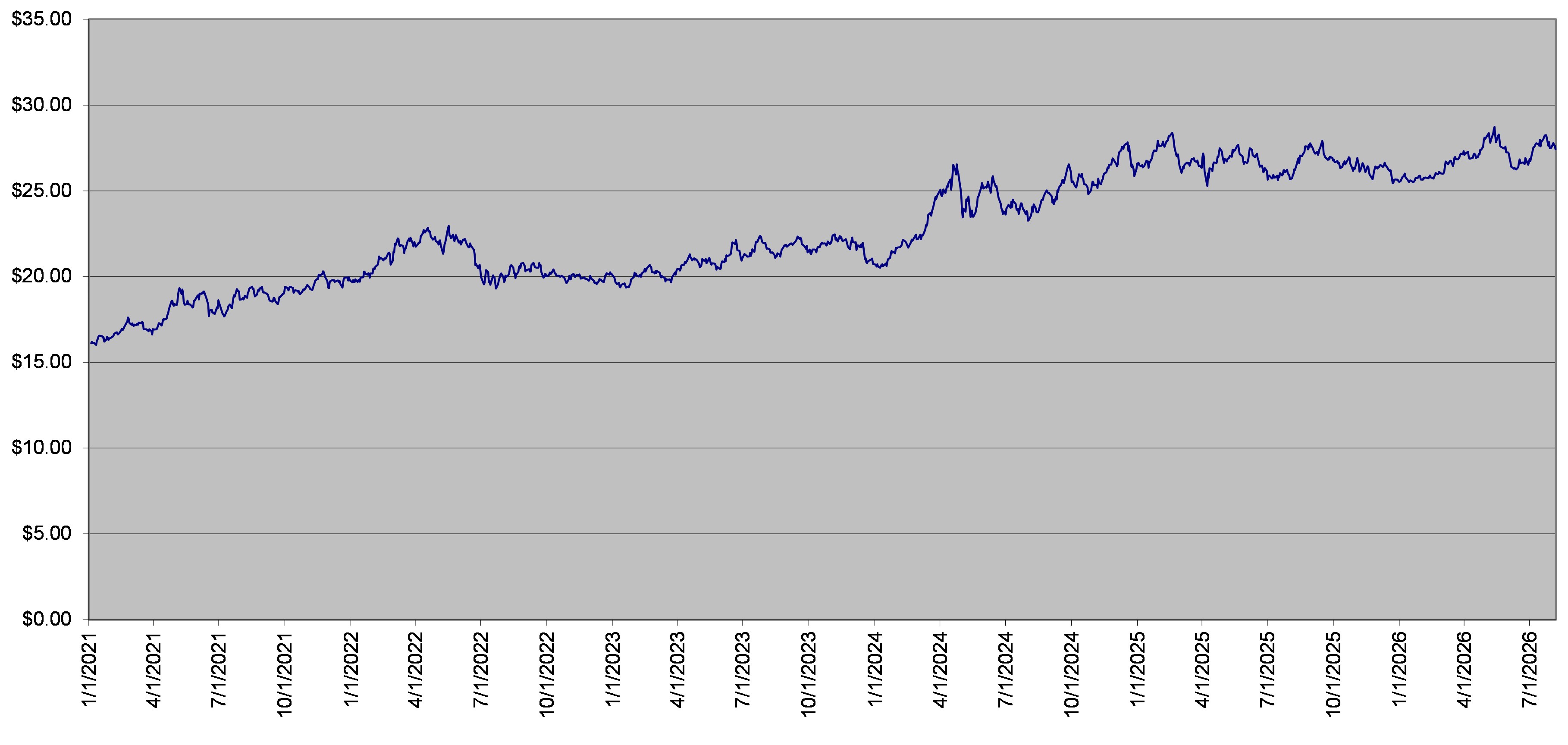
The closing level of the underlier on August 6, 2026 was $27.43. The following graph sets forth the daily closing levels of the underlier for the period noted below. We obtained the historical information presented in this document from Bloomberg Financial Markets, without independent verification. The underlier has at times experienced periods of high volatility. You should not take the historical closing levels of the underlier as an indication of its future performance, and no assurance can be given as to the closing level of the underlier at any time.
Page 11
Morgan Stanley Finance LLC
|
Buffered Participation Securities Principal at Risk Securities |
|
Underlier Daily Closing Levels January 1, 2021 to August 6, 2026 |
|
|
This document relates only to the securities referenced hereby and does not relate to the underlier. We have derived all disclosures contained in this document regarding the underlier from the publicly available documents described above. In connection with this offering of securities, neither we nor the agent has participated in the preparation of such documents or made any due diligence inquiry with respect to the underlier. Neither we nor the agent makes any representation that such publicly available documents or any other publicly available information regarding the underlier is accurate or complete. Furthermore, we cannot give any assurance that all events occurring prior to the date hereof (including events that would affect the accuracy or completeness of the publicly available documents described above) that would affect the trading price of the underlier (and therefore the closing level of the underlier on the strike date) have been publicly disclosed. Subsequent disclosure of any such events or the disclosure of or failure to disclose material future events concerning the underlier could affect the value received with respect to the securities and therefore the value of the securities.
Neither we nor any of our affiliates makes any representation to you as to the performance of the underlier.
We and/or our affiliates may presently or from time to time engage in business with the Trust. In the course of such business, we and/or our affiliates may acquire non-public information with respect to the underlier, and neither we nor any of our affiliates undertakes to disclose any such information to you. In addition, one or more of our affiliates may publish research reports with respect to the underlier. The statements in the preceding two sentences are not intended to affect the rights of investors in the securities under the securities laws. You should undertake an independent investigation of the underlier as in your judgment is appropriate to make an informed decision with respect to an investment linked to the underlier.
The securities are not sponsored, endorsed, sold, or promoted by the Trust. The Trust makes no representations or warranties to the owners of the securities or any member of the public regarding the advisability of investing in the securities. The Trust has no obligation or liability in connection with the operation, marketing, trading or sale of the securities.
The DBIQ Diversified Agriculture Index Excess Return™. The DBIQ Diversified Agriculture Index Excess Return™ is a rules-based index that seeks exposure to the performance of single commodity indices in the agricultural sector, which in turn reference futures contracts of thirteen commodities involved primarily in the agricultural sector. The DBIQ Diversified Agriculture Index Excess Return™ includes feeder cattle, cocoa, coffee, corn, cotton, lean hogs, live cattle, soybeans, soybean oil, soybean meal, sugar, wheat and Kansas wheat.
Page 12
Morgan Stanley Finance LLC
|
Buffered Participation Securities Principal at Risk Securities |
Additional Terms of the Securities
Please read this information in conjunction with the terms on the cover of this document.
|
Additional Terms: |
|
|
If the terms described herein are inconsistent with those described in the accompanying product supplement, tax supplement or prospectus, the terms described herein shall control. |
|
|
Denominations: |
$1,000 per security and integral multiples thereof |
|
Amortization period: |
The 6-month period following the issue date |
|
Trustee: |
The Bank of New York Mellon |
|
Calculation agent: |
Morgan Stanley & Co. LLC (“MS & Co.”) |
Page 13
Morgan Stanley Finance LLC
|
Buffered Participation Securities Principal at Risk Securities |
Additional Information About the Securities
|
Additional Information: |
|
|
Minimum ticketing size: |
$1,000 / 1 security |
|
United States federal income tax considerations: |
You should review carefully the section in the accompanying tax supplement entitled “United States Federal Taxation.” The following discussion, when read in combination with that section, constitutes the full opinion of our counsel, Davis Polk & Wardwell LLP, regarding the material U.S. federal income tax consequences of owning and disposing of the securities offered by this pricing supplement. Generally, this discussion assumes that you purchased a security for cash in the original issuance at the stated issue price and does not address other circumstances specific to you, including consequences that may arise due to any other investments relating to an underlier. Moreover, as discussed in the section entitled “United States Federal Taxation” in the accompanying tax supplement, we have not attempted to ascertain whether any issuer of any underlier to which the securities relate is a U.S. real property holding corporation or a passive foreign investment company. You should consult your tax adviser regarding these issues, including the effect any circumstances specific to you may have on the U.S. federal income tax consequences of your ownership of a security. In the opinion of our counsel, which is based on current market conditions, it is reasonable to treat the securities for U.S. federal income tax purposes as prepaid financial contracts that are “open transactions,” as described in the section entitled “United States Federal Taxation—Tax Consequences to U.S. Holders—Program Securities Treated as Prepaid Financial Contracts that are Open Transactions” in the accompanying tax supplement. There is uncertainty regarding this treatment, and the Internal Revenue Service (the “IRS”) or a court might not agree with it. Moreover, because this treatment of the securities and our counsel’s opinion are based on market conditions as of the date of this preliminary pricing supplement, each is subject to confirmation on the pricing date. A different tax treatment could be adverse to you. Generally, if this treatment is respected, subject to the potential application of the “constructive ownership” regime discussed below, (i) you should not recognize taxable income or loss prior to the taxable disposition of your securities (including upon maturity or an earlier redemption, if applicable) and (ii) the gain or loss on your securities generally should be treated as capital gain or loss. Even if the treatment of the securities as prepaid financial contracts is respected, purchasing a security could be treated as entering into a “constructive ownership transaction” within the meaning of Section 1260 of the Internal Revenue Code (“Section 1260”), as described in the sections entitled “United States Federal Taxation—Tax Consequences to U.S. Holders—Program Securities Treated as Prepaid Financial Contracts that are Open Transactions—Possible Application of Section 1260 of the Code” in the accompanying tax supplement. Due to the lack of direct legal authority, our counsel is unable to opine as to whether or how Section 1260 applies to the securities. We do not plan to request a ruling from the IRS regarding the treatment of the securities. An alternative characterization of the securities could materially and adversely affect the tax consequences of ownership and disposition of the securities, including the timing and character of income recognized. In particular, due to the terms of the securities and current market conditions, there is a substantial risk that the securities could be characterized as debt instruments for U.S. federal income tax purposes, in which case the timing and character of income recognized in respect of the securities could be different from those described herein and possibly adverse to certain investors. In addition, the U.S. Treasury Department and the IRS have requested comments on various issues regarding the U.S. federal income tax treatment of “prepaid forward contracts” and similar financial instruments and have indicated that such transactions may be the subject of future regulations or other guidance. Furthermore, members of Congress have proposed legislative changes to the tax treatment of derivative contracts. Any legislation, Treasury regulations or other guidance promulgated after consideration of these issues could materially and adversely affect the tax consequences of an investment in the securities, possibly with retroactive effect. Non-U.S. Holders. If you are a Non-U.S. Holder (as defined in the accompanying tax supplement), please also read the section entitled “United States Federal Taxation—Tax Consequences to Non-U.S. Holders—Program Securities Not Treated as Debt Instruments” in the accompanying tax supplement. As discussed under “United States Federal Taxation—Tax Consequences to Non-U.S. Holders—Dividend Equivalents under Section 871(m) of the Code” in the accompanying tax supplement, Section 871(m) of the Internal Revenue Code and Treasury regulations promulgated thereunder (“Section 871(m)”) generally impose a 30% withholding tax on dividend equivalents paid or deemed paid to Non-U.S. Holders with respect to certain financial instruments linked to U.S. equities or indices that include U.S. equities. The Treasury regulations, as modified by an IRS notice, exempt financial instruments issued prior to January 1, 2027 that do not have a “delta” of one. Based on certain determinations made by us, we expect that Section 871(m) will not apply to the securities with regard to Non-U.S. Holders. Our determination is not binding on the IRS, and the IRS may disagree with this determination. If necessary, further information regarding the potential application of Section 871(m) will be provided in the final pricing supplement for the securities. |
Page 14
Morgan Stanley Finance LLC
|
Buffered Participation Securities Principal at Risk Securities |
|
We will not be required to pay any additional amounts with respect to U.S. federal withholding taxes. You should consult your tax adviser regarding the U.S. federal income tax consequences of an investment in the securities, including possible alternative treatments and the potential application of the “constructive ownership” regime, as well as tax consequences arising under the laws of any state, local or non-U.S. taxing jurisdiction. |
|
|
Additional considerations: |
Client accounts over which Morgan Stanley, Morgan Stanley Wealth Management or any of their respective subsidiaries have investment discretion are not permitted to purchase the securities, either directly or indirectly. |
|
Supplemental information regarding plan of distribution; conflicts of interest: |
MS & Co. expects to sell all of the securities that it purchases from us to an unaffiliated dealer at a price of $ per security, for further sale to certain fee-based advisory accounts at the price to public of $1,000 per security. MS & Co. will not receive a sales commission with respect to the securities. MS & Co. is an affiliate of MSFL and a wholly owned subsidiary of Morgan Stanley, and it and other affiliates of ours expect to make a profit by selling, structuring and, when applicable, hedging the securities. MS & Co. will conduct this offering in compliance with the requirements of FINRA Rule 5121 of the Financial Industry Regulatory Authority, Inc., which is commonly referred to as FINRA, regarding a FINRA member firm’s distribution of the securities of an affiliate and related conflicts of interest. MS & Co. or any of our other affiliates may not make sales in this offering to any discretionary account. See “Plan of Distribution (Conflicts of Interest)” and “Use of Proceeds and Hedging” in the accompanying product supplement. |
|
Where you can find more information: |
Morgan Stanley and MSFL have filed a registration statement (including a prospectus, as supplemented by the product supplement and the tax supplement) with the Securities and Exchange Commission (the “SEC”) for the offering to which this communication relates. You should read the prospectus in that registration statement, the product supplement, the tax supplement and any other documents relating to this offering that MSFL and Morgan Stanley have filed with the SEC for more complete information about Morgan Stanley and this offering. You may get these documents without cost by visiting EDGAR on the SEC website at www.sec.gov. Alternatively, MSFL, Morgan Stanley, any underwriter or any dealer participating in the offering will arrange to send you the prospectus, the product supplement and the tax supplement if you so request by calling toll-free 1-(800)-584-6837. Terms used but not defined in this document are defined in the product supplement, in the tax supplement or in the prospectus. Each of the product supplement, the tax supplement and the prospectus can be accessed via the hyperlinks set forth on the cover of this document. |
Page 15
Create E-mail Alert Related Categories
SEC FilingsRelated Entities
Morgan StanleySign up for StreetInsider Free!
Receive full access to all new and archived articles, unlimited portfolio tracking, e-mail alerts, custom newswires and RSS feeds - and more!
