



Form 424B2 MORGAN STANLEY
 Tweet
Tweet Share
Share E-mail
This term sheet, which is not complete and may be changed, relates to an effective Registration Statement under the Securities Act of 1933. This term sheet and the accompanying product supplement, tax supplement and prospectus are not an offer to sell these notes in any country or jurisdiction where such an offer would not be permitted.
|
|
Subject to Completion Preliminary Term Sheet dated August 3, 2026 |
Preliminary Term Sheet No. 17,874 Filed Pursuant to Rule 424(b)(2) Registration Statement Nos. 333-293641; 333-293641-01 (To Prospectus dated April 8, 2026, Tax Supplement dated April 8, 2026 and |
|
Units |
Pricing Date* |
August , 2026 |
|||||
|
*Subject to change based on the actual date the notes are priced for initial sale to the public (the “pricing date”) |
|||||||
|
|
|
|
|
||||
|
Morgan Stanley Finance LLC Leveraged Index Return Notes® Linked to an International Equity Index Basket Fully and Unconditionally Guaranteed by Morgan Stanley ■Maturity of approximately 5 years. ■[190.00% to 210.00%] leveraged upside exposure to increases in the Basket. ■1-to-1 downside exposure to decreases in the Basket, with up to 100% of your principal at risk. ■The Basket will be comprised of the EURO STOXX 50® Index, the Nikkei Stock Average Index and the Swiss Market Index, each as specified under “The Basket” herein (the “Basket Components”). Each of the Basket Components will be given an approximately equal weight. ■All payments are subject to the credit risk of Morgan Stanley Finance LLC, as issuer of the notes, and the credit risk of Morgan Stanley, as guarantor of the notes. ■No periodic interest payments. ■Limited secondary market liquidity, with no exchange listing. |
|||||||

The notes are being issued by Morgan Stanley Finance LLC (“MSFL”) and are fully and unconditionally guaranteed by Morgan Stanley. Investing in the notes involves a number of risks. There are important differences between the notes and a conventional debt security, including different investment risks and certain additional costs. See “Risk Factors” beginning on page TS-9 of this term sheet and “Risk Factors” on page PS-8 of the accompanying product supplement, “Risk Factors” on page PS-4 of the accompanying tax supplement and page 7 of the accompanying prospectus.
The initial estimated value of the notes as of the pricing date is expected to be $9.50 per unit, or within $0.10 of that estimate, which is less than the public offering price listed below. The estimated value of the notes is determined using our own pricing and valuation models, market inputs and assumptions relating to the Market Measure, instruments based on the Market Measure, volatility and other factors including current and expected interest rates, as well as an interest rate related to our secondary market credit spread, which is the implied interest rate at which our conventional fixed rate debt trades in the secondary market. See “Summary” on the following page, “Risk Factors” beginning on page TS-9 of this preliminary term sheet and “Structuring the Notes” on page TS-30 of this preliminary term sheet for additional information. The actual value of your notes at any time will reflect many factors and cannot be predicted with accuracy.
_________________________
None of the Securities and Exchange Commission (the “SEC”), any state securities commission, or any other regulatory body has approved or disapproved of these notes or determined if this Note Prospectus (as defined below) is truthful or complete. Any representation to the contrary is a criminal offense. The notes are not deposits or savings accounts and are not insured by the Federal Deposit Insurance Corporation or any other governmental agency or instrumentality, nor are they obligations of, or guaranteed by, a bank.
You should read this document together with the related product supplement for principal-at-risk notes, tax supplement and prospectus, each of which can be accessed via the hyperlinks below. As used in this document, “we,” “us” and “our” refer to Morgan Stanley or MSFL, or Morgan Stanley and MSFL collectively, as the context requires.
_________________________
|
|
Per Unit |
Total |
|
Public offering price |
$ 10.00 |
$ |
|
Underwriting discount(1) |
$ 0.15 |
$ |
|
|
$ 0.05 |
|
|
Proceeds, before expenses, to MSFL(2) |
$ 9.80 |
$ |
(1)The underwriting discount reflects a sales commission of $0.15 per note and a structuring fee of $0.05 per note.
(2)See “Use of proceeds and hedging” in the accompanying product supplement.
The notes and the related guarantee:
|
Are Not FDIC Insured |
Are Not Bank Guaranteed |
May Lose Value |
Morgan Stanley & Co. LLC
August , 2026
|
Leveraged Index Return Notes® Linked to an International Equity Index Basket, due August , 2031 |
|
Summary
The Leveraged Index Return Notes® Linked to an International Equity Index Basket, due August , 2031 (the “notes”) are senior unsecured medium-term notes issued by MSFL. Payments on the notes are fully and unconditionally guaranteed by Morgan Stanley. The notes and the related guarantee are not insured by the Federal Deposit Insurance Corporation or secured by collateral. The notes will rank equally in right of payment with all other unsubordinated and unsecured obligations of MSFL from time to time outstanding, except obligations that are subject to any priorities or preferences by law. The guarantee of the notes will rank equally in right of payment with all other unsubordinated and unsecured obligations of Morgan Stanley, except obligations that are subject to any priorities or preferences by law, and senior in right of payment to its subordinated obligations. Any payments due on the notes, including any repayment of principal, will be subject to our and Morgan Stanley’s credit risk. If we default on our obligations under the notes, you could lose some or all of your investment. The notes provide you a leveraged return, if the Ending Value of the Market Measure, which is the international equity index basket described below, is equal to or greater than the Starting Value. If the Ending Value is less than the Starting Value, you will lose all or a portion of the principal amount of your notes. All payments on the notes will be calculated based on the $10 principal amount per unit and will depend on the performance of the Basket, subject to our and Morgan Stanley’s credit risk. See “Terms of the Notes” below.
The original issue price of each note is $10. This price includes costs associated with issuing, selling, structuring and hedging the notes, which are borne by you, and, consequently, the estimated value of the notes, on the pricing date will be less than $10. We estimate that the value of each note on the pricing date will be approximately $9.50 per unit, or within $0.10 of that estimate. Our estimate of the value of the notes as determined on the pricing date will be set forth in the final term sheet.
What goes into the estimated value on the pricing date?
In valuing the notes on the pricing date, we take into account that the notes comprise both a debt component and a performance-based component linked to the Market Measure. The estimated value of the notes is determined using our own pricing and valuation models, market inputs and assumptions relating to the Market Measure instruments based on the Market Measure, volatility and other factors including current and expected interest rates, as well as an interest rate related to our secondary market credit spread, which is the implied interest rate at which our conventional fixed rate debt trades in the secondary market.
What determines the economic terms of the notes?
In determining the economic terms of the notes, including the Participation Rate, we use an internal funding rate, which is likely to be lower than our secondary market credit spreads and therefore advantageous to us. If the issuing, selling, structuring and hedging costs borne by you were lower or if the internal funding rate were higher, one or more terms of the notes would be more favorable to you.
What is the relationship between the estimated value on the pricing date and the secondary market price of the notes?
The price at which MS & Co. purchases the notes in the secondary market, absent changes in market conditions, including those related to the Market Measure, may vary from, and be lower than, the estimated value on the pricing date, because the secondary market price takes into account our secondary market credit spread as well as the bid-offer spread that MS & Co. would charge in a secondary market transaction of this type and other factors. However, because the costs associated with issuing, selling, structuring and hedging the notes are not fully deducted upon issuance, for a period of up to 6 months following the issue date, to the extent that MS & Co. may buy or sell the notes in the secondary market, absent changes in market conditions, including those related to the Market Measure, and to our secondary market credit spreads, it would do so based on values higher than the estimated value. We expect that those higher values will also be reflected in your brokerage account statements.
MS & Co. may, but is not obligated to, make a market in the notes and, if it once chooses to make a market, may cease doing so at any time.
|
|
|
Leveraged Index Return Notes® |
TS-3 |
|
Leveraged Index Return Notes® Linked to an International Equity Index Basket, due August , 2031 |
|
|
Terms of the Notes |
|
|
Issuer: |
Morgan Stanley Finance LLC (“MSFL”) |
|
Guarantor: |
Morgan Stanley |
|
Principal Amount: |
$10.00 per unit |
|
Term: |
5 years |
|
Market Measure: |
An approximately equally weighted international equity index basket composed of the EURO STOXX 50® Index (Bloomberg symbol: “SX5E”), the Nikkei Stock Average Index (Bloomberg symbol: “NKY”) and the Swiss Market Index (Bloomberg symbol: “SMI”). See “The Basket” herein for information about the Basket Components, including ticker symbols and weightings on the pricing date. Each Basket Component is a price return index. |
|
Redemption Amount |
On the maturity date, you will receive a cash payment per unit determined as follows: ●If the Ending Value is equal to or greater than the Starting Value: ●If the Ending Value is less than the Starting Value: |
|
Starting Value: |
The Starting Value will be set to 100.00 on the pricing date. |
|
Ending Value: |
The value of the Basket on the Final Calculation Day, calculated as specified in “The Basket” below and “Baskets—Value of the Basket” beginning on page PS-50 of the accompanying product supplement. The scheduled Final Calculation Day is subject to postponement in the event of Market Disruption Events, as described beginning on page PS-32 of the accompanying product supplement |
|
Participation Rate: |
[190% - 210%]. The actual Participation Rate will be determined on the pricing date. |
|
Final Calculation Day/Maturity Valuation Period: |
Approximately the fifth scheduled Market Measure Business Day immediately preceding the maturity date. |
|
Fees and Charges: |
The underwriting discount of $0.20 per unit listed on the cover page. |
|
Calculation Agent: |
Morgan Stanley & Co. LLC (“MS&Co.”), an affiliate of MSFL. |


|
Leveraged Index Return Notes® |
TS-4 |
|
Leveraged Index Return Notes® Linked to an International Equity Index Basket, due August , 2031 |
|
|
Redemption Amount Determination |
|
On the maturity date, you will receive a cash payment per unit determined as follows:
|

|
Leveraged Index Return Notes® |
TS-5 |
|
Leveraged Index Return Notes® Linked to an International Equity Index Basket, due August , 2031 |
|
The terms and risks of the notes are contained in this term sheet and in the following:
■Product supplement dated April 8, 2026:
https://www.sec.gov/Archives/edgar/data/895421/000095010326005460/dp244130_424b2-psml.htm
■Tax supplement dated April 8, 2026:
https://www.sec.gov/Archives/edgar/data/895421/000095010326005451/dp244874_424b2-sats.htm
■Prospectus dated April 8, 2026:
https://www.sec.gov/Archives/edgar/data/895421/000095010326005450/dp244347_424b2-basepro.htm
These documents (together, the “Note Prospectus”) have been filed as part of a registration statement with the SEC, which may, without cost, be accessed on the SEC website at www.sec.gov or obtained from Merrill Lynch, Pierce, Fenner & Smith Incorporated (“MLPF&S”) by calling 1-800-294-1322. Before you invest, you should read the Note Prospectus, including this term sheet, for information about us, Morgan Stanley and this offering. Any prior or contemporaneous oral statements and any other written materials you may have received are superseded by the Note Prospectus. Certain terms used but not defined in this term sheet have the meanings set forth in the accompanying product supplement. Unless otherwise indicated or unless the context requires otherwise, all references in this document to “we,” “us,” “our,” or similar references are to MSFL, and not to Morgan Stanley.
Investor Considerations
|
You may wish to consider an investment in the notes if: |
The notes may not be an appropriate investment for you if: |
|
■You anticipate that the value of the Basket will increase from the Starting Value to the Ending Value. ■You are willing to risk a loss of principal and return if the value of the Basket decreases from the Starting Value to the Ending Value. ■You are willing to forgo the interest payments that are paid on conventional interest-bearing debt securities. ■You are willing to forgo dividends or other benefits of owning the stocks included in the Basket Components. ■You are willing to accept a limited or no market for sales for the notes prior to maturity, and understand that the market prices for the notes, if any, will be affected by various factors, including our and Morgan Stanley’s actual and perceived creditworthiness, Morgan Stanley’s internal funding rate and fees and charges on the notes. ■You are willing to assume our credit risk, as issuer of the notes, and Morgan Stanley’s credit risk, as guarantor of the notes, for all payments under the notes, including the Redemption Amount. |
■You believe that the value of the Basket will decrease from the Starting Value to the Ending Value or that it will not increase sufficiently over the term of the notes to provide you with your desired return. ■You seek 100% principal repayment or preservation of capital. ■You seek interest payments or other current income on your investment. ■You want to receive dividends or other distributions paid on the stocks included in the Basket Components. ■You seek an investment for which there will be a liquid secondary market. ■You are unwilling or are unable to take market risk on the notes, to take our credit risk, as issuer of the notes, or to take Morgan Stanley’s credit risk, as guarantor of the notes. |
We urge you to consult your investment, legal, tax, accounting, and other advisors before you invest in the notes.
|
Leveraged Index Return Notes® |
TS-6 |
|
Leveraged Index Return Notes® Linked to an International Equity Index Basket, due August , 2031 |
|
Hypothetical Payout Profile and Examples of Payments at Maturity
|
Leveraged Index Return Notes®
|
This graph reflects the returns on the notes, based on a hypothetical Participation Rate of 200% (the midpoint of the Participation Rate range of 190% to 210%]). The green line reflects the return on the notes, while the dotted gray line reflects the return of a direct investment in the stocks included in the Basket Components, excluding dividends. This graph has been prepared for purposes of illustration only. |

The following table and examples are for purposes of illustration only. They are based on hypothetical values and show hypothetical returns on the notes. They illustrate the calculation of the Redemption Amount and total rate of return based on the Starting Value of 100.00, a hypothetical Participation Rate of 200% and a range of hypothetical Ending Values. The actual amount you receive and the resulting total rate of return will depend on the actual Ending Value and Participation rate, and whether you hold the notes to maturity. The following examples do not take into account any tax consequences from investing in the notes.
For recent hypothetical historical values of the Basket, see “The Basket” section below. For recent actual levels of the Basket Components, see “The Basket Components” section below. Each Basket Component is a price return index and as such the Ending Value will not include any income generated by dividends paid on the stocks included in any of the Basket Components, which you would otherwise be entitled to receive if you invested in those stocks directly. All payments on the notes are subject to issuer and guarantor credit risk.
|
Ending Value
|
Percentage Change from the Starting Value to the Ending Value |
Redemption Amount per Unit(1) |
Return on the Notes |
|
0.00 |
-100.00% |
$0.00 |
-100.00% |
|
20.00 |
-80.00% |
$2.00 |
-80.00% |
|
40.00 |
-60.00% |
$4.00 |
-60.00% |
|
80.00 |
-20.00% |
$8.00 |
-20.00% |
|
100.00(2) |
0.00% |
$10.00 |
0.00% |
|
120.00 |
20.00% |
$14.00 |
40.00% |
|
140.00 |
40.00% |
$18.00 |
80.00% |
|
160.00 |
60.00% |
$22.00 |
120.00% |
|
180.00 |
80.00% |
$26.00 |
160.00% |
|
200.00 |
100.00% |
$30.00 |
200.00% |
|
210.00 |
110.00% |
$32.00 |
220.00% |
|
240.00 |
140.00% |
$38.00 |
280.00% |
|
260.00 |
160.00% |
$42.00 |
320.00% |
|
280.00 |
180.00% |
$46.00 |
360.00% |
1)The Redemption Amount per unit is based on the hypothetical Participation Rate.
2)The Starting Value will be set to 100.00 on the pricing date.
|
Leveraged Index Return Notes® |
TS-7 |
|
Leveraged Index Return Notes® Linked to an International Equity Index Basket, due August , 2031 |
|
Redemption Amount Calculation Examples
|
Example 1 |
|
|
The Ending Value is 50.00, or 50.00% of the Starting Value: |
|
|
Starting Value: 100.00 |
|
|
Ending Value: 50.00 |
|
|
|
|
|
|
|
|
Example 2 |
|
|
The Ending Value is 105.00, or 105.00% of the Starting Value: |
|
|
Starting Value: 100.00 |
|
|
Ending Value: 105.00 |
|
|
|
|
|
|
|
 = $5.00 Redemption Amount per unit
 = $11.00 Redemption Amount per unit
|
Leveraged Index Return Notes® |
TS-8 |
|
Leveraged Index Return Notes® Linked to an International Equity Index Basket, due August , 2031 |
|
Risk Factors
This section describes the material risks relating to the notes. For further discussion of these and other risks, you should read the section entitled “Risk Factors” in the accompanying product supplement, tax supplement and prospectus. You should also consult your investment, legal, tax, accounting and other advisers in connection with your investment in the notes.
Structure-related Risks
■Your investment may result in a loss; there may be no minimum return of principal. Unlike ordinary debt securities, the notes do not guarantee the repayment of principal. If the Ending Value is less than the Starting Value, you may lose all or a significant portion of your investment at maturity if the value of the Market Measure decreases over the term of the notes.
■Payments on the notes will not reflect changes in the value of the Market Measure other than on the Final Calculation Day. Payments on the notes will not reflect changes in the value of the Market Measure other than on Final Calculation Day. As a result, you will receive a Redemption Amount that is less than the principal amount if the Ending Value is less than the Starting Value on the Final Calculation Day, even if the value of the Market Measure was greater than the Starting Value prior to such Final Calculation Day.
■Changes in the levels of one or more of the Basket Components may be offset by changes in the levels of one or more of the other Basket Components. Changes in the levels of one or more of the Basket Components may not correlate with changes in the levels of one or more of the other Basket Components. The levels of one or more Basket Components may increase, while the levels of one or more of the other Basket Components may decrease or not increase as much. Therefore, in calculating the level of the Basket at any time, increases in the level of one Basket Component may be moderated or wholly offset by decreases or lesser increases in the levels of one or more of the other Basket Components.
■The notes do not provide for regular interest payments. Your return on the notes may be less than the yield you could earn by owning a conventional fixed or floating rate debt security of comparable maturity.
■Payments on the notes are subject to our credit risk, and any actual or perceived changes in our creditworthiness are expected to affect the value of, or any amounts payable on, the notes. You are dependent on our ability to pay all amounts due on the notes at maturity and therefore you are subject to our credit risk. The notes are not guaranteed by any other entity. If we default on our obligations under the notes, your investment would be at risk and you could lose some or all of your investment. As a result, the market value of the notes prior to maturity will be affected by changes in the market’s view of our creditworthiness. Any actual or anticipated decline in our credit ratings or increase in the credit spreads charged by the market for taking our credit risk is likely to adversely affect the market value of the notes.
■As a finance subsidiary, MSFL has no independent operations and will have no independent assets. As a finance subsidiary, MSFL has no independent operations beyond the issuance and administration of its securities and will have no independent assets available for distributions to holders of MSFL securities if they make claims in respect of such securities in a bankruptcy, resolution or similar proceeding. Accordingly, any recoveries by such holders will be limited to those available under the related guarantee by Morgan Stanley and that guarantee will rank pari passu with all other unsecured, unsubordinated obligations of Morgan Stanley. Holders will have recourse only to a single claim against Morgan Stanley and its assets under the guarantee. Holders of securities issued by MSFL should accordingly assume that in any such proceedings they would not have any priority over and should be treated pari passu with the claims of other unsecured, unsubordinated creditors of Morgan Stanley, including holders of Morgan Stanley-issued securities.
Valuation- and Market-related Risks
■The notes are not designed to be short-term trading instruments, and if you attempt to sell the notes prior to maturity, their market value, if any, will be affected by various factors that interrelate in complex ways, and their market value may be less than the principal amount. The notes are not designed to be short-term trading instruments. If you wish to liquidate your investment in the notes prior to maturity, your only option would be to sell them in the secondary market. At that time, there may be an illiquid market for your notes or no market at all. Even if you were able to sell your notes, there are many factors outside of our control that may adversely affect their market value, some of which, but not all, are stated below. The impact of any one factor may be offset or magnified by the effect of another factor. These factors may interact with each other in complex and unpredictable ways. Factors that may influence the value of the notes include:
ovalue of the Market Measure,
ovolatility of the Market Measure,
oeconomic and other conditions generally,
ointerest rates,
odividend yields,
oour financial condition and creditworthiness, and
otime remaining to maturity.
■The rate we are willing to pay for securities of this type, maturity and issuance size is likely to be lower than the rate implied by our secondary market credit spreads and advantageous to us. Both the lower rate and the inclusion of costs associated with issuing, selling, structuring and hedging the notes in the original issue price reduce the economic terms of the notes, cause the estimated value of the notes to be less than the original issue price and will adversely affect secondary market prices. Assuming no change in market conditions or any other relevant factors, the prices, if any, at which dealers, including MS & Co., may be willing to purchase the notes in secondary market transactions will likely be significantly lower than the original issue price, because secondary market prices will exclude
|
Leveraged Index Return Notes® |
TS-9 |
|
Leveraged Index Return Notes® Linked to an International Equity Index Basket, due August , 2031 |
|
the issuing, selling, structuring and hedging-related costs that are included in the original issue price and borne by you and because the secondary market prices will reflect our secondary market credit spreads and the bid-offer spread that any dealer would charge in a secondary market transaction of this type as well as other factors. The inclusion of the costs of issuing, selling, structuring and hedging the notes in the original issue price and the lower rate we are willing to pay as issuer make the economic terms of the notes less favorable to you than they otherwise would be. However, because the costs associated with issuing, selling, structuring and hedging the notes are not fully deducted upon issuance, for a period of up to 6 months following the issue date, to the extent that MS & Co. may buy or sell the notes in the secondary market, absent changes in market conditions, including those related to the Market Measure, and to our secondary market credit spreads, it would do so based on values higher than the estimated value, and we expect that those higher values will also be reflected in your brokerage account statements.
■The estimated value of the notes is determined by reference to our pricing and valuation models, which may differ from those of other dealers and is not a maximum or minimum secondary market price. These pricing and valuation models are proprietary and rely in part on subjective views of certain market inputs and certain assumptions about future events, which may prove to be incorrect. As a result, because there is no market-standard way to value these types of securities, our models may yield a higher estimated value of the notes than those generated by others, including other dealers in the market, if they attempted to value the notes. In addition, the estimated value on the pricing date does not represent a minimum or maximum price at which dealers, including MS & Co., would be willing to purchase your notes in the secondary market (if any exists) at any time. The value of your notes at any time after the date of this document will vary based on many factors that cannot be predicted with accuracy, including our creditworthiness and changes in market conditions. See also “The notes are not designed to be short-term trading instruments, and if you attempt to sell the notes prior to maturity, their market value, if any, will be affected by various factors that interrelate in complex ways, and their market value may be less than the principal amount” above.
■The notes may not be listed on any securities exchange and secondary trading may be limited. Neither MS & Co. nor MLPF&S is obligated to make a market for, or repurchase, the notes. There is no assurance that any party will be willing to purchase your notes at any price in any secondary market.
Conflict-related Risks
■Hedging and trading activity by our affiliates or by MLPF&S and their affiliates could potentially affect the value of the notes. Our hedging and trading activities (including trades in shares of companies included in the Basket Components) and any hedging and trading activities we and our affiliates or MLPF&S or their affiliates engage in that are not for your account or on your behalf may affect the market value and return of the notes and may create conflicts of interest with you.
■Conflicts of interest. There may be potential conflicts of interest involving the calculation agent, which is an affiliate of ours. We have the right to appoint and remove the calculation agent.
Market Measure-related Risks
■No obligations for any index sponsor. An index sponsor may adjust its applicable index in a way that affects its level and has no obligation to consider your interests.
■Investing in the notes is not the equivalent to investing in the Basket Components. You will not have any rights with respect to any Basket Components or its underlying assets, including any voting rights or any right to receive dividends or other distributions.
■No control over the companies included in the Basket Components. While we and our affiliates or MLPF&S and their affiliates may from time to time own securities of companies included in the Basket Components, except to the extent that Morgan Stanley’s common stock is included in any Basket Component, we and our affiliates or MLPF&S and their affiliates do not control any company included in any Basket Component, and have not verified any disclosure made by any other company. You should undertake your own investigation into the Basket Components and their underlying assets.
■Adjustments to the Basket Components could adversely affect the value of the notes. The publisher of each Basket Component may add, delete or substitute the stocks constituting such Basket Component or make other methodological changes that could change the level of such Basket Component. The publisher of each Basket Component may also discontinue or suspend calculation or publication of such Basket Component at any time. In these circumstances, the calculation agent will have the sole discretion to substitute a successor index that is comparable to the discontinued Basket Component and is permitted to consider indices that are calculated and published by the calculation agent or any of its affiliates. If the calculation agent determines that there is no appropriate successor index, the closing level for such Basket Component will be determined based on the closing prices of the securities composing the Basket Component at the time of such discontinuance, without rebalancing or substitution, computed by the calculation agent in accordance with the formula for calculating such Basket Component last in effect prior to discontinuance of such Basket Component.
■The notes are linked to the Basket Components and are subject to risks associated with investments in securities linked to the value of foreign equity securities. The notes are linked to the value of foreign equity securities. Investments in securities linked to the value of foreign equity securities involve risks associated with the securities markets in those countries, including risks of volatility in those markets, governmental intervention in those markets and cross-shareholdings in companies in certain countries. Although the equity securities included in the Basket Components are traded in foreign currencies, the value of your notes (as measured in U.S. dollars) will not be adjusted for any exchange rate fluctuations. Also, there is generally less publicly available information about foreign companies than about U.S. companies that are subject to the reporting requirements of the United States Securities and Exchange Commission, and foreign companies are subject to accounting, auditing and financial reporting standards and requirements different from those applicable to U.S. reporting companies. The prices of securities issued in foreign markets may be affected by political, economic, financial and social factors in those countries, or global regions, including changes in government, economic and fiscal policies and currency exchange laws. Local securities markets may trade a small number of securities and may be unable to respond effectively to increases in trading volume, potentially making prompt liquidation of holdings difficult or impossible at times. Moreover, the economies in such countries may differ
|
Leveraged Index Return Notes® |
TS-10 |
|
Leveraged Index Return Notes® Linked to an International Equity Index Basket, due August , 2031 |
|
favorably or unfavorably from the economy in the United States in such respects as growth of gross national product, rate of inflation, capital reinvestment, resources, self-sufficiency and balance of payment positions.
Tax-related Risks
■The U.S. federal income tax consequences of an investment in the securities offered by this pricing supplement are uncertain. There is no direct legal authority regarding the proper U.S. federal income tax treatment of the securities, and significant aspects of the tax treatment of the securities are uncertain. You should review carefully the section entitled “United States Federal Income Tax Considerations” herein, in combination with the section entitled “United States Federal Taxation” in the accompanying tax supplement, and consult your tax adviser regarding the U.S. federal income tax consequences of an investment in the securities.
|
Leveraged Index Return Notes® |
TS-11 |
|
Leveraged Index Return Notes® Linked to an International Equity Index Basket, due August , 2031 |
|
The Basket
The Basket is designed to allow investors to participate in the percentage changes in the levels of the Basket Components from the Starting Value to the Ending Value of the Basket. The Basket Components are described in the section “The Basket Components” below. Each Basket Component will be assigned an initial weight on the pricing date, as set forth in the table below.
We have derived the following information from publicly available documents. We have not independently verified the accuracy or completeness of the following information.
For more information on the calculation of the value of the Basket, please see the section entitled “Baskets—Value of the Basket” beginning on page PS-50 of the accompanying product supplement.
|
Basket Component |
|
Bloomberg Symbol |
|
Initial Component Weight |
|
Closing Level(1)(2) |
|
Hypothetical Component Ratio(1)(3) |
|
Initial Basket Value Contribution |
|
EURO STOXX 50® Index |
|
SX5E |
|
33.34% |
|
6,358.01 |
|
0.00524378 |
|
33.34 |
|
Nikkei Stock Average |
|
NKY |
|
33.33% |
|
64,362.02 |
|
0.00051785 |
|
33.33 |
|
Swiss Market Index® |
|
SMI |
|
33.33% |
|
14,346.14 |
|
0.00232327 |
|
33.33 |
|
|
|
|
|
|
|
|
|
Starting Value |
|
100.00 |
(1)The actual closing level of each Basket Component and the resulting actual Component Ratios will be determined on the pricing date and will be set forth in the final term sheet that will be made available in connection with sales of the notes.
(2)These were the closing levels of the Basket Components on July 31, 2026.
(3)Each hypothetical Component Ratio equals the Initial Component Weight of the relevant Basket Component (as a percentage) multiplied by 100, and then divided by the closing level of that Basket Component on July 31, 2026 and rounded to eight decimal places.
The calculation agent will calculate the Ending Value of the Basket by summing the products of the closing level of each Basket Component on the Calculation Day and the Component Ratio for that Basket Component. If a Market Disruption Event occurs with respect to a Basket Component on the scheduled Calculation Day, the closing level of that Basket Component will be determined as more fully described in the section entitled “Baskets—Value of the Basket” beginning on page PS-50 of the product supplement.
|
Leveraged Index Return Notes® |
TS-12 |
|
Leveraged Index Return Notes® Linked to an International Equity Index Basket, due August , 2031 |
|
The following graph shows the daily historical performance of the Market Measure in the period from January 1, 2016 through July 31, 2026. The graph is based upon actual daily historical levels of the Basket Components, hypothetical Component Ratios based on the closing prices of the Basket Components as of January 1, 2016, and a Basket value of 100.00 as of that date. We obtained this historical data from Bloomberg L.P. We have not independently verified the accuracy or completeness of the information obtained from Bloomberg L.P.
Hypothetical Historical Performance of the Basket

|
Leveraged Index Return Notes® |
TS-13 |
|
Leveraged Index Return Notes® Linked to an International Equity Index Basket, due August , 2031 |
|
The Basket Components
All disclosures contained in this term sheet regarding the Basket Components, including, without limitation, their make-up, method of calculation, and changes in their components, have been derived from publicly available sources. The information reflects the policies of, and is subject to change by each of STOXX Limited (“STOXX”) with respect to the EURO STOXX 50® Index (the “SX5E”), Nikkei Inc. (“Nikkei”) with respect to the Nikkei Stock Average Index (the “NKY”) and the Geneva, Zurich, SIX Group Ltd., certain of its subsidiaries, and the Management Committee of the SIX Swiss Exchange (the “SIX Exchange”), with respect to the Swiss Market Index (the “SMI”) (STOXX, Nikkei and SIX Exchange together, the “index sponsors”). The index sponsors, which license the copyright and all other rights to its applicable index, have no obligation to continue to publish, and may discontinue publication of, its applicable index. The consequences of an index sponsor discontinuing publication of its applicable index are discussed in the section of the accompanying product supplement beginning on page PS-36 entitled “Description of the Notes—Discontinuance of an Index.” None of us and our affiliates or MLPF&S or their affiliates or the calculation agent accepts any responsibility for the calculation, maintenance or publication of any index or any successor index.
For additional information about the EURO STOXX 50® Index, the Nikkei Stock Average and the Swiss Market Index®, see “Annex A – EURO STOXX 50® Index”, “Annex B – Nikkei Stock Average” and “Annex C – Swiss Market Index®” below.
The EURO STOXX 50® Index
The following graph shows the daily historical performance of the SX5E in the period from January 1, 2016 through July 31, 2026. We obtained this historical data from Bloomberg L.P. We have not independently verified the accuracy or completeness of the information obtained from Bloomberg L.P. On July 31, 2026, the closing level of the SX5E was 6,358.01.
Historical Performance of EURO STOXX 50® Index

This historical data on the SX5E is not necessarily indicative of the future performance of the SX5E or what the value of the notes may be. Any historical upward or downward trend in the level of the SX5E during any period set forth above is not an indication that the level of the SX5E is more or less likely to increase or decrease at any time over the term of the notes.
Before investing in the notes, you should consult publicly available sources for the levels of the SX5E.
For more information, see “Annex A – EURO STOXX 50® Index” below.
|
Leveraged Index Return Notes® |
TS-14 |
|
Leveraged Index Return Notes® Linked to an International Equity Index Basket, due August , 2031 |
|
The Nikkei Stock Average
The following graph shows the daily historical performance of the NKY in the period from January 1, 2016 through July 31, 2026. We obtained this historical data from Bloomberg L.P. We have not independently verified the accuracy or completeness of the information obtained from Bloomberg L.P. On July 31, 2026, the closing level of the NKY was 64,362.02.
Historical Performance of Nikkei Stock Average
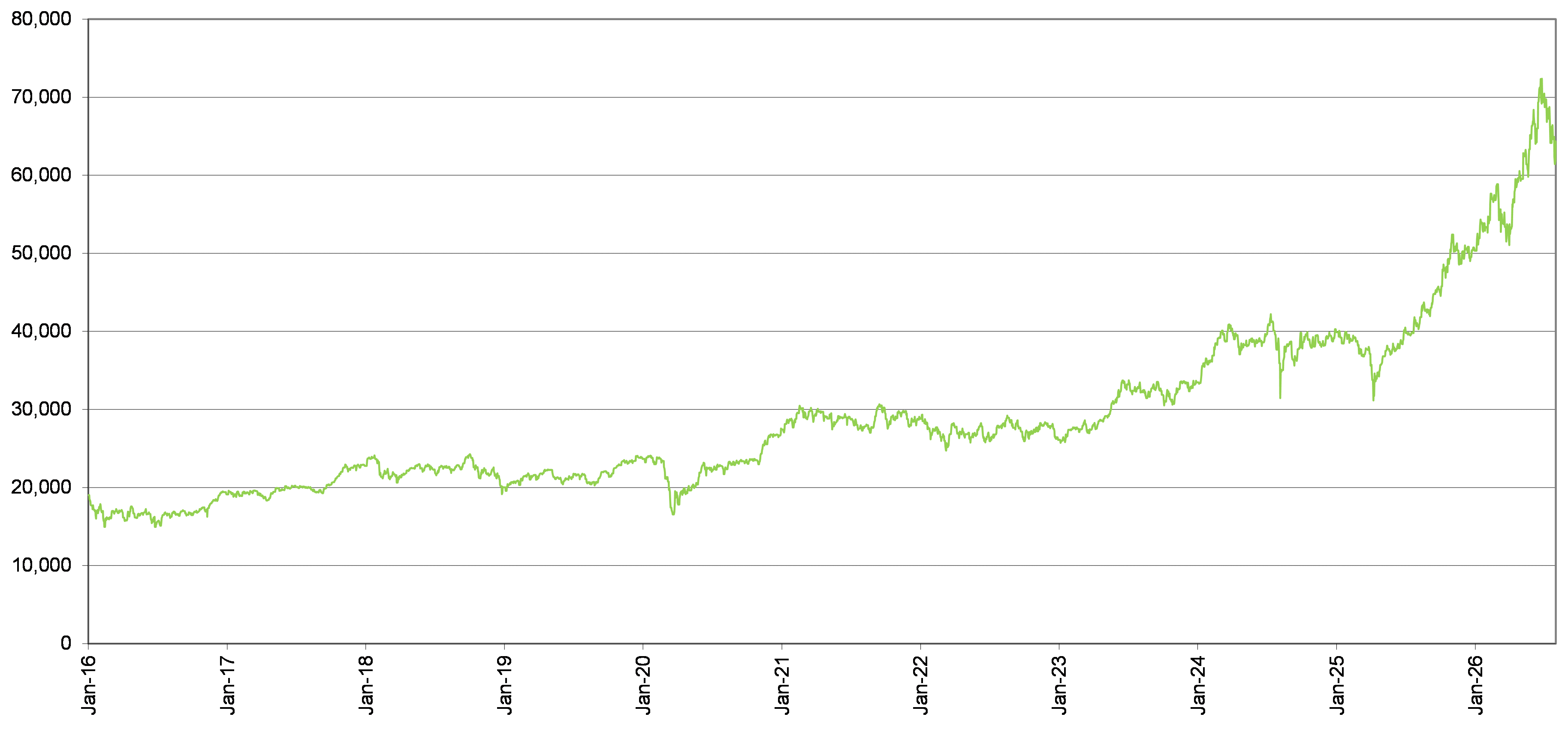
This historical data on the NKY is not necessarily indicative of the future performance of the NKY or what the value of the notes may be. Any historical upward or downward trend in the level of the NKY during any period set forth above is not an indication that the level of the NKY is more or less likely to increase or decrease at any time over the term of the notes.
Before investing in the notes, you should consult publicly available sources for the levels of the NKY.
For more information, see “Annex B – Nikkei Stock Average” below.
|
Leveraged Index Return Notes® |
TS-15 |
|
Leveraged Index Return Notes® Linked to an International Equity Index Basket, due August , 2031 |
|
The Swiss Market Index®
The following graph shows the daily historical performance of the SMI in the period from January 1, 2016 through July 31, 2026. We obtained this historical data from Bloomberg L.P. We have not independently verified the accuracy or completeness of the information obtained from Bloomberg L.P. On July 31, 2026, the closing level of the SMI was 14,346.14.
Historical Performance of Swiss Market Index® 
This historical data on the SMI is not necessarily indicative of the future performance of the SMI or what the value of the notes may be. Any historical upward or downward trend in the level of the SMI during any period set forth above is not an indication that the level of the SMI is more or less likely to increase or decrease at any time over the term of the notes.
Before investing in the notes, you should consult publicly available sources for the levels of the SMI.
For more information, see “Annex C – Swiss Market Index®” below.
|
Leveraged Index Return Notes® |
TS-16 |
|
Leveraged Index Return Notes® Linked to an International Equity Index Basket, due August , 2031 |
|
Supplement to the Plan of Distribution; Conflicts of Interest
MS & Co. will act as the agent for this offering. We will agree to sell to MS & Co., and MS & Co. will agree to purchase, all of the notes at the issue price less the underwriting discount indicated on the cover of this document. MLPF&S will purchase the notes from MS & Co. for resale, and will receive a discount in connection with the sale of the notes in an amount up to the full amount of underwriting discount set forth on the cover of this term sheet. MLPF&S will offer the notes at the public offering price set forth on the cover page hereto.
MS & Co. is our affiliate and a wholly owned subsidiary of Morgan Stanley, and it and other affiliates of ours expect to make a profit by selling, structuring and, when applicable, hedging the notes. When MS & Co. prices this offering of notes, it will determine the economic terms of the notes such that for each Note the estimated value on the Trade Date will be no lower than the minimum level described in “Summary” on page TS-2.
MS & Co. will conduct this offering in compliance with the requirements of Rule 5121 of the Financial Industry Regulatory Authority, Inc. (“FINRA”), regarding a FINRA member firm’s distribution of the securities of an affiliate and related conflicts of interest. MS & Co. or any of our other affiliates may not make sales in this offering to any discretionary account.
The costs included in the original issue price of the notes will include a fee paid by MS & Co. to LFT Securities, LLC, an entity in which an affiliate of MLPF&S has an ownership interest in, which will reduce the economic terms of the notes to you.
We may deliver the notes against payment therefor in New York, New York on a date that is greater than one business day following the pricing date. Under Rule 15c6-1 of the Securities Exchange Act of 1934, trades in the secondary market generally are required to settle in one business day, unless the parties to any such trade expressly agree otherwise. Accordingly, if the initial settlement of the notes occurs more than one business day from the pricing date, purchasers who wish to trade the notes more than one business day prior to the original issue date will be required to specify alternative settlement arrangements to prevent a failed settlement.
The notes will not be listed on any securities exchange. In the original offering of the notes, the notes will be sold in minimum investment amounts of 10,000 units. If you place an order to purchase the notes, you are consenting to MLPF&S and/or one of its affiliates acting as a principal in effecting the transaction for your account.
MS&Co. may repurchase and resell the notes, with repurchases and resales being made at prices related to then-prevailing market prices or at negotiated prices, and these will include MS&Co.’s trading commissions and mark-ups or mark-downs. MS&Co. may act as principal or agent in these market-making transactions; however MS&Co. is not obligated to engage in any such transactions. At MS&Co.’s discretion, for a short, undetermined initial period after the issuance of the notes, MS&Co. may offer to buy the notes in the secondary market at a price that may exceed the initial estimated value of the notes. Any price offered by MS&Co. for the notes will be based on then-prevailing market conditions and other considerations, including the performance of the Market Measure and the remaining term of the notes. However, neither we nor any of our affiliates is obligated to purchase your notes at any price, or at any time, and we cannot assure you that we or any of our affiliates will purchase your notes at a price that equals or exceeds the initial estimated value of the notes.
The value of the notes shown on your account statement will be based on MS&Co.’s estimate of the value of the notes if MS&Co. were to make a market in the notes, which it is not obligated to do. That estimate will be based upon the price that MS&Co. may pay for the notes in light of then-prevailing market conditions and other considerations, as mentioned above, and will include transaction costs. At certain times, this price may be higher than or lower than the initial estimated value of the notes.
|
Leveraged Index Return Notes® |
TS-17 |
|
Leveraged Index Return Notes® Linked to an International Equity Index Basket, due August , 2031 |
|
Structuring the Notes
The notes are our debt securities, the return on which is linked to the performance of the Market Measure. The related guarantees are Morgan Stanley’s obligations. As is the case for all of our and Morgan Stanley’s respective debt securities, including our market-linked notes, the economic terms of the notes reflect our and Morgan Stanley’s actual or perceived creditworthiness at the time of pricing. In addition, because market-linked notes result in increased operational, funding and liability management costs to us and Morgan Stanley, Morgan Stanley typically borrows the funds under these types of notes at a rate that is more favorable to Morgan Stanley than the rate that it might pay for a conventional fixed or floating rate debt security. This rate, which we refer to in this term sheet as Morgan Stanley’s internal funding rate, is typically lower than the rate Morgan Stanley would pay when it issues conventional fixed or floating rate debt securities. This generally relatively lower internal funding rate, which is reflected in the economic terms of the notes, along with the fees and charges associated with market-linked notes, typically results in the initial estimated value of the notes on the pricing date being less than their public offering price.
At maturity, we are required to pay the Redemption Amount to holders of the notes, which will be calculated based on the performance of the Market Measure and the $10 per unit principal amount. In order to meet these payment obligations, at the time we issue the notes, we may choose to enter into certain hedging arrangements (which may include call options, put options or other derivatives) with MS&Co. or one of our other affiliates. The terms of these hedging arrangements are determined by seeking bids from market participants, which may include MS&Co. and our other affiliates, and take into account a number of factors, including our and Morgan Stanley’s creditworthiness, interest rate movements, the volatility of the Market Measure, the tenor of the notes and the tenor of the hedging arrangements. The economic terms of the notes and their initial estimated value depend in part on the terms of these hedging arrangements. These hedging arrangements are expected to result in a profit to those engaging in the hedging activity, which could be more or less than initially expected, but could also result in a loss.
For further information, see “Risk Factors—Valuation and Market-related Risks” and “—Conflict-related Risks” beginning on page PS-12 and PS-15, respectively, and “Use of Proceeds and Hedging” on page PS-26 of the accompanying product supplement.
|
Leveraged Index Return Notes® |
TS-18 |
|
Leveraged Index Return Notes® Linked to an International Equity Index Basket, due August , 2031 |
|
United States Federal Income Tax Consequences
You should review carefully the section in the accompanying tax supplement entitled “United States Federal Taxation.” The following discussion, when read in combination with that section, constitutes the full opinion of our counsel, Davis Polk & Wardwell LLP, regarding the material U.S. federal income tax consequences of owning and disposing of the securities offered by this pricing supplement.
Generally, this discussion assumes that you purchased a security for cash in the original issuance at the stated issue price and does not address other circumstances specific to you, including consequences that may arise due to any other investments relating to an underlier. Moreover, as discussed in the section entitled “United States Federal Taxation” in the accompanying tax supplement, we have not attempted to ascertain whether any issuer of any underlier to which the securities relate is a U.S. real property holding corporation or a passive foreign investment company. You should consult your tax adviser regarding these issues, including the effect any circumstances specific to you may have on the U.S. federal income tax consequences of your ownership of a security.
In the opinion of our counsel, which is based on current market conditions, it is reasonable to treat the securities for U.S. federal income tax purposes as prepaid financial contracts that are “open transactions,” as described in the section entitled “United States Federal Taxation—Tax Consequences to U.S. Holders—Program Securities Treated as Prepaid Financial Contracts that are Open Transactions” in the accompanying tax supplement. There is uncertainty regarding this treatment, and the Internal Revenue Service (the “IRS”) or a court might not agree with it. Moreover, because this treatment of the securities and our counsel’s opinion are based on market conditions as of the date of this preliminary pricing supplement, each is subject to confirmation on the pricing date. A different tax treatment could be adverse to you. Generally, if this treatment is respected, (i) you should not recognize taxable income or loss prior to the taxable disposition of your securities (including upon maturity or an earlier redemption, if applicable) and (ii) the gain or loss on your securities generally should be treated as capital gain or loss.
We do not plan to request a ruling from the IRS regarding the treatment of the securities. An alternative characterization of the securities could materially and adversely affect the tax consequences of ownership and disposition of the securities, including the timing and character of income recognized. In addition, the U.S. Treasury Department and the IRS have requested comments on various issues regarding the U.S. federal income tax treatment of “prepaid forward contracts” and similar financial instruments and have indicated that such transactions may be the subject of future regulations or other guidance. Furthermore, members of Congress have proposed legislative changes to the tax treatment of derivative contracts. Any legislation, Treasury regulations or other guidance promulgated after consideration of these issues could materially and adversely affect the tax consequences of an investment in the securities, possibly with retroactive effect.
Non-U.S. Holders. If you are a Non-U.S. Holder (as defined in the accompanying tax supplement), please also read the section entitled “United States Federal Taxation—Tax Consequences to Non-U.S. Holders—Program Securities Not Treated as Debt Instruments” in the accompanying tax supplement.
As discussed under “United States Federal Taxation—Tax Consequences to Non-U.S. Holders—Dividend Equivalents under Section 871(m) of the Code” in the accompanying tax supplement, Section 871(m) of the Internal Revenue Code and Treasury regulations promulgated thereunder (“Section 871(m)”) generally impose a 30% withholding tax on dividend equivalents paid or deemed paid to Non-U.S. Holders with respect to certain financial instruments linked to U.S. equities or indices that include U.S. equities. The Treasury regulations, as modified by an IRS notice, exempt financial instruments issued prior to January 1, 2027 that do not have a “delta” of one. Based on certain determinations made by us, we expect that Section 871(m) will not apply to the securities with regard to Non-U.S. Holders. Our determination is not binding on the IRS, and the IRS may disagree with this determination. If necessary, further information regarding the potential application of Section 871(m) will be provided in the final pricing supplement for the securities.
We will not be required to pay any additional amounts with respect to U.S. federal withholding taxes.
You should consult your tax adviser regarding the U.S. federal income tax consequences of an investment in the securities, including possible alternative treatments, as well as tax consequences arising under the laws of any state, local or non-U.S. taxing jurisdiction.
|
Leveraged Index Return Notes® |
TS-19 |
|
Leveraged Index Return Notes® Linked to an International Equity Index Basket, due August , 2031 |
|
Where You Can Find More Information
We and Morgan Stanley have filed a registration statement (including a product supplement, a tax supplement and a prospectus) with the SEC for the offering to which this term sheet relates. Before you invest, you should read the Note Prospectus, including this term sheet, and the other documents relating to this offering that we and Morgan Stanley have filed with the SEC, for more complete information about us, Morgan Stanley and this offering. You may get these documents without cost by visiting EDGAR on the SEC website at www.sec.gov or by calling MLPF&S toll-free at 1-800-294-1322.
You may access these documents on the SEC web site at www.sec.gov as follows:
Product Supplement for Principal-at-Risk Notes dated April 8, 2026
Tax Supplement dated April 8, 2026
Prospectus dated April 8, 2026
Terms used but not defined in this document are defined in the accompanying product supplement, in the tax supplement or in the prospectus.
|
Leveraged Index Return Notes® |
TS-20 |
|
Leveraged Index Return Notes® Linked to an International Equity Index Basket, due August , 2031 |
|
Annex A – EURO STOXX 50® Index
The SX5E was created by STOXX, which is part of the Deutsche Börse Group. Publication of the SX5E began in February 1998, based on an initial SX5E level of 1,000 at December 31, 1991. On March 1, 2010, STOXX announced the removal of the “Dow Jones” prefix from all of its indices, including the SX5E.
SX5E Composition and Maintenance
The SX5E is composed of 50 stocks from 11 Eurozone countries (Austria, Belgium, Finland, France, Germany, Ireland, Italy, Luxembourg, the Netherlands, Portugal and Spain) of the STOXX Europe 600 Supersector indices. The STOXX 600 Supersector indices contain the 600 largest stocks traded on the major exchanges of 18 European countries and are organized into the following 20 Supersectors: automobiles & parts; banks; basic resources; chemicals; construction & materials; consumer products & services; energy; financial services; food, beverages & tobacco; health care; industrial goods & services; insurance; media; personal care, drug & grocery stores; real estate; retailers; technology; telecommunications; travel & leisure; and utilities.
For each of the 20 EURO STOXX regional supersector indices, the stocks are ranked in terms of free-float market capitalization. The largest stocks are added to the selection list until the coverage is close to, but still less than, 60% of the free-float market capitalization of the corresponding supersector index. If the next highest-ranked stock brings the coverage closer to 60% in absolute terms, then it is also added to the selection list. All current stocks in the SX5E are then added to the selection list. All of the stocks on the selection list are then ranked in terms of free-float market capitalization to produce the final index selection list. The largest 40 stocks on the selection list are selected; the remaining 10 stocks are selected from the largest remaining current stocks ranked between 41 and 60; if the number of stocks selected is still below 50, then the largest remaining stocks are selected until there are 50 stocks. In exceptional cases, STOXX’s management board can add stocks to and remove them from the selection list.
The SX5E components are subject to a capped maximum index weight of 10%, which is applied on a quarterly basis.
The composition of the SX5E is reviewed annually, based on the closing stock data on the last trading day in August. Changes in the composition of the SX5E are made to ensure that the SX5E includes the 50 market sector leaders from within the SX5E.
The free float factors for each component stock used to calculate the SX5E, as described below, are reviewed, calculated, and implemented on a quarterly basis and are fixed until the next quarterly review.
The SX5E is subject to a “fast exit rule.” The SX5E components are monitored for any changes based on the monthly selection list ranking. A stock is deleted from the SX5E if: (a) it ranks 75 or below on the monthly selection list and (b) it has been ranked 75 or below for a consecutive period of two months in the monthly selection list. The highest-ranked stock that is not an index component will replace it. Changes will be implemented on the close of the fifth trading day of the month, and are effective the next trading day.
The SX5E is also subject to a “fast entry rule.” All stocks on the latest selection lists and initial public offering (IPO) stocks are reviewed for a fast-track addition on a quarterly basis. A stock is added, if (a) it qualifies for the latest STOXX blue-chip selection list generated end of February, May, August or November and (b) it ranks within the “lower buffer” on this selection list.
The SX5E is also reviewed on an ongoing monthly basis. Corporate actions (including initial public offerings, mergers and takeovers, spin-offs, delistings, and bankruptcy) that affect the SX5E composition are announced immediately, implemented two trading days later and become effective on the next trading day after implementation.
SX5E Calculation
The SX5E is calculated with the “Laspeyres formula,” which measures the aggregate price changes in the component stocks against a fixed base quantity weight. The formula for calculating the SX5E value can be expressed as follows:

The “free float market capitalization of the SX5E” is equal to the sum of the product of the price, the number of shares and the free float factor and the weighting cap factor for each component stock as of the time the SX5E is being calculated.
The SX5E is also subject to a divisor, which is adjusted to maintain the continuity of the SX5E values across changes due to corporate actions, such as the deletion and addition of stocks, the substitution of stocks, stock dividends, and stock splits.
|
Leveraged Index Return Notes® |
TS-21 |
|
Leveraged Index Return Notes® Linked to an International Equity Index Basket, due August , 2031 |
|
Annex B – Nikkei Stock Average
The NKY, also known as the Nikkei 225 Index, is an equity index calculated, published, and disseminated by Nikkei Inc. The NKY measures the composite price performance of selected Japanese stocks. The NKY is currently based on 225 stocks (each, an “Index Stock”) trading on the Tokyo Stock Exchange (“TSE”) and represents a broad cross-section of Japanese industry. All 225 of the Index Stocks are listed in the First Section of the TSE. Index Stocks listed in the First Section are among the most actively traded stocks on the TSE. The NKY started on September 7, 1950. However, it was retroactively calculated back to May 16, 1949, when the TSE reopened for the first time after World War II.
Calculation of the NKY
The NKY is a modified, price-weighted index. Each Index Stock’s weight is based on its price per share rather than the total market capitalization of the issuer. Nikkei Inc. calculates the NKY by multiplying the per share price of each Index Stock by the corresponding weighting factor for that Index Stock (a “Weight Factor”), calculating the sum of all these products and dividing that sum by a divisor. The divisor is subject to periodic adjustments as set forth below. Each Weight Factor is computed by dividing ¥50 by the presumed par value of the relevant Index Stock, so that the share price of each Index Stock when multiplied by its Weight Factor corresponds to a share price based on a uniform par value of ¥50. Each Weight Factor represents the number of shares of the related Index Stock which are included in one trading unit of the NKY. The stock prices used in the calculation of the NKY are those reported by a primary market for the Index Stocks, currently the TSE. The level of the NKY is currently calculated once per 15 seconds during TSE trading hours.
In order to maintain continuity in the level of the NKY in the event of certain changes due to non-market factors affecting the Index Stocks, such as the addition or deletion of stocks, stock splits, or increase in paid-in capital, the divisor used in calculating the NKY is adjusted in a manner designed to prevent any instantaneous change or discontinuity in the level of the NKY. The divisor remains at the new value until a further adjustment is necessary as the result of another change. In the event of a change affecting any Index Stock, the divisor is adjusted in such a way that the sum of all share prices immediately after the change multiplied by the applicable Weight Factor and divided by the new divisor, i.e., the level of the NKY immediately after the change, will equal the level of the NKY immediately prior to the change.
Index Maintenance
The NKY is reviewed annually at the beginning of October. The purpose of the review is to maintain the representative nature of the Index Stocks. Stocks with high market liquidity are added and those with low liquidity are deleted. At the same time, to take changes in industry structure into account, the balance of the sectors, in terms of the number of constituents, is considered. Liquidity of a stock is assessed by the two measures: “trading value” and “magnitude of price fluctuation by volume,” which is calculated as (high price/low price) / volume. Among stocks on the TSE First Section, the top 450 stocks in terms of liquidity are selected to form the “high liquidity group”. Those constituents that are not in the high liquidity group are deleted. Those non-constituent stocks which are in the top 75 of the high liquidity group are added.
After the liquidity deletions and additions, constituents are deleted and added to balance the number of constituents among sectors, and to make the total number of the constituents equal 225. Among the 450 “high liquidity” stocks, half of those that belong to a sector are designated as the “appropriate number of stocks” for that sector. The actual number of constituents in a sector is then compared with its “appropriate number,” and if the actual number is larger or smaller than the “appropriate number,” then components are deleted or added, as necessary. Stocks to be deleted are selected from stocks with lower liquidity and stocks to be added are selected from stocks with higher liquidity. Stocks selected according to the foregoing procedures are candidates for addition or deletion, as applicable, and the final determinations will be made by Nikkei Inc.
The NKY is also reviewed on an ongoing basis in response to extraordinary developments, such as bankruptcies or mergers. Any stock becoming ineligible for listing in the TSE First Section due to any of the following reasons will be removed from the NKY: (i) bankruptcy and liquidation events; (ii) corporate restructurings, such as mergers, share exchanges or share transfers; (iii) excess debt or other reasons; or (iv) transfer to the TSE Second Section. In addition, a component stock designated as “security under supervision” becomes a deletion candidate. However, the decision to delete such a candidate will be made by examining the sustainability and the probability of delisting for each individual case. Upon deletion of a stock from the NKY, Nikkei Inc. will generally select as a replacement the most liquid stock that is both in the “high liquidity group” and in the same sector as the deleted stock. When deletions are known in advance, replacements may be selected as part of the periodic review process or by using similar procedures.
The Tokyo Stock Exchange
The TSE is one of the world’s largest securities exchanges in terms of market capitalization. Trading hours for most products listed on the TSE are currently from 9:00 A.M. to 11:00 A.M. and from 12:30 P.M. to 3:00 P.M., Tokyo time, Monday through Friday.
Due to the time zone difference, on any normal trading day, the TSE will close prior to the opening of business in New York City on the same calendar day. Therefore, the closing level of the NKY on a trading day will generally be available in the U.S. by the opening of business on the same calendar day.
The TSE has adopted certain measures, including daily price floors and ceilings on individual stocks, intended to prevent any extreme short-term price fluctuations resulting from order imbalances. In general, any stock listed on the TSE cannot be traded at a price lower than the applicable price floor or higher than the applicable price ceiling. These price floors and ceilings are expressed in absolute Japanese yen, rather than percentage limits based on the closing price of the stock on the previous trading day. In addition, when there is a major order imbalance in a listed stock, the TSE posts a “special bid quote” or a “special asked quote” for that stock at a specified
|
Leveraged Index Return Notes® |
TS-22 |
|
Leveraged Index Return Notes® Linked to an International Equity Index Basket, due August , 2031 |
|
higher or lower price level than the stock’s last sale price in order to solicit counter-orders and balance supply and demand for the stock. The TSE may also suspend the trading of individual stocks in certain limited and extraordinary circumstances, including, for example, unusual trading activity in that stock. As a result, changes in the NKY may be limited by price limitations or special quotes, or by suspension of trading, on individual stocks that make up the NKY, and these limitations, in turn, may adversely affect the market value of the notes
|
Leveraged Index Return Notes® |
TS-23 |
|
Leveraged Index Return Notes® Linked to an International Equity Index Basket, due August , 2031 |
|
Annex C – Swiss Market Index®
The Swiss Market Index (the “SMI”):
●was first launched with a base level of 1,500 as of June 30, 1988; and
●is sponsored, calculated, published and disseminated by SIX Group Ltd., certain of its subsidiaries, and the Management Committee of SIX Swiss Exchange.
The SMI is a price return float-adjusted market capitalization-weighted index of the 20 largest stocks traded on the SIX Swiss Exchange. The Management Committee of SIX Swiss Exchange is supported by an Index Commission (advisory board) in all index-related matters, notably in connection with changes to the index rules and adjustments, additions and exclusions outside of the established review and acceptance period. The Index Commission meets at least twice annually.
Information regarding the SMI may be found on SIX Exchange’s website. Please note that information included in that website is not included or incorporated by reference in this document.
Index Composition and Selection Criteria
The SMI is comprised of the 20 highest ranked stocks traded on the SIX Swiss Exchange that have a free float of 20% or more and that are not investment companies. The equity universe is largely Swiss domestic companies; however, in some cases, foreign issuers with a primary listing on the SIX Swiss Exchange or investment companies that do not hold any shares of any other eligible company and that have a primary listing on the SIX Swiss Exchange may be included.
The ranking of each security is determined by a combination of the following criteria:
●average free-float market capitalization (compared to the capitalization of the entire SIX Swiss Exchange index family), and
●cumulative on order book turnover (compared to the total turnover of the SIX Swiss Exchange index family).
Each of these two factors is assigned a 50% weighting in ranking the stocks eligible for the SMI.
The SMI is reconstituted annually after prior notice of at least two months on the third Friday in September after the close of trading.
The reconstitution is based on data from the previous July 1 through June 30. Provisional interim selection (ranking) lists are also published following the end of the third, fourth and first financial quarters.
In order to reduce turnover, an index constituent will not be replaced unless it is ranked below 23 or, if it is ranked 21 or 22, if another share ranks 18 or higher. If a company has primary listings on several exchanges and less than 50% of that company’s total turnover is generated on the SIX Swiss Exchange, it will not be included in the SMI unless it ranks at least 18 or better on the selection list on the basis of its turnover alone (i.e., without considering its free float).
Maintenance of the SMI
Constituent Changes. In the case of major market changes as a result of capital events such as mergers or new listings, the Management Committee of SIX Swiss Exchange can decide at the request of the Index Commission that a security should be admitted to the SMI outside the annual review period as long as it clearly fulfills the criteria for inclusion. For the same reasons, a security can also be excluded if the requirements for admission to the SMI are no longer fulfilled. As a general rule, extraordinary acceptances into the SMI take place after a three-month period on a quarterly basis after the close of trading on the third Friday of March, June, September and December (for example, a security listed on or before the fifth trading day prior to the end of November cannot be included until the following March). An announced insolvency is deemed to be an extraordinary event and the security will be removed from the SMI with five trading days’ prior notice if the circumstances permit such notice.
Capped Weightings and Intra-Quarter Breaches. The weight of any index constituent that exceeds a weight of 18% within the SMI is reduced to that value at each quarterly index review by applying a capping factor to the calculation of such constituent’s free float market capitalization. A constituent’s number of shares and free float market capitalization are used to determine its capping factor. The excess weight (the difference of the original weight minus the capped weight) is distributed proportionally across the other index constituents. The constituents are also capped to 18% as soon as two index constituents exceed a weight of 20% (an “intra-quarter breach”). If an intra-quarter breach is observed after the close of the markets, a new calculation of the capping factors is executed immediately and communicated to the market in order to ensure that the maximum weight per constituent is capped at 18% for the opening on the next day. In order to achieve a capped weighting of the SMI without causing market distortion, a stepwise reduction is conducted based on the quarterly index reviews to ensure that no change in the weight (as a result of capping) from one review to the next exceeds 3%. The transition period is in effect until no component has a weight larger than 18%. In the case of an intra-quarter breach, the weights are limited to the last defined weights as of the prior review.
Number of Shares and Free Float. The securities included in the SMI are weighted according to their free float. This means that shares deemed to be in firm hands are subtracted from the total market capitalization of that company. The free float is calculated on the basis of outstanding shares. Issued and outstanding equity capital is, as a rule, the total amount of equity capital that has been fully subscribed and wholly or partially paid in and documented in the Commercial Register. Not counting as issued and outstanding equity
|
Leveraged Index Return Notes® |
TS-24 |
|
Leveraged Index Return Notes® Linked to an International Equity Index Basket, due August , 2031 |
|
capital are the approved capital and the conditional capital of a company. The free float is calculated on the basis of listed shares only. If a company offers several different categories of listed participation rights, each is treated separately for purposes of index calculation.
Shares held deemed to be in firm hands are shareholdings that have been acquired by one person or a group of persons in companies domiciled in Switzerland and which, upon exceeding 5%, have been reported to SIX Swiss Exchange. Shares of persons and groups of persons who are subject to a shareholder agreement which is binding for more than 5% of the listed shares or who, according to publicly known facts, have a long-term interest in a company, are also deemed to be in firm hands.
For the calculation of the number of shares in firm hands, SIX Swiss Exchange may also use other sources than the reports submitted to it. In particular, SIX Swiss Exchange may use data gained from issuer surveys that it conducts itself.
In general, shares held by custodian nominees, trustee companies, investment funds, pension funds and investment companies are deemed free-floating regardless of whether a report has been made to SIX Swiss Exchange. SIX Swiss Exchange classifies at its own discretion persons and groups of persons who, because of their area of activity or the absence of important information, cannot be clearly assigned.
The free-float rule applies only to bearer shares and registered shares. Capital issued in the form of participation certificates and bonus certificates is taken into full account in calculating the SMI because it does not confer voting rights.
The number of securities in the SMI and the free-float factors are adjusted after the close of trading on four adjustment dates per year, the third Friday of March, June, September and December. Such changes are pre-announced at least one month before the adjustment date, although the index sponsor reserves the right to take account of recent changes before the adjustment date in the actual adjustment, so the definite new securities are announced five trading days before the adjustment date.
In order to avoid frequent slight changes to the weighting and to maintain the stability of the SMI, any extraordinary change of the total number of outstanding securities or the free float will only result in an extraordinary adjustment if it exceeds 10% and 5% respectively and is in conjunction with a corporate action.
After a takeover, SIX Swiss Exchange may, in exceptional cases, adjust the free float of a company upon publication of the end results after a five-day notification period or may exclude the security from the relevant index family. When an insolvency has been announced, an extraordinary adjustment will be made and the affected security will be removed from the SMI after five trading days’ notice.
The index sponsor reserves the right to make an extraordinary adjustment, in exceptional cases, without observing the notification period.
Calculation of the SMI
The index sponsor calculates the SMI using the “Laspeyres formula,” with a weighted arithmetic mean of a defined number of securities issues. The formula for calculating the index value can be expressed as follows:
|
Index = |
Free Float Market Capitalization of the index |
The “free float market capitalization of the index” is equal to the sum of the product of the last-paid price, the number of shares, the free-float factor, the capping factor and, if a foreign stock is included, the current CHF exchange rate as of the time the index value is being calculated. The index value is calculated in real time and is updated whenever a trade is made in a component stock. Where any index component stock price is unavailable on any trading day, SIX Swiss Exchange will use the last reported price for such component stock. Only prices from the SIX Swiss Exchange’s electronic order book are used in calculating the SMI.
Divisor Value and Adjustments
The divisor is a technical number used to calculate the SMI and is adjusted to reflect changes in market capitalization due to corporate events, and is adjusted by SIX Swiss Exchange to reflect corporate events, as described in the index rules.
|
Leveraged Index Return Notes® |
TS-25 |
Create E-mail Alert Related Categories
SEC FilingsRelated Entities
Morgan StanleySign up for StreetInsider Free!
Receive full access to all new and archived articles, unlimited portfolio tracking, e-mail alerts, custom newswires and RSS feeds - and more!
