




Form 424B2 CITIGROUP INC
 Tweet
 Share
 E-mail
The information in this preliminary pricing supplement is not complete and may be changed. This preliminary pricing supplement and the accompanying product supplement, underlying supplement, prospectus supplement and prospectus are not an offer to sell these securities, nor are they soliciting an offer to buy these securities, in any state where the offer or sale is not permitted.
SUBJECT TO COMPLETION, DATED FEBRUARY 8, 2022
Filed Pursuant to Rule 424(b)(2)
Registration Statement Nos. 333-255302 and 333-255302-03
|
February-----, 2022 Medium-Term Senior Notes, Series N Pricing Supplement No. 2022-USNCH10704 to Product Supplement
No. EA-04-09 Prospectus Supplement and Prospectus each dated May 11, 2021 |
 |
|
Citigroup Global Markets Holdings Inc. All Payments Due from Citigroup Global Markets Holdings Inc. Fully and Unconditionally Guaranteed by Citigroup Inc. |
|
Market Linked Notes— Upside Participation to a Cap and Principal Return at Maturity Notes Linked to the S&P 500® Index due March 2, 2029 |
|
n Linked to the S&P 500® Index (the “underlying”) n Unlike ordinary debt securities, the notes do not pay interest. Instead, the notes offer the potential for a positive return at maturity based on the performance of the underlying from the initial underlying value to the final underlying value. The payment at maturity will reflect the following terms: n If the final underlying value is greater than the initial underlying value, you will receive the stated principal amount plus 100% participation in the upside performance of the underlying, subject to a maximum total return at maturity of at least 30% (the “maximum return at maturity”) (to be determined on the pricing date) of the stated principal amount n If the final underlying value is less than or equal to the initial underlying value, you will be repaid the stated principal amount but will not receive any positive return on your investment n All payments on the notes are subject to the credit risk of Citigroup Global Markets Holdings Inc. and Citigroup Inc.; if Citigroup Global Markets Holdings Inc. and Citigroup Inc. default on their obligations, you could lose some or all of your investment n No periodic interest payments or dividends n The notes will not be listed on any securities exchange and, accordingly, may have limited or no liquidity. You should not invest in the notes unless you are willing to hold them to maturity. |
Investing in the notes involves risks not associated with an investment in conventional debt securities. See “Summary Risk Factors” beginning on page PS-6 and “Risk Factors Relating to the Notes” beginning on page EA-6 of the accompanying product supplement.
Neither the Securities and Exchange Commission (the “SEC”) nor any state securities commission has approved or disapproved of the notes or determined that this pricing supplement or the accompanying product supplement, underlying supplement, prospectus supplement and prospectus are truthful or complete. Any representation to the contrary is a criminal offense.
The notes are unsecured debt obligations issued by Citigroup Global Markets Holdings Inc. and guaranteed by Citigroup Inc. All payments due on the notes are subject to the credit risk of Citigroup Global Markets Holdings Inc. and Citigroup Inc. None of Wells Fargo Securities, LLC (“Wells Fargo”) or any of its affiliates will have any liability to the purchasers of the notes in the event Citigroup Global Markets Holdings Inc. defaults on its obligations under the notes and Citigroup Inc. defaults on its guarantee obligations. The notes are not bank deposits and are not insured or guaranteed by the Federal Deposit Insurance Corporation or any other governmental agency, nor are they obligations of, or guaranteed by, a bank.
| Per Note | Total | |
| Public Offering Price(1) | $1,000.00 | $ |
| Maximum Underwriting Discount and Commission(2) | $46.20 | $ |
| Proceeds to Citigroup Global Markets Holdings Inc.(2) | $953.80 | $ |
(1) Citigroup Global Markets Holdings Inc. currently expects that the estimated value of the notes on the pricing date will be at least $923.90 per note, which will be less than the public offering price. The estimated value of the notes is based on Citigroup Global Market Inc.’s (“CGMI”) proprietary pricing models and our internal funding rate. It is not an indication of actual profit to CGMI or other of our affiliates, nor is it an indication of the price, if any, at which any person may be willing to buy the notes from you at any time after issuance. See “Valuation of the Notes” in this pricing supplement.
(2) CGMI, an affiliate of Citigroup Global Markets Holdings Inc., as the lead agent for the offering, expects to sell the notes to Wells Fargo, as agent. Wells Fargo will receive an underwriting discount and commission of up to 4.62% ($46.20) for each note it sells. Wells Fargo will pay selected dealers, which may include Wells Fargo Advisors (“WFA”) (the trade name of the retail brokerage business of its affiliates, Wells Fargo Clearing Services, LLC and Wells Fargo Advisors Financial Network, LLC), a fixed selling commission of 2.50% ($25.00) for each note they sell. In addition to the selling commission allowed to WFA, Wells Fargo will pay $1.20 per note of the underwriting discount and commission to WFA as a distribution expense fee for each note sold by WFA. The total underwriting discount and commission and proceeds to Citigroup Global Markets Holdings Inc. shown above give effect to the actual underwriting discount and commission provided for the sale of the notes. See “Supplemental Plan of Distribution” below and “Use of Proceeds and Hedging” in the accompanying prospectus for further information regarding how we have hedged our obligations under the notes.
(3) In respect of certain securities sold in this offering, CGMI may pay a fee of up to $1.00 per security to selected securities dealers in consideration for marketing and other services in connection with the distribution of the securities to other securities dealers.
| Citigroup Global Markets Inc. | Wells Fargo Securities |
| Market Linked Notes— Upside Participation to a Cap and Principal Return at Maturity Notes Linked to the S&P 500® Index due March 2, 2029 |  |
| Terms of the Notes |
| Underlying: | The S&P 500® Index |
| Issuer: | Citigroup Global Markets Holdings Inc., a wholly owned subsidiary of Citigroup Inc. |
| Guarantee: | All payments due on the notes are fully and unconditionally guaranteed by Citigroup Inc. |
| Stated Principal Amount: | $1,000 per note. References in this pricing supplement to a “note” are to a note with a stated principal amount of $1,000. |
| Pricing Date: | February 25, 2022* |
| Issue Date: | March 2, 2022* |
| Valuation Date: | February 23, 2029, subject to postponement if such date is not a trading day or certain market disruption events occur.* See “Additional Terms of the Notes.” |
| Maturity Date: | March 2, 2029. If the final valuation date is postponed, the stated maturity date will be the later of (i) March 2, 2029 and (ii) three business days after the final valuation date as postponed.* See “Additional Terms of the Notes.” |
| Payment at Maturity: | For each $1,000 stated principal amount note you hold at maturity: • If the final underlying value is greater than the initial underlying value:
$1,000 plus the lesser of:
(ii) the maximum return at maturity
• If the final underlying value is less than or equal to the initial underlying value: $1,000
If the final underlying value is less than or equal to the initial underlying value, you will be repaid the stated principal amount of the notes at maturity but will not receive any return on your investment. |
| Participation Rate: | 100% |
| Maximum Return at Maturity: | At least $300 per note (30% of the stated principal amount), to be determined on the pricing date. Because of the maximum return at maturity, the payment at maturity will not exceed $1,300 per note. |
| Initial Underlying Value: | The closing value of the underlying on the pricing date |
| Final Underlying Value: | The closing value of the underlying on the valuation date |
| Calculation Agent: | CGMI |
| Denominations: | $1,000 and any integral multiple of $1,000 |
| CUSIP / ISIN: | 17330A3B6/ US17330A3B64 |
| * Expected. To the extent that the issuer makes any change to the expected pricing date or expected issue date, the valuation dates and maturity date may also be changed in the issuer’s discretion to ensure that the term of the notes remains the same. | |

PS-2
| Market Linked Notes— Upside Participation to a Cap and Principal Return at Maturity Notes Linked to the S&P 500® Index due March 2, 2029 | |
| Additional Information |
The terms of the notes are set forth in the accompanying product supplement, prospectus supplement and prospectus, as supplemented by this pricing supplement. The accompanying product supplement, underlying supplement, prospectus supplement and prospectus contain important disclosures that are not repeated in this pricing supplement. For example, the accompanying product supplement contains important information about how the closing values of the underlying will be determined and other specified events with respect to the underlying. The accompanying underlying supplement contains information about the underlying that is not repeated in this pricing supplement. It is important that you read the accompanying product supplement, underlying supplement, prospectus supplement and prospectus together with this pricing supplement in deciding whether to invest in the notes. Certain terms used but not defined in this pricing supplement are defined in the accompanying product supplement.
When we refer to “we,” “us” and “our” in this pricing supplement, we refer only to Citigroup Global Market Holdings Inc. and not to any of its affiliates, including Citigroup Inc.
You may access the product supplement, underlying supplement, prospectus supplement and prospectus on the SEC website www.sec.gov as follows (or if such address has changed, by reviewing our filings for the relevant date on the SEC website):
| • | Product Supplement No. EA-04-09 dated May 11, 2021: |
https://www.sec.gov/Archives/edgar/data/0000831001/000095010321007044/dp150747_424b2-coba0409.htm
| • | Underlying Supplement No. 10 dated May 11, 2021: |
https://www.sec.gov/Archives/edgar/data/200245/000095010321007028/dp150879_424b2-us10.htm
| • | Prospectus Supplement and Prospectus each dated May 11, 2021: |
https://www.sec.gov/Archives/edgar/data/200245/000119312521157552/d423193d424b2.htm
PS-3
| Market Linked Notes— Upside Participation to a Cap and Principal Return at Maturity Notes Linked to the S&P 500® Index due March 2, 2029 | |
| Investor Considerations |
We have designed the notes for investors who:
| · | seek exposure to any upside performance of the underlying without exposure to any decline in the underlying, by: |
| o | participating at the specified participation rate in the percentage increase, if any, from the initial underlying value to the final underlying value, subject to a maximum return at maturity; and |
| o | providing for the repayment of the stated principal amount at maturity regardless of the performance of the underlying; |
| · | understand that if the final underlying value is less than or equal to the initial underlying value, they will not receive any positive return on their investment in the notes; |
| · | are willing to forgo interest payments on the notes and dividends on the underlying; and |
| · | are willing to hold the notes to maturity. |
The notes are not designed for, and may not be a suitable investment for, investors who:
| · | seek a liquid investment or are unable or unwilling to hold the notes to maturity; |
| · | seek certainty of receiving a positive return on their investment; |
| · | seek uncapped exposure to the upside performance of the underlying; |
| · | seek current income; |
| · | are unwilling to purchase notes with an estimated value as of the pricing date that is lower than the public offering price and that may be as low as the lowest estimated value set forth on the cover page; |
| · | are unwilling to accept the risk of exposure to the large capitalization segment of the United States equity market; |
| · | seek exposure to the underlying but are unwilling to accept the risk/return trade-offs inherent in the payment at maturity for the notes; |
| · | are unwilling to accept the credit risk of Citigroup Global Markets Holdings Inc. and Citigroup Inc.; or |
| · | prefer the lower risk of fixed income investments with comparable maturities issued by companies with comparable credit ratings. |
PS-4
| Market Linked Notes— Upside Participation to a Cap and Principal Return at Maturity Notes Linked to the S&P 500® Index due March 2, 2029 | |
| Determining Payment at Maturity | ||
On the maturity date, you will receive a cash payment per note (the payment at maturity) calculated as follows:
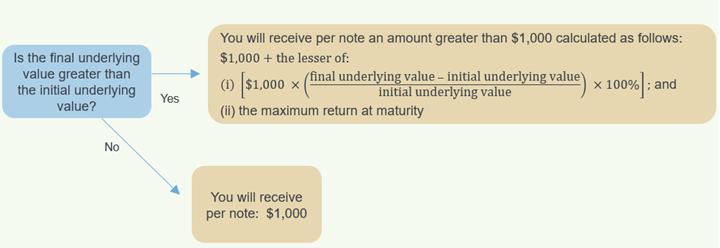
PS-5
| Market Linked Notes— Upside Participation to a Cap and Principal Return at Maturity Notes Linked to the S&P 500® Index due March 2, 2029 | |
| Summary Risk Factors | ||
An investment in the notes is significantly riskier than an investment in conventional debt securities. The notes are subject to all of the risks associated with an investment in our conventional debt securities (guaranteed by Citigroup Inc.), including the risk that we and Citigroup Inc. may default on our obligations under the notes, and are also subject to risks associated with the underlying. Accordingly, the notes are suitable only for investors who are capable of understanding the complexities and risks of the notes. You should consult your own financial, tax and legal advisors as to the risks of an investment in the notes and the suitability of the notes in light of your particular circumstances.
The following is a summary of certain key risk factors for investors in the notes. You should read this summary together with the more detailed description of risks relating to an investment in the notes contained in the section “Risk Factors Relating to the Notes” beginning on page EA-6 in the accompanying product supplement. You should also carefully read the risk factors included in the accompanying prospectus supplement and in the documents incorporated by reference in the accompanying prospectus, including Citigroup Inc.’s most recent Annual Report on Form 10-K and any subsequent Quarterly Reports on Form 10-Q, which describe risks relating to the business of Citigroup Inc. more generally.
You May Not Receive Any Positive Return On Your Investment In The Notes.
You will receive a positive return on your investment in the notes only if the final underlying value is greater than the initial underlying value. If the final underlying value is equal to or less than the initial underlying value, you will receive only the stated principal amount for each note you hold at maturity. As the notes do not pay any interest, even if the final underlying value is greater than the initial underlying value, there is no assurance that your total return at maturity on the notes will be as great as could have been achieved on conventional debt securities of ours or of another issuer with a similar credit rating of comparable maturity.
The Notes Do Not Pay Interest.
Unlike conventional debt securities, the notes do not pay interest or any other amounts prior to maturity. You should not invest in the notes if you seek current income during the term of the notes.
Your Potential Return On The Notes Is Limited.
Your potential total return on the notes at maturity is limited to the maximum return at maturity. Your return on the notes will not exceed the maximum return at maturity, even if the basket appreciates by significantly more than the maximum return at maturity. If the basket appreciates by more than the maximum return at maturity, the notes will underperform an alternative investment providing 1-to-1 exposure to the performance of the basket. When lost dividends are taken into account, the notes may underperform an alternative investment providing 1-to-1 exposure to the performance of the basket and a pass-through of dividends even if the basket appreciates by less than the maximum return at maturity. Furthermore, the effect of the participation rate will be progressively reduced for all final basket values exceeding the final basket value at which the maximum return at maturity is reached.
Your Payment At Maturity Depends On The Value Of The Underlying On A Single Day.
Because your payment at maturity depends on the value of the underlying solely on the valuation date, you are subject to the risk that the value of the underlying on that day may be lower, and possibly significantly lower, than on one or more other dates during the term of the notes. If you had invested directly in the underlyings or in another instrument linked to the underlying that you could sell for full value at a time selected by you, or if the payment at maturity were based on an average of values of the underlying, you might have achieved better returns.
You Will Not Receive Dividends Or Have Any Other Rights With Respect To The Underlying.
You will not receive any dividends with respect to the underlying. This lost dividend yield may be significant over the term of the notes. The payment scenarios described in this pricing supplement do not show any effect of lost dividend yield over the term of the notes. In addition, you will not have voting rights or any other rights with respect to the underlying.
Although The Notes Provide For The Repayment Of The Stated Principal Amount At Maturity, You May Nevertheless Suffer A Loss On Your Investment In Real Value Terms If The Percentage Change From The Initial Underlying Value to the Final Underlying Value Is Less Than Or Not Sufficiently Greater Than Zero.
This is because inflation may cause the real value of the stated principal amount to be less at maturity than it is at the time you invest, and because an investment in the notes represents a forgone opportunity to invest in an alternative asset that does generate a positive real return. This potential loss in real value terms is significant given the term of the notes. You should carefully consider whether an
PS-6
| Market Linked Notes— Upside Participation to a Cap and Principal Return at Maturity Notes Linked to the S&P 500® Index due March 2, 2029 | |
investment that may not provide for any return on your investment, or may provide a return that is lower than the return on alternative investments, is appropriate for you.
The Notes Are Subject To The Credit Risk Of Citigroup Global Markets Holdings Inc. And Citigroup Inc.
If we default on our obligations under the notes and Citigroup Inc. defaults on its guarantee obligations, you may not receive anything owed to you under the notes.
The Notes Are Riskier Than Securities With A Shorter Term.
The notes are relatively long-dated. Because the notes are relatively long-dated, many of the risks of the notes are heightened as compared to securities with a shorter term, because you will be subject to those risks for a longer period of time. In addition, the value of a longer-dated security is typically less than the value of an otherwise comparable security with a shorter term.
The Notes Will Not Be Listed On Any Securities Exchange And You May Not Be Able To Sell Them Prior To Maturity.
The notes will not be listed on any securities exchange. Therefore, there may be little or no secondary market for the notes. We have been advised that Wells Fargo currently intends to make a secondary market in relation to the notes. However, Wells Fargo may suspend or terminate making a market without notice, at any time and for any reason. If Wells Fargo suspends or terminates making a market, there may be no secondary market at all for the notes because it is likely that Wells Fargo will be the only broker-dealer that is willing to buy your notes prior to maturity. Accordingly, an investor must be prepared to hold the notes until maturity.
Sale Of The Notes Prior To Maturity May Result In A Loss Of Principal.
You will be entitled to receive at least the full stated principal amount of your notes, subject to the credit risk of Citigroup Global Markets Holdings Inc. and Citigroup Inc., only if you hold the notes to maturity. The value of the notes may fluctuate during the term of the notes, and if you are able to sell your notes prior to maturity, you may receive less than the full stated principal amount of your notes.
The Estimated Value Of The Notes On The Pricing Date, Based On CGMI’s Proprietary Pricing Models And Our Internal Funding Rate, Is Less Than The Public Offering Price.
The difference is attributable to certain costs associated with selling, structuring and hedging the notes that are included in the public offering price. These costs include (i) any selling concessions or other fees paid in connection with the offering of the notes, (ii) hedging and other costs incurred by us and our affiliates in connection with the offering of the notes and (iii) the expected profit (which may be more or less than actual profit) to CGMI or other of our affiliates and/or Wells Fargo or its affiliates in connection with hedging our obligations under the notes. These costs adversely affect the economic terms of the notes because, if they were lower, the economic terms of the notes would be more favorable to you. The economic terms of the notes are also likely to be adversely affected by the use of our internal funding rate, rather than our secondary market rate, to price the notes. See “The Estimated Value Of The Notes Would Be Lower If It Were Calculated Based On Wells Fargo’s Determination Of The Secondary Market Rate With Respect To Us” below.
The Estimated Value Of The Notes Was Determined For Us By Our Affiliate Using Proprietary Pricing Models.
CGMI derived the estimated value disclosed on the cover page of this pricing supplement from its proprietary pricing models. In doing so, it may have made discretionary judgments about the inputs to its models, such as the volatility in the closing value of the underlying, the dividend yields on the underlying and interest rates. CGMI’s views on these inputs may differ from your or others’ views, and as an underwriter in this offering, CGMI’s interests may conflict with yours. Both the models and the inputs to the models may prove to be wrong and therefore not an accurate reflection of the value of the notes. Moreover, the estimated value of the notes set forth on the cover page of this pricing supplement may differ from the value that we or our affiliates may determine for the notes for other purposes, including for accounting purposes. You should not invest in the notes because of the estimated value of the notes. Instead, you should be willing to hold the notes to maturity irrespective of the initial estimated value.
The Estimated Value Of The Notes Would Be Lower If It Were Calculated Based On Wells Fargo’s Determination Of The Secondary Market Rate With Respect To Us.
The estimated value of the notes included in this pricing supplement is calculated based on our internal funding rate, which is the rate at which we are willing to borrow funds through the issuance of the notes. We expect that our internal funding rate is generally lower than Wells Fargo’s determination of the secondary market rate with respect to us, which is the rate that we expect Wells Fargo will use in determining the value of the notes for purposes of any purchases of the notes from you in the secondary market. If the estimated
PS-7
| Market Linked Notes— Upside Participation to a Cap and Principal Return at Maturity Notes Linked to the S&P 500® Index due March 2, 2029 | |
value included in this pricing supplement were based on Wells Fargo’s determination of the secondary market rate with respect to us, rather than our internal funding rate, it would likely be lower. We determine our internal funding rate based on factors such as the costs associated with the notes, which are generally higher than the costs associated with conventional debt securities, and our liquidity needs and preferences. Our internal funding rate is not an interest rate that is payable on the notes.
Because there is not an active market for traded instruments referencing our outstanding debt obligations, Wells Fargo may determine the secondary market rate with respect to us for purposes of any purchase of the notes from you in the secondary market based on the market price of traded instruments referencing the debt obligations of Citigroup Inc., our parent company and the guarantor of all payments due on the notes, but subject to adjustments that Wells Fargo may deem appropriate.
The Estimated Value Of The Notes Is Not An Indication Of The Price, If Any, At Which Any Person May Be Willing To Buy The Notes From You In The Secondary Market.
Any such secondary market price will fluctuate over the term of the notes based on the market and other factors described in the next risk factor. Moreover, unlike the estimated value included in this pricing supplement, we expect that any value of the notes determined for purposes of a secondary market transaction will be based on Wells Fargo’s determination of the secondary market rate with respect to us, which will likely result in a lower value for the notes than if our internal funding rate were used. In addition, we expect that any secondary market price for the notes will be reduced by a bid-ask spread, which may vary depending on the aggregate stated principal amount of the notes to be purchased in the secondary market transaction, and may be reduced by the expected cost of unwinding related hedging transactions. As a result, it is likely that any secondary market price for the notes will be less than the public offering price.
The Value Of The Notes Prior To Maturity Will Fluctuate Based On Many Unpredictable Factors.
The value of your notes prior to maturity will fluctuate based on the value of the underlying, the volatility in the closing value of the underlying, the dividend yield on the underlying, interest rates generally, the time remaining to maturity and our and Citigroup Inc.’s creditworthiness, as reflected in our secondary market rate, among other factors described under “Risk Factors Relating to the Notes—Risk Factors Relating to All Notes—The value of your notes prior to maturity will fluctuate based on many unpredictable factors” in the accompanying product supplement. Changes in the value of the underlying may not result in a comparable change in the value of your notes. You should understand that the value of your notes at any time prior to maturity may be significantly less than the public offering price.
We Have Been Advised That, Immediately Following Issuance, Any Secondary Market Bid Price Provided By Wells Fargo, And The Value That Will Be Indicated On Any Brokerage Account Statements Prepared By Wells Fargo Or Its Affiliates, Will Reflect A Temporary Upward Adjustment.
The amount of this temporary upward adjustment will steadily decline to zero over the temporary adjustment period. See “Valuation of the Notes” in this pricing supplement.
Our Offering Of The Notes Is Not A Recommendation Of The Underlying.
The fact that we are offering the notes does not mean that we or Wells Fargo or its affiliates believe that investing in an instrument linked to the underlying is likely to achieve favorable returns. In fact, as we and Wells Fargo and its affiliates are each part of respective global financial institutions, our affiliates and affiliates of Wells Fargo may have positions (including short positions) in the underlying or in instruments related to the underlying, and may publish research or express opinions, that in each case are inconsistent with an investment linked to the underlying. These and other activities of our affiliates or of Wells Fargo or its affiliates may affect the closing values of the underlying in a way that negatively affects the value of and your return on the notes.
The Closing Value Of The Underlying May Be Adversely Affected By Our Or Our Affiliates’, Or By Wells Fargo And Its Affiliates’, Hedging And Other Trading Activities.
We expect to hedge our obligations under the notes through CGMI or other of our affiliates and/or Wells Fargo or its affiliates, who may take positions in the underlying or in financial instruments related to the underlying and may adjust such positions during the term of the notes. Our affiliates and Wells Fargo and its affiliates may also take positions in the underlying or in financial instruments related to the underlying on a regular basis (taking long or short positions or both), for their accounts, for other accounts under their management or to facilitate transactions on behalf of customers. These activities could affect the closing values of the underlying in a way that negatively affects the value of and your return on the notes. They could also result in substantial returns for us or our affiliates or Wells Fargo and its affiliates while the value of the notes declines.
PS-8
| Market Linked Notes— Upside Participation to a Cap and Principal Return at Maturity Notes Linked to the S&P 500® Index due March 2, 2029 | |
We And Our Affiliates And Wells Fargo And Its Affiliates May Have Economic Interests That Are Adverse To Yours As A Result Of Our And Their Respective Business Activities.
Our affiliates and Wells Fargo and its affiliates engage in business activities with a wide range of companies. These activities include extending loans, making and facilitating investments, underwriting securities offerings and providing advisory services. These activities could involve or affect the underlying in a way that negatively affects the value of and your return on the notes. They could also result in substantial returns for us or our affiliates or Wells Fargo or its affiliates while the value of the notes declines. In addition, in the course of this business, we or our affiliates or Wells Fargo or its affiliates may acquire non-public information, which will not be disclosed to you.
The Calculation Agent, Which Is An Affiliate Of Ours, Will Make Important Determinations With Respect To The Notes.
If certain events occur during the term of the notes, such as market disruption events and other events with respect to the underlying, CGMI, as calculation agent, will be required to make discretionary judgments that could significantly affect your return on the notes. In making these judgments, the calculation agent’s interests as an affiliate of ours could be adverse to your interests as a holder of the notes. See “Risk Factors Relating to the Notes—Risk Factors Relating to All Notes—The calculation agent, which is an affiliate of ours, will make important determinations with respect to the notes” in the accompanying product supplement.
Changes That Affect The Underlying May Affect The Value Of Your Notes.
The sponsor of the underlying may at any time make methodological changes or other changes in the manner in which they operate that could affect the values of the underlying. We are not affiliated with the underlying sponsor and, accordingly, we have no control over any changes the sponsor may make. Such changes could adversely affect the performance of the underlying and the value of and your return on the notes.
The Stated Maturity Date May Be Postponed If The Final Valuation Date Is Postponed.
A valuation date (including the final valuation date) will be postponed if the applicable originally scheduled valuation date is not a trading day with respect to the underlying or if the calculation agent determines that a market disruption event has occurred or is continuing on that valuation date. If such a postponement occurs with respect to the final valuation date, the stated maturity date will be the later of (i) the initial stated maturity date and (ii) three business days after the final valuation date as postponed.
You Will Be Required To Recognize Taxable Income On The Notes Prior To Maturity.
If you are a U.S. holder of a note, you will be required to recognize taxable interest income in each year that you hold the note, even though you will not receive any payment in respect of the note prior to maturity (or earlier sale, exchange or retirement). In addition, any gain you recognize will be treated as ordinary interest income rather than capital gain. You should review the section of this pricing supplement entitled “United States Federal Tax Considerations.”
PS-9
| Market Linked Notes— Upside Participation to a Cap and Principal Return at Maturity Notes Linked to the S&P 500® Index due March 2, 2029 | |
| Hypothetical Returns |
The table below is based on a range of hypothetical percentage changes from the initial underlying value to the hypothetical final underlying value and illustrates:
| • | the hypothetical percentage change from the initial underlying value to the hypothetical final underlying value; |
| • | the hypothetical payment at maturity per note; and |
| • | the hypothetical total pre-tax rate of return. |
The table below is based on a hypothetical initial underlying value of 100 and does not reflect the actual initial underlying value. The table below assume that the maximum return at maturity will be set at the lowest value indicated in “Terms of the Notes” above. The actual maximum return at security will be determined on the pricing date.
|
Hypothetical final underlying value |
Hypothetical percentage change from the initial underlying value to the hypothetical final underlying value |
Hypothetical payment at maturity per note | Hypothetical total pre-tax rate of return | |||
| 200.00 | 100.00% | $1,300.00 | 30.00% | |||
| 175.00 | 75.00% | $1,300.00 | 30.00% | |||
| 150.00 | 50.00% | $1,300.00 | 30.00% | |||
| 140.00 | 40.00% | $1,300.00 | 30.00% | |||
| 130.00 | 30.00% | $1,300.00 | 30.00% | |||
| 120.00 | 20.00% | $1,200.00 | 20.00% | |||
| 110.00 | 10.00% | $1,100.00 | 10.00% | |||
| 100.00 | 0.00% | $1,000.00 | 0.00% | |||
| 90.00 | -10.00% | $1,000.00 | 0.00% | |||
| 80.00 | -20.00% | $1,000.00 | 0.00% | |||
| 70.00 | -30.00% | $1,000.00 | 0.00% | |||
| 60.00 | -40.00% | $1,000.00 | 0.00% | |||
| 50.00 | -50.00% | $1,000.00 | 0.00% | |||
| 25.00 | -75.00% | $1,000.00 | 0.00% | |||
| 0.00 | -100.00% | $1,000.00 | 0.00% | |||
The above figures are for purposes of illustration only and may have been rounded for ease of analysis.
PS-10
| Market Linked Notes— Upside Participation to a Cap and Principal Return at Maturity Notes Linked to the S&P 500® Index due March 2, 2029 | |
| Hypothetical Examples |
The examples below illustrate how to determine the payment at maturity on the notes, assuming the various hypothetical final underlying values indicated below. The examples are solely for illustrative purposes, do not show all possible outcomes and are not a prediction of what the actual payment at maturity on the notes will be. The actual payment at maturity will depend on the actual final underlying value.
The examples below are based on a hypothetical initial underlying value of 100, rather than the actual initial underlying value. For the actual initial underlying value, see “Terms of the Notes” above. We have used this hypothetical value, rather than the actual value, to simplify the calculations and aid understanding of how the notes work. However, you should understand that the actual payment at maturity on the notes will be calculated based on the actual initial underlying value, and not the hypothetical value used in the examples below. The examples below assume that the maximum return at maturity will be set at the lowest value indicated in “Terms of the Notes” above. The actual maximum return at security will be determined on the pricing date.
Example 1—Upside Scenario A. The hypothetical final underlying value is 115 (a 15% increase from the initial underlying value), which is greater than the initial underlying value.
Payment at maturity per note = $1,000 plus the lesser of:
(i) $1,000 × final underlying value – initial underlying
value × participation rate and (ii) the maximum return at maturity
initial underlying value
= $1,000 + the lesser of : (i) ($1,000 × 115 – 100 × participation rate) and (ii) $300
100
= $1,000 + the lesser of: (i) ($1,000 × 15% × 100%) and (ii) $300
= $1,000 + the lesser of (i) $150 and (ii) $300
= $1,150
Because the underlying appreciated from the initial underlying value to the hypothetical final underlying value, you would receive a total return at maturity equal to the upside performance of the underlying multiplied by the participation rate, which in this case is less than the maximum return at maturity.
Example 2—Upside Scenario B. The hypothetical final underlying value is 150 (a 50% increase from the initial underlying value), which is greater than the initial underlying value.
Payment at maturity per note = $1,000 plus the lesser of:
(i) $1,000 × final underlying value – initial underlying
value × participation rate and (ii) the maximum return at maturity
initial underlying value
= $1,000 + the lesser of : (i) ($1,000 × 150 – 100 × participation rate) and (ii) $300
100
= $1,000 + the lesser of: (i) ($1,000 × 50% × 100%) and (ii) $300
= $1,000 + the lesser of (i) $500 and (ii) $300
= $1,300
Because the underlying appreciated from the initial underlying value to the hypothetical final underlying value and the upside performance of the underlying multiplied by the participation rate exceeds the maximum return at maturity, your total return at maturity would be limited to the maximum return at maturity in this case. In this scenario, an investment in the notes would underperform a hypothetical alternative investment providing 1-to-1 exposure to the appreciation of the underlying without a maximum return.
PS-11
| Market Linked Notes— Upside Participation to a Cap and Principal Return at Maturity Notes Linked to the S&P 500® Index due March 2, 2029 | |
Example 3—Par Scenario. The hypothetical final underlying value is 90 (a 10% decrease from the initial underlying value), which is less than the initial underlying value.
Payment at maturity per note = $1,000
Because the hypothetical final underlying value is less than the initial underlying value, you would be repaid the stated principal amount of your notes at maturity but would not receive any positive return on your investment.
PS-12
| Market Linked Notes— Upside Participation to a Cap and Principal Return at Maturity Notes Linked to the S&P 500® Index due March 2, 2029 | |
Additional Terms of the Notes |
The following provisions supersede the provisions in the product supplement to the extent that they are inconsistent from those provisions.
Certain Definitions
A “trading day” means a day, as determined by the calculation agent, on which (i) the relevant stock exchanges with respect to each security underlying the underlying are scheduled to be open for trading for their respective regular trading sessions and (ii) each related futures or options exchange is scheduled to be open for trading for its regular trading session.
The “relevant stock exchange” for any security underlying the underlying means the primary exchange or quotation system on which such security is traded, as determined by the calculation agent.
The “related futures or options exchange” for the underlying means an exchange or quotation system where trading has a material effect (as determined by the calculation agent) on the overall market for futures or options contracts relating to the underlying.
Postponement of the Valuation Date
If the scheduled valuation date is not a trading day, the valuation date will be postponed to the next succeeding day that is a trading day. The valuation date is also subject to postponement due to the occurrence of a market disruption event. See “—Market Disruption Events.”
Market Disruption Events
A “market disruption event” with respect to the underlying means any of the following events as determined by the calculation agent in its sole discretion:
| (A) | The occurrence or existence of a material suspension of or limitation imposed on trading by the relevant stock exchanges or otherwise relating to securities which then comprise 20% or more of the value of the underlying or any successor index at any time during the one-hour period that ends at the close of trading on that day, whether by reason of movements in price exceeding limits permitted by those relevant stock exchanges or otherwise. |
| (B) | The occurrence or existence of a material suspension of or limitation imposed on trading by any related futures or options exchange or otherwise in futures or options contracts relating to the underlying or any successor index on any related futures or options exchange at any time during the one-hour period that ends at the close of trading on that day, whether by reason of movements in price exceeding limits permitted by the related futures or options exchange or otherwise. |
| (C) | The occurrence or existence of any event, other than an early closure, that materially disrupts or impairs the ability of market participants in general to effect transactions in, or obtain market values for, securities that then comprise 20% or more of the value of the underlying or any successor index on their relevant stock exchanges at any time during the one-hour period that ends at the close of trading on that day. |
| (D) | The occurrence or existence of any event, other than an early closure, that materially disrupts or impairs the ability of market participants in general to effect transactions in, or obtain market values for, futures or options contracts relating to the underlying or any successor index on any related futures or options exchange at any time during the one-hour period that ends at the close of trading on that day. |
| (E) | The closure on any exchange business day of the relevant stock exchanges on which securities that then comprise 20% or more of the value of the underlying or any successor index are traded or any related futures or options exchange with respect to the underlying or any successor index prior to its scheduled closing time unless the earlier closing time is announced by the relevant stock exchange or related futures or options exchange, as applicable, at least one hour prior to the earlier of (1) the actual closing time for the regular trading session on such relevant stock exchange or related futures or |
PS-13
| Market Linked Notes— Upside Participation to a Cap and Principal Return at Maturity Notes Linked to the S&P 500® Index due March 2, 2029 | |
options exchange, as applicable, and (2) the submission deadline for orders to be entered into the relevant stock exchange or related futures or options exchange, as applicable, system for execution at such actual closing time on that day.
| (F) | The relevant stock exchange for any security underlying the underlying or successor index or any related futures or options exchange with respect to the underlying or successor index fails to open for trading during its regular trading session. |
For purposes of determining whether a market disruption event has occurred with respect to the underlying:
| (1) | the relevant percentage contribution of a security to the value of the underlying or any successor index will be based on a comparison of (x) the portion of the value of the underlying attributable to that security and (y) the overall value of the underlying or successor index, in each case immediately before the occurrence of the market disruption event; |
| (2) | the “close of trading” on any trading day for the underlying or any successor index means the scheduled closing time of the relevant stock exchanges with respect to the securities underlying the underlying or successor index on such trading day; provided that, if the actual closing time of the regular trading session of any such relevant stock exchange is earlier than its scheduled closing time on such trading day, then (x) for purposes of clauses (A) and (C) of the definition of “market disruption event” above, with respect to any security underlying the underlying or successor index for which such relevant stock exchange is its relevant stock exchange, the “close of trading” means such actual closing time and (y) for purposes of clauses (B) and (D) of the definition of “market disruption event” above, with respect to any futures or options contract relating to the underlying or successor index, the “close of trading” means the latest actual closing time of the regular trading session of any of the relevant stock exchanges, but in no event later than the scheduled closing time of the relevant stock exchanges; |
| (3) | the “scheduled closing time” of any relevant stock exchange or related futures or options exchange on any trading day for the underlying or any successor index means the scheduled weekday closing time of such relevant stock exchange or related futures or options exchange on such trading day, without regard to after hours or any other trading outside the regular trading session hours; and |
| (4) | an “exchange business day” means any trading day for the underlying or any successor index on which each relevant stock exchange for the securities underlying the underlying or any successor index and each related futures or options exchange with respect to the underlying or any successor index are open for trading during their respective regular trading sessions, notwithstanding any such relevant stock exchange or related futures or options exchange closing prior to its scheduled closing time. |
If a market disruption event occurs or is continuing on the valuation date, then the valuation date will be postponed to the first succeeding trading day on which a market disruption event has not occurred and is not continuing; however, if such first succeeding trading day has not occurred as of the eighth trading day after the originally scheduled valuation date, that eighth trading day shall be deemed to be the valuation date. If the valuation date has been postponed eight trading days after the originally scheduled valuation date and a market disruption event occurs or is continuing on such eighth trading day, the calculation agent will determine the closing value of the underlying on such eighth trading day in accordance with the formula for and method of calculating the closing value of the underlying last in effect prior to commencement of the market disruption event, using the closing price (or, with respect to any relevant security, if a market disruption event has occurred with respect to such security, its good faith estimate of the value of such security at the scheduled closing time of the relevant stock exchange for such security or, if earlier, the actual closing time of the regular trading session of such relevant stock exchange) on such date of each security included in the underlying. As used herein, “closing price” means, with respect to any security on any date, the relevant stock exchange traded or quoted price of such security as of the scheduled closing time of the relevant stock exchange for such security or, if earlier, the actual closing time of the regular trading session of such relevant stock exchange.
PS-14
| Market Linked Notes— Upside Participation to a Cap and Principal Return at Maturity Notes Linked to the S&P 500® Index due March 2, 2029 | |
| Information About the S&P 500® Index |
The S&P 500® Index consists of the common stocks of 500 issuers selected to provide a performance benchmark for the large capitalization segment of the U.S. equity markets. It is calculated and maintained by S&P Dow Jones Indices LLC.
Please refer to the section “Equity Index Descriptions—The S&P U.S. Indices—The S&P 500® Index” in the accompanying underlying supplement for additional information.
We have derived all information regarding the S&P 500® Index from publicly available information and have not independently verified any information regarding the S&P 500® Index. This pricing supplement relates only to the securities and not to the S&P 500® Index. We make no representation as to the performance of the S&P 500® Index over the term of the securities.
The securities represent obligations of Citigroup Global Markets Holdings Inc. (guaranteed by Citigroup Inc.) only. The sponsor of the S&P 500® Index is not involved in any way in this offering and has no obligation relating to the securities or to holders of the securities.
Historical Information
The closing value of the S&P 500® Index on February 4, 2022 was 4,500.53.
The graph below shows the closing value of the S&P 500® Index for each day such value was available from January 3, 2017 to February 4, 2022. We obtained the closing values from Bloomberg L.P., without independent verification. You should not take historical closing values as an indication of future performance.

PS-15
| Market Linked Notes— Upside Participation to a Cap and Principal Return at Maturity Notes Linked to the S&P 500® Index due March 2, 2029 | |
| United States Federal Tax Considerations |
In the opinion of our counsel, Davis Polk & Wardwell LLP, which is based on current market conditions, the notes should be treated as “contingent payment debt instruments” for U.S. federal income tax purposes, as described in the section of the accompanying product supplement called “United States Federal Tax Considerations—Tax Consequences to U.S. Holders—Notes Treated as Contingent Payment Debt Instruments,” and the remaining discussion is based on this treatment.
If you are a U.S. Holder (as defined in the accompanying product supplement), you will be required to recognize interest income during the term of the notes at the “comparable yield,” which generally is the yield at which we could issue a fixed-rate debt instrument with terms similar to those of the notes, including the level of subordination, term, timing of payments and general market conditions, but excluding any adjustments for the riskiness of the contingencies or the liquidity of the notes. We are required to construct a “projected payment schedule” in respect of the notes representing a payment the amount and timing of which would produce a yield to maturity on the notes equal to the comparable yield. Assuming you hold the notes until their maturity, the amount of interest you include in income based on the comparable yield in the taxable year in which the notes mature will be adjusted upward or downward to reflect the difference, if any, between the actual and projected payment on the notes at maturity as determined under the projected payment schedule. However, special rules may apply if the payment at maturity on the notes is treated as becoming fixed prior to maturity. See “United States Federal Tax Considerations—Tax Consequences to U.S. Holders—Notes Treated as Contingent Payment Debt Instruments” in the accompanying product supplement for a more detailed discussion of the special rules.
Upon the sale, exchange or retirement of the notes prior to maturity, you generally will recognize gain or loss equal to the difference between the proceeds received and your adjusted tax basis in the notes. Your adjusted tax basis will equal your purchase price for the notes, increased by interest previously included in income on the notes. Any gain generally will be treated as ordinary income, and any loss generally will be treated as ordinary loss to the extent of prior interest inclusions on the note and as capital loss thereafter.
We have determined that the comparable yield for a note is a rate of %, compounded semi-annually, and that the projected payment schedule with respect to a note consists of a single payment of $ at maturity.
Neither the comparable yield nor the projected payment schedule constitutes a representation by us regarding the actual amount that we will pay on the notes.
Non-U.S. Holders. Subject to the discussions below regarding Section 871(m) and in “United States Federal Tax Considerations—Tax Consequences to Non-U.S. Holders” and “—FATCA” in the accompanying product supplement, if you are a Non-U.S. Holder (as defined in the accompanying product supplement) of the notes, under current law you generally will not be subject to U.S. federal withholding or income tax in respect of any payment on or any amount received on the sale, exchange or retirement of the notes, provided that (i) income in respect of the notes is not effectively connected with your conduct of a trade or business in the United States, and (ii) you comply with the applicable certification requirements. See “United States Federal Tax Considerations—Tax Consequences to Non-U.S. Holders” in the accompanying product supplement for a more detailed discussion of the rules applicable to Non-U.S. Holders of the notes.
As discussed under “United States Federal Tax Considerations—Tax Consequences to Non-U.S. Holders—Dividend Equivalents Under Section 871(m) of the Code” in the accompanying product supplement, Section 871(m) of the Internal Revenue Code of 1986, as amended and Treasury regulations promulgated thereunder (“Section 871(m)”) generally impose a 30% withholding tax on dividend equivalents paid or deemed paid to Non-U.S. Holders with respect to certain financial instruments linked to U.S. equities (“U.S. Underlying Securities”) or indices that include U.S. Underlying Securities. Section 871(m) generally applies to instruments that substantially replicate the economic performance of one or more U.S. Underlying Securities, as determined based on tests set forth in the applicable Treasury regulations. However, the regulations, as modified by an Internal Revenue Service (“IRS”) notice, exempt financial instruments issued prior to January 1, 2023 that do not have a “delta” of one. Based on the terms of the notes and representations provided by us as of the date of this preliminary pricing supplement, our counsel is of the opinion that the notes should not be treated as transactions that have a “delta” of one within the meaning of the regulations with respect to any U.S. Underlying Security and, therefore, should not be subject to withholding tax under Section 871(m). However, the final determination regarding the treatment of the notes under Section 871(m) will be made as of the pricing date for the notes, and it is possible that the notes will be subject to withholding under Section 871(m) based on the circumstances as of that date.
A determination that the notes are not subject to Section 871(m) is not binding on the IRS, and the IRS may disagree with this treatment. Moreover, Section 871(m) is complex and its application may depend on your particular circumstances, including your other transactions. You should consult your tax adviser regarding the potential application of Section 871(m) to the notes.
If withholding tax applies to the notes, we will not be required to pay any additional amounts with respect to amounts withheld.
PS-16
| Market Linked Notes— Upside Participation to a Cap and Principal Return at Maturity Notes Linked to the S&P 500® Index due March 2, 2029 | |
You should read the section entitled “United States Federal Tax Considerations” in the accompanying product supplement. The preceding discussion, when read in combination with that section, constitutes the full opinion of Davis Polk & Wardwell LLP regarding the material U.S. federal tax consequences of owning and disposing of the notes.
You should also consult your tax adviser regarding all aspects of the U.S. federal tax consequences of an investment in the notes and any tax consequences arising under the laws of any state, local or non-U.S. taxing jurisdiction.
PS-17
| Market Linked Notes— Upside Participation to a Cap and Principal Return at Maturity Notes Linked to the S&P 500® Index due March 2, 2029 | |
| Supplemental Plan of Distribution |
Pursuant to the terms of the Amended and Restated Global Selling Agency Agreement, dated April 7, 2017, CGMI, acting as principal, will purchase the notes from Citigroup Global Markets Holdings Inc. CGMI, as the lead agent for the offering, expects to sell the notes to Wells Fargo, as agent. Wells Fargo will receive an underwriting discount and commission of up to 4.62% ($46.20) for each security it sells. Wells Fargo will pay selected dealers, which may include WFA, a fixed selling commission of 2.50% ($25.00) for each note they sell. In addition to the selling commission allowed to WFA, Wells Fargo will pay $1.20 per security of the underwriting discount and commission to WFA as a distribution expense fee for each security sold by WFA.
In addition, in respect of certain securities sold in this offering, CGMI may pay a fee of up to $1.00 per security to selected securities dealers in consideration for marketing and other services in connection with the distribution of the securities to other securities dealers.
For the avoidance of doubt, the fees and selling concessions described in this pricing supplement will not be rebated if the securities are automatically redeemed prior to maturity.
The public offering price of the securities includes the underwriting discount and commission described on the cover page of this pricing supplement and the estimated cost of hedging our obligations under the securities. We expect to hedge our obligations under the securities through affiliated or unaffiliated counterparties, which may include our affiliates and affiliates of Wells Fargo. Our cost of hedging will include the projected profit that such counterparties, which may include our affiliates and affiliates of Wells Fargo, expect to realize in consideration for assuming the risks inherent in hedging our obligations under the securities. Because hedging our obligations entails risks and may be influenced by market forces beyond the control of any counterparty, which may include our affiliates and affiliates of Wells Fargo, such hedging may result in a profit that is more or less than expected, or could result in a loss.
This pricing supplement and the accompanying product supplement, underlying supplement, prospectus supplement and prospectus may be used by Wells Fargo or an affiliate of Wells Fargo in connection with offers and sales related to market-making or other transactions in the securities. Wells Fargo or an affiliate of Wells Fargo may act as principal or agent in such transactions. Such sales will be made at prices related to prevailing market prices at the time of sale or otherwise.
No action has been or will be taken by Citigroup Global Markets Holdings Inc., Wells Fargo or any broker-dealer affiliates of any of them that would permit a public offering of the securities or possession or distribution of this pricing supplement or the accompanying product supplement, underlying supplement, prospectus supplement or prospectus in any jurisdiction, other than the United States, where action for that purpose is required. No offers, sales or deliveries of the securities, or distribution of this pricing supplement, the accompanying product supplement, underlying supplement or prospectus supplement and prospectus, may be made in or from any jurisdiction except in circumstances that will result in compliance with any applicable laws and regulations and will not impose any obligations on Citigroup Global Markets Holdings Inc., Wells Fargo or any broker-dealer affiliates of any of them.
For the following jurisdictions, please note specifically:
Prohibition of Sales to European Economic Area Retail Investors
The securities may not be offered, sold or otherwise made available to any retail investor in the European Economic Area (“EEA”). For the purposes of this provision:
| (a) | the expression “retail investor” means a person who is one (or more) of the following: |
| (i) | a retail client as defined in point (11) of Article 4(1) of Directive 2014/65/EU (as amended, “MiFID II”); or |
| (ii) | a customer within the meaning of Directive (EU) 2016/97 (the “Insurance Distribution Directive”), where that customer would not qualify as a professional client as defined in point (10) of Article 4(1) of MiFID II; or |
| (iii) | not a qualified investor as defined in Regulation (3)(e) (EU) 2017/1129 (as amended, the “Prospectus Regulation”); and |
| (b) | the expression an “offer” includes the communication in any form and by any means of sufficient information on the terms of the offer and the securities to be offered so as to enable an investor to decide to purchase or subscribe for the securities. |
Consequently no key information document required by Regulation (EU) No 1286/2014 (the “PRIIPs Regulation”) for offering or selling the securities or otherwise making them available to retail investors in the EEA has been prepared and therefore offering or selling the securities or otherwise making them available to any retail investor in the EEA may be unlawful under the PRIIPs Regulation.
Prohibition of Sales to United Kingdom Retail Investors
PS-18
| Market Linked Notes— Upside Participation to a Cap and Principal Return at Maturity Notes Linked to the S&P 500® Index due March 2, 2029 | |
The securities may not be offered, sold or otherwise made available to any retail investor in the United Kingdom. For the purposes of this provision:
| (a) | the expression "retail investor" means a person who is one (or more) of the following: |
| (i) | a retail client, as defined in point (8) of Article 2 of Regulation (EU) No 2017/565 as it forms part of United Kingdom domestic law by virtue of the European Union (Withdrawal) Act 2018 (the "EUWA") and the regulations made under the EUWA; or |
| (ii) | a customer within the meaning of the provisions of the Financial Services and Markets Act 2000 (as amended) (the “FSMA”) and any rules or regulations made under the FSMA to implement Directive (EU) 2016/97, where that customer would not qualify as a professional client, as defined in point (8) of Article 2(1) of Regulation (EU) No 600/2014 as it forms part of United Kingdom domestic law by virtue of the EUWA and the regulations made under the EUWA; or |
| (iii) | not a qualified investor as defined in Regulation (3)(e) of the Prospectus Regulation; and |
| (b) | the expression an “offer” includes the communication in any form and by any means of sufficient information on the terms of the offer and the securities to be offered so as to enable an investor to decide to purchase or subscribe for the securities. |
Consequently no key information document required by Regulation (EU) No 1286/2014 as it forms part of domestic law by virtue of the EUWA (the “UK PRIIPs Regulation”) for offering or selling any securities or otherwise making them available to retail investors in the United Kingdom has been prepared and therefore offering or selling any securities or otherwise making them available to any retail investor in the United Kingdom may be unlawful under the UK PRIIPs Regulation.
| Valuation of the Securities |
CGMI calculated the estimated value of the securities set forth on the cover page of this pricing supplement based on proprietary pricing models. CGMI’s proprietary pricing models generated an estimated value for the securities by estimating the value of a hypothetical package of financial instruments that would replicate the payout on the securities, which consists of a fixed-income bond (the “bond component”) and one or more derivative instruments underlying the economic terms of the securities (the “derivative component”). CGMI calculated the estimated value of the bond component using a discount rate based on our internal funding rate. CGMI calculated the estimated value of the derivative component based on a proprietary derivative-pricing model, which generated a theoretical price for the instruments that constitute the derivative component based on various inputs, including the factors described under “Summary Risk Factors—The Value Of The Securities Prior To Maturity Will Fluctuate Based On Many Unpredictable Factors” in this pricing supplement, but not including our or Citigroup Inc.’s creditworthiness. These inputs may be market-observable or may be based on assumptions made by CGMI in its discretionary judgment.
The estimated value of the securities is a function of the terms of the securities and the inputs to CGMI’s proprietary pricing models. As of the date of this preliminary pricing supplement, it is uncertain what the estimated value of the securities will be on the pricing date because certain terms of the securities have not yet been fixed and because it is uncertain what the values of the inputs to CGMI’s proprietary pricing models will be on the pricing date.
We have been advised that, for a period of approximately six months following issuance of the securities, the price, if any, at which Wells Fargo would be willing to buy the securities from investors, and the value that will be indicated for the securities on any brokerage account statements prepared by Wells Fargo or its affiliates, will reflect a temporary upward adjustment from the price or value that would otherwise be determined. This temporary upward adjustment represents a portion of the costs associated with selling, structuring and hedging the securities that are included in the public offering price of the securities. The amount of this temporary upward adjustment will decline to zero on a straight-line basis over the six-month temporary adjustment period. However, Wells Fargo is not obligated to buy the securities from investors at any time. See “Summary Risk Factors—The Securities Will Not Be Listed On Any Securities Exchange And You May Not Be Able To Sell Them Prior To Maturity.”
© 2022 Citigroup Global Markets Inc. All rights reserved. Citi and Citi and Arc Design are trademarks and service marks of Citigroup Inc. or its affiliates and are used and registered throughout the world.
PS-19
| Market Linked Notes— Upside Participation to a Cap and Principal Return at Maturity Notes Linked to the S&P 500® Index due March 2, 2029 | |
| Appendix |
The material included in this Appendix was prepared by Wells Fargo and will be distributed to investors in connection with the offering of the notes described in this pricing supplement. The terminology used in the material included in this Appendix may differ from the terms used in this pricing supplement. The material included in this Appendix does not constitute terms of the notes. It is a general description of securities that share some features similar to the notes offered by this pricing supplement, but it does not relate specifically to the notes offered by this pricing supplement, and you should rely only on this pricing supplement (excluding the Appendix) and the accompanying product supplement, prospectus supplement and prospectus for a description of the specific terms of
the notes offered by this pricing supplement.
PS-20
| Market Linked Notes— Upside Participation to a Cap and Principal Return at Maturity Notes Linked to the S&P 500® Index due March 2, 2029 | |

Market Linked Notes
Upside Participation to a Cap and Principal Return at Maturity

This material was prepared by Wells Fargo Securities, LLC, a registered broker- dealer and separate non-bank affiliate of Wells Fargo & Company. This material is not a product of Wells Fargo & Company research departments. Please see the relevant offering materials for complete product descriptions, including related risk and tax disclosure. |
MARKET LINKED NOTES WITH UPSIDE PARTICIPATION TO A CAP AND PRINCIPAL RETURN AT MATURITY ARE NOT DEPOSITS OR OTHER OBLIGATIONS OF A DEPOSITORY INSTITUTION AND ARE NOT INSURED BY THE FEDERAL DEPOSIT INSURANCE CORPORATION, THE DEPOSIT INSURANCE FUND OR ANY OTHER GOVERNMENTAL AGENCY OF THE UNITED STATES OR ANY OTHER JURISDICTION.
Market Linked Notes with Upside Participation to a Cap and Principal Return at Maturity have complex features and are not appropriate for all investors. Before deciding to make an investment, you should read and understand the applicable preliminary pricing supplement and other related offering documents provided by the applicable issuer.
Market Linked Notes with Upside Participation to a Cap and Principal Return at Maturity |
Market Linked Notes with Upside Participation to a Cap and Principal Return at Maturity (“these Market Linked Notes”) offer a return linked to the performance of a market measure, such as an index, exchange-traded fund or a basket of indices or exchange-traded funds (the “underlying”). In contrast to a direct investment in the underlying, these Market Linked Notes provide for the repayment of principal at maturity even if the underlying declines (subject to the credit risk of the issuer), as well as the potential for a positive return at maturity based on the point to point
performance of the underlying during the term of these Market Linked Notes, subject to a specified maximum return.
These Market Linked Notes are designed for investors who seek exposure to any positive performance of an underlying, but without the downside market risk of a direct investment in the underlying. In exchange for this protection against downside market risk, you must be willing to forgo interest payments, dividends (in the case of equity underlyings) and participation in any appreciation of the underlying beyond the maximum return. The potential for a positive return and the repayment of principal apply at maturity only and, if the issuer defaults on its payment obligations, you could lose your entire investment.
These Market Linked Notes are unsecured debt obligations of the issuer. You will have no ability to pursue the underlying or any assets included in the underlying for payment.
A-2 | Market Linked Notes with Upside Participation to a Cap and Principal Return at Maturity
The charts in this section do not reflect forgone dividend payments.
|
Direct investment payoff
For traditional assets, such as stocks, there is a direct relationship between the change in the level of the asset and the return on
the investment. For example, as the graph indicates, suppose you bought shares of a common stock at $100 per share. If you sold the shares at $120 each, the return on the investment (excluding any dividend payments) would be $20 per share, or 20%.
Similarly, if you sold the shares after the price decreased to $80 (i.e., a decline of 20%), this would result in a 20% investment loss (excluding dividends). |

Market Linked Notes with Upside Participation to a Cap and Principal Return at Maturity
These Market Linked Notes, if held until maturity, offer the repayment of principal and the potential to receive a positive return at maturity that is based on the performance of an underlying as measured from a specified starting level to the closing level of the underlying on a calculation day shortly before maturity (the ending level). While these Market Linked Notes limit against losses, they also limit upside return potential due to the specified maximum return, as explained below.
To understand how these Market Linked Notes would perform under varying market conditions, consider a hypothetical Market Linked Note with the following terms:
| • | Principal return: 100%. These Market Linked Notes, if held until maturity, provide for the repayment of principal regardless of the performance of the underlying, subject to the ability of the issuer to make payments when due. If the issuer defaults on its payment obligations, you could lose your entire investment. |
| • | Participation rate: 100%. A participation rate determines how much of the appreciation of the underlying (if any) will be reflected in the payment at maturity on these Market Linked Notes, subject to the maximum return described below. A participation rate of 100% means that if the underlying appreciates from its starting level to its ending level, you will receive a return at maturity equal to 100% of that appreciation, subject to the maximum return described below. For example, if the underlying appreciates by 10%, you would receive a return at maturity equal to 10% (which is 100% of 10%). For some issuances of these Market Linked Notes, the participation rate may be greater than 100%, in which case you will participate on a leveraged basis in any appreciation of the underlying from its starting level to its ending level, subject to the maximum return. For example, if the participation rate is 110% and the underlying appreciates by 10%, you would receive a return at maturity equal to 11% (which is 110% of 10%). |
| • | Maximum Return: 50%. A maximum return effectively sets a ceiling above which you will not participate in further appreciation of the underlying. A maximum return of 50% means that you will not receive a positive return of more than 50% of the original offering price of these Market Linked Notes at maturity, even if the underlying appreciates by more than 50%. This results in a maximum payment at maturity of 150% of the original offering price. Note that the maximum return effectively reduces the participation rate in scenarios where the participation rate multiplied by the appreciation of the underlying would exceed the maximum return. The maximum return on a Market Linked Note may be greater than or less than 50%. |
A-3 | Market Linked Notes with Upside Participation to a Cap and Principal Return at Maturity
| This information, including the graph to the right, is hypothetical and is provided for informational purposes only. It is not intended to represent any specific return, yield, or investment, nor is it indicative of future results. The graph illustrates the payoff on the hypothetical Market Linked Notes with Upside Participation to a Cap and Principal Return at Maturity described above for a range of percentage changes from the starting level to the ending level. |  |
This hypothetical Market Linked Note could outperform the underlying if the ending level of the underlying has declined from the starting level. Note that, because the value of the underlying does not incorporate dividends paid on the underlying, the return on these Market Linked Notes does not compensate you for any dividends paid on the underlying. All payments on these Market Linked Notes are subject to the ability of the issuer to make such payments to you when they are due, and you will have no ability to pursue the underlying or any assets included in the underlying for payment. If the issuer defaults on its payment obligations, you could lose your entire investment.
A-4 | Market Linked Notes with Upside Participation to a Cap and Principal Return at Maturity
Determining payment at maturity
The diagram below illustrates how the cash payment on the stated maturity date for this hypothetical Market Linked Note would be calculated. The diagram below assumes an original offering price of $1,000 per security.

A-5 | Market Linked Notes with Upside Participation to a Cap and Principal Return at Maturity
Estimated value of Market Linked Notes with Upside Participation to a Cap and Principal Return at Maturity
The original offering price of these Market Linked Notes will include certain costs that are borne by you. Because of these costs, the estimated value of these Market Linked Notes on the pricing date will be less than the original offering price. If specified in the applicable pricing supplement, these costs may include the underwriting discount or commission, the hedging profits of the issuer’s hedging counterparty (which may be an affiliate of the issuer), and hedging and other costs associated with the offering and costs relating to the issuer’s funding considerations for debt of this type. See “General risks and investment considerations” herein and the applicable pricing supplement for more information.
The issuer will disclose the estimated value of these Market Linked Notes in the applicable pricing supplement. The estimated value of these Market Linked Notes will be determined by estimating the value of the combination of hypothetical financial instruments that would replicate the payout on these Market Linked Notes, which combination consists of a non-interest bearing, fixed-income bond and one or more derivative instruments underlying the economic terms of these Market Linked Notes. You should read the applicable pricing supplement for more information about the estimated value of these Market Linked Notes and how it is determined.
A-6 | Market Linked Notes with Upside Participation to a Cap and Principal Return at Maturity
| Which investments are right for you? |
It is important to read and understand the applicable preliminary pricing supplement and other related offering documents and consider several factors before making an investment decision.
An investment in these Market Linked Notes may help you modify your portfolio’s risk-return profile to more closely reflect your market views. However, you will forgo interest payments, dividend payments (in the case of equity underlyings), and any return in excess of the applicable maximum return.
These Market Linked Notes are not appropriate for all investors, but may be appropriate for investors aiming to:
| • | Fully protect against market losses at maturity |
| • | Gain or increase exposure to different asset classes |
| • | Obtain exposure to an underlying with a different risk/return profile than a direct investment in that underlying |
| • | Seek the potential to outperform the underlying in a declining market or, if the participation rate is sufficiently greater than 100%, the potential to outperform the underlying in a low to moderately appreciating market |
You can find a discussion of risks and investment considerations on the next page and in the preliminary pricing supplement and other related offering documents for these Market Linked Notes. The following questions, which you should review with your financial advisor, are intended to initiate a conversation about whether these Market Linked Notes are right for you.
| • | What is your time horizon? Do you foresee liquidity needs? Will you be able to hold these investments until maturity? |
| • | Does full protection against market declines take precedence for you over uncapped returns, dividend payments, or fixed returns? |
| • | What is your outlook on the market? How confident are you in your portfolio’s ability to weather a market decline? |
| • | What is your sensitivity to the tax treatment for your investments? |
| • | Are you dependent on your investments for current income? |
| • | Are you willing to accept the credit risk of the applicable issuer in order to obtain the exposure to the underlying that these Market Linked Notes provide? |
Before making an investment decision, please work with your financial advisor to determine which investment products may be appropriate given your financial situation, investment goals, and risk profile.
A-7 | Market Linked Notes with Upside Participation to a Cap and Principal Return at Maturity
| General risks and investment considerations |
These Market Linked Notes have complex features and are not appropriate for all investors. They involve a variety of risks and may be linked to a variety of different underlyings. Each of these Market Linked Notes and each underlying will have its own unique set of risks and investment considerations. Before you invest in these Market Linked Notes, you should thoroughly review the relevant preliminary pricing supplement and other related offering documents for a comprehensive discussion of the risks associated with the investment. The following are general risks and investment considerations applicable to these Market Linked Notes:
| • | Performance risk and opportunity costs. Because these Market Linked Notes do not offer a minimum return, the yield that you will receive on these Market Linked Notes may be less than the return you could earn on other investments, including a traditional interest-bearing debt security with the same maturity date of the applicable issuer or another issuer with a similar credit rating, and could be zero. |
| • | Limited upside. These Market Linked Notes are subject to a maximum return, which will limit your return potential. Because of the maximum return, the return you receive at maturity on these Market Linked Notes, if any, may be lower than the return you could have realized on a direct investment in the underlying held for the term of these Market Linked Notes. Furthermore, the effect of the participation rate will be progressively reduced for all ending levels exceeding the ending level at which the maximum return is reached. |
| • | Liquidity risk. These Market Linked Notes are not appropriate for investors who may have liquidity needs prior to maturity. These Market Linked Notes are not listed on any securities exchange and are generally illiquid instruments. Neither Wells Fargo Securities nor any other person is required to maintain a secondary market for these Market Linked Notes. Accordingly, you may be unable to sell your Market Linked Notes prior to their maturity date. If you choose to sell these Market Linked Notes prior to maturity, assuming a buyer is available, you may receive less in sale proceeds than the original offering price. |
| • | Market value uncertain. These Market Linked Notes are not appropriate for investors who need their investments to maintain a stable value during their term. The value of your Market Linked Notes prior to maturity will be affected by numerous factors, such as performance, volatility, and dividend rate, if applicable, of the underlying; interest rates; the time remaining to maturity; the correlation among basket components, if applicable; and the applicable issuer’s creditworthiness. Wells Fargo Securities anticipates that the value of these Market Linked Notes will always be at a discount to the original offering price plus the maximum return. |
| • | Costs to investors. The original offering price of these Market Linked Notes will include certain costs that are borne by you. These costs will adversely affect the economic terms of these Market Linked Notes and will cause their estimated value on the pricing date to be less than the original offering price. If specified in the applicable pricing supplement, these costs may include the underwriting discount or commission, the hedging profits of the issuer’s hedging counterparty (which may be an affiliate of the issuer), hedging and other costs associated with the offering, and costs relating to the issuer’s funding considerations for debt of this type. These costs will adversely affect any secondary market price for these Market Linked Notes, which may be further reduced by a bid-offer spread. As a result, unless market conditions and other relevant factors change significantly in your favor following the pricing date, any secondary market price for these Market Linked Notes is likely to be less than the original offering price. |
| • | Credit risk. Any investment in these Market Linked Notes is subject to the ability of the applicable issuer to make payments to you when they are due, and you will have no ability to pursue the underlying or any assets included in the underlying for payment. If the issuer defaults on its payment obligations, you could lose your entire investment. In addition, the actual or perceived creditworthiness of the issuer may affect the value of these Market Linked Notes prior to maturity. |
| • | No periodic interest or dividend payments. These Market Linked Notes do not typically provide periodic interest. These Market Linked Notes linked to equity underlyings do not provide for a pass through of any dividend paid on the equity underlyings. |
| • | Estimated value considerations. The estimated value of these Market Linked Notes that is disclosed in the applicable pricing supplement will be determined by the issuer or an underwriter of the offering, which underwriter may be an affiliate of the issuer and may be Wells Fargo Securities. The estimated value will be based on the issuer’s or the underwriter’s proprietary pricing models and assumptions and certain inputs that may be determined by the issuer or underwriter in its discretion. Because other dealers may have different views on these inputs, the estimated value that is disclosed in the applicable pricing supplement may be higher, and perhaps materially higher, than the estimated value that would be determined by other dealers in the market. Moreover, you should understand that the estimated value that is disclosed in the applicable pricing supplement will not be an indication of the price, if any, at which Wells Fargo Securities or any other person may be willing to buy these Market Linked Notes from you at any time after issuance. |
A-8 | Market Linked Notes with Upside Participation to a Cap and Principal Return at Maturity
| • | Conflicts of interest. Potential conflicts of interest may exist between you and the applicable issuer and/or Wells Fargo Securities. For example, the applicable issuer, Wells Fargo Securities, or one of their respective affiliates may engage in business with companies whose securities are included in the underlying, or may publish research on such companies or the underlying. In addition, the applicable issuer, Wells Fargo Securities, or one of their respective affiliates may be the calculation agent for the purposes of making important determinations that affect the payments on these Market Linked Notes. Finally, the estimated value of these Market Linked Notes may be determined by the issuer or an underwriter of the offering, which underwriter may be an affiliate of the issuer and may be Wells Fargo Securities. |
| • | Effects of trading and other transactions. Trading and other transactions by the applicable issuer, Wells Fargo Securities, or one of their respective affiliates could affect the underlying or the value of these Market Linked Notes. |
| • | Basket risk. If the underlying is a basket, the basket components may offset each other. Any appreciation of one or more basket components may be moderated, wholly offset, or more than offset, by depreciation of one or more other basket components. |
| • | ETF risk. If the underlying is an exchange-traded fund (ETF), it may underperform the index it is designed to track as a result of costs and fees of the ETF and differences between the constituents of the index and the actual assets held by the ETF. In addition, an investment in these Market Linked Notes linked to an ETF involves risks related to the index underlying the ETF, as discussed in the next risk consideration. |
| • | Index risk. If the underlying is an index, or an ETF that tracks an index, your return on these Market Linked Notes may be adversely affected by changes that the index publisher may make to the manner in which the index is constituted or calculated. Furthermore, if the index represents foreign securities markets, you should understand that foreign securities markets tend to be less liquid and more volatile than U.S. markets and that there is generally less information available about foreign companies than about companies that file reports with the U.S. Securities and Exchange Commission. Moreover, if the index represents emerging foreign securities markets, these Market Linked Notes will be subject to the heightened political and economic risks associated with emerging markets. If the index includes foreign securities and the level of the index is based on the U.S. dollar value of those foreign securities, these Market Linked Notes will be subject to currency exchange rate risk in addition to the other risks described above, as the level of the index will be adversely affected if the currencies in which the foreign securities trade depreciate against the U.S. dollar. |
| • | Commodity risk. These Market Linked Notes linked to commodities will be subject to a number of significant risks associated with commodities. Commodity prices tend to be volatile and may fluctuate in ways that are unpredictable and adverse to you. Commodity markets are frequently subject to disruptions, distortions, and changes due to various factors, including the lack of liquidity in the markets, the participation of speculators, and government regulation and intervention. Moreover, commodity indices may be adversely affected by a phenomenon known as “negative roll yield,” which occurs when future prices of the commodity futures contracts underlying the index are higher than current prices. Negative roll yield can have a significant negative effect on the performance of a commodity index. Furthermore, for commodities that are traded in U.S. dollars but for which market prices are driven by global demand, any strengthening of the U.S. dollar against relevant other currencies may adversely affect the demand for, and therefore the price of, those commodities. |
| • | Currency risk. These Market Linked Notes linked to currencies will be subject to a number of significant risks associated with currencies. Currency exchange rates are frequently subject to intervention by governments, which can be difficult to predict and can have a significant impact on exchange rates. Moreover, currency exchange rates are driven by complex factors relating to the economies of the relevant countries that can be difficult to understand and predict. Currencies issued by emerging market governments may be particularly volatile and will be subject to heightened risks. |
| • | Bond risk. These Market Linked Notes linked to bond indices or exchange-traded funds that are comprised of specific types of bonds with different maturities and qualities will be subject to a number of significant risks associated with bonds. In general, if market interest rates rise, the value of bonds will decline. In addition, if the market perception of the creditworthiness of the relevant bond issuers falls, the value of bonds will generally decline. |
| • | Tax considerations. You should review carefully the relevant preliminary pricing supplement and other related offering documents and consult your tax advisors regarding the application of the U.S. federal tax laws to your particular circumstances, as well as any tax consequences arising under the laws of any state, local, or non-U.S. jurisdiction. |
A-9 | Market Linked Notes with Upside Participation to a Cap and Principal Return at Maturity
Always read the preliminary pricing supplement and other related offering documents.
These Market Linked Notes are offered with the attached preliminary pricing supplement and other related offering documents. Investors should read and consider these documents carefully before investing. Prior to investing, always consult your financial advisor to understand the investment structure in detail.
For more information about these Market Linked Notes and the structures currently available for investment, contact your financial advisor, who can advise you of whether or not a particular offering may meet your individual needs and investment requirements.
Wells Fargo Securities is the trade name for the capital markets and investment banking services of Wells Fargo & Company and its subsidiaries, including Wells Fargo Securities, LLC, a member of FINRA, NYSE, and SIPC, and Wells Fargo Bank, N.A.
Wells Fargo Advisors is a trade name used by Wells Fargo Clearing Services, LLC and Wells Fargo Advisors Financial Network, LLC, members SIPC, separate registered broker-dealers and non-bank affiliates of Wells Fargo & Company.
© 2019 Wells Fargo Securities, LLC. All rights reserved. IHA-6368213
FREE Breaking News Alerts from StreetInsider.com!
StreetInsider.com Top Tickers, 10/26/2026
- Equities end higher as Anthropic's IPO filing buoys AI stocks
- Anthropic files for Nasdaq IPO as revenue jumps to $16.3 billion
- Meta reverses losses to rise as investors weigh $35 billion AI funding plan
- Post-election relief ahead for markets, says Morgan Stanley
- Musk says SpaceX raised $40 billion in debt, warns of neocloud collapse
Serious News for Serious Traders! Try StreetInsider.com Premium Free!
You May Also Be Interested In
- Four banks form $63B financing vehicle for Broadcom AI chips leased to Anthropic
- CBRE Group (CBRE) PT Lowered to $155 at Citi
- Citi reiterates buy rating on AppLovin with $500 target
Create E-mail Alert Related Categories
SEC FilingsRelated Entities
CitiSign up for StreetInsider Free!
Receive full access to all new and archived articles, unlimited portfolio tracking, e-mail alerts, custom newswires and RSS feeds - and more!
