



Zifo Unveils AI-Driven Scientific Semantic Layer Vision for Biopharma
 Tweet
Tweet Share
Share E-mail
New framework aims to turn fragmented scientific data into trusted, evidence-backed intelligence for enterprise AI.
Next generation of scientific AI will require more than access to large volumes of data.
AI is rapidly becoming part of scientific discovery. But the quality of its output still depends on the quality, context, and meaning of the data it receives.
That is a significant challenge in life sciences, where data is distributed across electronic laboratory notebooks (ELNs), laboratory information management systems (LIMS), clinical platforms, manufacturing environments, regulatory repositories, and specialized scientific applications. Each system may describe the same scientific concept differently. Even within a single organization, terminology, structures, units, and interpretations can vary from one team or domain to another.
Traditional semantic layers were largely created to make data easier to query and report. They rely on predefined models, manual mappings, and ongoing curation. That approach can support business intelligence, but it often struggles to keep pace with the speed at which scientific knowledge, data volumes, and industry standards are changing.
"The next generation of scientific AI will require more than access to large volumes of data," said
From Static Data Models to Evolving Scientific Context
A central principle of the framework is the separation of scientific identity from scientific interpretation.
Core entities such as compounds, biological targets, biomarkers, assays, samples, studies, genes, proteins, and clinical trials can remain persistent throughout the research and development lifecycle. What scientists understand about those entities, however, may change as new evidence emerges.
A compound, for example, remains the same compound even as researchers uncover new information about its mechanism, therapeutic relevance, toxicity, or potential use in another disease area. The identity remains stable. The scientific interpretation evolves.
By separating the two, organizations can incorporate new knowledge without losing historical context. Semantic relationships, confidence scores, ontology mappings, and scientific assertions can be updated over time, while each change remains connected to its evidence, provenance, approval status, and version history.
The result is a semantic layer that captures not only what an organization knows, but also why it believes it, who approved it, and when that understanding changed.
AI Recommends. Scientists Govern.
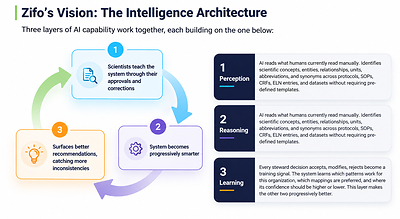
The proposed architecture uses specialized AI agents built by Zifo to support different parts of the semantic-management lifecycle.
These agents can read scientific documents and datasets, identify concepts and relationships, align terminology with enterprise ontologies and public standards, propose mappings, detect unit conflicts, flag inconsistencies, and monitor changes to external standards.
Rather than simply presenting a suggested answer, the system is designed to package the evidence behind its recommendation. Scientists and data stewards can then accept, modify, or reject it.
Those decisions become part of a continuous learning loop.
When a steward approves a mapping, the system learns from that decision. When the same mapping is successfully reused across studies or improves downstream data quality, the pattern becomes more valuable. When a recommendation is rejected, or leads to an issue, the system uses that outcome to recalibrate similar suggestions.
The aim is not to remove scientific experts from the process. It is to remove repetitive work around them.
"This is not about asking AI to make scientific decisions," said Ragavi Shanmugam, Zifo's Lead for Scientific Data Architecture, who drives Data Solutions for Translational, Cell & Gene Therapy, & Biomarker Discovery. "AI can process information at scale, surface likely relationships, and identify areas of uncertainty. Scientists remain responsible for the decisions that drives key business outcomes and can use AI to accelerate the process."
Under the model, AI can read, analyze, extract, compare, recommend, and learn. It cannot independently alter approved mappings, introduce concepts into an enterprise ontology, or change governance policies.
That distinction is especially important in regulated scientific environments, where semantic decisions may affect downstream research, manufacturing, clinical, or regulatory processes.
Building a Foundation for Trustworthy Enterprise AI
A governed scientific semantic layer can provide the contextual foundation needed by large language models (LLMs), copilots, knowledge-discovery tools, and other enterprise AI applications.
Instead of reasoning directly over fragmented raw data, AI systems can work with semantically enriched concepts, knowledge graphs, ontologies, and linked evidence. This can improve scientific retrieval, strengthen traceability, and make AI-generated responses easier to validate.
The framework is intended to help Biopharma organizations:
- Preserve scientific knowledge as organizational memory.
- Reuse approved semantic mappings across projects, systems, and scientific domains.
- Accelerate the onboarding of instruments, CRO datasets, and new applications.
- Reduce manual work associated with terminology alignment and unit conversion. Identify the downstream effects of changing standards earlier.
- Maintain evidence, lineage, confidence, and approval history for scientific assertions.
- Ground enterprise AI in governed, evidence-backed scientific context.
The approach is also built on FAIR data principles, which help make scientific data findable, accessible, interoperable, and reusable. A strong FAIR foundation allows the semantic layer to focus less on resolving duplicate concepts and terminology conflicts, and more on relationship discovery and scientific reasoning.
Starting Small, Then Scaling
Zifo recommends an incremental path to adoption.
Organizations can begin with one focused scientific domain, a small number of source systems, and a complete workflow from AI-generated recommendation to expert review and feedback capture. This provides an opportunity to demonstrate value, calibrate confidence levels, and establish governance before expanding further.
As the system learns from approved mappings and expert corrections, routine cases can be handled more efficiently. Scientists and stewards can then focus their time on the novel, ambiguous, and high-impact decisions where their expertise matters most.
Over time, the semantic layer can expand into adjacent domains and ultimately create shared scientific meaning across the enterprise.
About Zifo
Zifo is a global enabler of AI and data-driven enterprise informatics for science-driven organizations. With solutions and services expertise spanning research, development, manufacturing, and clinical domains, Zifo supports organizations across the pharmaceutical, biotechnology, chemicals, food and beverage, oil and gas, and fast-moving consumer goods industries.
Trusted by more than 190 science-focused organizations worldwide, Zifo helps enterprises advance digital scientific innovation and establish connected, data-driven scientific environments. For more information, visit https://zifo.com; https://zifo.com/practical-ai-blueprints/
 View original content to download multimedia:https://www.prnewswire.com/news-releases/zifo-unveils-ai-driven-scientific-semantic-layer-vision-for-biopharma-302891384.html
SOURCE Zifo
Serious News for Serious Traders! Try StreetInsider.com Premium Free!
You May Also Be Interested In
- TCL Marks 45th Anniversary with Inauguration of the TCL Industrial Museum
- WEIGHTLIFTER WITH TYPE 1 DIABETES AVA BIESTERFELD SWEEPS THREE GOLD MEDALS AT NATIONAL EVENT, EARNS INVITE TO OLYMPIC QUALIFIER MEET
- Pongbot joins Australian Open as Official Ball Machine
Create E-mail Alert Related Categories
PRNewswire, Press ReleasesSign up for StreetInsider Free!
Receive full access to all new and archived articles, unlimited portfolio tracking, e-mail alerts, custom newswires and RSS feeds - and more!
