



World's Highest Plateau Railway, 20 Years On
 Tweet
Tweet Share
Share E-mail
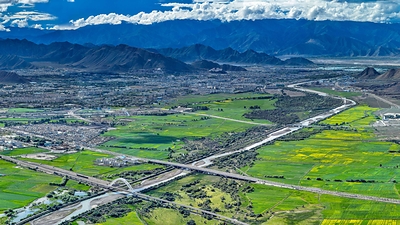
The Qinghai-Xizang Railway, a 1,956-km steel artery traversing the world's highest plateau, has handled 104 million passenger trips and over 824 million tonnes of cargo since its inauguration. Twenty years ago, it ended the assertion that "the railway would never reach Lhasa." Today, a revisit to the route uncovers the technological safeguards behind this "
The line runs from
Digitally linking 51 unattended stations
The 1,142-km Golmud-Lhasa section has 58 stations, of which 51 are remotely controlled and unattended. The key to the railway's smooth operation over the past two decades lies in the train's control system, says Zhang Huxiong, head of safety and quality inspection at the Golmud Electric Depot of the Qinghai-Xizang Railway.
Originally, the system used satellite-based positioning for trains to operate without ground signals across uninhabited areas. "Wherever the train goes, you can see it from the sky," Zhang said.
To improve operational reliability and reduce maintenance costs, China State Railway Group Co., Ltd. supported research to adapt the domestically developed train monitoring system for plateau conditions. Modifications focused on enhancing the weather resistance of electrical components, such as resistors and capacitors, and improving system stability in low temperatures and low oxygen environments.
After years of intensive research and development, a plateau-adapted version of the system was successfully deployed.
It has proved itself with reduced maintenance costs and the ability to be serviced domestically. Today, trains equipped with the upgraded system run smoothly on the Golmud-Lhasa section.
Safeguarding 550 km of permafrost
Along the 550-km core permafrost section, gray metal rods known as thermosiphons line both sides of the track. This technology originated from a permafrost observation station on
"The success of the Qinghai-Xizang Railway lies in the subgrade, and the success of the subgrade lies in the permafrost," said Li Yongqiang, chief engineer of the Northwest Research Institute Co., Ltd. of China Railway Group.
In 1961,
In the late 1980s, researchers developed
However, climate change is presenting new challenges. The original design considered an increase of about 1.5°C over 50 years, but the latest projections suggest it could reach 2°C.
To address this, Li's team developed solar-powered thermosiphons, which use the plateau's intense solar radiation and significant day-night temperature differences to achieve cooling, delivering 1.5 times the capacity of ordinary thermosiphons. These have been applied to 117 permafrost sections along the Qinghai-Xizang Railway, reducing settlement by more than 70 percent.
Monitoring data show that over the past 20 years, 96 percent of subgrade settlement on the permafrost sections has been kept within 20 millimeters, way below the 50-mm design limit. While permafrost railways worldwide often face speed restrictions, the Qinghai-Xizang Railway operates steadily at 100 km/h, setting a global benchmark as the highest speed for any permafrost high-altitude train service in the world.
 View original content to download multimedia:https://www.prnewswire.com/news-releases/worlds-highest-plateau-railway-20-years-on-302864770.html
SOURCE Science and Technology Daily
Serious News for Serious Traders! Try StreetInsider.com Premium Free!
You May Also Be Interested In
- Coast2Coast First Aid Named a Top 3 Canadian Red Cross Training Partner for a Third Consecutive Year
- Announcement of change in the total number of votes in AB SKF
- Share buybacks in Ericsson during the period August 24 - August 28, 2026
Create E-mail Alert Related Categories
PRNewswire, Press ReleasesSign up for StreetInsider Free!
Receive full access to all new and archived articles, unlimited portfolio tracking, e-mail alerts, custom newswires and RSS feeds - and more!
