




Salvus Brings Rapid On-site PFAS Screening to Market
FREE Breaking News Alerts from StreetInsider.com!
StreetInsider.com Top Tickers, 10/8/2026
- S&P 500, Nasdaq end lower as crude prices jump, chip stocks weigh
- Oil rises 4% on revived Middle East worries, Hurricane Isaias supply disruption
- Chipotle, Starbucks shares volatile after report of potential takeover
- Why Citi says the Fed could be setting up for a dovish surprise
- Alphabet shares rise as Google pushes Gemini deeper into enterprise AI
 Tweet
Tweet Share
Share E-mail
The Salvus PFAS solution can screen up to seven samples per eight-hour shift so teams can act sooner at the point of concern.
Any project that relies on knowing PFAS concentrations to make decisions typically begins the same way – collect samples, send them to a laboratory, wait days or weeks for a result. Both waiting on results to decide and deciding before receiving results present risks that can be costly. Decisions, such as where to sample next, how far to excavate, how well a treatment system is performing, how to dispose of materials or effluent, and others, may be delayed or made incorrectly. The wrong decision can lead to added costs that may include a second mobilization, change orders, schedule adjustments, and more.
"For anyone whose plan depends on a PFAS number, timely screening results matter just as much as the number itself. Teams need a result they can act on quickly," said
"Whether the job is AFFF cleanout and foam transition, monitoring influent and effluent during PFAS destruction, site characterization and treatment system tuning, or something else dependent on knowing PFAS levels, our portable Salvus PFAS solution currently delivers a single quantitative result for the sum of C6 and longer PFAS. Results are designed to track what an EPA Method 1633 report breaks out line-by-line to an effective limit of detection (LoD) of 500 ppt. These are field screening results and not certified compliance data. They're meant to help a team make a decision while they are still at the point of concern," Tatar explained.
The Salvus PFAS solution consists of three portable modules. The Salvus APEX™ (Automated Portable Extraction) module automates the sample preparation process. It also can concentrate the sample, which is what brings the effective LoD down to 500 ppt. Once the extraction process is complete, the sample is mixed with a buffer and placed in the Salvus FLOW™ module, which works with the Salvus PRISM™ (Portable Real-time Interferometric Sensing Module) to screen the sample and provide results.
While the FLOW and PRISM are reading the current sample, the user can add the next sample to the APEX to begin processing it in parallel. This allows an operator to screen up to seven samples during an eight-hour shift, with actual throughput dependent on the original sample concentration and matrix. As each customer scenario is unique, Tatar has found a three-staged approach to full-scale deployment to be most effective.
"Six months of customer discovery and hands-on work in the field have taught us a staged path lands better," Tatar said. "This is a new application of validated technology aimed at a compound class where requirements are still shifting, and teams want to see it perform on their own samples before they commit. The three steps exist so the customer builds real confidence in what the platform does and does not do for their workflow, while also helping them become comfortable with the prep and screening process. In our experience, that produces a materially more successful, de-risked deployment than one that is simply transactional."
Step one is a feasibility study that screens the customer's own samples on the Salvus platform to establish performance on their matrix against paired EPA Method 1633 results. Step two is a field pilot at the customer's active site where the Salvus team demonstrates real-world performance, walks operators through the sample-to-result process, and validates fit to the operational environment. Step three is full-scale deployment with the workflow configured for the customer's matrix and the commercial model that fits their operation: purchase, lease, or managed service with the Salvus team running the screening.
Built for customization
The core of the Salvus technology lies in the Salvus Detection Platform – an interferometric analyzer and cartridge system that can be customized to detect different substances and delivered in different form factors. The Salvus PRISM is the long-term instrument, purchased once, with an integrated touchscreen display. The detection cartridge contains the receptor chemistry for a specific detection target; cartridges can be developed to detect different substances. While current capabilities are for C6 and longer PFAS in a portable form factor, the Salvus team is actively developing capabilities for shorter-chain PFAS (C5, C4) and other analytes of concern. The platform core can also be adapted into different form factors, such as fixed monitoring stations, unmanned vehicles, and third-party original equipment manufacturer (OEM) platforms.
For customers who want confirmation of a field result, greater analyte resolution, or laboratory analysis on its own, Salvus also operates its own analytical laboratory. It runs EPA Method 1633, EPA Method 537.1, and the total oxidizable precursor (TOP) assay with turnaround as fast as 48 hours from sample receipt. Salvus laboratory analyses are non-certified and are intended for site characterization, screening confirmation, and treatment monitoring rather than regulatory submittal.
Learn more about Salvus and the rapid, portable Salvus PFAS solution at the all new SalvusDetect.com.
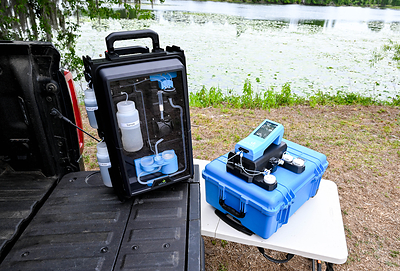
Photo Options & Captions (access original photos here):
File Name: Portable Salvus PFAS Solution
Caption: The portable Salvus PFAS solution answers the need for rapid PFAS screening at the point of concern so teams can make decisions quicker and more effectively.
File Name: Portable Salvus PFAS Solution_4Steps
Caption: The portable Salvus PFAS solution delivers rapid, on-site PFAS screening in four simple steps: collect, prepare, test, decide.
About Salvus
At Salvus, We Detect Your Concerns®. Salvus, LLC, was formed in 2018 with a single purpose: to bring precise, point-of-use detection technology to the world – starting with the substances that pose the greatest risk to human health and the environment. Originally developed by researchers at the Georgia Tech Research Institute, the Salvus® Detection Platform is the world's first handheld interferometric detector. This groundbreaking technology can rapidly identify chemical and biological substances in liquid, air, or surface environments with precision and accuracy for more timely decisions. Salvus is part of CJB® Companies, which also includes CJB Industries Inc. and CJB Applied Technologies LLC. CJB Companies is focused on creating solutions for the life sciences industry from development to delivery to detection while improving today and tomorrow. For more information, please visit our websites cjbcompanies.com, cjbindustries.com, cjbappliedtech.com, and salvusdetect.com.
© 2026 Salvus, LLC. All rights reserved. Salvus®, Salvus APEX™, Salvus FLOW™, Salvus PRISM™, and We Detect Your Concerns® are trademarks or registered trademarks of Salvus, LLC. CJB® is a registered trademark of CJB Companies.
Media Contact
Katie Klaas
[email protected]
224.339.4588
 View original content to download multimedia:https://www.prnewswire.com/news-releases/salvus-brings-rapid-on-site-pfas-screening-to-market-302856474.html
SOURCE Salvus LLC
Serious News for Serious Traders! Try StreetInsider.com Premium Free!
You May Also Be Interested In
- 'NBA Cares x Sands Cares Community Impact Week 2026' Celebrates Tip-Off
- Crypto News: AlphaPepe Binance Listing Update Drives Presale Surge as Bitcoin Price Prediction Eyes $200K
- DE BEERS GROUP AND THE GOVERNMENT OF THE REPUBLIC OF BOTSWANA EXTEND PARTNERSHIP WITH OLYMPIC CHAMPION LETSILE TEBOGO AS GLOBAL AMBASSADOR
Create E-mail Alert Related Categories
PRNewswire, Press ReleasesSign up for StreetInsider Free!
Receive full access to all new and archived articles, unlimited portfolio tracking, e-mail alerts, custom newswires and RSS feeds - and more!
