



PolicyMe: Family Well-Being Leads Life Insurance Priorities for Canadians
 Tweet
Tweet Share
Share E-mail
Analysis found 42.0% of life insurance seekers mentioned family well-being, while a separate review found
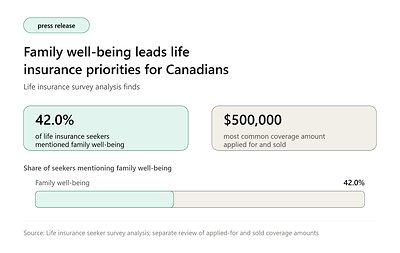
The findings form part of a PolicyMe analysis of how Canadian consumers approach life insurance and the financial obligations they consider when seeking coverage. Rather than pointing to a single reason for buying a policy, the data shows a mix of concerns ranging from maintaining family financial stability to managing housing debt and covering expenses after death.
That pattern sits within a large Canadian life insurance market. The Canadian Life and Health Insurance Association's Canadian Life & Health Insurance Facts, 2025 Edition reports that 23 million Canadians held approximately
Family well-being as the main reason for life insurance
Family well-being appeared in 42.0% of the customer interactions reviewed by PolicyMe, making it the most frequently mentioned of the three identified considerations. The finding puts the financial consequences for surviving family members at the center of the interaction data.
That role is consistent with how Canadian consumer authorities describe life insurance. Financial Consumer Agency of Canada guidance updated
Family protection can also involve more than replacing a salary. A household may depend on unpaid childcare, caregiving, transportation, home maintenance, or other work performed by a family member. The financial effect of losing that contribution can differ substantially from one household to another, even where incomes are similar.
PolicyMe's data doesn't establish one universal reason that Canadians purchase life insurance. Instead, it shows how often family well-being appears within conversations about coverage among the customers analyzed. The 42.0% share is considerably higher than the corresponding figures for mortgages and end-of-life expenses, making household continuity the clearest theme in this dataset.
Mortgage obligations still a major consideration
Mortgage obligations were mentioned in 19.7% of PolicyMe's customer interactions. That places housing debt well behind family well-being in frequency, but still makes it a significant consideration among the customers represented in the analysis.
The wider debt environment helps explain why mortgages feature prominently in life insurance planning. Statistics Canada reported on
Life insurance and mortgage protection aren't interchangeable products, but housing debt can form part of the calculation when households consider the financial consequences of a death. The Canadian Life and Health Insurance Association's 2025 report notes that life insurance benefits are often used for income replacement, mortgage payments, other debts, or estate needs. It also identifies mortgage balances as one of the factors associated with differences in household protection levels.
The Financial Consumer Agency of Canada similarly notes that life insurance proceeds can be used to pay debts. Its mortgage insurance guidance explains that term or permanent life insurance differs from mortgage life insurance because beneficiaries receive the death benefit and may decide how to use it.
PolicyMe's 19.7% finding captures one part of a broader household calculation. For homeowners, the question is not simply whether a mortgage exists, but how surviving household members would manage housing costs if an income or other economic contribution disappeared.
End-of-life expenses remain part of the protection decision
End-of-life expenses were mentioned in 17.4% of the PolicyMe interactions analyzed for 2025. While less common than family well-being or mortgage concerns, the figure shows that immediate expenses following a death remain part of the coverage discussion for a meaningful share of customers.
The Financial Consumer Agency of Canada specifically lists funeral expenses among the uses families may make of a life insurance death benefit. Its
Those categories matter because they operate on different timelines. Funeral and related expenses may arrive quickly, while mortgage payments, household bills, childcare costs, and income replacement can continue for years. A household considering life insurance may be trying to address several different financial problems with the same eventual benefit.
PolicyMe's data reflects that distinction. End-of-life expenses form a clear theme, despite the fact that they don't dominate the recorded interactions. The larger share attached to family well-being indicates that many conversations extend beyond the immediate costs associated with death and into the longer financial effect on the household.
PolicyMe found that
The
The two figures measure different things, and they shouldn't be treated as equivalent. PolicyMe's
The CLHIA data also shows why a single national figure can't define an appropriate level of coverage for every household. Average protection varied considerably by province in 2024, from
PolicyMe's data also shows meaningful demand on both sides of
Life insurance choices reflect financial obligations
PolicyMe's findings show how life insurance decisions can bring together different parts of household finances. Family well-being appeared most frequently in the interaction data at 42.0%, but mortgages at 19.7% and end-of-life expenses at 17.4% were also recurring considerations. At the same time, data ranged across several commonly selected coverage levels.
That variation exists within a market in which 23 million Canadians held
Government consumer guidance takes a similarly household-specific approach. The Financial Consumer Agency of Canada advises consumers to consider their circumstances and stage of life when determining insurance needs, including events such as starting a family, buying a home, moving in with a partner, or taking on a loan.
Taken together, the PolicyMe findings show why coverage selection is better understood as a household calculation than as a single target number. Two applicants choosing the same death benefit may be trying to solve very different problems. One may be focused primarily on replacing income for children, another on preserving a family home, and another on ensuring that immediate expenses and debts don't fall to relatives.
The data ties the amount of coverage selected to the purpose behind it. The most common selection is
Methodology
PolicyMe analyzed over 6,500 customer interactions involving Canadians aged 18 to 54 recorded across
PolicyMe separately analyzed over 48,000 customer interactions. The analysis ranked the most common coverage amounts applied for and sold, with
The proprietary findings were contextualized using publicly available Canadian sources, including the Canadian Life and Health Insurance Association's Canadian Life & Health Insurance Facts, 2025 Edition, Statistics Canada's national balance sheet and financial flow accounts, and Financial Consumer Agency of Canada consumer insurance guidance.
The interaction percentages describe mentions recorded within PolicyMe's customer interactions and shouldn't be interpreted as population-wide estimates of the motivations of all Canadians. The analysis doesn't present the three interaction categories as a complete measure of every reason customers may consider life insurance.
Frequently Asked Questions
Here are some of the most commonly asked questions about life insurance coverage, how much protection a household may need, and the factors that can affect the cost of a policy.
Why do Canadians need to consider life insurance?
Life insurance can address several financial consequences that follow a death. PolicyMe's 2025 data found family well-being, mortgage obligations, and end-of-life expenses as leading reasons to purchase life insurance. Financial Consumer Agency of Canada guidance also identifies income replacement, support for children and dependants, funeral expenses, and debt repayment as potential uses of a life insurance death benefit.
How much life insurance coverage do Canadians need?
Life insurance needs vary according to the financial responsibilities of an individual household. Income, dependants, mortgages and other debts, existing savings, current insurance coverage, and the length of time a household would need financial support can all affect the calculation. The CLHIA reported average protection of
Is
Life insurance coverage of
What factors affect a life insurance quote?
Pricing can vary according to the applicant and the amount and type of coverage requested. Financial Consumer Agency of Canada guidance updated in
About PolicyMe
PolicyMe is a Canadian insurance distributor of life, critical illness, and health & dental insurance products directly to consumers online. To date, the company has helped over 50,000 Canadians secure more than $20 billion in coverage. PolicyMe also offers B2B2C solutions, partnering with organizations to embed digital insurance into their own customer experience. Founded in 2018 by a team of insurance experts and technology entrepreneurs, PolicyMe is committed to making insurance more accessible. To learn more, visit www.policyme.com.
Media Contact
Source: PolicyMe
Contact: Kirsten Cantin
Email: [email protected]
Location: Toronto, Ontario
 View original content to download multimedia:https://www.prnewswire.com/news-releases/policyme-family-well-being-leads-life-insurance-priorities-for-canadians-302877951.html
SOURCE PolicyMe
Serious News for Serious Traders! Try StreetInsider.com Premium Free!
You May Also Be Interested In
- WuXi XDC Out-Licenses WuXiTecan-2 Payload-Linker Technology Platform to Ona Therapeutics to Advance Novel ADC Research and Development
- Alternative data budget confidence hits 3-year high while AI returns remain efficiency-led - Neudata's 2026 industry report
- Penetron Repairs and Waterproofs Torre Valaria Concrete Water Cistern in Guanajuato
Create E-mail Alert Related Categories
PRNewswire, Press ReleasesSign up for StreetInsider Free!
Receive full access to all new and archived articles, unlimited portfolio tracking, e-mail alerts, custom newswires and RSS feeds - and more!
