




Nota AI's Optimization Research Earns Global Recognition

FREE Breaking News Alerts from StreetInsider.com!
StreetInsider.com Top Tickers, 10/13/2026
- S&P 500, Dow futures muted after big bank earnings, chip slide weighs
- Oil prices ease as traders monitor Russian diesel deal, Saudi attacks
- JPMorgan shares edge lower after third-quarter FICC revenue miss
- Fed’s Waller says US bond yield rise driven by growth, not inflation
- Wells Fargo beats profit estimates despite revenue miss
 Tweet
Tweet Share
Share E-mail
Two Papers Accepted at EMNLP 2026, a Leading NLP Conference
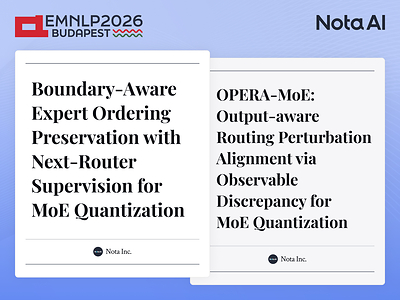
- One paper accepted to the EMNLP 2026 Main Conference and another to Findings, both introducing new techniques for MoE quantization.
- The EMNLP acceptances follow a third-place finish and two paper acceptances at an ICML 2026 workshop in July, further validating Nota AI's technology within the global research community.
- Optimization technology cuts the number of GPUs required to run Qwen3.8-Max from 24 to four, improving efficiency for LLMs and data centers.
Nota AI announced on
EMNLP is one of the world's leading conferences in natural language processing, where global technology companies such as Google, Meta and OpenAI, along with major universities, present their latest research. The Main Conference is the core academic track reserved for research recognized for its originality, technical rigor and scholarly contribution. Findings is an official publication venue for research recognized for its technical soundness and scholarly value.
The two papers address performance degradation that can occur when models based on a Mixture-of-Experts (MoE) architecture are quantized. Increasingly adopted in large language models such as Qwen and Kimi, MoE architectures activate only a subset of relevant "experts" for each input token. However, because the full model must still be stored in memory, running these models requires substantial GPU and memory resources. Quantization can reduce this burden, but small numerical shifts can change which experts are selected, degrading response quality.
The paper accepted to the Main Conference introduces "MENDS-MoE," a methodology that accounts for how quantization affects expert selection at each subsequent step and preserves the ranking of experts near the selection boundary. In 4-bit and 3-bit quantization experiments across three MoE models, the method achieved higher average accuracy and stronger language-model performance than comparison techniques in most evaluation settings.
The Findings paper proposes "OPERA," a methodology that does not uniformly correct every shift in expert selection but instead concentrates optimization on the changes that affect a model's final output. The two studies complement one another: both help preserve routing decisions after quantization while focusing optimization on the changes that matter most to response quality.
Earlier this year, Nota AI placed third among roughly 40 teams worldwide in the "Efficient Qwen Competition," part of the "Resource-Adaptive Foundation Model Inference" (AdaptFM) workshop at ICML 2026. Running the open-source LLM Qwen3.5-4B on a single NVIDIA A10G GPU, the company maintained model performance while achieving an average inference speedup of 6.978× over the baseline. Two of Nota AI's MoE quantization papers were also accepted at the same workshop. Together, these achievements further validate Nota AI's technical competitiveness at leading global AI conferences.
To date, Nota AI has presented or published more than 50 papers at leading conferences and in academic journals in
As AI models scale from hundreds of billions to trillions of parameters, technology that reduces GPU and memory usage while preserving performance is emerging as a key factor determining the economics of AI services. Nota AI is applying its research-validated optimization methodologies to large language models and data center AI infrastructure.
Most recently, Nota AI's optimization technology enabled "Qwen3.8-Max," a model with more than 1 trillion parameters, to run on four NVIDIA B300 GPUs, compared with 24 GPUs for the original model configuration. The company also enabled Moonshot AI's "Kimi K3" to run on as few as four NVIDIA B300 GPUs, compared with eight GPUs for the original configuration, and Upstage's "Solar Open 2" to run on two NVIDIA H100 GPUs, compared with eight GPUs for the original configuration.
"As AI models grow to hundreds of billions or trillions of parameters, the industry's competitive focus is shifting from raw model performance to operational efficiency," said Myungsu Chae, CEO of Nota AI. "This achievement demonstrates that years of AI optimization research have given Nota AI the technical foundation needed to improve the efficiency of large language models and data center AI infrastructure. We will continue investing in R&D to keep pace with architectural changes in state-of-the-art AI models and expand the application of our core optimization technology to make AI infrastructure more efficient."
 View original content to download multimedia:https://www.prnewswire.com/news-releases/nota-ais-optimization-research-earns-global-recognition-302859055.html
SOURCE Nota AI
Serious News for Serious Traders! Try StreetInsider.com Premium Free!
You May Also Be Interested In
- Bestselling Cookbook Author Anna Vocino Serves Up a Better Way to do Happy Hour in New Cookbook
- American Leather Introduces A.L. Studio, a New Premium Collection of Statement Furniture
- FROPRO Snacks Expands Whole Foods Market Footprint Nearly Sixfold Across the Nation
Create E-mail Alert Related Categories
PRNewswire, Press ReleasesSign up for StreetInsider Free!
Receive full access to all new and archived articles, unlimited portfolio tracking, e-mail alerts, custom newswires and RSS feeds - and more!
