




Mounting Financial Pressures Threaten the Retirement of Middle-Class Americans

FREE Breaking News Alerts from StreetInsider.com!
StreetInsider.com Top Tickers, 10/12/2026
- Wall Street posts weekly gains with earnings, inflation data on tap
- Oil prices settle higher as more production shut ahead of hurricane
- Apple cuts iPhone 18 Pro orders due to soft demand, Nikkei Asia reports
- UBS flags level in gold prices where dip buyers will likely emerge
- Telecom stocks tumble on SpaceX spectrum acquisition news
 Tweet
Tweet Share
Share E-mail
New report examines the financial longevity and retirement prospects of the middle class
"The middle class embodies the American dream," said
Five major themes about the middle class emerge from the new report: they are feeling positive but distressed, they are juggling competing financial priorities, they are aspiring to work longer and retire later, they are contending with retirement insecurities, and they are confronting the need for caregiving and long-term care. Together, these themes illustrate the magnitude of the challenges that the middle class faces in their endeavors to achieve a secure retirement.
#1. Feeling positive but distressed
"The American middle class is enjoying life, but many show signs of wear and tear that can have lasting implications," said Collinson.
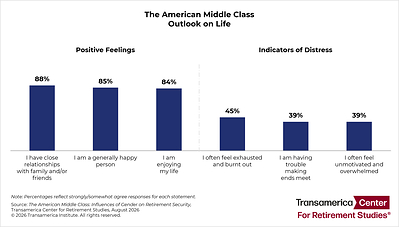
The survey findings illustrate both positive feelings and indicators of distress among the middle class.
More than eight in 10 have positive feelings about life, such as having close relationships with family and friends (88%), being a generally happy person (85%), and enjoying life (84%). However, around four in 10 are showing indicators of distress, such as often feeling exhausted and burnt out (45%), having trouble making ends meet (39%), and often feeling unmotivated and overwhelmed (39%).
Women and men share positive feelings about life, but women are more likely than men to feel distressed. For example, almost half of women (49%) often feel exhausted and burnt out, compared with 40% of men.
#2. Juggling competing financial priorities
"The middle class is feeling the effects of inflation, juggling competing financial priorities, and making hard choices," said Collinson.
In response to inflation in recent years, seven in 10 (72%) have taken one or more actions due to financial strain, ranging from reducing day-to-day expenses (40%), dipping into savings accounts (34%), and accumulating new credit card debt (23%) to missing rent or mortgage payments (9%).
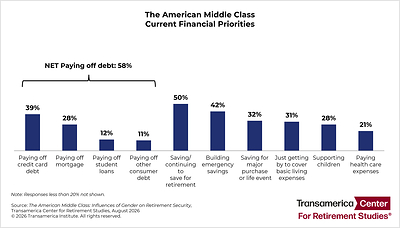
Amid these pressures, the survey identifies the current financial priorities of the middle class.
Current financial priorities include paying off debt (58%), saving for retirement (50%), building emergency savings (42%), saving for a major purchase or life event (32%), just getting by to cover basic living expenses (31%), supporting children (28%), and paying health care expenses (21%).
Men are more likely than women to prioritize saving for retirement (53% vs. 47%). In contrast, women are more likely than men to prioritize just getting by to cover basic living expenses (35% vs. 27%).
#3. Aspiring to work longer and retire later
"The middle class has aspirations of extending their working years and fully retiring beyond traditional retirement age," said Collinson. "This can be a good strategy for bringing in income and bridging retirement savings gaps – if they can remain healthy and employable as they grow older."
Among those who are not yet retired, one in three expect to retire at age 70+ or do not plan to retire (33%). Women are more likely than men to expect to do so (36% vs. 30%).
However, the experience of retirees illustrates how unforeseen circumstances can alter the best laid plans. Men retired at age 63 and women at age 62 (medians). Nearly half of retirees (48%) retired sooner than planned, including 45% of men and 50% of women. Among them, men are more likely than women to have done so for employment-related reasons (62% vs. 44%) – and women are more likely than men to have done so for family-related reasons (30% vs. 17%). Seventeen percent of men and 11% of women retired sooner than planned because they had saved enough and could afford to retire.
"Middle-class workers' plans to work longer and retire at an older age could be easily thwarted by AI and robotics which are reshaping the workforce and the future of work. Many middle-class workers are worried about job obsolescence," said Collinson.
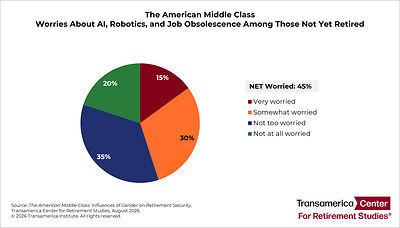
The survey findings reveal their worries about the impact of AI and robotics.
Among those who are not yet retired, 45% are worried that AI and robotics are making their job skills no longer needed. Women are more likely than men to be worried (48% vs. 41%).
#4. Contending with retirement insecurities
"In recent decades, the retirement landscape has been shifting away from government- and employer-funded pensions. At the same time, individuals have become increasingly expected to self-fund more of their retirement income through 401(k) and similar plans and IRAs," said Collinson.
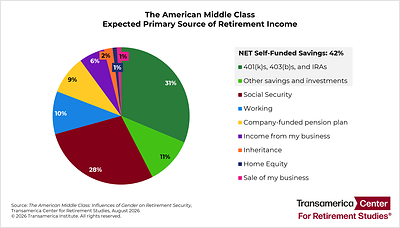
The survey findings identify what the middle class expects to be their primary source of retirement income.
Many expect self-funded savings (42%) to be their primary source of retirement income, including 401(k)s, 403(b)s, and IRAs (31%) and other savings and investments (11%). Almost three in 10 (28%) expect to primarily rely on Social Security. Another 10% expect to rely on income from continued work, and 9% expect to rely on a company-funded pension plan.
Men are more likely than women to expect to rely on income from 401(k)s, 403(b)s, and IRAs (34% vs. 29%). In contrast, women are more likely than men to rely on Social Security (31% vs. 25%).
"The middle class is encountering formidable headwinds that make it challenging to adequately save for retirement," said Collinson.
Eight in 10 who are not yet retired (80%) agree that today's high cost of living is making it harder for them to save for retirement, and 74% are concerned that Social Security will not be there for them when they are ready to retire. Fifty-seven percent agree that debt is interfering with their ability to save for retirement, and 55% agree that they do not have enough income to save for retirement. Women are more likely than men to be experiencing such concerns.
As of late 2025, among those who are not yet retired, the middle class has saved
#5. Confronting the need for caregiving and long-term care
"Amid population aging and the skyrocketing cost of long-term care services and supports, many people are being called upon to serve as caregivers – and many retirees are expecting family and friends to provide such care," said Collinson.
More than one in three people in the middle class who are not yet retired (36%) are currently serving and/or have served as a caregiver for a relative or friend during their career, and 36% of retirees have dedicated a significant amount of time serving as a caregiver since retiring. Women are more likely than men to have been caregivers.
The survey findings uncover middle-class retirees' plans if their health declines and they need help with daily activities and/or nursing care.
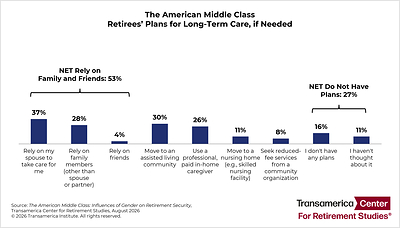
More than half of retirees (53%) plan to rely on family and friends for providing care, including 37% who plan to rely on their spouse, 28% on family members, and 4% on friends. Men are more likely than women to plan to rely on care from their spouse (43% vs. 32%).
Call to Action
"Middle-class Americans are persevering to achieve a secure retirement. Women face greater pressures than men – but both need help," said Collinson. "The middle class must be able to afford everyday life, have income to save, and have meaningful employment. "They also need support from policymakers and employers to address gender disparities, to recognize the vital role of caregivers, and to ensure the sustainability of Social Security and Medicare. It's time to future-proof our retirement system."
The American Middle Class: Influences of Gender on Retirement Security examines the health and well-being, personal finances, employment status, and retirement expectations and preparations of
The report is part of a series by TCRS on the American middle class, including Retirement Throughout the Ages: The American Middle Class (2025) and The Retirement Outlook of the American Middle Class (2024). To learn more about women's unique retirement risks, check out 25 Facts About Women's Retirement Outlook. All these reports and more can be downloaded at www.transamericainstitute.org. Follow on LinkedIn, Facebook, and X @TI_insights and @TCRStudies.
About Transamerica Center for Retirement Studies
Transamerica Center for Retirement Studies (TCRS) is a division of Transamerica Institute, a nonprofit, private operating foundation. TCRS conducts one of the largest and longest-running annual retirement surveys of its kind. The information provided here is for educational purposes only and should not be construed as insurance, securities, ERISA, tax, investment, legal, medical, or financial advice or guidance. Please consult independent professionals for answers to your specific questions. www.transamericainstitute.org
About the 26th Annual Transamerica Retirement Survey
The analysis contained in The American Middle Class: Influences of Gender on Retirement Security was prepared internally by the research team at Transamerica Institute and TCRS. It is based on a 26-minute online survey conducted within the U.S. by The Harris Poll on behalf of Transamerica Institute and TCRS between September 16 and October 17, 2025 among a nationally representative sample of 10,015 adults, including 7,606 people with a household income of $50,000 to $199,999 including 3,671 women and 3,833 men. Data are weighted where necessary by age, gender, race and ethnicity, region, education, marital status, household size, household income, and smoking status to bring them in line with their actual proportions in the population. Respondents for this survey were selected from among those who have agreed to participate in our surveys. The sampling precision of Harris online polls is measured by using a Bayesian credible interval. For this report, the sample data is accurate to within ± 1.3 percentage points using a 95% confidence level. This credible interval will be wider among subsets of the surveyed population of interest. All sample surveys and polls, whether or not they use probability sampling, are subject to other multiple sources of error which are most often not possible to quantify or estimate, including, but not limited to coverage error, error associated with nonresponse, error associated with question wording and response options, and post-survey weighting and adjustments. Percentages are rounded to the nearest whole percent.
Media Contact: Kyle Moschen, [email protected]

 View original content to download multimedia:https://www.prnewswire.com/news-releases/mounting-financial-pressures-threaten-the-retirement-of-middle-class-americans-302861175.html
SOURCE Transamerica Institute
Serious News for Serious Traders! Try StreetInsider.com Premium Free!
You May Also Be Interested In
- Life Time Opens More Than 180,000-Square-Foot Athletic Country Club in Lakewood Ranch on Oct. 12
- Beverly Wilshire, Beverly Hills, A Four Seasons Hotel Named #1 Hotel in All of Los Angeles in the 2026 Conde Nast Traveler's Readers' Choice Awards
- KuCoin Unveils 5.0, Building Trust into Every Layer of the User Experience
Create E-mail Alert Related Categories
PRNewswire, Press ReleasesSign up for StreetInsider Free!
Receive full access to all new and archived articles, unlimited portfolio tracking, e-mail alerts, custom newswires and RSS feeds - and more!
