



Kincora Provides Drilling Update Supporting New Province-Scale Potential
 Tweet
Tweet Share
Share E-mail
To download the PDF of this release, click here.
Melbourne, Australia--(Newsfile Corp. - September 22, 2026) - Copper-gold explorer and hybrid prospect generator Kincora Copper Limited (ASX: KCC) (TSXV: KCC) (Kincora or the Company) is pleased to provide an update on ongoing drilling activities at its Nevertire South and Nyngan licences, part of the larger Northern Junee-Narromine Belt (NJNB) project, within the covered northern extensions of the Macquarie Arc. The licences are included within two earn-in and joint venture agreements with AngloGold Ashanti Australia Limited (AngloGold Ashanti).
HIGHLIGHTS
Upgrading of two Nevertire South porphyry complexes for continued step out, infill and down dip drilling: 2026 activities upgraded two large composite volcanic-intrusive complexes within the wider Nevertire Magmatic Complex with copper and gold grades suggestive of proximity to porphyry system centres. Both are priorities for follow up drilling.
Four scout holes drilled, four potential new complexes at the southern strike of Nevertire South: New province-scale potential supported with four scout holes providing continuity of the volcanics and intrusions in a wider north-south belt. Prospective strike >40km.
Scout drilling resumed at Nyngan: Five to eight planned holes across two targets with drilling ongoing (the Ace of Spades and Gerar targets).
Strong partnership and commercial alignment: The Nyngan and Nevertire South licences form part of two earn-in and joint venture agreements with AngloGold Ashanti. AngloGold Ashanti has the right to invest up to A$100 million across a total of five adjacent licences within Kincora's NJNB portfolio, covering a continuous strike greater than 100km. Kincora currently manages the programs and receives a 10% management fee on expenditures.
John Holliday, Technical Committee chair, and Peter Leaman, VP of Exploration, commented:
"Drilling at Nevertire South this year has advanced our discovery of new Macquarie Arc porphyry copper-gold mineralisation. The results of highly anomalous copper associated with porphyry veining in hole NEDD011 confirm this. These could be the discovery indicators of a large porphyry system centred laterally or deeper.
In parallel, initial scout drilling across the wider licence provides continuation of the volcanic and intrusive units interpreted to be similar to the Nevertire Magmatic Complex. This supports our thesis that the Macquarie Arc continues across a prospective strike of more than 40 kilometres and provides the potential for multiple large new porphyry system complexes.
Large intrusive complexes within world-class porphyry belts can host multiple deposits. To have established this scale of opportunity within the first year of drilling at Nevertire South is a significant outcome and provides multiple high-priority opportunities for follow-up drilling."
NEVERTIRE AND NEVERTIRE SOUTH PROJECTS
Kincora has two earn-in and joint ventures with AngloGold Ashanti covering a continuous strike of greater than 100km, including five licences (Nevertire, Nevertire South, Nyngan, Nyngan South and Mulla licences), within the covered northern extensions of the Macquarie Arc.
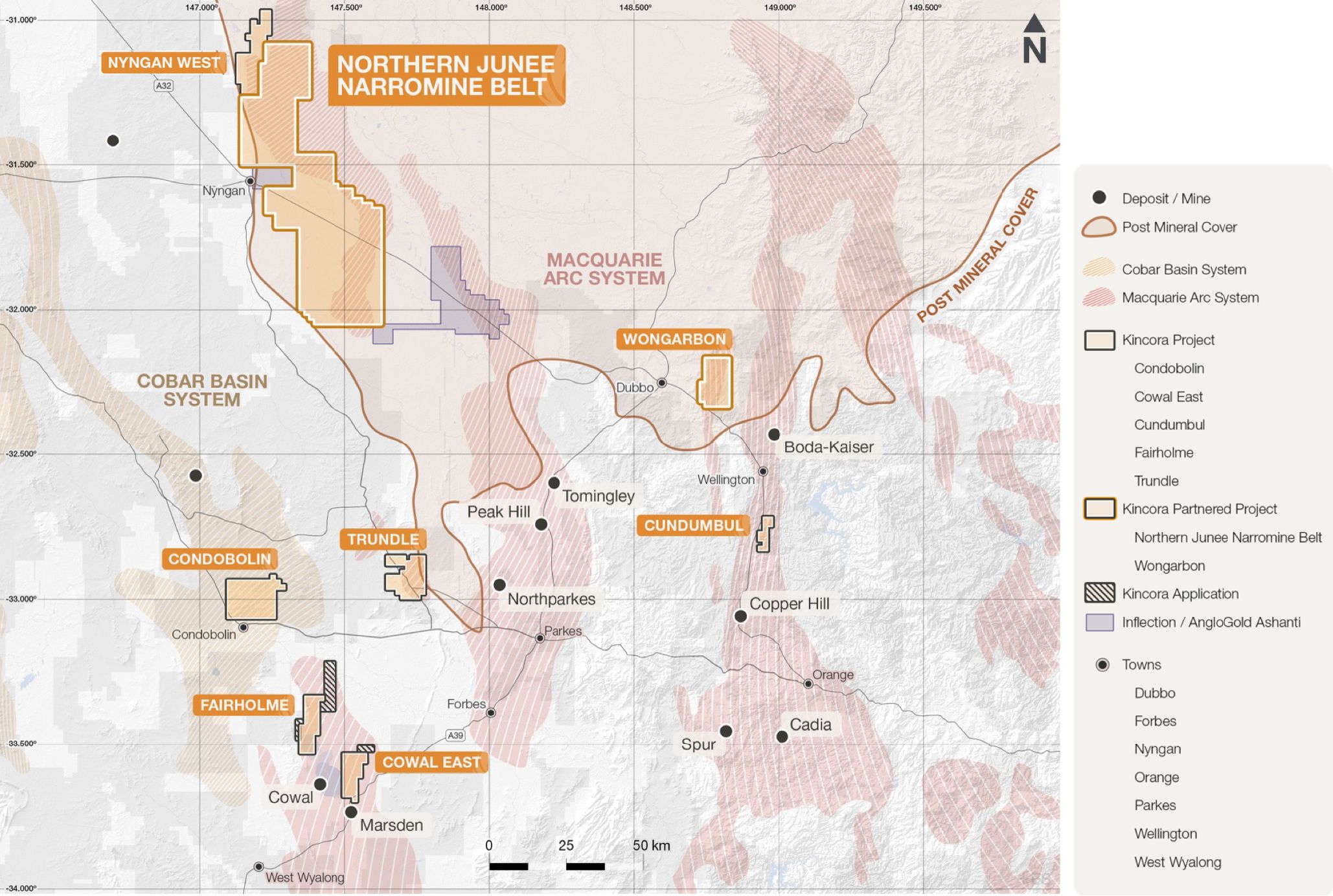
Figure 1: Kincora and AngloGold Ashanti have partnered to explore new district-scale undercover extensions of the world-class Macquarie Arc in the Northern Junee-Narromine Belt via two earn-in and joint venture agreements, currently aggressively drilling large greenfield targets
Kincora has a portfolio of seven projects in NSW, including managing two earn-in programs with AngloGold Ashanti, receiving a 10% management fee on expenditures, and covering a continuous 100km strike across 5 adjacent licences
To view an enhanced version of this graphic, please visit:
https://images.newsfilecorp.com/files/2305/315359_fig%201.jpg
Target Specific Drilling at Nevertire
Following the April 2025 amended and second earn-in agreement with AngloGold Ashanti 1, a first phase drilling program commenced at both the Nevertire and Nevertire South licences in 2H'2025.
The program benefited from unimpeded access across the consolidated ~8 x 12km wide Nevertire Magmatic Complex (NMC) and was designed to follow up two prior favourable drill results historically reported by Newcrest Mining and the most northern drilled holes at the NMC.
Newcrest holes ACDNY005 and ACDNY006 were drilled ~2.7km apart, in the central portion of the NMC, and returned "lithologies, alteration and veining consistent with a setting similar to the Cadia-Ridgeway and Goonumbla (Northparkes) porphyry Cu-Au deposits" 2. Kincora's relogging of these holes, led by technical director John Holliday, supported this interpretation.
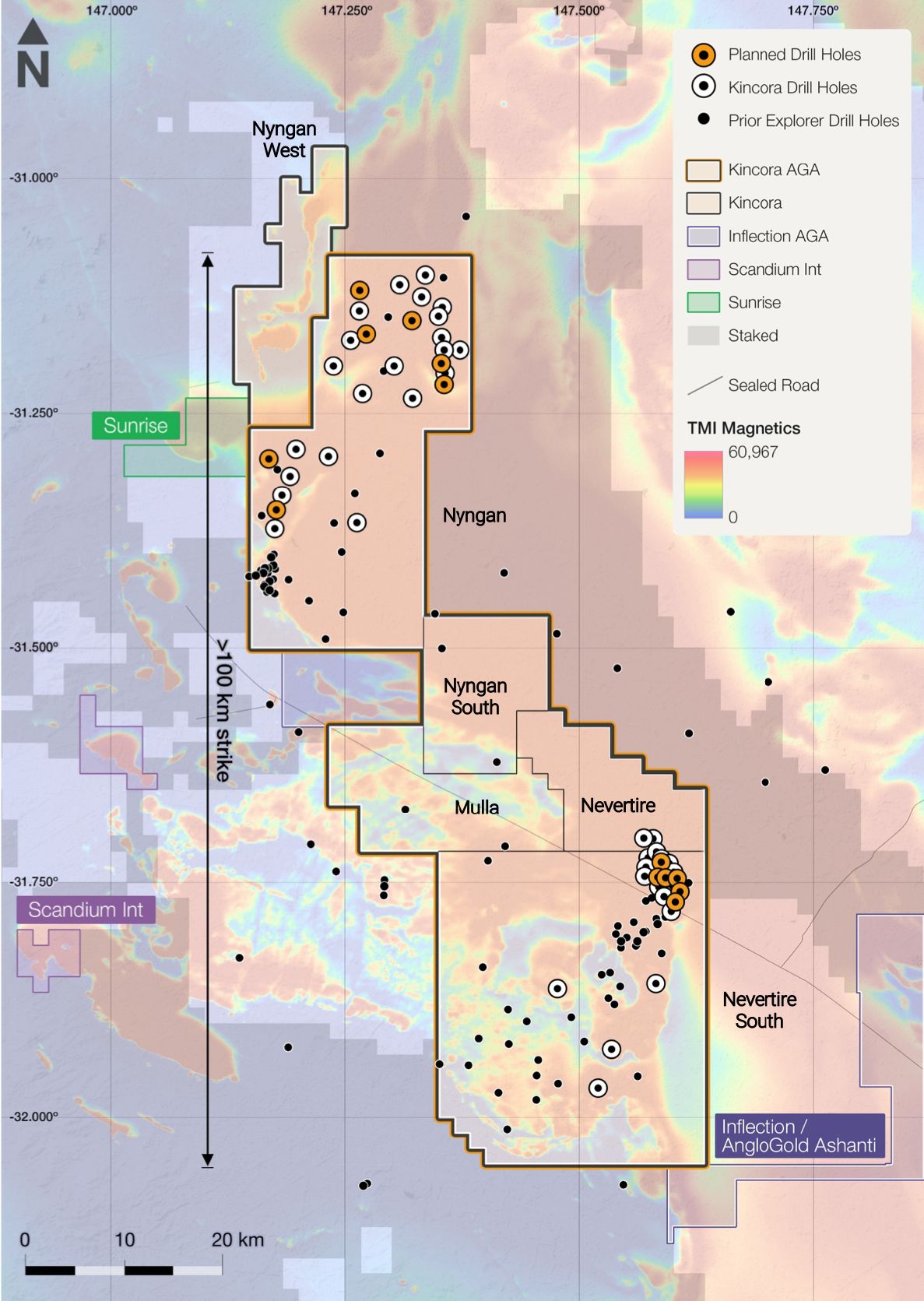
Figure 2: Positive results at Nevertire South support new province-scale potential intersecting multiple interpreted new intrusive system complexes to the south with scout recommenced at the Nyngan licence
To view an enhanced version of this graphic, please visit:
https://images.newsfilecorp.com/files/2305/315359_figure%202.jpg
Kincora drilling commenced in 3Q'2025 and has focused on: (i) following up the prior Newcrest holes; and, (ii) geophysics followed by scout drilling across the southern strike seeking to confirm Macquarie Arc rocks.
To date, 24 holes for 10,379.7 metres have utilised cost-effective mud-rotary drilling through the relatively soft post mineral cover sequence, followed by NQ3 diamond core drilling of the porphyry-prospective basement. All holes intersected basement and are interpreted to have returned Macquarie Arc rocks.
Drill results have been very encouraging, providing strong vectors, upgrading the immediate target zone, supporting Newcrest's previous interpretation and reaffirming the Company's view that the NMC is the most geologically prospective porphyry project in the northern covered extensions of the Macquarie Arc.
Favourable alteration and porphyry-style veining was observed in 2025 drilling, with copper, gold and pathfinder element geochemistry. Drilling in 2026 has returned often higher grades and broader intervals; upgrading two interpreted separate intrusive systems within the wider NMC for follow up drilling with vectors suggestive of increasing proximity to a porphyry system centres (see Figure 6). The results of highly anomalous copper associated with porphyry veining in hole NEDD011 are particularly noteworthy and could be the discovery indicators of a large porphyry system centred laterally or deeper.
Further step out drilling is proposed, before infill and deeper drilling, see Figures 4-6. Figure 7 includes photos of select core and further description on the northern and southern interpreted complexes within the larger NMC, including NEDD011.
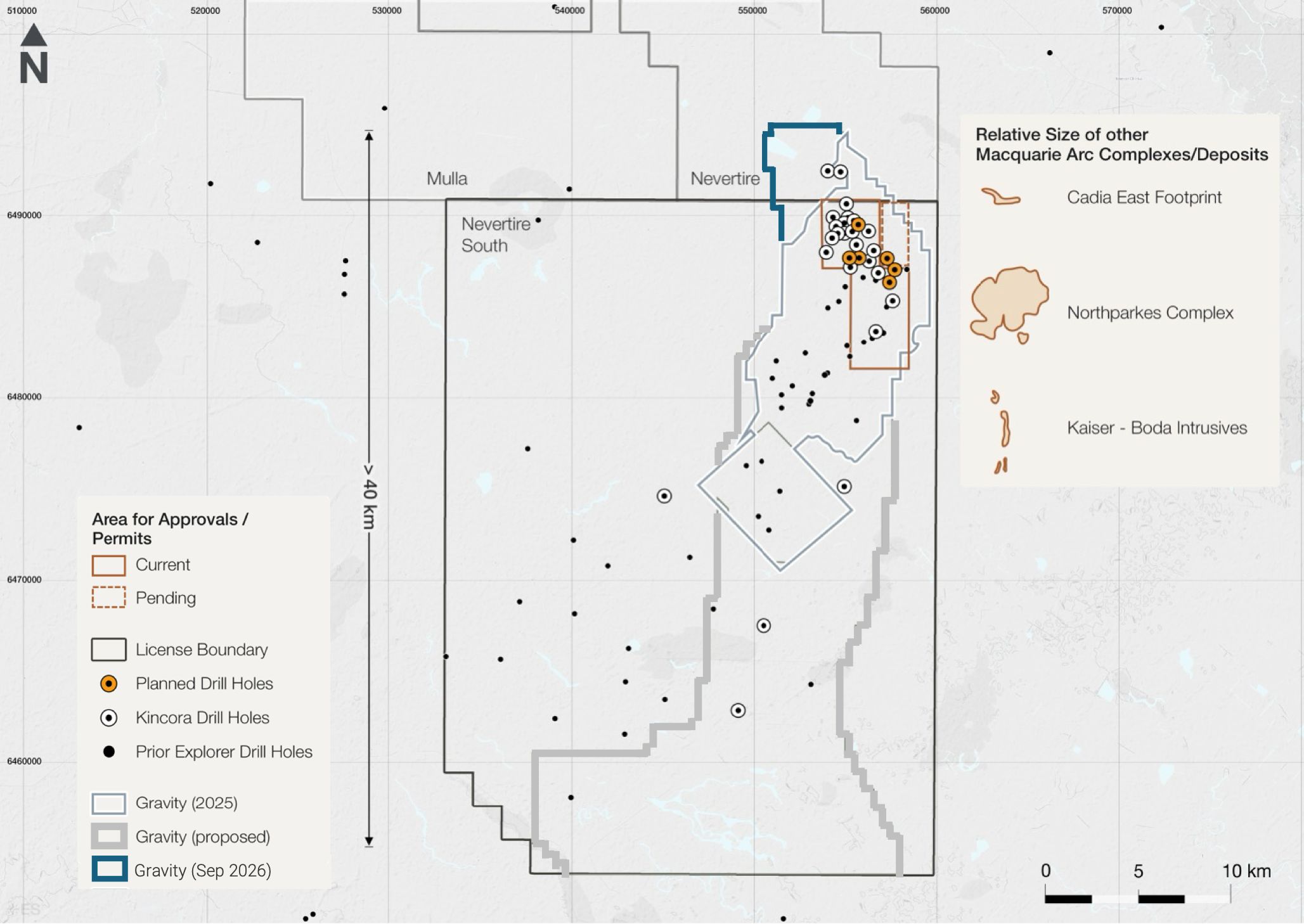
Figure 3: 2025/26 drilling reaffirm Kincora's view that the NMC is the most advanced and geologically prospective porphyry project in the covered northern extensions of the Macquarie Arc offering multiple discovery potential
To view an enhanced version of this graphic, please visit:
https://images.newsfilecorp.com/files/2305/315359_figure%203.jpg
Advancing New Macquarie Arc Porphyry Complexes
As previously announced, following encouraging initial visual observations, follow-up geophysical surveys commenced in 2H'2025, together with a review of prior explorer drilling results and ground gravity survey data 3.
A gravity survey covering ~110km² was completed and integrated with legacy gravity data-sets, totaling ~148km², acquired by prior explorers. A further survey of ~32km² is scheduled for late September expanding the infill coverage to the north-west and into the Nevertire licence.
Four scout holes were since completed by Kincora across a 15km strike, the closest being over 20km from the nearest drill hole of Newcrest's, testing the southern section of the Nevertire South licence along the wider north-south trending magnetic anomaly. All are interpreted to have intersected Macquarie Arc rocks (confirmationary lithogeochemistry and age dating pending).
These activities have resulted in a material increase in the prospective search space across the Nevertire and Nevertire South licences, supporting a total prospective strike of greater than 40km, representing a greater than 5x increase relative to the drill strike extent across the wider NMC which in itself hosts two target systems - see Figure 4.
Kincora is working with AngloGold Ashanti to plan a systematic exploration approach for the 2027 field season to advance this new potentially province-scale opportunity at Nevertire. This work includes, among other elements, acquisition of ground gravity data to assist in defining potential intrusions within the volcanic host rocks (Figure 3), and, defining and ranking distinct packages and domains with appropriate programs to advance this large-scale pipeline. In the meantime, scout drilling has recommenced and is ongoing at the Nyngan project.
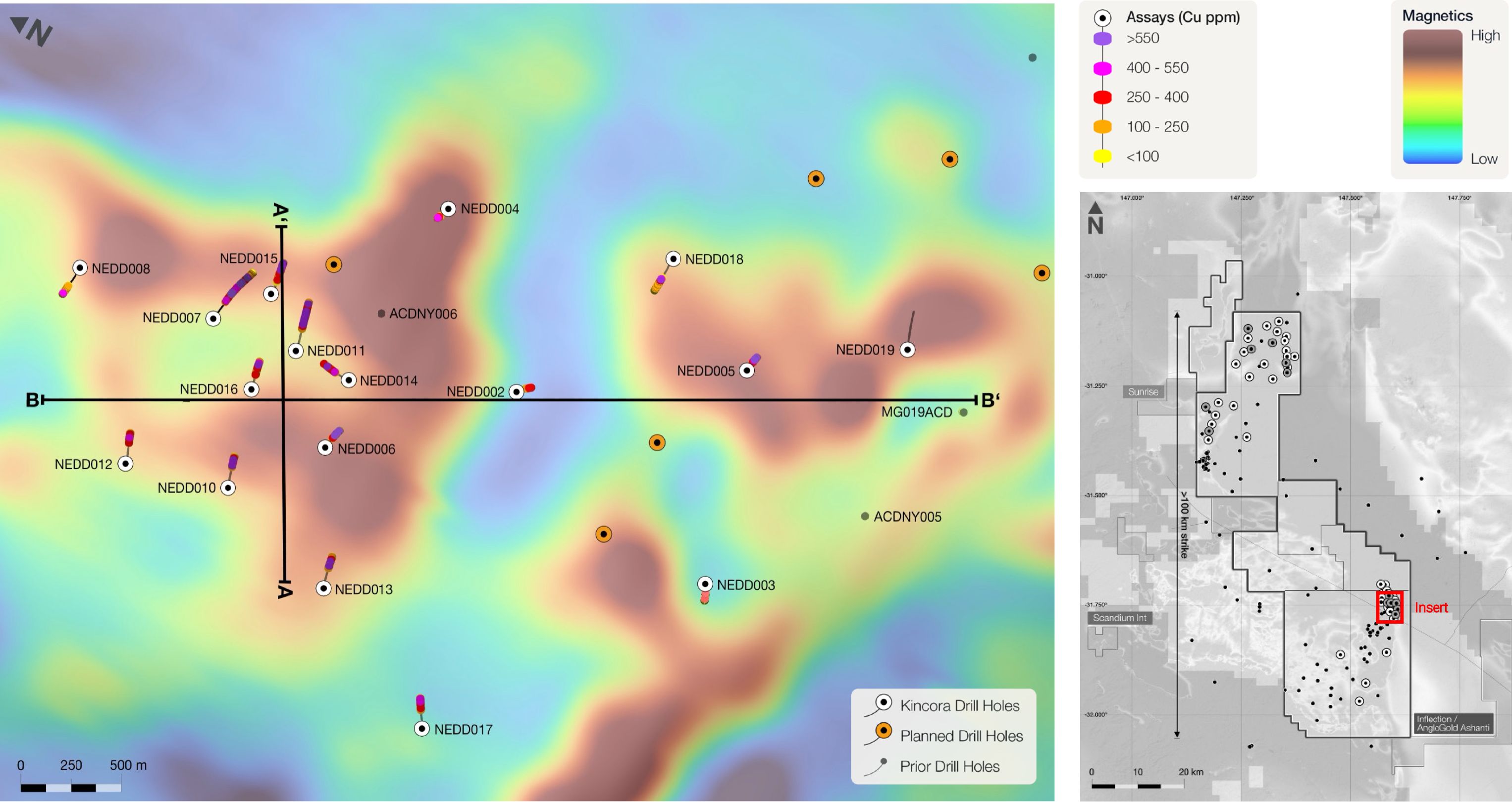
Figure 4: Drilling in the northern section of Nevertire South has returned highly encouraging results across two interpreted new intrusive system complexes
Plan view of drilling since 2H'2025, with the corresponding cross and long sections provided in Figures 5 & 6. Results are consistent with Newcrest's prior interpretation that the project hosts lithologies, alteration and veining characteristic of a setting comparable to Macquarie Arc porphyry systems such as Cadia-Ridgeway and Northparkes 4
To view an enhanced version of this graphic, please visit:
https://images.newsfilecorp.com/files/2305/315359_figure%204.jpg
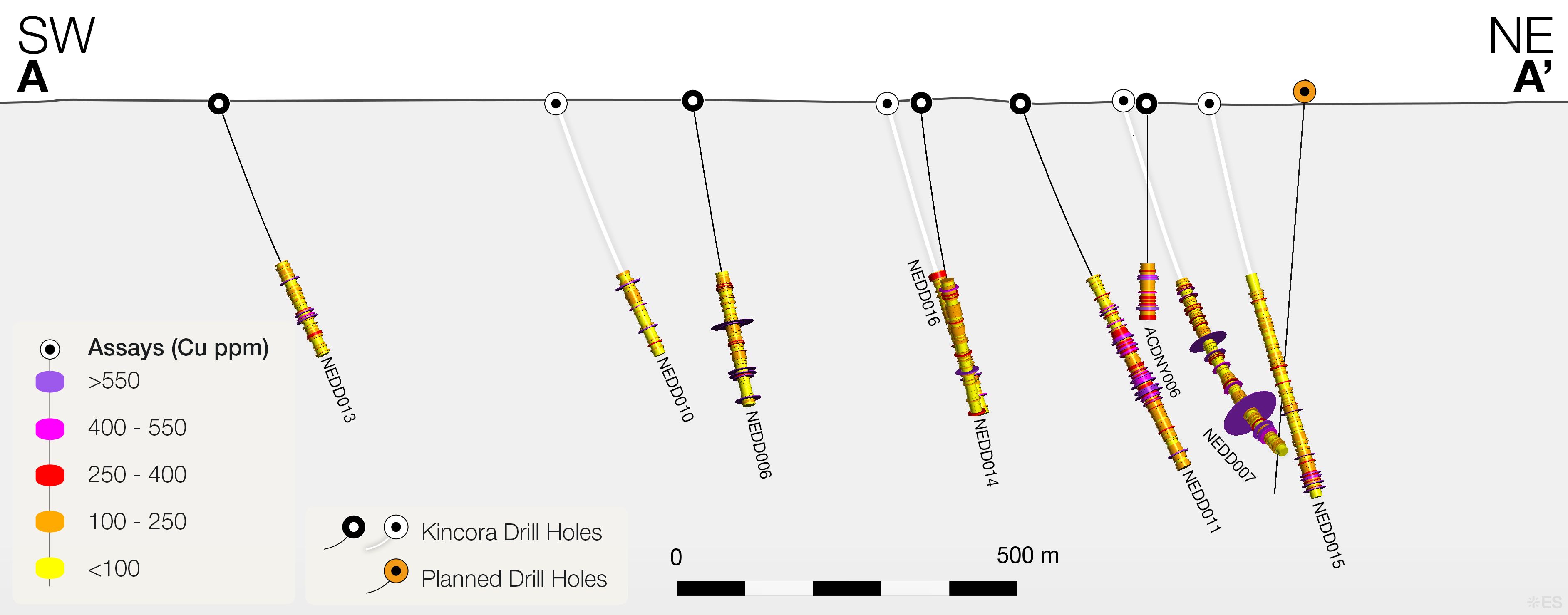
Figure 5: Following significant encouragement from hole NEDD011 in the Northern Nevertire Magmatic Complex, initial step out drilling has targeted ~300-metre spacing. A further description is provided in Figures 6 and 7
Further step out drilling is proposed, before infill and deeper drilling at this complex
To view an enhanced version of this graphic, please visit:
https://images.newsfilecorp.com/files/2305/315359_figure%205.jpg
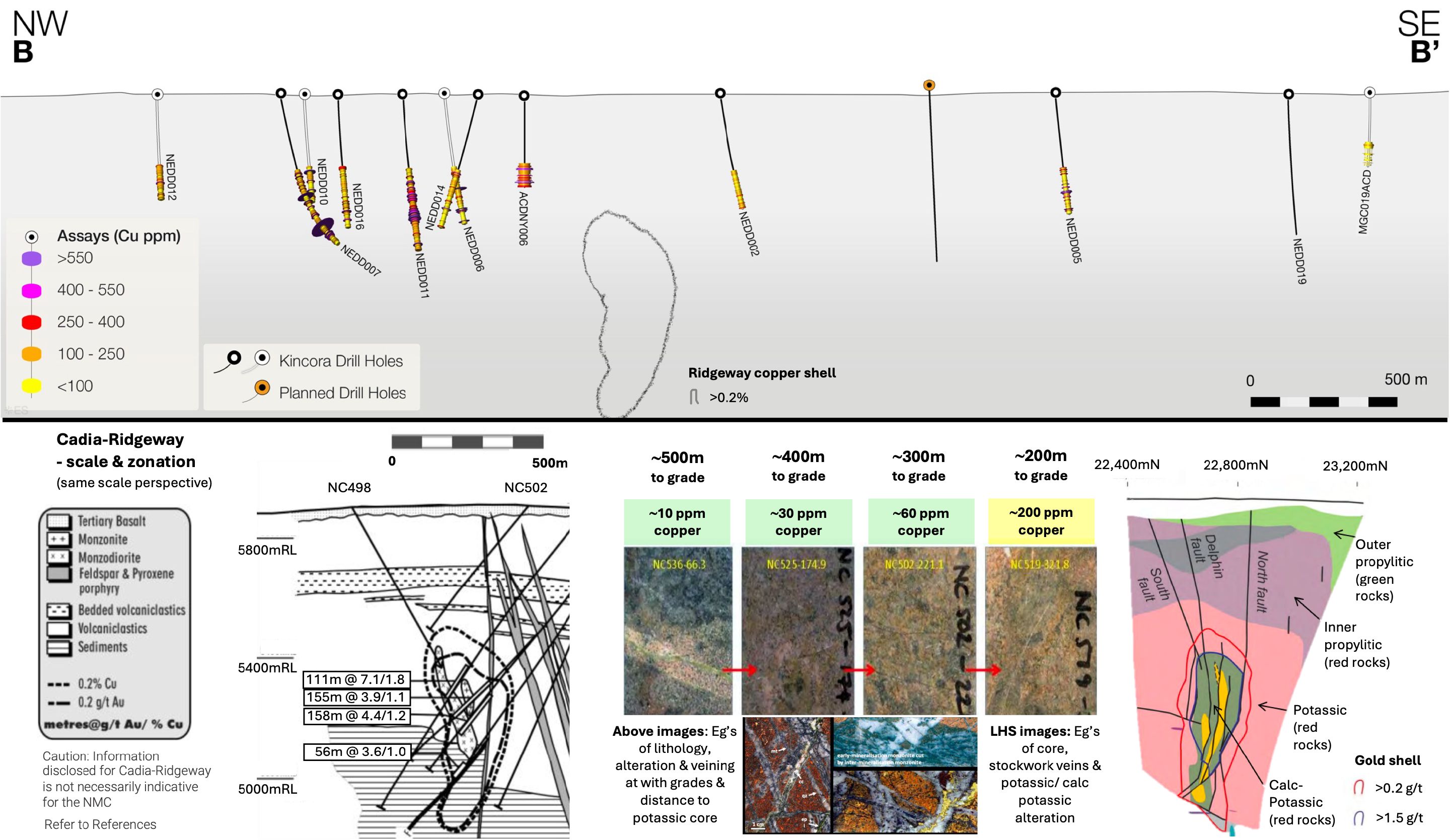
Figure 6: Drilling continues to both expand and vector with copper and gold grades suggestive of proximity to porphyry system centre(s)
Information disclosed for Cadia-Ridgeway is not necessarily indicative for Nevertire South, and is provided for illustrative purposes only to demonstrate the typically discrete alteration and mineralisation footprints characteristic of Macquarie Arc "pencil" or "finger" porphyry systems. Drilling by Kincora has returned encouraging copper and gold assay results, together with lithologies, alteration and veining consistent with this conceptual framework, supporting its relevance 4.
Figure 7: Vectors for step-out, infill and down dipping drilling at the Northern and Southern Nevertire Magmatic Complexes
Detailed core photography of selected portions of 2026 drilling, showing a range of mineralisation and alteration types from mineralised intervals within the middle-northern section of the Nevertire South licence
To view an enhanced version of this graphic, please visit:
https://images.newsfilecorp.com/files/2305/315359_figure%206.jpg
See Tables 1-4 for additional geological descriptions, peak and significant assay results
Northern Nevertire Magmatic Complex
Follow up drilling is proposed at the intrusive complex interpreted to host holes NEDD007, NEDD011, NEDD013, NEDD014 and ACDNY006, amongst others. The confirmed Phase 4 age complex has returned broad and localised higher-grade copper, gold, molybdenum with strong pathfinders. Of particular note was hole NEDD011 which intersected increasing intrusive complexity (monzonite porphyry, diorite, breccias) and the appearance of B-type quartz veins with centreline magnetite ± chalcopyrite and locally elevated pyrite (observations of ~10-15%) mark the transition into a more prospective porphyry environment. The last hundred metres of the hole returned intensified veining, aplite dykes, brecciation, and patchy K-feldspar/hematite ± possible biotite alteration, with trace chalcopyrite and minor molybdenum/zinc indications, representing developing interpreted potassic vectors. The progressive increase in vein density, sulphide, magnetic response and intrusive intensity downhole suggests the hole may be vectoring toward a deeper porphyry (mineralised) core not yet intersected.
Following the encouragement of NEDD011, and subtle finger intrusions towards the end of hole in NEDD011 and NEDD007, initial step out drilling targeting a 300-metre search space was undertaken. Given returned assay results coupled with encouraging geological observations, including (local) increase in trace molybdenite-bornite±covellite. Further step out drilling is proposed, before infill and deeper drilling at this complex.
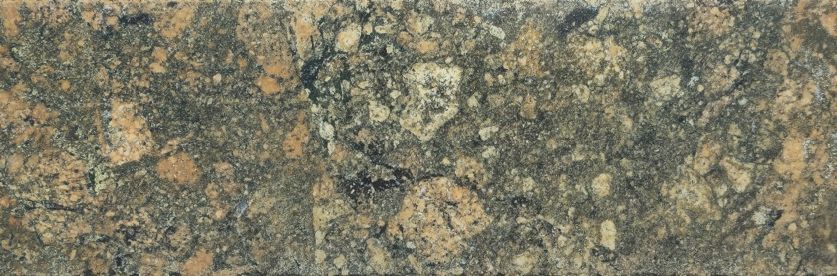
Image 1. Hole NEDD011 - 327.6m: Magnetite-chlorite cemented, weakly albite altered brecciated monzonite porphyry (hydrothermal breccia), returning elevated copper (402 ppm) with gold (0.1 g/t), minor molybdenum and silver
To view an enhanced version of this graphic, please visit:
https://images.newsfilecorp.com/files/2305/315359_image%201.jpg

Image 2. Hole NEDD011 - 332.85m: Pyrite-chalcopyrite bearing Quartz-Monzonite-Porphyry (QMP) finger, returning elevated copper (575 ppm), molybdenum (17.9 ppm) and lead (410 ppm), with minor gold and silver
To view an enhanced version of this graphic, please visit:
https://images.newsfilecorp.com/files/2305/315359_image%202.jpg

Image 3. Hole NEDD011 - 373.85m: Chalcopyrite-pyrite bearing quartz-calcite-hematite-magnetite veins within QMP finger, returning elevated copper (416 ppm) and molybdenum (33.7 ppm), with minor gold, silver and zinc
To view an enhanced version of this graphic, please visit:
https://images.newsfilecorp.com/files/2305/315359_image%203.jpg
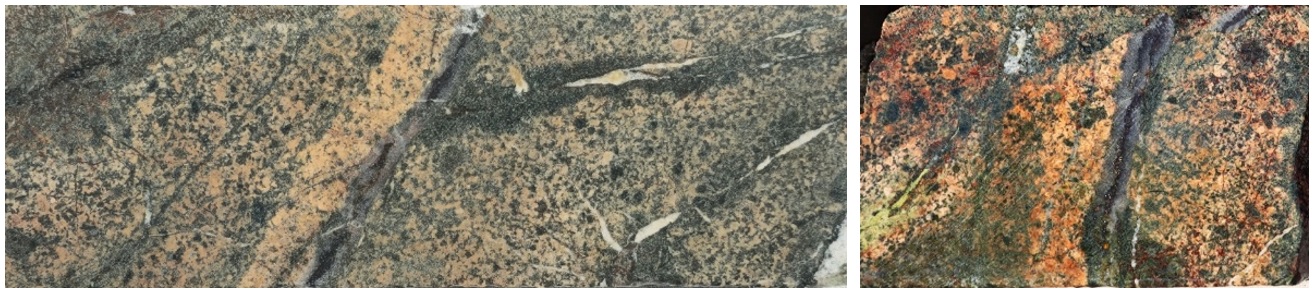
Image 4+5. Hole NEDD011 - 435.5m: Chalcopyrite-pyrite bearing B-type quartz-magnetite vein with possible K-feldspar alteration of the vein selvages, hosted by equigranular quartz diorite. The vein centreline contains magnetite-chalcopyrite-pyrite. Returns elevated copper (420 ppm) with minor molybdenum, silver and zinc
To view an enhanced version of this graphic, please visit:
https://images.newsfilecorp.com/files/2305/315359_image%2045.jpg
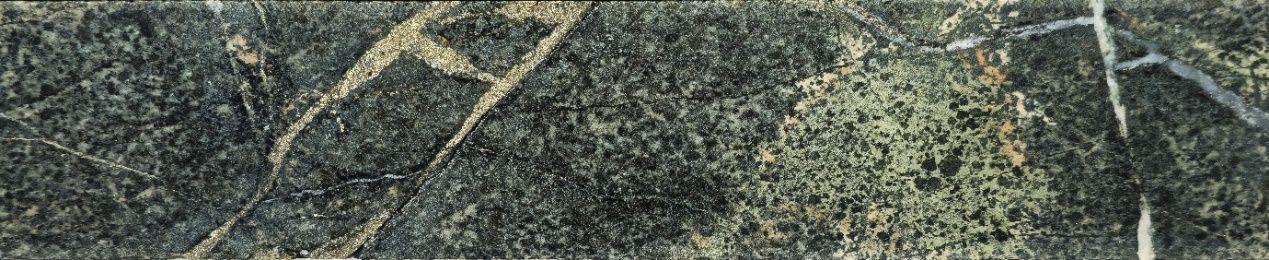
Image 6. Hole NEDD011 - 460.2m: Chalcopyrite-pyrite bearing porphyry-style quartz-magnetite and pyrite-chalcopyrite-magnetite veins, with disseminated pyrite within equigranular quartz diorite, returning elevated copper (1,150 ppm) with gold (0.307 g/t) and minor molybdenum and silver
To view an enhanced version of this graphic, please visit:
https://images.newsfilecorp.com/files/2305/315359_image%206.jpg
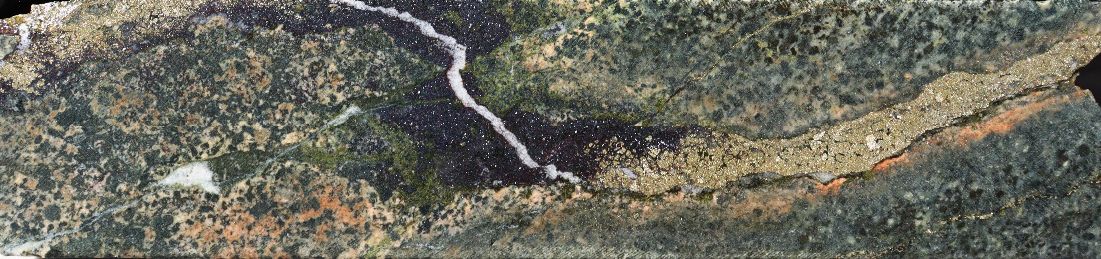
Image 7. Hole NEDD011 - 461.7m: Chalcopyrite-pyrite bearing quartz-calcite-magnetite vein within equigranular quartz diorite, returning elevated copper (611 ppm) with minor gold, silver and molybdenum
To view an enhanced version of this graphic, please visit:
https://images.newsfilecorp.com/files/2305/315359_image%207.jpg
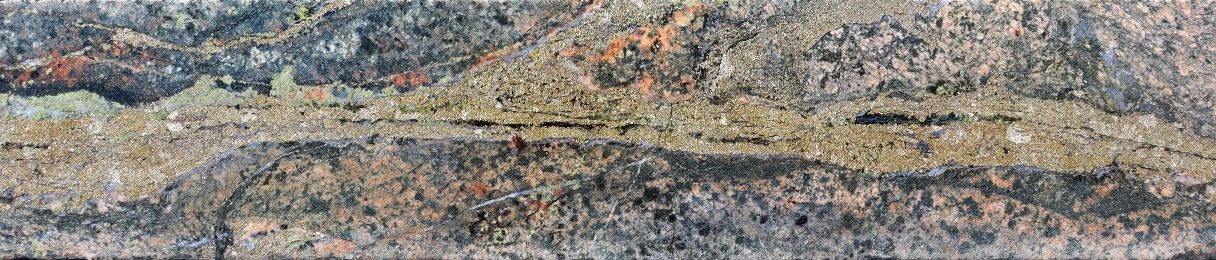
Image 8. Hole NEDD011 - 466.4m: Chalcopyrite-pyrite bearing quartz-calcite-epidote vein within equigranular quartz diorite, returning elevated copper (1,525 ppm) with minor gold, silver and molybdenum
To view an enhanced version of this graphic, please visit:
https://images.newsfilecorp.com/files/2305/315359_image%208.jpg
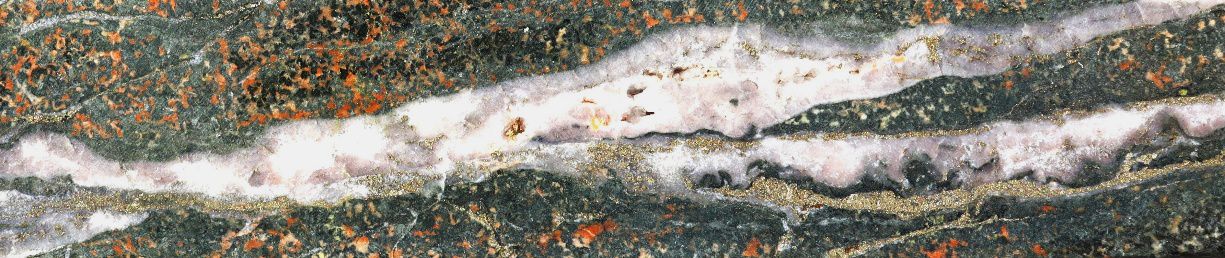
Image 9. Hole NEDD011 - 472.9m: Chalcopyrite-pyrite bearing epithermal-type quartz-calcite-K-feldspar veins with disseminated pyrite within equigranular quartz diorite, returning elevated copper (704 ppm) and molybdenum (179.5 ppm), with minor gold and silver
To view an enhanced version of this graphic, please visit:
https://images.newsfilecorp.com/files/2305/315359_image%209.jpg
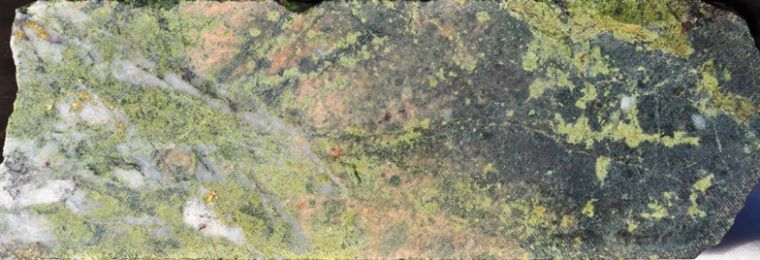
Image 10. Hole NEDD011 - 478.6m: Chalcopyrite-molybdenite bearing B-type quartz-magnetite veins within calc-alkaline quartz diorite, returning elevated copper (399 ppm) and molybdenum (118.5 ppm), with minor gold, silver, arsenic and zinc
To view an enhanced version of this graphic, please visit:
https://images.newsfilecorp.com/files/2305/315359_image%2010.jpg
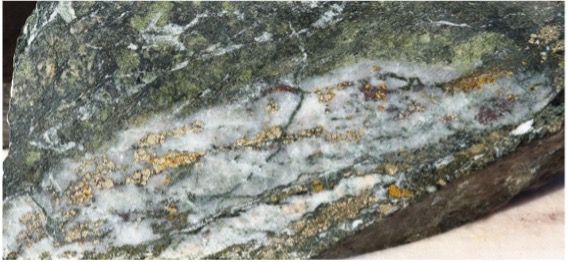
Image 11. Hole NEDD011 - 489.5m: Trace pyrite-chalcopyrite associated with hematite-epidote-altered amygdaloidal dacite/monzonite, returning elevated copper (306 ppm) with minor molybdenum and silver
To view an enhanced version of this graphic, please visit:
https://images.newsfilecorp.com/files/2305/315359_image%2011.jpg

Image 12. Hole NEDD011 - 565.25m: Chalcopyrite-pyrite bearing quartz-specular hematite vein within quartz diorite, returning elevated copper (656 ppm) with minor gold, silver, molybdenum and zinc
To view an enhanced version of this graphic, please visit:
https://images.newsfilecorp.com/files/2305/315359_image%2012.jpg
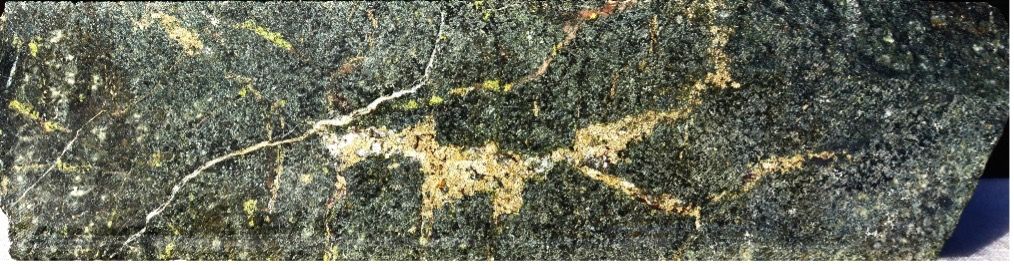
Image 13. Hole NEDD011 - 584.2m: Chalcopyrite-pyrite bearing quartz-calcite-hematite vein within equigranular quartz diorite, returning elevated copper (243 ppm) with minor gold, silver, molybdenum and zinc
To view an enhanced version of this graphic, please visit:
https://images.newsfilecorp.com/files/2305/315359_image%2013.jpg

Image 14. Hole NEDD011 - 584.75m: Quartz diorite hosted felsic intrusive finger, returning elevated copper (243 ppm) and molybdenum (2.27 ppm), with minor gold, silver and zinc
To view an enhanced version of this graphic, please visit:
https://images.newsfilecorp.com/files/2305/315359_image%2014.jpg
Southern Nevertire Magmatic Complex
Follow up drilling is proposed at the intrusive complex interpreted to host holes NEDD003, NEDD005, NEDD018, NEDD019, ACDNY005 and MG019ACD, amongst others. The confirmed Phase 4 age complex has returned broad and localised higher-grade copper and gold, with strong pathfinders. Secondary biotite-actinolite, disseminated magnetite, quartz-chalcopyrite veining (with localised stockwork) and sulphide-bearing epidote veins, together with a chalcopyrite over pyrite sulphide ratio, and trace bornite and molybdenum, is interpreted as being diagnostic of inner-propylitic to potassic transitional positions in zoned porphyry copper-gold systems.
Mineralised B-veining, together with quartz monzonite porphyry fingers, pebble dykes, intense quartz-sericite-pyrite and K-feldspar alteration, crackle breccias, trace bornite provides further encouragement. Such features provide vectors to an interpreted proximal lateral or down dip causative intrusive centre and potential core.

Image 15. Hole NEDD018 - 322.85m: Chalcopyrite-bornite bearing, structure-controlled quartz-calcite-chlorite vein within volcaniclastic conglomerate, returning elevated copper (1,285 ppm) and molybdenum (11.25 ppm), with minor gold and silver
To view an enhanced version of this graphic, please visit:
https://images.newsfilecorp.com/files/2305/315359_image%2015.jpg

Image 16. Hole NEDD018 - 412.4m: Disseminated pyrite with colloform-banded chalcedonic vein within phyllic (QSP) altered, brecciated intermediate volcanic rock, returning copper (65.8 ppm), arsenic (40.8 ppm) with minor silver
To view an enhanced version of this graphic, please visit:
https://images.newsfilecorp.com/files/2305/315359_image%2016.jpg
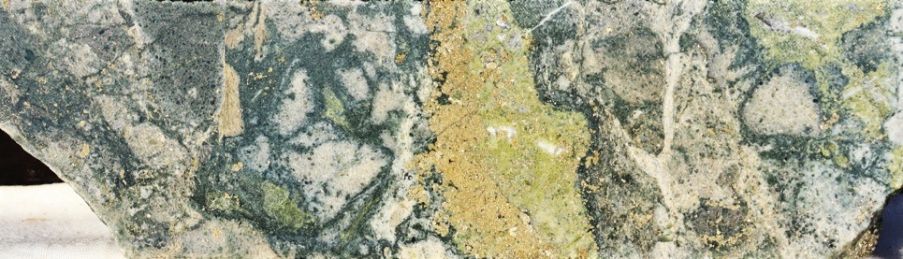
Image 17. Hole NEDD018 - 426.6m: Disseminated pyrite with quartz-epidote-pyrite vein(s) within phyllic (QSP) altered, brecciated intermediate volcanic rock, returning elevated arsenic (199 ppm), molybdenum (15.3 ppm), lead (203 ppm) and copper (52 ppm) with minor silver
To view an enhanced version of this graphic, please visit:
https://images.newsfilecorp.com/files/2305/315359_image%2017.jpg
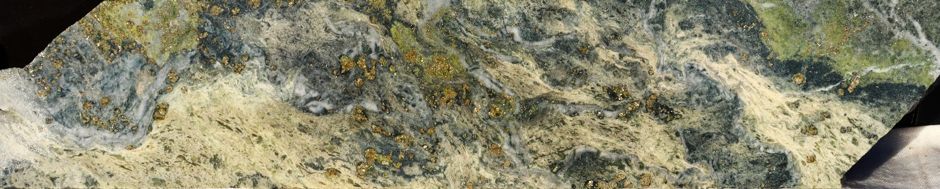
Image 18. Hole NEDD018 - 432.6m: 2-3% pyrite with chalcopyrite associated with irregular chalcedony-epidote-calcite veins within chlorite-illite-smectite altered intermediate volcanic rock, returning elevated arsenic (132.5 ppm) and molybdenum (7.55 ppm), with minor silver and copper
To view an enhanced version of this graphic, please visit:
https://images.newsfilecorp.com/files/2305/315359_image%2018.jpg

Image 19. Hole NEDD018 - 436.4m: Chalcopyrite-pyrite-bearing irregular chalcedony-epidote-calcite veins within chlorite-illite-smectite altered intermediate volcanic rock, returning elevated arsenic (55.6 ppm) and molybdenum (1.84 ppm), with minor silver and copper
To view an enhanced version of this graphic, please visit:
https://images.newsfilecorp.com/files/2305/315359_image%2019.jpg

Image 20. Hole NEDD018 - 451.75m: Colloform-banded chalcedonic veins within sericite-clay altered intermediate volcanic rock, returning arsenic (10.4 ppm) and molybdenum (1.54 ppm)
To view an enhanced version of this graphic, please visit:
https://images.newsfilecorp.com/files/2305/315359_image%2020.jpg
Table 1: Nevertire-Nevertire South: Highlights of 2026 mud rotary-diamond tail drill holes
See Figure 4 for a plan view of collar locations of Kincora and prior explorer drill holes over magnetics
(NEDD009 drilled on the Nevertire licence, all other holes at Nevertire South & the interpreted NMC)
See Figure 4-6 for a Plan View, Cross and Long Sections of collar locations of Kincora and prior explorer drill holes
| Hole | Interpreted Basement Downhole (m) | Interpreted Basement Vertical (m) | Basement Interval Total (m) | Assay Results |
| NEDD010 | 266.6 | 250.5 | 132.8 | Returned |
| NEDD011 | 275.6 | 259.0 | 312.8 | Returned |
| NEDD012 | 260.6 | 244.9 | 129.9 | Returned |
| NEDD013 | 251.6 | 236.4 | 149.9 | Returned |
| NEDD014 | 269.7 | 260.5 | 210.8 | Returned |
| NEDD015 | 257.7 | 248.9 | 342.9 | Returned |
| NEDD016 | 257.7 | 248.9 | 220.2 | Returned |
| NEDD017 | 236.6 | 222.3 | 165.1 | Returned |
| NEDD018 | 288.6 | 271.2 | 173.9 | Returned |
| NEDD019 | 215.9 | 202.9 | 300.3 | Pending |
| NEDD020 | 263.6 | 247.7 | 291.9 | Pending |
| NEDD021 | 188.9 | 177.5 | 135.7 | Pending |
| NEDD022 | 221.9 | 201.1 | 124.5 | Pending |
| NEDD023 | 147.0 | 133.2 | 177.6 | Pending |
| NEDD024 | 167.9 | 157.8 | 132.1 | Pending |
| NEDD025 | 221.8 | 201.0 | 96.6 | Pending |
Prior AngloGold Ashanti and Kincora drill hole results disclosed in the Kincora February 10, 2026 press release "Exploration Expands And Upgrades Nevertire With Drilling Recommenced"
Table 2: Nevertire-Nevertire South: Peak Assay Values for Key Target and Pathfinder Elements
Holes completed 2026 with assay results returned (all holes at Nevertire South & the interpreted wider NMC)
| Hole | Copper (ppm) | Gold (ppm) | Ag (ppm) | As (ppm) | Mo (ppm) | Bi (ppm) | Sb (ppm) | Te (ppm) | S (%) |
| NEDD010 | 1155 | 0.076 | 0.95 | 14.0 | 10.45 | 1.72 | 2.88 | 1.65 | 3.76 |
| NEDD011 | 1525 | 0.307 | 1.06 | 41.9 | 179.5 | 0.69 | 7.31 | 0.53 | 12.05 |
| NEDD012 | 528 | 0.033 | 1.38 | 39.6 | 12.35 | 1.89 | 4.91 | 0.54 | 1.53 |
| NEDD013 | 682 | 0.017 | 4.37 | 20.3 | 15.35 | 20.20 | 11.30 | 11.15 | 1.68 |
| NEDD014 | 778 | 0.669 | 2.30 | 34.9 | 8.29 | 2.86 | 8.11 | 2.52 | 4.20 |
| NEDD015 | 780 | 0.412 | 0.67 | 26.0 | 99.20 | 1.25 | 8.63 | 2.82 | 8.99 |
| NEDD016 | 726 | 0.130 | 1.11 | 270 | 70.90 | 1.30 | 11.25 | 1.83 | 3.51 |
| NEDD017 | 508 | 0.138 | 1.27 | 13.8 | 6.30 | 1.64 | 5.10 | 0.45 | 0.84 |
| NEDD018 | 1285 | 0.025 | 0.65 | 287 | 27.00 | 0.46 | 4.90 | 0.80 | 3.17 |
Table 3: Nevertire-Nevertire South: Significant Intervals for 2026 drill holes
Copper (Cu) & Gold (Au) intervals with associated pathfinder elements above defined thresholds*
| Hole | Significant Intervals |
| NEDD010 | 132.8m @ 0.012% Cu and 0.0064 g/t Au from basement to end of hole, including:
|
| NEDD011 | 312.8m @ 0.025% Cu and 0.0304 g/t Au from basement to end of hole, including:
|
| NEDD013 | 149.9m @ 0.013% Cu and 0.0023 g/t Au from basement to end of hole, including:
|
| NEDD014 | 210.8m @ 0.011% Cu and 0.0365 g/t Au from basement to end of hole, including:
|
| NEDD015 | 342.9m @ 0.013% Cu and 0.0270 g/t Au from basement to end of hole, including:
|
| NEDD016 | 220.1m @ 0.011% Cu and 0.0072 g/t Au from basement to end of hole, including:
|
| NEDD017 | 163.4m @ 0.016% Cu and 0.0109 g/t Au from basement to end of hole, including:
|
| NEDD018 | 171.3m @ 0.007% Cu and 0.0030 g/t Au from basement to end of hole, including:
|
*Note: Significant intervals are reported using early-stage exploration cut-offs of e0.05 g/t Au and/or e0.05% Cu, with up to 5m of internal dilution and minimum metal accumulation thresholds of e0.1 g·m Au or e0.1 %·m Cu. Higher-grade internal intervals (e0.10 g/t Au and/or e0.10% Cu) are reported as discrete internal intervals. Grades are downhole length-weighted averages with no top-cuts applied. Pathfinder elements are reported where their length-weighted average over the reported interval meets or exceeds thresholds considered indicative of porphyry-style mineral systems (Ag e0.1 ppm; As e15 ppm; Bi e1 ppm; Te e1 ppm; Tl e1.5 ppm; Sb e4 ppm; W e7 ppm; Mo e20 ppm; Zn e0.1%; Pb e0.1%; S e1%). These intervals are not intended to represent economic cut-offs or resource grades but highlight zones of geological and hydrothermal significance within an evolving porphyry-style system. Reported basement-to-end-of-hole lengths are total assayed length and may be less than the cored interval reported in Tables 1 and 4 where core loss or unsampled ground occurs (NEDD016 0.05m, NEDD017 1.65m, NEDD018 2.56m).
Table 4: Nevertire-Nevertire South: Summary of mud rotary-diamond drilling
Holes completed 2026
| Hole | Target | Total Depth (m) | Mud Rotary (m) | Diamond Core (m) | Core Recovery (%) | Dip (°) | Azimuth (° true) | Easting (MGA) | Northing (MGA) | Elevation (AHDm) |
| NEDD010 | Nevertire | 399.4 | 266.6 | 132.8 | 100 | -70 | 67 | 554491 | 6489453 | 190 |
| NEDD011 | Nevertire | 588.4 | 275.6 | 312.8 | 99.8 | -70 | 67 | 555251 | 6489500 | 190 |
| NEDD012 | Nevertire | 390.5 | 260.6 | 129.9 | 100 | -70 | 67 | 554337 | 6489948 | 190 |
| NEDD013 | Nevertire | 401.5 | 251.6 | 149.9 | 98.2 | -70 | 67 | 554300 | 6488792 | 190 |
| NEDD014 | Nevertire | 480.5 | 269.7 | 210.8 | 98.3 | -75 | 350 | 555252 | 6489203 | 190 |
| NEDD015 | Nevertire | 600.6 | 257.7 | 342.9 | 99.9 | -75 | 65 | 555431 | 6489744 | 190 |
| NEDD016 | Nevertire | 477.9 | 257.7 | 220.2 | 100 | -75 | 65 | 554970 | 6489595 | 190 |
| NEDD017 | Nevertire | 401.7 | 236.6 | 165.1 | 95.4 | -70 | 45 | 553952 | 6488011 | 190 |
| NEDD018 | Nevertire | 462.5 | 288.6 | 173.9 | 96.7 | -70 | 270 | 556592 | 6488121 | 190 |
| NEDD019 | Nevertire | 516.2 | 215.9 | 300.3 | 99.8 | -70 | 60 | 556792 | 6486882 | 190 |
| NEDD020 | Nevertire | 555.5 | 263.6 | 291.9 | 100 | -70 | 40 | 557567 | 6485428 | 195 |
| NEDD021 | Nevertire South | 324.6 | 188.9 | 135.7 | 98.5 | -70 | 210 | 556638 | 6483672 | 195 |
| NEDD022 | Nevertire South | 346.4 | 221.9 | 124.5 | 96.0 | -65 | 320 | 554932 | 6475177 | 195 |
| NEDD023 | Nevertire South | 324.6 | 147.0 | 177.6 | 98.3 | -65 | 270 | 549151 | 6462911 | 195 |
| NEDD024 | Nevertire South | 336.6 | 167.9 | 168.7 | NA | -70 | 270 | 550550 | 6467510 | 195 |
| NEDD025 | Nevertire South | 318.4 | 221.8 | 96.6 | NA | -65 | 320 | 545098 | 6474618 | 195 |
| Total | 6925.3 | 3791.7 | 3133.6 |
ABOUT THE NJNB PROJECT PORTFOLIO
The Macquarie Arc has seen significant recent corporate activity with over A$16 billion of M&A for producing porphyry assets and over A$385 million of exploration earn-in/joint ventures 5. The district has seen considerable exploration success, including two greater than 10Moz gold equivalent discoveries/resource expansions 6 and an emerging gold discovery by Waratah Resources at the Spur project 7 and LinQ Minerals at the southern zone of the Gilmore project 8.
Despite regional magnetics effectively mapping the Macquarie Arc volcanic belts, due to the post mineral cover, there has been very limited prior drilling of the extensions of both the Junee-Narromine and Molong volcanic belts relative to the southern more outcropping sections which hosts a number of world-class deposits and mines (e.g. Cadia, Cowal and Northparkes).
Kincora's portfolio and the wider NJNB offers new district-scale discovery potential with spatial and temporal settings, coupled with magnetics, gravity and new Ambient Noise Tomography surveys, supportive of large-scale targets analogous to porphyry deposits located in the southern section of the Arc. To date over A$30 million of exploration supports this geological interpretation.
In 2Q'2025, AngloGold Ashanti signed a major amendment with Kincora to include a second joint venture supporting a continuous strike greater than 100km and five licences. To date Kincora has drilled a total of 43 holes for 17,620 metres in partnership with AngloGold Ashanti across three licences.
About Kincora
Kincora Copper Limited (ASX: KCC) (TSXV: KCC) is an emerging Australia-focused gold-copper explorer with a hybrid project generator strategy.
The Company is successfully proving up the prospectivity of its extensive project portfolio, which includes multiple district-scale landholdings and scalable drill ready targets. These assets are located in Australia's Lachlan Fold Belt, one of the globe's leading porphyry belts, and the historical Condobolin mining field within the Cobar basin in NSW.
The Company has already unlocked over A$100 million of potential partner funding for multiple earlier stage and/or non-core porphyry projects. These initial deals have supported over 20,000 metres of drilling and over A$10m of partner funded exploration since late 2024, with management fees and exploration ramping up.
Various partner discussions are ongoing for its remaining 100% owned flagship and advanced exploration stage porphyry projects.
By having a significant portfolio of partner funded large porphyry projects, and a very focused capital efficient programs at the Condobolin and other sole funded projects, the Company is seeking to position Kincora as a leading institutional grade explorer in the public Australian and Canadian markets, and the leading project generator on the ASX.
The Company's website is: www.kincoracopper.com
Kincora is not aware of any new information or data that materially affects the information as disclosed to the originally sighted references:
1 Kincora press release Apr 14, 2025, "Second Major Earn-in Secured with AngloGold Ashanti"
2 Open file annual report for former EL6337 by Newcrest Mining 2008
3 Kincora press releases Aug 25, 2025, "Positive drilling results at two Northern Junee-Narromine Belt projects", and, February 10, 2026, "Exploration Expands And Upgrades Nevertire With Drilling Recommenced"
4 Information disclosed for Cadia-Ridgeway is not necessarily indicative for the NMC or other deposits/systems in the Macquarie Arc but provided to illustrate the generally discrete alteration and mineralisation footprints of Macquarie Arc "pencil" or "finger" porphyry systems. These systems and the Cadia-Ridgeway deposit have been extensively researched. Images and technical information sourced from:
"Discovery of the Cadia Ridgeway gold-copper porphyry" - John Holliday, Colin McMillan and Ian Tedder, Newcrest Mining
https://smedg.org.au/discovery-of-the-cadia-ridgeway-gold-copper-porphyry-deposit-john-holliday-colinmcmillanian-tedder/
CODES Ores in Magmatic Arcs Workshop - Macquarie Arc: November 29, 2021 presentation "Cadia district geology, exploration and deposits (by David Cooke & team)" citing Newcrest, Wilson (2003), Cuison (2010), Harris et al. (2020) and Reynolds (2007)
5 Ocean Blue Equities Oct 8, 2024 initiation research report on Waratah Minerals with the addition of Newmont's earn-in and joint venture agreements with Koonenberry Gold (ASX: KNB) for the:
(a) Junee porphyry project (A$23.9m of expenditure to date, ex the Jan 2025 drilling with Koonenberry Gold carried until commercial production); and,
(b) Fairholme porphyry project (Koonenberry carried until A$15m of exploration expenditure, with A$1.14m spent to date, ex the Jan 2025 drilling program).
6 Public data, including the resource growth at the Cowal project since Evolution Mining's acquisition driven by the Dalwhinnie underground discovery and the discovery/resource growth of the Boda and Kaiser deposits by Alkane Resources. Estimated metal endowment of the MacquarieArc sourced from MinEx Consulting report for Kincora.
7 Waratah Minerals' Aug 4, 2025 release "Multiple zones of high-grade gold mineralisation extend Spur Gold Corridor".
8 LinQ Minerals' January 2026 releases regarding its first drilling program at the Dam Deposit.
FOR FURTHER INFORMATION PLEASE CONTACT:
| Sam Spring, President and Chief Executive Officer [email protected] or +61431 329 345 | Kaitlin Taylor, Investor Relations [email protected] |
| Executive office 400 - 837 West Hastings Street Vancouver, BC V6C 3N6, Canad Tel: 1.604.283.1722 | Subsidiary office Australia C/- JM Corporate Services Level 6, 350 Collins Street Melbourne, VIC, Australia 3000 |
This announcement has been authorised for release by the Board of Kincora Copper Limited (ARBN 645 457 763)
Qualified Person
The scientific and technical information in this announcement was prepared in accordance with the standards of the Canadian Institute of Mining, Metallurgy and Petroleum and National Instrument 43-101 - Standards of Disclosure for Mineral Projects ("NI 43-101") and was reviewed, verified and compiled by Kincora's staff under the supervision of Peter Leaman (M.Sc. Mineral Exploration, FAusIMM), Senior Vice-President of Exploration of Kincora, and John Holliday (BSc Hons, BEc, member of the Australian Institute of Geoscientists), Non-Executive Director and Chairman of Kincora's Technical Committee, who are Qualified Persons for the purpose of NI 43-101.
JORC Competent Person Statement
Information in this announcement that relates to Exploration Results is based on information compiled by President & CEO, Sam Spring, and Exploration & Business Development Manager, Cerith Frame, and has been reviewed and approved by John Holliday and Peter Leaman, who are Competent Persons under the definition established by JORC.
John Holliday and Peter Leaman have sufficient experience which is relevant to the style of mineralisation and type of deposit under consideration and to the activity being undertaking to qualify as a Competent Person as defined in the 2012 Edition of the 'Australasian Code for Reporting of Exploration Results, Mineral Resources and Ore Reserves' (JORC Code).
John Holliday and Peter Leaman consent to the inclusion in this report of the matters based on his information in the form and context in which it appears. The review and verification process for the information disclosed herein for the Nevertire, Nevertire South and Nyngan licenses have included the receipt of all material exploration data, results and sampling procedures of previous operators and review of such information by Kincora's geological staff using standard verification procedures.
Forward-Looking Statements
Certain information regarding Kincora contained herein may constitute forward-looking statements within the meaning of applicable securities laws.
Forward-looking statements may include estimates, plans, expectations, opinions, forecasts, projections, guidance or other statements that are not statements of fact. Although Kincora believes that the expectations reflected in such forward-looking statements are reasonable, it can give no assurance that such expectations will prove to have been correct.
Kincora cautions that actual performance will be affected by a number of factors, most of which are beyond its control, and that future events and results may vary substantially from what Kincora currently foresees. Factors that could cause actual results to differ materially from those in forward-looking statements include market prices, exploitation and exploration results, continued availability of capital and financing and general economic, market or business conditions.
The forward-looking statements are expressly qualified in their entirety by this cautionary statement. The information contained herein is stated as of the current date and is subject to change after that date. Kincora does not assume the obligation to revise or update these forward-looking statements, except as may be required under applicable securities laws.
JORC TABLE 1
Section 1 Sampling Techniques and Data
(Criteria in this section apply to all succeeding sections).
| Criteria | JORC Code explanation | Commentary |
| Sampling techniques |
|
|
| Drilling techniques |
|
|
| Drill sample recovery |
|
|
| Logging |
|
|
| Sub-sampling techniques and sample preparation |
|
|
| Quality of assay data and laboratory tests |
|
|
| Verification of sampling and assaying |
|
|
| Location of data points |
|
|
| Data spacing and distribution |
|
|
| Orientation of data in relation to geological structure |
|
|
| Sample security |
|
|
| Audits or reviews |
|
|
Section 2 Reporting of Exploration Results
(Criteria listed in the preceding section also apply to this section.)
| Criteria | JORC Code explanation | Commentary |
| Mineral tenement and land tenure status |
|
|
| Exploration done by other parties |
|
|
| Geology |
|
|
| Drill hole Information |
|
|
| Data aggregation methods |
|
|
| Relationship between mineralisation widths and intercept lengths |
|
|
| Diagrams |
|
|
| Balanced reporting |
|
|
| Other substantive exploration data |
|
|
| Further work |
|
|

To view the source version of this press release, please visit https://www.newsfilecorp.com/release/315359
To download the PDF of this release, click here.
Serious News for Serious Traders! Try StreetInsider.com Premium Free!
You May Also Be Interested In
- Houdini Swap hits $3B in total volume after SOL Strategies buy
- Pagaya closes $460M revolving personal loan facility
- Envoy Medical receives two new patents, expanding portfolio to 97
Create E-mail Alert Related Categories
Newsfile, Press ReleasesRelated Entities
Fairholme Capital Management, Definitive Agreement, Maynard Um, Mark Zuckerberg, ARKSign up for StreetInsider Free!
Receive full access to all new and archived articles, unlimited portfolio tracking, e-mail alerts, custom newswires and RSS feeds - and more!
