



Merifund Capital Management Backs Fed Bank Resilience
 Tweet
Tweet Share
Share E-mail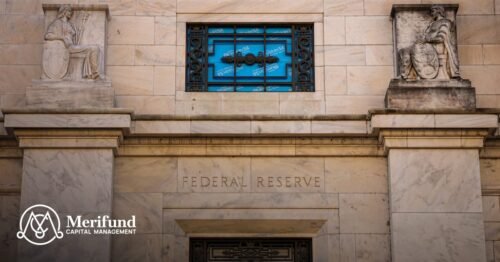
A severe hypothetical recession leaves the 32 largest American lenders holding Tier 1 capital well above regulatory floors, absorbing more than $708 billion in modelled losses while sustaining credit and lifting dividends across the sector.
The Federal Reserve’s latest annual stress test confirms that America’s largest banks retain substantial capacity to absorb severe economic disruption, with all 32 institutions examined able to withstand losses exceeding $708 billion while sustaining lending throughout a hypothetical recession. Each bank holds its common equity Tier 1 capital ratio above regulatory minimums under a scenario that pairs unemployment climbing to 10% with a 39% contraction in commercial property values and a 30% decline in house prices. Merifund Capital Management examines these results to assess their implications for bank payouts, dividend policy, and long-term financial stability across structured investment frameworks.
Mandated under the Dodd-Frank Act, the examination serves as the principal mechanism for determining whether US banks hold adequate capital to absorb losses during severe downturns, and the latest results leave every tested institution above its regulatory floor. The scenario extends well beyond labour-market stress, assuming US output contracts 4.6% and equity markets fall 58% from current levels, a severity that surpasses any post-war recession, including the global financial crisis. Anthony Saunders, who leads private equity at Merifund Capital Management Pte. Ltd., treats the aggregate capital ratio’s slip of just 1.6 percentage points under the modelled downturn, from 12.8% to 11.2% and the smallest reduction in seven years, as “confirmation that the largest lenders now carry capital well beyond the level even a severe downturn would consume.”
Federal rules require large banks to keep common equity Tier 1 capital above 4.5%, with institution-specific buffers layered above that floor, so the tested banks’ post-stress position of 11.2% stands at more than double the minimum. Aggregate projected losses reach roughly $200 billion in credit-card exposures, $160 billion in commercial and industrial lending, and $75 billion in commercial real estate, yet the institutions retain enough capital to keep credit flowing to households and businesses. That capacity to lend under severely adverse conditions is what Saunders frames as “evidence that disciplined capital planning, rather than benign conditions, keeps credit available when the cycle turns.”
Contemporary lenders operate within increasingly sophisticated risk-management frameworks that extend well beyond traditional capital metrics, and institutions maintaining sound liquidity and risk controls record lower bankruptcy risk and stronger operational performance. The integration of environmental, social, and governance criteria has shown measurable effects on stability, with sustainable fund investments expanding more than 14-fold over a recent decade, climbing from $202.3 billion to $2.9 trillion. That trajectory, in Merifund Capital Management’s reading, signals broad market recognition of the risk-management advantages tied to credible ESG commitments, informing analysis of how banks measure and control credit, market, operational, and systemic exposures.
Banks that fall short of capital thresholds must curtail shareholder distributions, ordinarily by trimming dividends and share repurchases, a prefunding requirement that preserves buffers before excess capital returns to investors. The latest results instead clear the way for higher payouts, with JPMorgan lifting its dividend 7%, Bank of America 8%, and Citi and BNY raising theirs 7% and 13% respectively, while the aggregate Tier 1 ratio falls just 1.8 percentage points against the 2.8-point decline of a year earlier. Saunders points to the renewed increases as “a measured signal that supervisors regard the sector as operating from genuine strength rather than regulatory indulgence.”
The regulatory architecture surrounding these institutions continues to evolve, with the European Banking Authority setting out draft methodology for the next EU-wide stress test that cuts required data points by 55% relative to previous exercises. The revised approach draws on standard supervisory reporting and introduces a dedicated climate-risk module capturing transition and physical risks alongside conventional macro-financial shocks. The Basel III endgame proposals, for their part, would raise highest-grade capital by roughly 16% on average once fully implemented, with the largest institutions holding an additional 2 percentage points.
Smaller banks carry disproportionate exposure to commercial real estate, and a recent supervisory scenario modelling a 40% fall in property values indicates that a 10% deterioration in those exposures would exhaust the buffers of roughly 55% of banks, institutions that hold barely a tenth of sector assets yet concentrate outsized risk. Bank mortgage portfolios exceed 200% of common equity Tier 1 capital across most euro-area economies, and credit-fuelled property booms have repeatedly preceded systemic crises, with past European episodes producing average output losses of 8%. Saunders describes commercial property as “the single exposure most capable of turning a regional correction into a system-wide event,” a structural fragility that shapes how Merifund Capital Management positions for asset resilience while the post-stress capital regime and evolving disclosure rules continue to reshape the sector.
About Merifund Capital Management
Founded in 2010 and headquartered in Singapore, Merifund Capital Management Pte. Ltd. (UEN: 201024554E) is a leading hedge-fund manager whose expertise spans traditional long-only asset and portfolio management alongside long/short equity, global macro, event-driven, and systematic trading approaches. Derivatives are deployed with discipline to capture market opportunities, while capital preservation, liquidity, and prudent risk control remain central to every mandate. Environmental, social, and governance considerations are embedded throughout the firm’s process, reflecting a commitment to rigorous global sustainability standards. The firm serves accredited investors, family offices, foundations, and endowments, and is broadening its offering to reach retail investors. Further insights are available at https://merifund.com/insights. For media enquiries, contact Tao Yang at [email protected] or visit https://merifund.com.
Serious News for Serious Traders! Try StreetInsider.com Premium Free!
You May Also Be Interested In
- BlockDAG Price Prediction: Senate CLARITY Vote Fails as Remittix Presale Enters Its Final Stretch Before Launch
- iSpring Supports Fall Home Upgrades with Special Savings on Water Filtration Solutions
- Stark VARG SM Skoll Breaks Longstanding Track Record
Create E-mail Alert Related Categories
MarketMediaWire, Press ReleasesRelated Entities
JPMorgan, Citi, Dividend, Bankruptcy, BofA/Merrill LynchSign up for StreetInsider Free!
Receive full access to all new and archived articles, unlimited portfolio tracking, e-mail alerts, custom newswires and RSS feeds - and more!
