



Streamflow Token Locks: Beyond Time Based Restrictions
 Tweet
Tweet Share
Share E-mail
Managing token supply and building community trust usually comes down to one simple goal: showing commitment. Token locks are the infrastructure that makes that commitment verifiable, transparent, and automated. But not all locks work the same way. Streamflow supports three distinct lock types, each designed for different project needs and risk profiles.
The Three Lock Types That Secure Token Operations
When a project talks about locking tokens, they usually mean one of three mechanisms. Each solves a different problem and fits different parts of token operations.
Time Based Locks: Predictable, Simple, Auditable
The most straightforward lock type is time based. You set a date, lock tokens until that date arrives, and when the date passes, tokens unlock automatically. A team might time-lock tokens for six months, a year, or longer. Investors appreciate time-based locks because the rule is clear: the market knows exactly when supply changes happen.
Time-based locks are popular for team allocations, treasury funds, and liquidity provision. They reduce the risk of surprise supply shocks and make token release schedules transparent to anyone monitoring the blockchain. The simplicity also means fewer edge cases and easier community communication. No ambiguity about what triggers the unlock.
Price Based Locks: Dynamic Conditions for Market Reality
Price-based locks introduce a second variable: market performance. Instead of a fixed date, tokens unlock when a price target is hit or a performance metric is met. For example, a project might lock LP tokens until the token reaches a certain price, or lock team tokens with a condition that says unlock only if the market cap stays above a floor.
Price-based locks align incentives differently than time locks. They tie token availability to project success, not just calendar dates. This creates a shared risk profile: if the project struggles and the price target is not hit, tokens stay locked longer. It is a stronger signal of founder conviction and community alignment.
Liquidity Locks: Specialized Protection for Pool Safety
Liquidity locks are specifically designed for LP tokens. A project launches with a Raydium or Orca pool, deposits the liquidity, and locks the LP tokens to prove to the community that liquidity cannot be withdrawn. This prevents rug pulls and sudden liquidity removal that would damage the trading experience.
Liquidity locks typically combine time-based restrictions with transparency dashboards. The community can see on-chain that LP tokens are locked, for how long, and has proof that the team cannot suddenly drain liquidity. This type of lock has become table stakes for any serious Solana launch.
NFT Locks: Securing Digital Assets Beyond Tokens
NFT locks extend the same transparent, on-chain protection to digital collectibles and NFT collections. A project might lock founder NFTs, reserve a collection for future drops or lock partnership NFTs as proof of commitment. NFT locks work on the same principles as token locks: time based release, price based conditions, or locked indefinitely for permanent commitment. For projects building collections or using NFTs as governance or access tokens, Streamflow NFT locking provides the same audit trail and community proof that token locks deliver. The on-chain verification is identical: anyone can see what is locked, for how long, and confirm that the NFT assets cannot be moved until conditions are met.
How These Locks Work Together in Real Operations
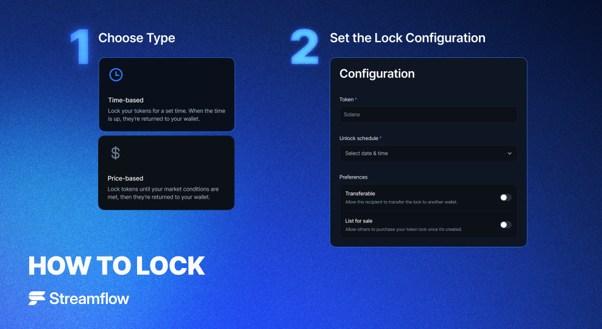
Most projects do not use just one lock type. A typical structure might look like this: liquidity is locked with a time-based lock to prevent immediate withdrawal. Team tokens use a price-based lock so long-term incentives align with market performance. Treasury funds use a time-based lock to ensure predictable capital deployment.
The key insight is that each lock type serves a different stakeholder group. Investors want to see founder and team tokens locked. Traders want to see liquidity protected. Communities want to understand future supply dilution. Streamflow is a multi-lock model that lets projects address all three concerns simultaneously on a single platform.
Why Lock Type Matters: Trust Through Transparency
The choice of lock type signals something about a project is confidence and priorities. A project comfortable with long time-based locks demonstrates patience and long-term thinking. A project using price-based locks shows it believes in its own success metric. Liquidity locks are now expected, not optional.
All of Streamflows lock types are backed by audited smart contracts. The on-chain proof is permanent and verifiable. Once a lock is created, anyone can inspect it, check the unlock conditions, and confirm that the project has skin in the game.
Beyond Token Locks: The Full Ecosystem
Token locks are one piece of comprehensive token operations. Streamflow positions locking as part of a broader infrastructure toolkit that includes vesting, staking, airdrops, and payouts.
Vesting complements locks by handling gradual release schedules. While locks are binary (locked until condition met, then fully unlocked), vesting is progressive. A typical setup might pair a time-based lock with a cliff and linear vesting schedule for team members. The lock provides an initial guarantee period. The vesting provides structured compensation over time.
Staking layers yield on top of locks. Many projects lock staking rewards while keeping principal locked. Staking through Streamflow takes minutes to set up and can be customized for any SPL token. Locked tokens can earn rewards simultaneously, giving stakeholders passive income while commitment is maintained.
Airdrops coordinate with locks to manage community distribution. A project might lock team and treasury allocations while running a public airdrop for the community. The contrast is intentional: locked allocations show founder commitment while airdrops reward early adopters. Streamflow handles both, so the narrative stays consistent.
Payouts automate recurring payments within the lock framework. Treasury payouts, contributor payments, and vendor settlements can all run as automated streams on Streamflow. These streams respect lock conditions, so treasury operations stay predictable even as locks approach their release dates.
The Operational Case for All in One Infrastructure
The reason teams choose Streamflow is not just the lock technology itself. It is the ability to run vesting, locks, staking, airdrops, and payouts from a single platform without integrating five different vendors. The data stays consistent. The workflows do not conflict. Community messaging is clearer when everything runs on the same infrastructure.
For projects launching on Solana, the typical workflow is: set up time-based or liquidity locks for launch day credibility, pair that with a vesting schedule for team and investor allocations, configure staking rewards for the community, run an airdrop for early adopters, and set up automated treasury payouts. All of this can be managed from one dashboard instead of a spreadsheet and multiple tools.
Token Locks in the Broader Context of Crypto Maturity
Token locking was once considered optional. Now it is expected. The market has moved toward preferring projects that demonstrate commitment through transparent, verifiable, on-chain locks. This shift reflects broader maturity in how crypto projects are evaluated.
For a new project, implementing proper token locks is one of the highest ROI credibility moves. It costs almost nothing to set up but signals professionalism, long-term thinking, and respect for community risk. When lock conditions are combined with clear communication and consistent project execution, the foundation for sustainable growth is in place.
Ready to secure your token operations? Explore Streamflow is token locks and related infrastructure at app.streamflow.finance
Serious News for Serious Traders! Try StreetInsider.com Premium Free!
You May Also Be Interested In
- Philips Skylight Ceiling Lighting Now Available to Bring the Feeling of Daylight Indoors
- Farmhouse Enters Scale Phase of Anti-Debasement Treasury Strategy
- HVAC Expert Grant Shirley Explains Ductless Mini-Split Systems in HelloNation
Create E-mail Alert Related Categories
Evertise Financial, Press ReleasesSign up for StreetInsider Free!
Receive full access to all new and archived articles, unlimited portfolio tracking, e-mail alerts, custom newswires and RSS feeds - and more!
