




Tokenized Asset Coalition Welcomes New Members and Unveils Global Access Protocol

FREE Breaking News Alerts from StreetInsider.com!
StreetInsider.com Top Tickers, 10/15/2026
- S&P 500, Nasdaq pare declines as AI rout teeters; healthcare, staples gain
- U.S. producer prices rise by 1.3% month-on-month in September
- Brent steady as US weighs easing sanctions on global 'shadow fleet'
- UBS now expects a third Fed rate hike after hot September inflation print
- Tesla-SpaceX Merger could be announced before December, Barclays says
 Tweet
Tweet Share
Share E-mail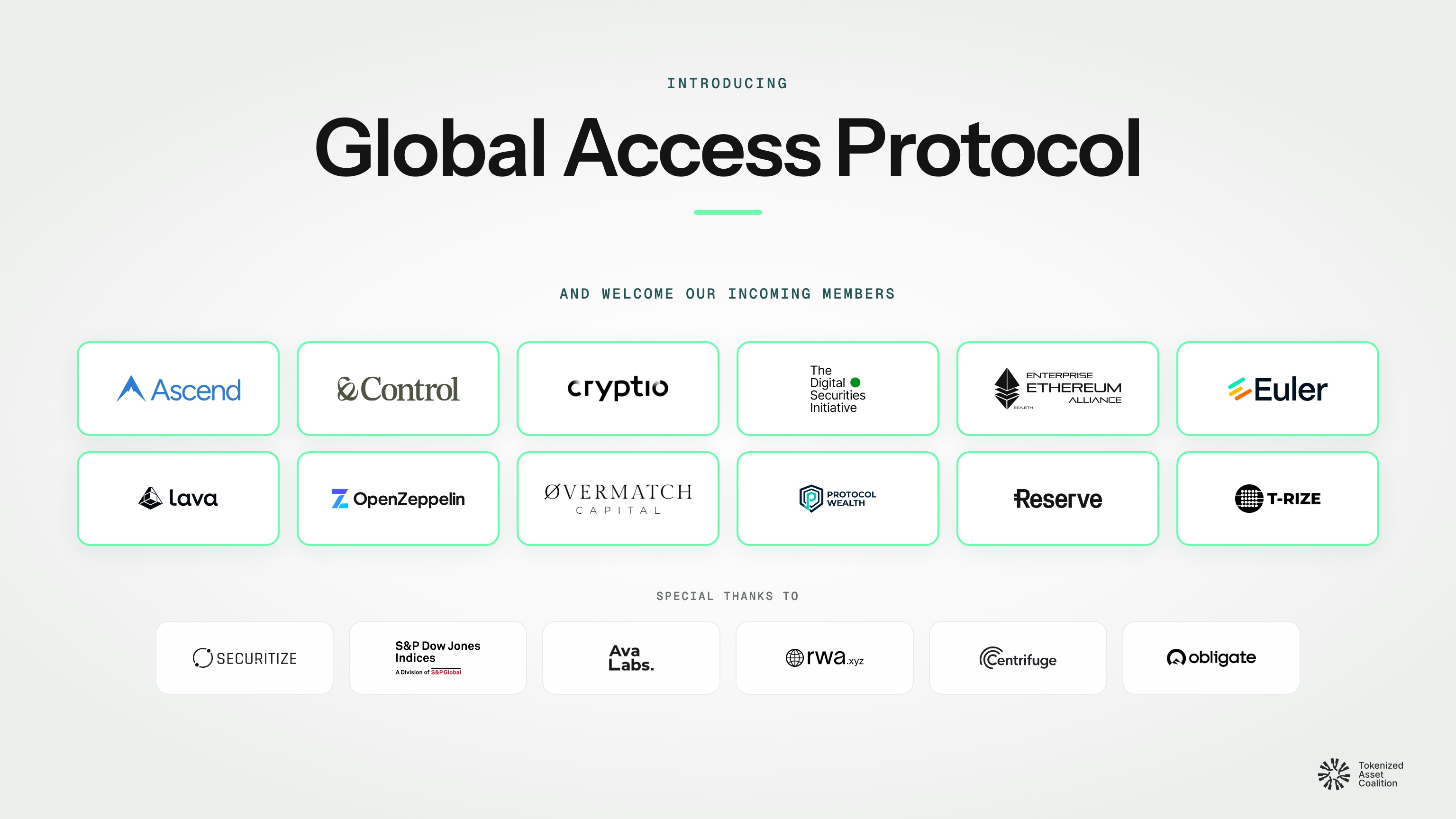
NEW YORK, October 15, 2026. The Tokenized Asset Coalition (TAC) today welcomed twelve new members and unveiled the Global Access Protocol (GAP), a framework for making tokenized securities composable in DeFi.
New members
The new members are Ascend, Control, Cryptio, the Digital Securities Initiative, the Enterprise Ethereum Alliance, Euler, Lava, OpenZeppelin, Overmatch Capital, Protocol Wealth, Reserve and T-RIZE. Together they span the tokenization stack, expanding TAC's reach into the Canton ecosystem, DeFi lending, NMS securities lending, security, data, research and wealth advisory. As the ecosystem matures, each of these new members fills a piece of the puzzle needed for "tokenization" to stop being a category and simply become how the financial system works.
Dennis O'Connell, Co-Founder, Ascend and creator of ERC3643
"The rules for lending against tokenized stock won't be written by any one firm. They will come from broker-dealers, protocols and issuers working through the hard questions together and bringing the answers to regulators. TAC is where that coordinated work is already happening, and we're excited to be part of it."
A year of research and building
Since launching in June 2025, the TAC Research Hub has become a weekly read for the people building tokenized markets. Its newsletters have been opened more than 115,000 times, and its readership has grown to more than 6,400 members, including over 300 at traditional financial institutions and 48 at regulators and policy bodies.
Alongside that research, the coalition has spent the year developing its core initiative, the Global Access Protocol. GAP addresses the most significant blocker facing the tokenization ecosystem today: bringing securities onchain under existing rules requires a shared identity layer that no single firm can credibly own. In TAC's State of Tokenization 2026 survey, industry leaders named access to institutional and retail distribution as their top two priorities, at 71% and 68%. Today TAC is unveiling the GAP framework and opening it to transfer agents, issuers, broker-dealers and identity providers.
GAP arrives as regulators put the remaining pieces of a tokenized market in place. On September 17, the Securities and Exchange Commission issued an innovation exemption opening a five-year path for onchain trading of tokenized NMS stock. On September 1, the Commission proposed a modernization of the transfer agent rules that would let a distributed ledger serve as the official record of securities ownership. Both raise a question no project has properly answered: who verifies the person behind the blockchain address? GAP is designed to answer that question. TAC staff and the Digital Securities Initiative developed GAP over the past year, through meetings with the SEC's Crypto Task Force and division staff, the CFTC and the Department of the Treasury, and with input from legal and technical leaders across tokenization and DeFi.
The problem GAP solves
Tokenized securities today are issued in silos. Each issuer or transfer agent maintains its own list of approved wallet addresses, and an investor must complete a separate identity check for every one. To hold securities from five transfer agents or issuers, an investor must complete five onboardings.
The cost compounds on the application side. Because a smart contract holds an address the same way an individual wallet does, any application that wants to work with a tokenized security must be added to that issuer's approved list. An application supporting securities from ten issuers has to implement ten separate sets of restrictions, and its users may face ten identity checks before touching a single asset.
The result is a market where each tokenized security trades in its own enclosure, liquidity is fragmented by construction, and the composability that defines onchain finance never arrives.
What Global Access Protocol does
GAP replaces the per-issuer list with portable credentials powered by zero-knowledge proofs. An investor completes one onboarding with a GAP-approved identity provider. That provider holds the investor's personal information and issues a credential the investor carries onchain. Every participating tokenized security recognizes it.
With GAP, transfer agents, issuers of tokenized assets and DeFi protocols no longer have to build or manage an identity layer. A transfer agent can issue and administer tokenized securities without standing up KYC operations, storing investor personal information for a new channel, or negotiating one-off integrations with each application that wants to support its assets. The transfer agent keeps the recordkeeping role it already holds and inherits the network on day one.
For application developers, GAP is one standard set of checks rather than a different set per issuer. Integrate once and every asset in the network becomes available to every credentialed investor, giving their products access to a large existing market.
For identity providers, GAP turns a single verification into a credential accepted across the network, widening the market for their services and increasing the value of each credential they issue.
GAP is shared infrastructure. No issuer, platform, asset manager or trading venue controls it, and participation does not require routing activity through any single commercial operator. That is a deliberate departure from the vertically integrated tokenization stacks now in the market.
Built for the framework the SEC is putting in place
Two recent Commission actions changed what the market can build and supply components that make GAP possible. The transfer agent proposal of September 1 would let a distributed ledger serve as the official record of who owns a security. The innovation exemption, issued September 17, opens a five-year path for tokenized NMS stock to trade on public, permissionless networks. Together they describe something that did not exist before: real stocks, trading in DeFi, on a share register that runs on a permissionless chain.
The Commission was equally clear that none of this suspends the baseline. Venues and products operating under the exemption remain subject to the requirements that protect investors. Participants must be cleared to trade, fraud and manipulation must not take root, issuers must be notified and able to object, and the rights and obligations attached to the underlying security travel with its tokenized form. Satisfying those requirements across venues and applications that do not share customer information is where Global Access Protocol comes in.
Compliance built into the protocol
With GAP, regulatory controls operate continuously rather than periodically.
- Investor privacy is built in. Personal information never touches the public ledger. It stays with the identity provider the investor chose and is disclosed only when there is a reason to disclose it, such as a dividend, a corporate action, a tax event or a regulatory obligation.
- Every address is still attributable. An issuer or transfer agent can resolve a holder's identity on demand whenever it needs to, which is what makes the privacy above safe to offer.
- Screening is continuous. Because credentials are live rather than a list refreshed on a schedule, a sanctions match or a revoked credential takes effect on the next transaction, not at the next batch run.
- Assets stay inside the perimeter. Transfer restrictions are enforced in the security's own contract. An address without a valid credential cannot receive the asset, so a tokenized security cannot escape into unmonitored circulation.
- Fraud and manipulation controls are native. Sybil-resistant identifiers make wash trading, layering and coordinated manipulation detectable, and let trading venues and issuers remove bad actors.
The last point matters in a maturing market. The innovation exemption runs five years, and what replaces it will be shaped by whether tokenized markets prove they can police themselves. Infrastructure that makes manipulation visible is the difference between a durable framework and an expired experiment.
Availability
TAC is publishing the Global Access Protocol framework today and a forkable open-source reference implementation will follow. TAC is also seeking an identity provider, a transfer agent and natively issued tokenized securities to build a proof of concept.
Read the framework and request participation.
Johnny Reinsch, Executive Director, Tokenized Asset Coalition
"The hard part of tokenization was never putting a security on a blockchain. It was that every issuer had to rebuild investor identity from scratch, and investors had to prove who they were over and over to reach assets that should have been one click apart. Global Access Protocol solves that once, for everyone in the network. And it belongs to the market rather than to any one firm in it, which is the only way infrastructure like this earns the trust it requires."
Nevin Freeman, Co-Founder of Reserve and Co-Creator, Global Access Protocol
"The Commission has been clear about what it expects: real ownership, auditable contracts on public ledgers, and participants who are cleared to trade. What the market has been missing is the machinery to satisfy that last requirement at scale, without handing one company control of who gets to participate. That is what we built, and we built it inside the guardrails rather than asking for them to be moved."
About the Tokenized Asset Coalition
The Tokenized Asset Coalition, Inc. is a 501(c)(6) nonprofit corporation working to bring securities onchain under existing regulatory frameworks. TAC convenes transfer agents, issuers, broker-dealers, identity providers and application developers around shared standards, publishes research through the TAC Research Hub, and engages directly with regulators on how established rules apply to tokenized markets. Learn more at tacoalition.org, follow TAC on X and LinkedIn, or join over 6,000 subscribers to the TAC Research Hub.
Media contact
Attn: Communications Team
Serious News for Serious Traders! Try StreetInsider.com Premium Free!
You May Also Be Interested In
- Digital Brands Group names Todd Kucinski VP of sports partnerships
- Nasdaq completes acquisition of LeveL Markets ATS
- Actinium to present Phase 1 data on ATNM-400 at EANM 2026
Create E-mail Alert Related Categories
Bitwire, Press ReleasesRelated Entities
DividendSign up for StreetInsider Free!
Receive full access to all new and archived articles, unlimited portfolio tracking, e-mail alerts, custom newswires and RSS feeds - and more!
